About the Department
 
Contact
 
Courses
 
Events
 
Languages
 
Links
 
People
 
Programs


Freshman Seminars

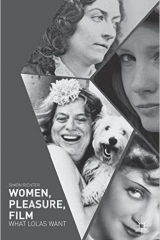
GRMN 001 (CINE 050) Looking for Lola: The Allure of a Cinematic Name.
Distributional Course Arts & Letters - Class of 2009 and prior
. Freshman Seminar. S. Richter. All readings and lectures in English. No knowledge of German is required.

We all know about Eve and Mary, two names that readily designate opposite relations to masculinity and sexuality. But what about Lola? Beginning in the early twentieth century, the name of Lola has gripped the imagination of directors and screenwriters and launched a cinematic tradition. The name is certainly based on Lola Montez, a nineteenth-century British woman of humble origins who used her sexuality and prevaricating charm to rise to worldwide renown as an erotic dancer and the lover of composers (Lizst) and kings (Ludwig of Bavaria), leaving disaster in her wake. Ever since Marlene Dietrich’s seductive role as Lola Lola, the risqué nightclub entertainer in Joseph Sternberg’s scandalous Blue Angel (1930), the name Lola has specified the realm of the quintessential vamp. In this course we will explore the cinematic femininity, sexuality and gender associated with the name Lola (and its close cousins Lulu and Lolita). We will encounter Lolas of ambiguous, precocious, calculating, and irresistible sexuality: a Turkish-German transvestite, a sexual nymph, a schemer during Germany’s economic miracle, and a man-killer eventually slain by Jack the Ripper, and many more. What is remarkable about the films associated with Lola is that each discovers her anew and contributes to a complex nexus of issues involving sexuality, pleasure, knowledge, and power, far more interesting, in the final analysis, than the alternatives of Mary and Eve.


GRMN 002 Lords of the Ring.

Distributional Course in Arts & Letters. Freshman Seminar. C. Frei. All readings and lectures in English. No knowledge of German is required.

"One Ring to rule them all; One Rich to find them; One Ring to bring them all and in the darkness bind them; In the Land of Mordor where the Shadows lie." (J.R.R. Tolkien) So begins your journey into legends and traditional lore. You will read stories of unrequited love, betrayal, magical powers, and the deeds of dragon slayers. This course traces the power of the tales of the ring from J.R.R. Tolkien to Richard Wagner, from the Middle High German epic the Nibelungenlied to the Norse poetry of The Saga of the Volsungs, and back to the twentieth century with Thomas Mann's The Blood of the Walsungs.

GRMN 004 Germany and the Holocaust.
Distributional Course in History & Tradition. Freshman Seminar. F. Trommler. All readings and lectures in English. No knowledge of German is required.

We know much about the Holocaust. Countless document collections, memoirs, and testimonies have shed light on the worst chapter of 20th century history. Less is known about how Germans have dealt with this cataclysm since 1945. How have writers, politicians, and teachers, young and old people, perpetrators and bystanders, East and West Germans reacted to this event which is still haunting this country? This seminar will illuminate the developments since 1945 with special emphasis on literature, which has been a catalyst for inquiries into memory and guilt.

GRMN 007 Food for Thought; Cannibalism and Gastronomy in Literature and Film.
Distributional Course in Arts & Letters. Freshman Seminar. S. Richter. All readings and lectures in English. No knowledge of German is required.

Focuses on works of literature and film that explore the philosophical, aesthetic and cultural meanings of hunger, cooking, and eating. Topics include history of gastronomy, culinary ethnic diversity, gender and eating, digestion as philosophical concept, cannibalism and the sublime, hunger and narrative, erotics of food.

GRMN 008 Superstition & Erudition: Daily Life in the Middle Ages
Distributional Course in History & Tradition - Cl of '09 and prior; Cross-Cultural Analysis - Cl of '10 and after. Freshman Seminar. F. Brevart. All readings and lectures in English. No knowledge of German is required.

Individuals in medieval times lived basically the same way we do today: they ate, drank, needed shelter, worked in a variety of ways to earn a living, and planned their lives around religious holidays. They talked about the weather and had sex, they had to deal with cold, hunger, illness, epidemics and natural catastrophes. Those fortunate few who could afford the luxury, went to local monastic schools and learned how to read and write. And fewer still managed to obtain some form of higher education in cathedral schools and nascent universities and became teachers themselves. Those eager to learn about other people and foreign customs traveled to distant places and brought back with them much knowledge and new ideas. The similarities, we will all agree, are striking. But what is of interest to us are the differences, the “alterity” (keyword) of the ways in which they carried out these actions and fulfilled their goals.
This course concentrates on two very broad aspects of daily life in the Middle Ages (12 th – 16 th centuries). The first part, Erudition, focuses on the world in and around the University. Taking Paris and Bologna as our paradigms, we will discuss the evolution of the medieval university from early cathedral schools, the organization, administration, financing, and maintenance of such an institution, the curriculum and degrees offered at the various faculties, and the specific qualifications needed to study or to teach at the university. We will familiarize ourselves with the modes of learning and lecturing, with the production of the instruments of knowledge, i.e. the making of a manuscript; we will explore the regimented daily life of the medieval student, his economic and social condition, his limited, but at times outrageous distractions, and the causes of frequent conflicts between town and gown. Finally, we will investigate the role of the medieval University in European history.
The second part, Superstition, revolves around astrology, medicine and pharmacy. Taking the German Volkskalender, the medieval predecessor of the modern Farmer’s Almanac, as our point of departure, we will gain insights into the ubiquitous role of astrology in the daily life of medieval individuals, for example in activities and decisions concerning farming; slaughtering of animals; personal hygiene; marrying; escaping from jail; conception of a male child; appropriate days to let blood; etc.
Medicine, frequently referred to as astromedicine because of its inextricable dependence on astrology, encompasses a multitude of characteristics. The course will explore the precarious state of medieval medicine and pharmacology, the specific diseases of women (e.g. suffocation of the womb) and their treatments, the use of so-called wonderdrugs by professional physicians and medical charlatans alike produced from exotic plants, precious stones, animal parts, blood or human excrements, and the medieval rationality behind these forms of therapy. Special topics are also planned on the astrological causes and magical treatments of the Black Death; embryology, the seven-chambered uterus and the causes of homosexuality / lesbianism; sex as therapy, etc.


GRMN 010 Translating Cultures : Literature on and in Translation.
Distribution Course in Arts & Letters - Cl of '09 and prior; Cross-Cultural Analysis - Cl of '10 and after. Freshman Seminar. K. Hellerstein. All readings and lectures in English.
"Languages are not strangers to one another," writes the great critic and translator Walter Benjamin. Yet two people who speak different languages have a difficult time talking to one another, unless they both know a third, common language or can find someone who knows both their languages to translate what they want to say. Without translation, most of us would not be able to read the Bible or Homer, the foundations of Western culture. Americans wouldn't know much about the cultures of Europe , China , Africa , South America , and the Middle East . And people who live in or come from these places would not know much about American culture. Without translation, Americans would not know much about the diversity of cultures within America . The very fabric of our world depends upon translation between people, between cultures, between texts. With a diverse group of readings—autobiography, fiction, poetry, anthropology, and literary theory—this course will address some fundamental questions about translating language and culture. What does it mean to translate? How do we read a text in translation? What does it mean to live between two languages? Who is a translator? What are different kinds of literary and cultural translation? What are their principles and theories? Their assumptions and practices? Their effects on and implications for the individual and the society?


return to top


German Language Courses

101. (GRMN501) Elementary German I.

Introduction to the basic elements of spoken and written German, with emphasis placed on the acquisition of communication skills. Readings and discussion focus on cultural differences. Final credit for this course is given only upon successful completion of GRMN 102.

102. Elementary German II.
Prerequisite(s): GRMN 101 or equivalent.

A continuation of GRMN 101. The student's expression and comprehension are expanded through the study of literature and social themes.

103. (GRMN503) Intermediate German I.
Prerequisite(s): GRMN 102 or equivalent.

Modern German texts of moderate difficulty and an integrated grammar review advance the student's command of the language.

104. Intermediate German II.
Prerequisite(s): GRMN 103 or equivalent.

A continuation of GRMN 103. Literary and non-literary texts of moderate difficulty. Continued practice in active communication.

105. German 103/104 Intensive.

This course is taught in Germany during the summer.

106. Accelerated Elementary German.

This course is intensive and is intended for dedicated, highly self-motivated students who will take responsibility for their learning and creation of meaning with their peers. An intensive two credit course in which two semesters of elementary German (GRMN 101 & 102) are completed in one.  Introduction to the basic elements of spoken and written German, with emphasis placed on the acquisition of communication skills.  Readings and discussions focus on cultural differences. Expression and comprehension are then expanded through the study of literature and social themes.


107. Accelerated Intermediate German.

This course is intensive and is intended for dedicated, highly self-motivated students who will take responsibility for their learning and creation of meaning with their peers. This accelerated course is designed to improve students’ writing and speaking competencies, to increase vocabulary, to deepen grammar usage, and to help develop effective reading and listening strategies in German across literary genres and media as students interpret and analyze cultural, political, and historical moments in German-speaking countries and compare them with their own cultural practices. This course is organized around content- based modules. Students conclude the basic-language program at PENN by reading an abridged and glossed version of an authentic literary text offering the opportunity to practice and deepen reading knowledge and to sensitize cultural and historical awareness of German-speaking countries.

180. German in Residence.

212. Reading Strategies.
Prerequisite(s): GRMN 104 or the equivalent.

This course seeks to develop the student's reading ability in German; emphasis on reading and comprehension of German expository prose, including readings from history, sociology, contemporary affairs, science, and literature.

215. Conversation and Composition.
Prerequisite(s): GRMN 104 or the equivalent.

Required for the major, also carries credit for the minor in German. Offers students the opportunity to improve significantly written and spoken discourse strategies and to raise language competence to an academic register. In addition, the course familiarizes students with several reading strategies. Students write several essays, weekly reaction pieces, lead discussions, and create short in-class presentations. During the second half of the semester, students create a common course web site in connection with their readings of an authentic literary text. In collaborative group work, students create the contents for different components: biography, text analyses, historical background, geography and didactizations emphasizing integrated skills and discourse competence. Their work is posted to a web site, which in turn, is incorporated in the 4 th-semester syllabus, where students use the peer-generated information and comprehension checks for their understanding of an abridged version of the authentic literary text.

Please visit the Homo.Cyber project at http://ccat.sas.upenn.edu/german/215/


216. Introduction to German Literature.
Distribution Course in Arts & Letters - Cl of '09 and prior; Cross-Cultural Analysis - Cl of '10 and after.
Foreign Languages Across Curriculum (FLAC)
Prerequisite(s): GRMN 215 or equivalent. All readings and lectures in German.

Develops students' basic skills of literary interpretation. Exposure to various reading techniques (e.g. close reading, reading for plot, etc.) and to literary terminology and its application. Readings will include selections from prose, drama and lyric poetry. In this course, we examine and explore over a thousand years of cultural history of the German-speaking lands with an eye toward clarifying the key cultural knowledge shared by German speakers. From the Holy Roman Empire in the Middle Ages to the twentieth century, we examine what makes the German nations -- and peoples -- what they are today. We will pay attention both to mainstream tendencies as well as oppositional political and cultural movements. Special emphasis will be placed on cultural achievements such as literature, music, and architecture as well as on a basic understanding of the politics, economics and cultural formations of Germany , Austria , and Switzerland in the 20th century. The language of instruction, readings, and discussion is – with few exceptions – German.

return to top

Business German

219. The German Business World I.
James. Distribution Course in Society - Cl of '09 and prior.
Foreign Languages Across Curriculum (FLAC)
Prerequisite(s): GRMN 215 or equivalent. No previous knowledge of economics or business required. Course taught in German.

This course offers you insights into the dynamics of Business German, while taking a macro approach.  Examples of various course topics include: economic geography and its diversity, the changing role of the European Union, and the economic importance of national transportation and tourism.  In addition, the course emphasizes the development of students’ discourse competencies, Business German vocabulary and grammar.  Course assignments include oral presentations on current events, class discussions, role-play, and collaborative group work.  Class time will be utilized to practice speaking, answering questions, reviewing exercises and holding group discussions on various topics.  Class participation is a key component of this course.


220. Business German: A Micro Perspective.
James. Foreign Languages Across Curriculum (FLAC)
Prerequisite(s): GRMN 215 or equivalent. Course taught in German.

This course is designed to enhance your speaking, reading and writing skills, in addition to helping you build a strong foundation in business vocabulary. Course objectives include acquiring skills in cross cultural communication, teamwork, business management, and creating a business plan. German grammar will be covered on a need be basis. This course will prepare you to perform and contribute while in a German-speaking business environment.


221. Advanced Grammar and Composition.

Brevart.

This course is designed to help the student develop a more sophisticated writing style in German. This is achieved by means of the study and discussion of the fine points of German syntax (e.g. correct usage of tenses, punctuation, experimentation with word order, etc.), by a variety of exercises in finding synonyms, similes, analogies, and rhetorical strategies, and by exposure to numerous idioms. Emphasis is also placed on determining the appropriate usage of language in a specific situation. The ultimate objective of this course is therefore to encourage an active and imaginative use of the German language. Students should be prepared to undertake an active role in critiquing one another's writing.


222. Zert Deutsch Beruf.

Staff. Prerequisite(s): GRMN 215, 219, 220, or equivalent.

This course prepares students for the "Zertifikat Deutsch fuer den Beruf" (ZDfB) exam. Upon passing this exam, the student will receive an internationally recognized proficiency certificate administered by the Goethe Institute. Students will be able to function confidently in a business German speaking environment and enhance their chances for employment.


225. Business German through Films and Documents I.
Distribution Course in Society.
Brevart. Prerequisite(s): Students must have passed the proficiency exams required by the German Department at the University of Pennsylvania and have completed at least one third-year course in the department (i.e. German 212, 215, 216, 221 or an approved equivalent). Offered through Penn Language Center.

This course is functionally designed to facilitate the acquisition of an extensive business and everyday vocabulary. A series of films dealing with a variety of business transactions as well as selected articles focusing on the most recent economic and political developments in eastern and western Germany provide the basis for an emphasis on practical applications.


226. Business German Through Films and Documents II.
Brevart.

A continuation of GRMN 225.


227. German for Daily Situations in the Profession.

Brevart. Offered through Penn Language Center.

This course is designed to facilitate the acquisition of an extensive business vocabulary together with the communicative skills needed to function daily in a professional setting. Emphasis is placed on the development of oral proficiency. A series of topics depicting a variety of situations in and around the workplace provide the basis for an emphasis on practical applications. Beyond helping students build a vocabulary useful in the professional world, this course also seeks to reveal differences between Germans and Americans. Such factual and cultural knowledge should prove most beneficial to anyone contemplating an internship or work in Germany.

The course material offers a wide range of topics, including: looking for a position and the situation of the job interview; introducing one's self and others; presenting the company and its structure; rules and responsibilities at the workplace; making smalltalk; giving directions; carrying out a conversation on the phone in all aspects; presenting and explaining how a product functions.

229. International Business Practices.
Staff. All readings and discussions in English.

This course is designed to broaden perspectives on cross-cultural issues related to international business and international relations. In addition, the course will enhance analytical decision-making skills in resolving cross-cultural issues. The course will focus on global issues such as leadership, communication, negotiations and strategic alliances, cultural impacts on international business, effective performance in a global marketplace, and doing business with various nationalities.

return to top

German Literature and Culture Courses in Translation - Taught in English


242. (COML126) The Fantastic and Uncanny in Literature.
Arts & Letters Sector (All Classes); Cross-Cultural Analysis - Cl of '10 and after. All readings and lectures in English.
Weissberg.

What is the "Fantastic"? And how can we describe the "Uncanny"? This course will examine these questions, and investigate the historical background of our understanding of "phantasy" as well as our concepts of the "fantastic" and "uncanny" in literature. Our discussions will be based on a reading of Sigmund Freud's essay on the uncanny, a choice of Friedrich Schlegel's and Novalis' aphorisms , and Romantic narratives by Ludwig Tieck, E.T.A. Hoffmann, Edgar Allan Poe, Nathaniel Hawthorne, and others. All of the texts will be available in English and no knowledge of a foreign language is required.


244. (COML254, URBS244) Metropolis: Culture of the City.

Distribution Course in Arts & Letters.
MacLeod. All lectures and readings in English. WATU credit optional.

An exploration of modern discourses on and of the city. Topics include: the city as site of avant-garde experimentation; technology and culture; the city as embodiment of social order and disorder; traffic and speed; ways of seeing the city; the crowd; city figures such as the detective, the criminal, the flaneur, the dandy; film as the new medium of the city. Special emphasis on Berlin. Readings by, among others, Dickens, Poe, Baudelaire, Rilke, Doeblin, Marx, Engels, Benjamin, Kracauer. Films include Fritz Lang's Metropolis and Tom Tykwer's Run Lola Run.


245. (COML231) Literature and Culture of Central Europe.
Staff.

It is difficult to imagine the current century without the remarkable contributions of Central European culture. Central Europe is the birthplace of Freud and psychoanalysis, Schoenberg and twelve-tone composition, Kafka, Kraus, and Musil. It is also a combustible world theater for raging conflicts among political ideologies, nationalisms, and world views. This course examines the many legacies of Central Europe to the present. Through literature, cinema, and other arts, it explores a unique history that extends from the Habsburg and Ottoman empires, through two world wars, to communism and beyond. Readings are in English and include representative works from Albanian, Austrian, Bosnian, Czech, Hungarian, and Polish fiction.


246. Heroes, Minstrels, Knights
All readings and lectures in English. General Requirement Course in Arts & Letters - Cl of '09 and prior only.
F. Brevart

In this course we will read medieval works of international literary importance, such as the Arthurian novels of Hartman von Aue Erec and Iwein, the German Song of the Nibelungs and the Old French Song of Roland as examples of heroic literature, and the tragic love story of Tristan and Isolde by Gottfried von Strasburg. We will also read two Spielmannsepen which have as their central theme the international motif of the bridal quest, namely Sankt Oswald and König Rother, and compare these works with the Nibelungenlied and Tristan, which themselves also involve the bridal quest as one of their principal structural elements. There is, however, a major and critical distinction between the traditional happy ending of the bridal quest epics and that of The Nibelungs and of Tristan and Isolde, for those two German works culminate in the total destruction and disintegration of entire peoples and values, or with the utter misery of the ideal couple. With our readings of the love poems of the French Troubadours and those of their German counterparts, the Minnesänger, our final genre of medieval literature, we will not only discuss the ubiquitous and timeless love theme in all its variations, but also the socio-political implications of such poetry.


247. Tracing the Carnivalesque in German Literature: Carnival, Community, Chaos.

Distributional Course in Arts & Letters.

This course surveys German literature and cultural history from the Middle Ages to the present through the prism of the carnivalesque. The defining aspects of this concept - festival, madness, community, laughter, and ambivalence - organize the sweep of German cultural history in a fascinating and illuminating way. Whether it be in the golden age of the carnivalesque, the Middle Ages through the Renaissance, or in the modern bourgeois period, where the carnivalization of life becomes increasingly more sublimated and individualized, the idea of the carnivalesque proves to be a fruitful analytical structure. Along with selected works by Grimmelshausen, Goethe, Nietzsche and Hesse (among others) the historical aspects of the social carnival will also be investigated.


252. Emergence of the Individual

(COLL 004)
Weissberg / Samuels

The concept of the modern "individual" was, as many would argue, an eighteenth century invention. This course will discuss the period of Enlightenment that gave rise to it, and follow its development until the twentieth century. Why would it be suddenly important to think of separate human beings with particular desires and needs, rather than a more uniform group of subjects? And what are the consequences of such a move?

Adopting a broad but focused historical perspective, this course will examine the ways in which the individual has been theorized, represented, and understood across various countries and disciplines. Two professors--one from German, and one from French--will provide lectures and lead discussions on the position of the individual in specific historical and cultural contexts, beginning with the French revolution and ending with Freud and the psychoanalytic revolution.


253. Freud: The Invention of Psychoanalysis

General Requirement VII: Science Studies
Weissberg.

Probably no other person of the twentieth century has influenced scientific thought, humanistic scholarship, medical therapy, and popular culture as much as Sigmund Freud. This seminar will try to study his work, its cultural background, and its impact on us today. In the first part of the course, we will learn about Freud's life and the Viennese culture of his time. We will then move to a discussion of seminal texts, such as excerpts from his Interpretation of Dreams, case studies, as well as essays on psychoanalytic practice, human development, neuroses, and culture in general. In the final part of the course, we will discuss the impact of Freud's work. Guest lecturers from the medical field, history of science, psychology, and the humanities will offer insights into the reception of Freud's work, and its consequences for various fields of study and therapy.

255. Mann-Hesse-Kafka.
Distributional Course in Arts & Letters.
Trommler. All readings and discussions in English.

Based on considerations of the cultural tradition and the intellectual currents of the twentieth century, the course presents a survey of the achievements of Mann, Hesse, and Kafka. The extensive study of representative works focus on the problems of the artist in the modern age.


256. (COML241, FILM252) The Devil's Pact in Literature, Music and Film.

Distributional Course in Arts & Letters.
Richter. All readings and discussions in English.

For centuries the pact with the devil has signified humankind's desire to surpass the limits of human knowledge and power. From the reformation chap book to the rock lyrics of Randy Newman's Faust, from Marlowe and Goethe to key Hollywood films, the legend of the devil's pact continues to be useful for exploring our fascination with forbidden powers.


257. (GRMN550) Nazi Cinema.

Distributional Course in Arts & Letters
Richter, MacLeod.

This course explores the world of Nazi cinema ranging from infamous propaganda pieces such as "The Triumph of the Will" and "The Eternal Jew" to entertainments by important directors such as Pabst and Douglas Sirk. More than sixty years later, Nazi Cinema challenges us to grapple with issues of more subtle ideological insinuation than we might think. The course also includes film responses to developments in Germany by exiled German directors (Pabst, Wilder) and concludes with Mel Brooks' "The Producers". Weekly screenings with subtitles.


GRMN 258 (FILM 258) German Cinema
MacLeod.

An introduction to the momentous history of German film, from its beginnings before World War One to developments following the fall of the Berlin Wall in 1989 and German reunification in 1990. With an eye to film's place in its historical and political context, the course will explore the "Golden Age" of German cinema in the Weimar Republic, when Berlin vied with Hollywood; the complex relationship between Nazi ideology and entertainment during the Third Reich; the fate of German film-makers in exile during the Hitler years; post-war film production in both West and East Germany; the call for an alternative to "Papa's Kino" and the rise of New German Cinema in the 1960s.


261. (ENGL287, FILM251, JWST261) Jewish Films and Literature.
Distributional Course in Arts & Letters.
Hellerstein.

From the 1922 silent film "Hungry Hearts" through the first "talkie," "The Jazz Singer," produced in 1927, and beyond "Schindler's List," Jewish characters have confronted the problems of their Jewishness on the silver screen for a general American audience. Alongside this Hollywood tradition of Jewish film, Yiddish film blossomed from independent producers between 1911 and 1939, and interpreted literary masterpieces, from Shakespeare's "King Lear" to Sholom Aleichem's "Teyve the Dairyman," primarily for an immigrant, urban Jewish audience. In this course, we will study a number of films and their literary sources (in fiction and drama), focusing on English language and Yiddish films within the framework of three dilemmas of interpretation: a) the different ways we "read" literature and film, b) the various ways that the media of fiction, drama, and film "translate" Jewish culture, and c) how these translations of Jewish culture affect and are affected by their implied audience.


262. (JWST 102 (formerly JWST 100), NELC 154, GSOC 262) Women in Jewish Literature.

Arts & Letters Sector
Hellerstein.
"Jewish woman, who knows your life? In darkness you have come, in darkness do you go." J. L. Gordon (1890)

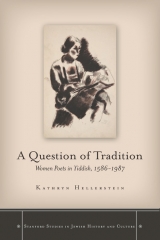
This course will introduce students of literature, women's studies, and Jewish studies to the long tradition of women as readers, writers, and subjects in Jewish literature. All texts will be in translation from Yiddish and Hebrew, or in English. Through a variety of genres -- devotional literature, memoir, fiction, and poetry -- we will study women's roles and selves, the relations of women and men, and the interaction between Jewish texts and women's lives. The legacy of women in Yiddish devotional literature will serve as background for our reading of modern Jewish fiction and poetry from the past century.

The course is divided into five segments. The first presents a case study of the Matriarchs Rachel and Leah, as they are portrayed in the Hebrew Bible, in rabbinic commentary, in pre-modern prayers, and in modern poems. We then examine a modern novel that recasts the story of Dinah, Leah’s daughter. Next we turn to the seventeenth century Glikl of Hamel, the first Jewish woman memoirist. The third segment focuses on devotional literature for and by women. In the fourth segment, we read modern women poets in Yiddish, Hebrew, and English. The course concludes with a fifth segment on fiction and a memoir written by women in Yiddish, Hebrew, and English.


263. (ENGL079, JWST261) Jewish American Literature.
Distributional course in Arts & Letters.
Hellerstein.

What makes Jewish American literature Jewish? What makes it American? This course will address these questions about ethnic literature through fiction, poetry, drama, and other writings by Jews in America , from their arrival in 1654 to the present. We will discuss how Jewish identity and ethnicity shape literature and will consider how form and language develop as Jewish writers "immigrate" from Yiddish, Hebrew, and other languages to American English. Our readings, from Jewish American Literature: A Norton Anthology, will include a variety of stellar authors, both famous and less-known, including Isaac Mayer Wise, Emma Lazarus, Isaac Bashevis Singer, Celia Dropkin, Abraham Cahan, Anzia Yezierska, Saul Bellow, Philip Roth, Cynthia Ozick, and Allegra Goodman. Students will come away from this course having explored the ways that Jewish culture intertwines with American culture in literature.


265. (GRMN565, JWST265) Yiddish in Eastern Europe.
Distributional course in Arts & Letters.
Hellerstein. All readings and lectures in English.

This course presents the major trends in Yiddish literature and culture in Eastern Europe from the mid-19th century through World War II. Divided into four sections - "The Shtetl," "Religious vs. Secular Jews," "Language and Culture," and "Confronting Destruction" - this course will examine how Jews expressed the central aspects of their experience in Eastern Europe through history, literature (fiction, poetry, drama, memoir), film, and song.

return to top

Advanced German Literature and Culture Courses - Taught in German

269. Introduction to German Culture.

Distributional course in Arts & Letters.
Prerequisite(s): GRMN 104 or equivalent.

In this course, we examine and explore over a thousand years of cultural history of the German-speaking lands with an eye toward clarifying the key cultural knowledge shared by German speakers. From the Germanic tribes to the Holy Roman Empire and into the twentieth century, we examine what makes the German nations -- and peoples -- what they are today. We will pay attention both to mainstream tendencies as well as oppositional political and cultural movements. A special emphasis will be placed on cultural achievements such as literature, music, and architecture as well as on a basic understanding of the politics, economics and cultural formations of Switzerland, Austria and Germany in the 20th and 21st centuries. Speaking knowledge of German is required, but the course will include exercises for improving language skills and learning to discuss difficult cultural concepts in the target language, German.


305. Masterworks of Medieval German Literature.
Gen Req III: May be counted towards the General Requirement in Arts & Letters.
Brevart.

This course introduces students to a very important era in European cultural history. Internationally renowned literary works of Medieval Germany (e.g., Tristan, Parzival, Song of the Nibelungs) will be studied with particular reference to their sociohistorical, political, religious, and literary situation.


325. Politics of the Past: Telling Early Modern Tales to Modern Readers

Wiggin.

In this class we will focus on how literary hi/stories are (re)written, and to what ends. Over the course of the semester, texts from the seventeenth century will be paired alongside a “rewrite” from the twentieth. Paired readings may include: Martin Opitz (Buch von der deutschen Poeterey) and Günther Grass (Das Treffen in Telgt), Grimmelshausen (Coursache) and Bertold Brecht (Mutter Courage) and Abraham à Sancta Clara (Predigten) and Barbara Frischmuth (Die Klosterschule).  In our discussions, we will explore a series of related questions: How does the older text resonate within the new? How does the newer text comment on the old? What are the politics of such dialogues with the distant past?


328. (GRMN528) German Phonetics and Phonology.
Santorini.

This course covers the sound system of German, particularly as it differs from that of English. We will discuss both how sounds are produced (phonetics) and how they are organized (phonology). The course has two related goals: to assist you in achieving a native-like pronunciation of German, and to give you knowledge that will help you be a more effective second-language teacher. Given these goals, the course will include some discussion of second-language acquisition.


330. Goethe and His Age.
Distributional course in Arts & Letters.
Richter, MacLeod.

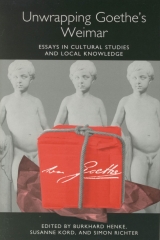
The course presents Goethe's unique achievement against the background of the intellectual currents of his age. Lectures and discussions cover selections from poetry, prose, and drama.


340. Prose of the Nineteenth Century.

Major works of Austrian, German, and Swiss Literatures from Romanticism to Naturalism will be examined. Readings include works by Kleist, Buechner, Grillparzer, Droste-Huelshoff, C.F. Meyer, Keller, Storm, and Fontane.
350. German Romanticism.
Distributional course in Arts & Letters.
MacLeod.

A study of such concepts as genius, creativity, irrationality, and imagination in representative works of German Romanticism by Tieck, Novalis, Eichendorff, Brentano, Hoelderlin, Kleist, Hoffmann, Fouque, and Heine. The relation of literature to history, the rise of German nationalism, and the new appreciation of folk art forms will also be considered. The course will refer as well to the philosophy, visual arts, and music of the period.
 
355. Jugendliteratur: From the Third Reich to the Present.

Distributional course in Arts & Letters.
Staff.

This course takes a critical look at Jugendliteratur ranging from the Nazi award-winning TECUMSEH by Steuben to the internationally acclaimed Austrian Kaethe Recheis and her radical account of fascism in Austria. The discussion includes West and East German authors such as Plenzdorf and deals with post-unification reality, including the latest Wunderkind author of age 16. The course will investigate the power and function of Jugendliteratur in various German-speaking settings.

360. Prose of the Twentieth Century.

Lectures and discussions of major works of modern German prose narrative, including Kafka, Mann, Hesse, Seghers, Grass, and Boell.

373. Dancing on the Volcano: Modern German Writers Confront Evil. Distributional course in Arts & Letters.
Trommler. Prerequisite(s): GRMN 215 or equivalent.

This course will discuss some of the most fascinating texts of German literature that reflect Germany's precarious history in the 20th century with two world wars and Nazi totalitarianism. Central is the individual's reaction to a situation of danger or threat and the ability to preserve dignity and identity. Readings will include shorter pieces and plays by Kafka, Brecht, Boell, Stefan Zweig, Wolf, Weiss, Jurek Becker and others.

Through this course, students will be able to improve their reading and speaking abilities in German on an advanced level.

375. German Literature after 1945.
Distributional course in Arts & Letters.

Focus on the continuity of the literary tradition, innovation, and prominent themes related to coming-of-age in today's society, and specific stylistic experiments. Topics include: the changing literary perspective on German history and World War II; the representation of such prominent issues as individual reponsibility, German reunification, and human relations in modern society.

377. Germany and the European Union.
Distributional course in Society.
Shields. Prerequisite(s): GRMN 215 or equivalent.

As of January 1999, a single monetary system unites Germany, a core nation, with 10 other European states, thus making their union stronger than ever before. This course provides an overview of the political and economic developments as they relate to the integration of postwar Europe, focusing on Germany's role in these developments. Studying content-rich reading materials, the course explores historical-political, social, economic, and cultural issues that are imperative to Germany's success in these developments as well as the European Community. Accompanying exercises will help students improve the level of complexity of their language skills.


378. Foreign in Germany.
Distributional course in Society.
Shields. Prerequisite(s): GRMN 215 or equivalent.

Foreign minority groups are integral elements of German society. This course will provide an overview of the history of foreigners in Germany and their political, social and economic significance. Content-rich reading materials will show Germany as a country that is rapidly developing into a multinational, multiracial and multicultural society. Focusing on the various attitudes of Germans held towards foreigners and the foreigners' attitudes towards life in Germany, the text selection will provide the basis for in-depth study of the subject, including the development of German policy regarding foreigners.


379. Decadence.
Distributional course in Arts & Letters.
Weissberg.

The period of the late nineteenth and turn to the twentieth century has often been described as a time of decadence--a decline in the "standards" of morals and virtue. While Freud explored the nature of sexual desire, writers like Schnitzler or Wedekind made this exploration central for their stories or plays. The course will focus on the literature and culture of fin-de-siecle Vienna and Berlin, and consider a variety of texts as well as their later reception and translation into film. Lectures and discussion in German.


381. Topics in German Culture.
Staff.


382. The German Media Landscape.
Distributional course in Society.
Richter. Prerequisite(s): GRMN 215 or equivalent.

An interactive course that introduces students to the world of German media (journalism, television, and radio). Analysis of major newspapers and magazines, editorial policy, history of media in the postwar period, types of television programming. Content-specific language instruction stressing complex language usage.


383. German Political Landscape.
Distributional course in History & Tradition.
Roth.

This course will provide an overview of the emergence and development of political parties in Germany since the 19th century. We will start with Robert Michels' classical study "Die Soziologie des Parteiwesens," first published in 1910. The course will cover the Weimar Republic, National Socialism, the founding of political parties in West and East Germany after 1945, the emergence of the Green party and the Republikaner in the 1980s, and the development after unification.

395. Senior Thesis Colloquium
Wiggin.
This course is intended for students completing their senior thesis for the German Major.


399. Independent Study.

return to top

Yiddish


YDSH 101. (JWST031) Beginning Yiddish I.
Staff.

Yiddish is a 1000-year-old language with a rich heritage. This course introduces the skills of reading, writing, and speaking Yiddish through the study of grammar, enriched by cultural materials such as song, literature, folklore, and film. This course assumes no previous knowledge of Yiddish.


YDSH 102. (JWST032) Beginning Yiddish II.
Staff. Prerequisite(s): YDSH 101 or permission of the instructor.

In this course, you can continue to develop basic reading, writing and speaking skills. Discover treasures of Yiddish culture: songs, literature, folklore, and films.


YDSH 103. (JWST033) Intermediate Yiddish I.
Hellerstein. Prerequisite(s): YDSH 102 or permission of the instructor.

A continuation of YDSH 102/JWST 032, Beginning Yiddish II, this course develops the skills of reading, writing, and speaking Yiddish on the intermediate level through the study of grammar and cultural materials, such as literature, newspapers, films, songs, radio programs.


YDSH 104. (JWST034) Intermediate Yiddish II.
Hellerstein. Prerequisite(s): YDSH 103 or permission of the instructor.

Continuation of YDSH 103. Emphasis on reading texts and conversation.


YDSH 105. Advanced Yiddish.

Hellerstein. Prerequisite(s): YDSH 104 or permission of the instructor.


YDSH 106. Advanced Yiddish II.
Hellerstein. Prerequisite(s): YDSH 105 or permission of the instructor.


YDSH 108. (JWST438) Readings in Modern Yiddish Literature.

Hellerstein. Prerequisite(s): Reading knowledge of Yiddish.

This course will survey modern Yiddish literature through readings of Yiddish prose and poetry from the end of the 19th century through the late 20th century. The class will be conducted in both Yiddish and English. Reading knowledge of Yiddish is required, although some texts will be available in English translation. Authors include I.L. Peretz, Isaac Bashevis Singer, Moyshe-Leyb Halpern, and Kadya Molodowsky.


GRMN 422. An Introduction to Modern Yiddish Literature.
Distributional course in Arts & Letters.
Offered through CGS.

This course will survey major periods in modern Yiddish fiction, and present translations of important works by central Yiddish authors. Short stories and novels by Sholem Aleykhem, Y. L. Perets, David Bergelson, Isaac Bashevis Singer, as well as exemplary works by some of these writers lesser known will be studied. Readings will be discussed in terms of their historical and social contexts as well as in the light of the varied stylistic accomplishments of the texts themselves.


GRMN 499. Independent Study.

return to top

Graduate Level Courses


507. Elementary Middle High German.
Brevart.

Designed to familiarize the student with the principal elements of Middle High German grammar and to develop skills in reading and translating a major work of the twelfth century. Limited text interpretation.


508. "Nibelungenlied".
Distributional course in Arts & Letters.
Brevart.

A study of the "Nibelungenlied," focusing on the courtly and heroic elements of this critical work of medieval literature.


SM 510. (RELS537, WSTD510) Writing and Gender in the Middle Ages.
Course taught in English.

This seminar addresses issues of authorship and writing, gender and authority in continental literature from 1100-1350. Readings from Hildegard of Bingen, Mechthild of Magdeburg , Bernard of Clairvaux, Hadewijch, Marguerit Porete, Meister Eckhart and Heinrich Seuse, as well as from courtly lyric and romance. Consideration also of feminist and postructuralist readings of medieval mysticism (Irigaray, Kristeva, De Certeau).

511. Stylistics for Scholars.
Brevart. Prerequisite(s): GRMN 221 or the equivalent language preparation.

Textual analysis based on communication theory. Texts selected from literature and other disciplines. Emphasis placed on the development of the student's own compositional and stylistic skills.


516. Teaching Methods.
Frei.

This course examines major foreign language methodologies, introduces resources available to foreign language teachers, and addresses current issues and concerns of foreign language teaching and learning, such as second language acquisition theory and application of technology.

517. (ROML691) Technology and Foreign Language Teaching.
Frei/McMahon.

This course focuses on the evaluation, design, and development of multimedia in foreign language teaching and seeks to spotlight intersections of pedagogy and technology. Emphases are on the evaluation and production of effective multimedia-based materials and the pedagogical concerns raised by their implementation.

In workshops, you will learn to use video-, image-, and sound-editing software applications. In weekly lectures, you will examine current trends and issues in pedagogically sound applications of technology. We will focus our discussions mainly on the efficacy of Web-based design and development.

You will design and produce an instructional project including different media such as text, image/graphics, sound, and video and create an on-line teaching portfolio as your final project.


528. (GRMN328) German Phonetics and Phonology.
Staffi. Prerequisite(s): At least two years of German at the college level or the equivalent.

This course covers the sound system of German, particularly as it differs from that of English. We will discuss both how sounds are produced (phonetics) and how they are organized (phonology). The course has two related goals: to assist you in achieving a native-like pronunciation of German, and to give you knowledge that will help you be a more effective second-language teacher. Given these goals, the course will include some discussion of second-language acquisition.


530. History of the German Language.

A historical survey of the German language, including lectures on the Indo-European and Germanic background, the development of German as a literary language, and the relationship of German and English.


531. German Literature to 18th Century.

Historical overview of authors, their works, genres, and epochs. Special attention to social, historical, cultural and religious backgrounds. Reading of selected works or passages.


532. German Literature 18th Century to Present.

A continuation of GRMN 531, this course examines literary developments from the Enlightenment to the present.


550. (COML552, FILM550) German Film History and Analysis.
Richter.

From the early 20th century, German cinema has played a key role in the history of film. Seminar topics may include: Weimar cinema, film in the Nazi period, East German film, the New German cinema, and feminist film.


551. (PHIL465) Kant's First Critique.
Guyer.

A study of Kant's epistemology, criticism of metaphysics, and theory of science. A close reading of the CRITIQUE OF PURE REASON and associated texts.


552. (PHIL466) Kant II.
Guyer.

A study of Kant's moral philosophy, political philosophy, and aesthetics, focusing on his GROUNDWORK FOR THE METAPHYSICS OF MORALS, CRITIQUE OF PRACTICAL REASON, METAPHYSICS OF MORALS, and CRITIQUE OF JUDGEMENT.

553. (COML581, RELS508) Hermeneutics.
Dunning.

Theory of interpretation and the construction of meaning. Focus is usually on a text by Hegel or Gadamer. May be repeated for credit.


565. (GRMN265, JWST265) Yiddish in Eastern Europe.
Distributional course in Arts & Letters.
Hellerstein. All readings and lectures in English.

This course presents the major trends in Yiddish literature and culture in Eastern Europe from the mid-19th century through World War II. Divided into four sections - "The Shtetl," "Religious vs. Secular Jews," "Language and Culture," and "Confronting Destruction" - this course will examine how Jews expressed the central aspects of their experience in Eastern Europe through history, literature (fiction, poetry, drama, memoir), film, and song.


580. (COML503, PHIL480) Topics In Aesthetics.

581. (HIST490, JWST490, RELS429) Topics in Jewish-German Culture.
Staff.

Topic vary.


600. Bibliography and Methods.

Designed to acquaint the student with bibliography as a research tool as well as the science of bibliography. Includes lectures, problem solving, library visits, and on-line research.


602. Seminar in German Philology.

Topics vary annually.


603. Seminar in German Literature.

Topics range from the study of individual authors to analyses of major texts.


604. Seminar in German-Jewish Studies.
Weissberg.

The course will focus on a specific topic, such as German-Jewish autobiography, writings related to the Jewish emancipation, German-Jewish philosophy and literature, the notion of exile, the Shoah, or contemporary German-Jewish literature. Topics will be announced.

606. Old High German.
Prerequisite(s): A good knowledge of modern German is a prerequisite.

Descriptive and historical study of the structure of Old High German; reading and translation of prose and poetry, including "Muspilli", Otfrid's "Evangelienbuch", "Hildebrandslied", and Notker.

SM 623. The Arthurian Novel.

A study of Hartmann Von Aue's "Erec", and "Iwein" and Wolfram Von Eschenbach's "Parzival" with emphasis on the genre and traditional structure of the Arthurian Novel. Middle High German adaptation of the French source discussed in light of the different socio-historical backgrounds in France and Germany.


631. The Age of Storm and Stress.
Richter.

An in-depth investigation of the major thinkers and writers of the Sturm and Drang period (1767-1785). Concepts to be considered include: genius, nature, language, violence, irrationality, "Germanness." Works by Herder, the young Goethe and Schiller, Hamann, Gerstenberg, Lenz, Klinger, and Wagner. Emphasis on drama and drama theory.


632. Romanticism.
MacLeod, Weissberg.

The course focuses both on the timely impact and the lasting contribution of Romanticism. Lectures cover the philosophical, intellectual, social, and political currents of the age. Authors: Schlegel, Wackenroder, Tieck, Brentano, Arnim, Novalis, Hoffmann, Kleist, Eichendorff.


633. Classicism.
MacLeod, Richter.

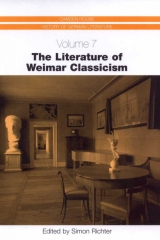
An investigation of Weimar Classicism. Drawing on literary and theoretical works by Goethe, Schiller, and others, the seminar will explore concepts such as: aesthetic education; the nature of a "classic;" "autonomous" art; imitation; German responses to Greek antiquity.

634. Goethe's "Faust".
Richter.

The seminar presents a systematic analysis of the text and covers the history of the "Faust" tradition, the significance of the work for the understanding of Goethe's writings, questions of myth formation, figure conception, thematic structure, and the influence of "Faust" on the literary tradition.


636. Literature of Enlightenment. Richter.

German intellectual and literary developments from 1690-1780 in the context of the European enlightenment.

638. Studies in 19th Century Literature.
MacLeod, Trommler, Weissberg.

The course concentrates on issues of "realism" and "representation". Examples will be drawn from nineteenth century German fiction.


640. Middle High German Lyric Poetry.

A study of the leading representatives of "Minnesang" and political poetry. Close analysis of poems by Walter von der Vogelweide, Heinrich von Morungen, Reinmar, and others.


641. Drama of the Nineteenth Century.
Trommler.

A study of the German drama after Goethe and Schiller, with special emphasis on the response of such authors as Kleist, Buechner, Grillparzer, and Hebbel to the classical drama. Discussions of theories and techniques (Freytag, Szondi). Readings also include Nestroy, Hauptmann, and Schnitzler.


642. Drama of the Twentieth Century.
Trommler.

Based on a discussion of the relationship of drama (text) and theater (performance), the course examines the development of realistic and antirealistic currents in modern German drama. From Wedekind and Expressionism to Piscator's political theater, Brecht's epic theater and beyond (Horvath, Fleisser, Frisch, Duerrenmatt, Handke).


643. Novels of the Nineteenth Century.
Trommler.

Major trends in novelistic writing: study of the novel of development, the historical, and social-critical novel; analysis of representative texts by Goethe, E.T.A. Hoffmann, Freytag, Ludwig, Raabe, Fontane, Storm, Meyer.


646. Novel of the Twentieth Century.
Trommler.

A study of the major developments in modern German narrative prose in its international context. Discussions of theories and techniques. Readings of authors such as Kafka, Thomas and Heinrich Mann, Doeblin, Seghers, Boell, and Grass.


647. History of German Lyric Poetry.

MacLeod, Trommler.

In depth discussions of individual types of poetry (e.g., sonnet, elegy, casual poetry, Erlebnisdichtung, etc.) and influences on change, especially external influences, from ca. 1500 to 1800.


648. Modern German Lyrics.
Trommler.

Origins and development of modern German lyrical poetry since the late nineteenth century. Authors such as George, Rilke, Hofmannsthal, Brecht, Benn, Bachmann, Celan will be interpreted in light of the important poetic trends in the twentieth century.


653. Baroque.
Wiggin.

Lectures on the concept of "Baroque" in literature and the social and intellectual backgrounds of German Baroque literature; reading and discussion of lyrics, dramas and novel.


654. Renaissance and Reformation.
Wiggin.

Major works and authors of the fifteenth and sixteenth centuries. Authors include Luther, Hans Sachs, Wickram, Fischart, and Frischlin.

659. Novel of the Eighteenth Century.
Richter.

Theory and forms of the novel in the eighteenth century. Readings and discussion of selected novels.


660. German Literature Since 1945.

Main trends in prose, drama and poetry in East and West. Discussions of the differences in the production and reception of literature on both sides of the wall until 1989. Readings include Boell, Grass, Weiss, Wolf, Muller, Handke, Frisch, Duerrenmatt, Enzensberger.


662. German-Jewish Autobiography.
Weissberg. Discussion and (most of the readings) will be in German.

The seminar commences with a discussion of Jewish ethical wills and of two early modern Jewish autobiographies, the autobiography by Leon Modena, a Rabbi from Venice, and the memoirs by Glickel von Hameln, a Jewish woman writing in Yiddish. Both texts will be read in English translation. The course will then focus on German-Jewish autobiographies written in the late eighteenth and early nineteenth centuries, and focus on the early emancipation period. Texts studied include the memoirs of Salomon Maimon, Lazarus Bendavid, Henriette Herz, and Fanny Lewald.


666. (COML686) History and Literature.
Trommler.

A seminar-style course on the complex interaction of history and literature and the theories reflecting it, including poststructuralism, critical theory, and New Historicism. Readings include H. White, La Capra, Foucault, Habermas, Jauss, Koselleck. Discussions and papers combine theoretical concerns and literary analysis (Buechner, Flaubert, Brecht).


670. (ARTH670, COML670) German Literary Theory & Criticism.

This course will concentrate on major and/or current issues in literary criticism, specific problems, critics, or approaches. Topics will vary; in the past, courses have concentrated on Walter Benjamin's work, and "The Frankfurt School and After."


672. (COML634) Reading Modernity.
Trommler. Taught in English.

A study of modernism and avant-garde as concepts in literature, theater, and criticism. It focuses on the crucial developments from Symbolism to Dadaism and Surrealism in their historical context. Readings of representative authors, including Baudelaire, Nietzsche, Joyce, Eliot, Mann, Benjamin, Adorno.The last part is devoted to the juxtaposition of Modernism and Postmodernism.


674. (ARTH674, COML674) Topics in Aesthetic Theory.
Weissberg, MacLeod.

Topics vary annually.


676. (COML676, WSTD676) Readings in Feminist Theory.
Weissberg.

The seminar will provide a survey of recent feminist theories, and a discussion of literary texts focusing on issues of gender, race, and class. The reading list will include essays by French, English, and American theorists as well as novels by Bachmann, Wolf, and Jelinek.


678. (ARTH678) Realism: Literature and Theory.

What is "realism"? What does it mean to depict the world as a "realist" writer or artist? This seminar will consider these questions and concentrate on German literature and art of the second half of the nineteenth century. It will focus on writers such as Stifter, Storm, Raabe, and Fontane; but also on Stifter's drawings and paintings, visual artists such as Menzel, and the vogue of historical painting. Finally, the seminar will consider the role of early photography in the development of the notion of "realism." Secondary literature will include studies by Michael Fried, Linda Nochlin, and others.


679. (ARTH662, ARTH762) German Art.
Staff.


680. (MUSC760) Studies in Contemporary Music.

Seminar on selected topics in the music of the twentieth century.


999. Independent Study.
Staff.

return to top

Dutch

008. Amsterdam.
Freshman seminar. Distribution I: May be counted as a Distributional course in Society.
Naborn. All readings and lectures in English. No knowledge of Dutch is required.

This freshman seminar will take you on a virtual canal boat trip through Amsterdam. In-class discussions will include Dutch policies on finance, education, art, health and crime.


101. (DTCH501) Elementary Dutch I.
Naborn.

A first semester language course covering the core Dutch grammar and vocabulary with the goal of providing the corner stone for developing overall linguistic proficiency in Dutch.

102. (DTCH502) Elementary Dutch II.
Naborn.

Continuation of DTCH 101.


103. (DTCH503) Intermediate Dutch I.
Naborn. Prerequisite(s): Dutch 102 or equivalent.

A third semester Dutch language course. The emphasis lies on vocabulary expansion through the use of audio-taped materials and readings. Grammar is expanded beyond the basics and focuses on compound sentences, features of text coherence and idiomatic language usage.

104. (DTCH504) Intermediate Dutch II.
Naborn. Prerequisite(s): Dutch 103 or equivalent.


105. (DTCH505) Cultural History of the Netherlands & Flanders.

Naborn. Prerequisite(s): DTCH 104 or equivalent.

This course combines a Dutch language course with a content-based course on Dutch history and literature. Units on linguistic aspects of the language are added as review and refinement. The course also serves as an introduction to writing papers in Dutch.


106. (DTCH506) Advanced Dutch II.
Naborn. Prerequisite(s): Dutch 105 or equivalent.

Continuation of Dutch 105. The emphasis lies on literary and other writings from the 20th Century.


230. (ARTH263, FOLK232, JWST230) Topics in Dutch Studies.
Distribution III: May be counted as a Distributional course in Arts & Letters.
Taught in English.

This seminar will focus on area studies of Belgium and the Netherlands. Topics may include political science, history, folklore or film studies. Students will read about and discuss major developments in the Low-Lands.


399. Independent Study.
Naborn.

457. (COML327) Survey of Dutch Literature.
Distribution III: May be counted as a Distributional course in Arts & Letters.
Naborn.

The course examines literary development from Reinaert de Vos to William Frederik Hermans and Paul van Ostayen. Readings include selections from Hooft, Vondel, Bredero, Gezelle, Multatuli, Vermeylen, etc. Special attention is given to social, historical, cultural, and religious backgrounds of the literature.


458. Selected Topics in Dutch Literature.
Distribution III: May be counted as a Distributional course in Arts & Letters.
Naborn.

Topics vary according to the needs and interests of students. The focus will be on specific literary and cultural issues of the Flemish and Dutch tradition. Advanced knowledge of Dutch is required to read original texts.


463. (ARTH463, HIST406, RELS416) Society, Art & Devotion.

This course will deal with the history of the Low Countries during the "Golden Age" of Burgundian rule. The immensely rich resources in art, religion, and history will be treated from the points of three disciplines: history, art

501. (DTCH101) Elementary Dutch I.
Naborn.

A first semester Dutch language course covering the core Dutch grammar and vocabulary with the goal of providing the corner stone for developing overall linguistic proficiency in Dutch.


502. (DTCH102) Elementary Dutch II.

Naborn.

Continuation of DTCH 501.


503. (DTCH103) Intermediate Dutch I.

Naborn. Prerequisite(s): Dutch 502 or equivalent.

A third semester Dutch language course. The emphasis lies on vocabulary expansion through the use of audio-taped materials and readings. Grammar is expanded beyond the basics and focuses on compound sentences, features of text coherence and idiomatic language usage.
504. (DTCH104) Intermediate Dutch II.
Naborn.


505. (DTCH105) Advanced Dutch I.
Naborn. Prerequisite(s): DTCH 504 or equivalent.

This course combines a Dutch language course with a content-based course on Dutch history and literature. Units on linguistic aspects of the language are added as review and refinement. The course also serves as an introduction to writing papers in Dutch.


506. (DTCH106) Advanced Dutch II.
Naborn. Prerequisite(s): Dutch 505 or equivalent.

Continuation of Dutch 505. The emphasis lies on literary and other writings from the 20th Century.


507. Dutch for Reading Knowledge.

Naborn. No knowledge of Dutch required.

This course is designed for undergraduates, graduate students and faculty who want to be able to read Dutch. Of particular interest to historians and art historians, people interested in international business and law, religious studies, social policy, and literature. Emphasis on reading skills; structures of grammar and pronunciation are taught as needed. Text selection will be tailored to individual student needs. No knowledge of Dutch required.

999. Independent Study.
Naborn.

return to top

Scandinavian

101. (SCND501) Elementary Swedish I.
Staff.

This is a two-semester course designed to teach beginning skills in Swedish reading comprehension, vocabulary acquisition, listening comprehension, writing, and conversation. Swedish social development will also be examined in relation to its cultural milieu. A trip to Gloria Dei Old Swedes Church in Philadelphia for their Luciafest will be included on a December weekend, a visit to a Swedish film during the Philadelphia Film festival will take place in late April, and other events as announced.

102. (SCND502) Elementary Swedish II.
Staff.

Continuation of SCND 101.

103. (SCND503) Intermediate Swedish I.
Staff.

104. (SCND504) Intermediate Swedish II.
Staff.


501. (SCND101) Elementary Swedish I.
Staff.


502. (SCND102) Elementary Swedish II.
Staff.

Continuation of SCND 501.


503. (SCND103) Intermediate Swedish I.
Staff.


504. (SCND104) Intermediate Swedish II.

Staff.


999. Independent Study.

return to top

Summer Abroad in Berlin

Penn offers a unique program that combines intensive language instruction with equally intensive cultural encounter. Since reunification, Berlin has undergone significant changes while respecting and preserving aspects of its tumultous past. Our intensive language program is comprised of language-based content instruction that focuses on Berlin's living history. You will have the opportunity to interview people who have lived in Berlin throughout its many changes. Working cooperatively with other students and the instructional staff, you will construct a living history profile that in turn will become the centerpiece of our website project. We will meet every day in the morning and three days a week in the afternoon. Weekends are open for personal exploration and travel. Students will stay with host families.
contact: Christina Frei, cefrei@sas.upenn.edu, 215.898.7035

GRMN 101-950
German Language for Beginners (1 CU)

This course is designed for the beginning student with no previous knowledge of German. By the end of the six-week course you will be able to engage in simple conversations about familiar things. You will be able to speak about events that happened in the immediate past and express plans for the future. In addition, you will have developed reading strategies that allow you to glean information from simple newspaper and magazine articles and short literary texts.