Inventory Catalog of the Papyri Collection at the Center for
Advanced Judaic Studies of the University of Pennsylvania
(with appendices on the associated paper [mostly Arabic] and
leather [mostly Hebrew] fragments)
This is a work in progress, coordinated by Robert A. Kraft (Berg Professor of
Religious Studies), based on a preliminary inventory created in 1994 under the
direction of Jenni Sheridan (coordinated by Kathleen Evans) and presented, along
with digitized images on CD-ROM and corresponding photographs, to Robert Kraft
on his 60th birthday by his graduate students. Others who were closely involved
in this initial phase of the project include:
Alan Humm (imaging consultant, technical coordinator); Sigrid Peterson (data
and photography); Ken Banner (photography, Greek); Noel Hubler (photography,
Demotic & Coptic); Fritz Knobloch (CD-ROM & Hebrew); Jay Treat (Coptic
& Greek); Beth Pollard (Greek); Brad Kirkegaard (Greek); Max Grossman (Hebrew);
David Sandmel (Hebrew, Treasurer).
updated 11fe2004 [began 08/16/96; 8/11/98; 16fe2001; 29oc2003, 10no2003]
For a brief history of the collection see Kraft's introductory article.
[see also the revised blue project booklet (1994)]
For information on the collections at the University of Pennsylvania, see
the PPenn home page.
The papyri have been assigned archival numbers as follows:
in first position (col 1), the page number of the mylar container
in which the papyri were found already mounted in 1994, followed
by "." and the number of the papyrus on the page -- numbers begin
at the top left-hand corner of the page and continue vertically
by rows. Adhesive labels were also attached to the mylar for each fragment for
the photographing process in 1994. These 35mm slides were also digitized and
placed on three CD-ROMs presented to RAK for his 60th birthday. The location of
these
images on the CD-ROMs is indicated in the inventory, with links to the images
where appropriate.
After each number, the indicator "-"
or "|" has been added to show the direction of the writing:
"-" along the fibers (horizontally) or "|" against the fibers
(perpendicular).
A renumbering will be needed as joins between some fragments are
found and the collection is conserved better and organized more
consistently (e.g. by language). [Much reorganization has already
been done by Kraft in July-August 1996, and it continues.]
NOTE: CAJS microfilm 1A.31x seems to contain all or most of the
fragments mounted as pp. 1-3, while microfilm 1A.71x contains
most or all of the fragments mounted on p. 4. [Does this tell us
anything about the acquisition of the materials? Probably not,
since there are joins between materials on pp.1-4 and elsewhere.]
[There are 132 separate frgs, by count taken by Kraft on 5 August
1998, including a few blank pieces, plus "PReich #1" consisting of 3
Greek pieces (= 135 total), plus a separate Coptic codex treated as a
unit (= 136 total).]
Literary
# 001v / Gk 001v
01.04 | Greek Homer, Od 4.803-817 [ID by
RAK]
2.9 x 8.3 cm.;
15 lines (including one blank);
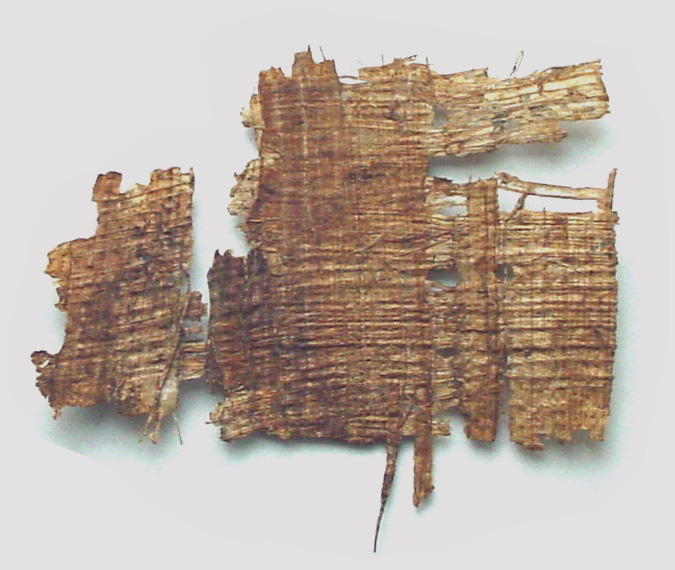
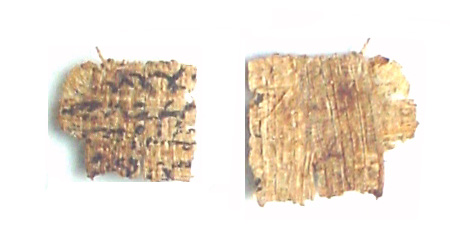
written against the fibers, with traces of documentary writing on the
other side (both sides enlarged here);
central fragment, lower margin intact;
medium color with some damage;
[visible in microfilm 1A.31x].
CD 1.025 (neg 1.26)
+new scan 2003 r&v
((transcription notes in green booklet))
Ptolemaic Fragments
#00x / Gk 00x
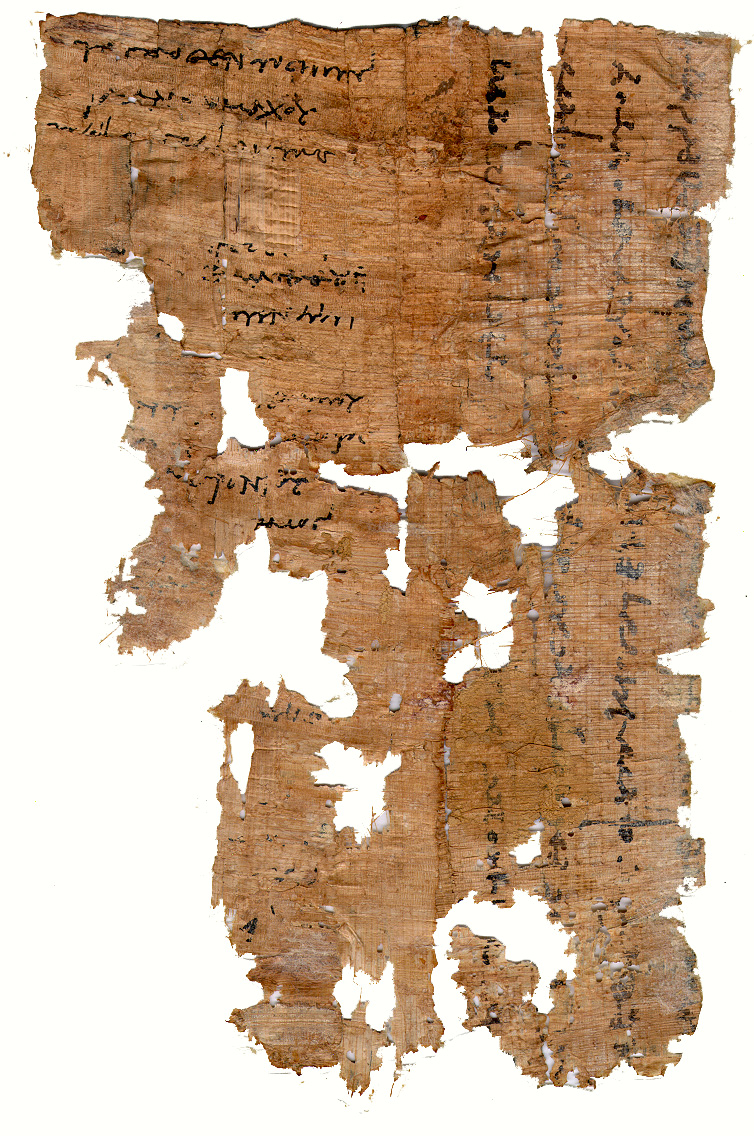
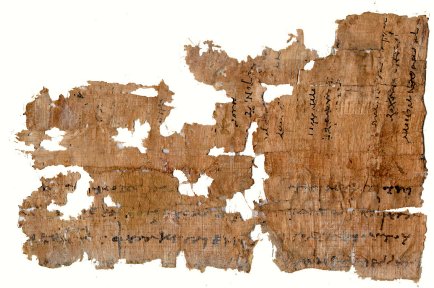
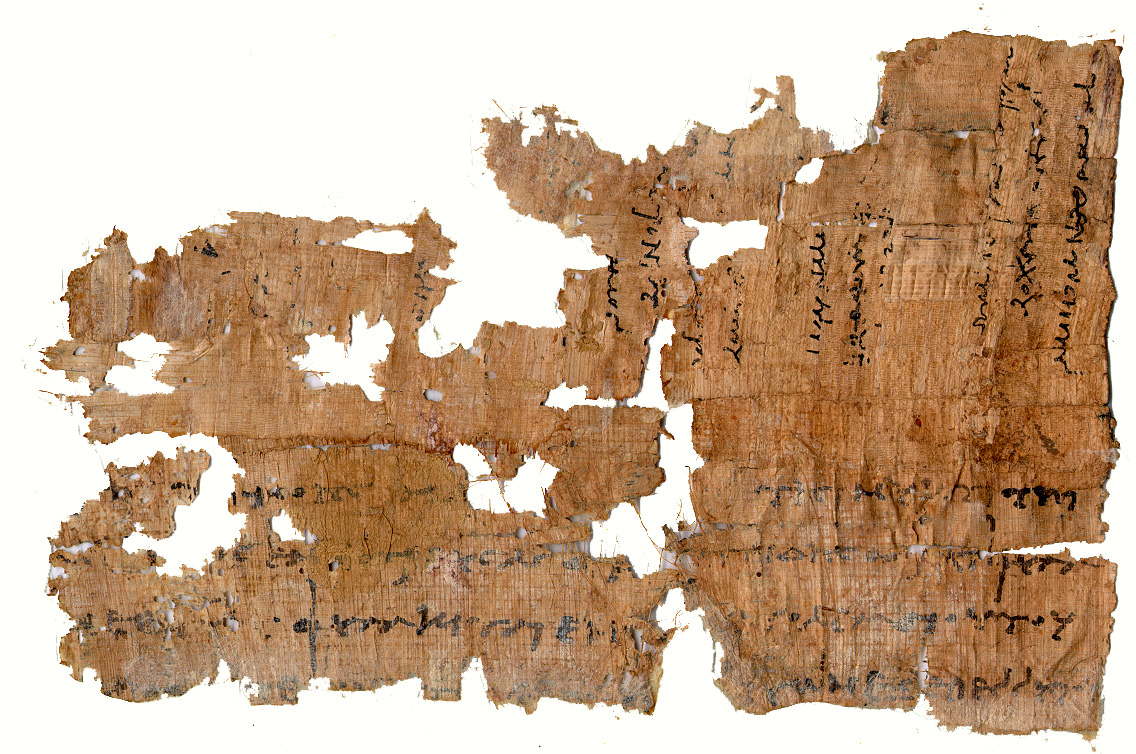
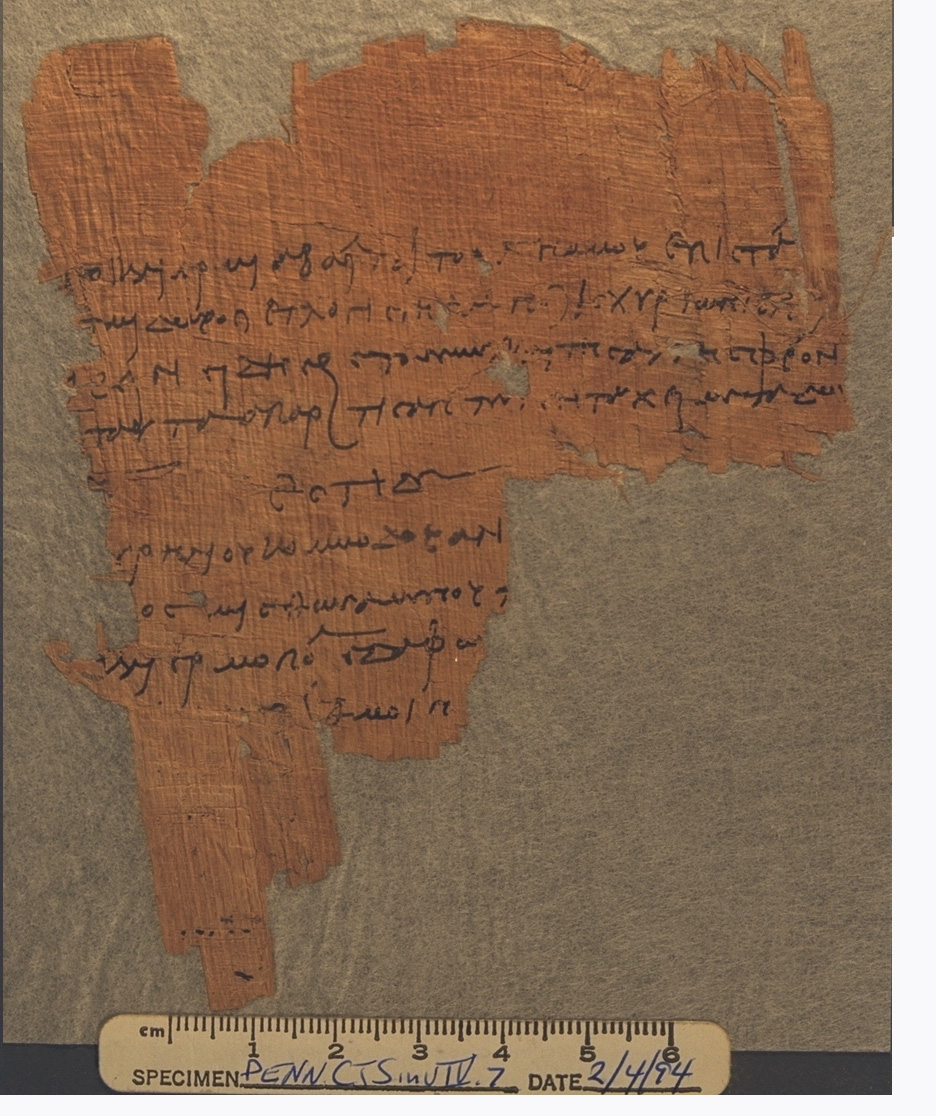
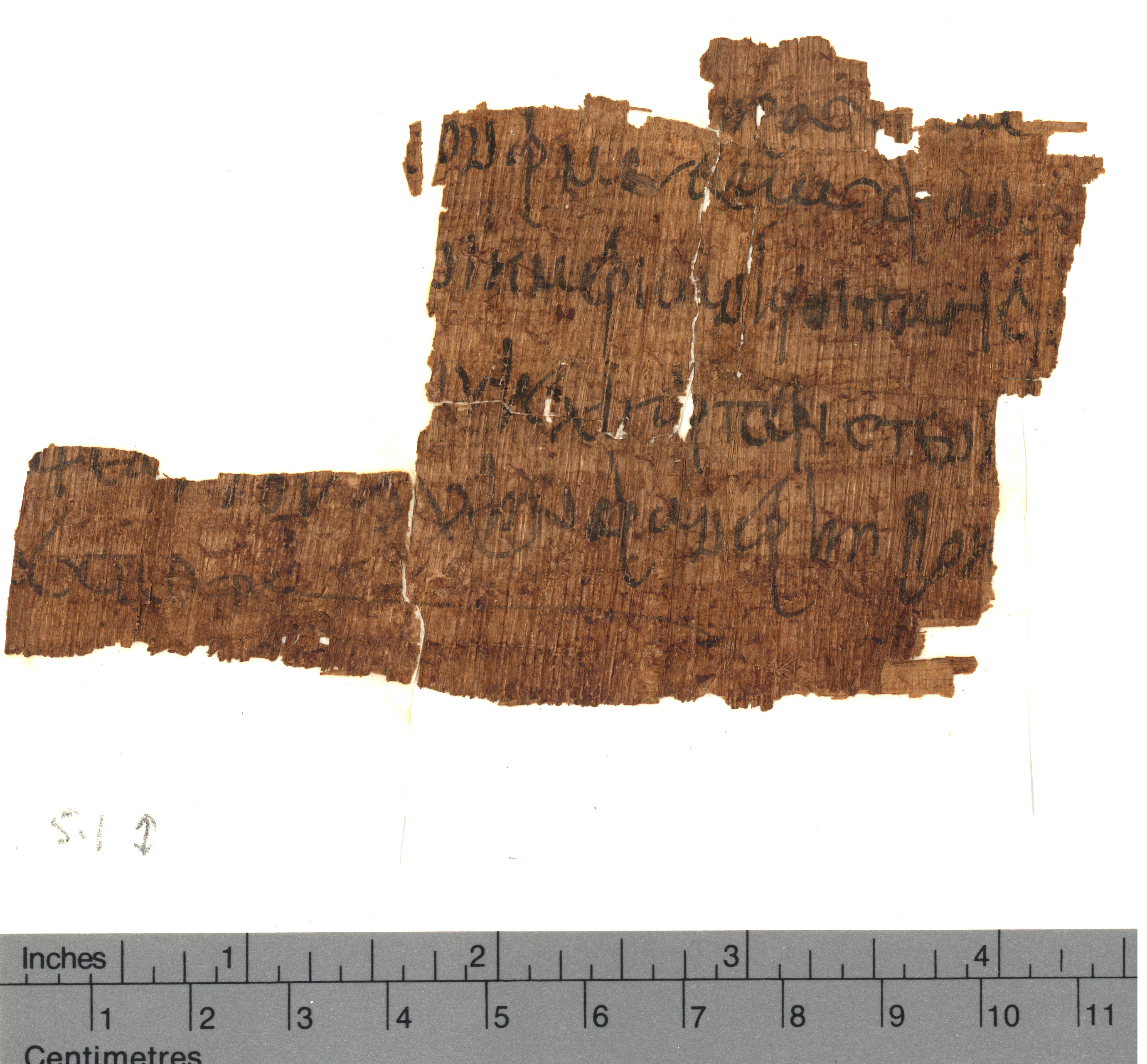
02.01 | (main piece) + 09.01 | (small piece) Greek document, also enlarged (also from the
microfilm).
12.3 x 18.2 cm.;
21 lines < | >;
central fragment (plus one large and 3 or 4 smaller fragments to
the side, some of which may be related);
darkened papyrus with surface abraded in many places;
Ptolemaic [RAK];
further conservation work done by rak 8/96 -- problems removing
the backing, but cleaned up sections, rejoined and remounted --
see detailed notes.
[Decipherment by RelSt 735 class members, recorded by Susan Marks]
[see microfilm 1A.31x for earlier state]
CD 1.001 (neg 1.02), CD 1.002 (neg 1.03), CD 1.020 (neg 1.21)
01 NH KAI ?() ANTIGRAU/P. . . ..EWI
02 QEWNI XAIREIN O . . ANATUL . . .
03 POU... E . . EMTI . . P?AM . . .
04 . . . . . . . . . . . KAI . . .
05 . KAI . . . TW PARESTA?TOU . . .
06 . . E/Q . . . . . ? . . KRA/H . . . MH .
07 . . H . . . . OFE . . . .
08 . . . . . . . . . . . . UA . . .
09 . . . . . . . . . . K . . . .
10 . . [ . ] . . [ ] . . . . . .
11 . TOLEDOU [ ] . . . . .
12 . DI? . . EA . [ . . ] . .
13 . . N . .
14 U KOF/YANTAI/USS . . .
15 . . . . ASEI?EI [
16 . . . . . . TOIS . [
17 . . EAU . . . .
18 . N . . [
19 . U . . [
20 KRI.T . . [ ] . .
21 . . . . . .
((transcription notes in green notebook))
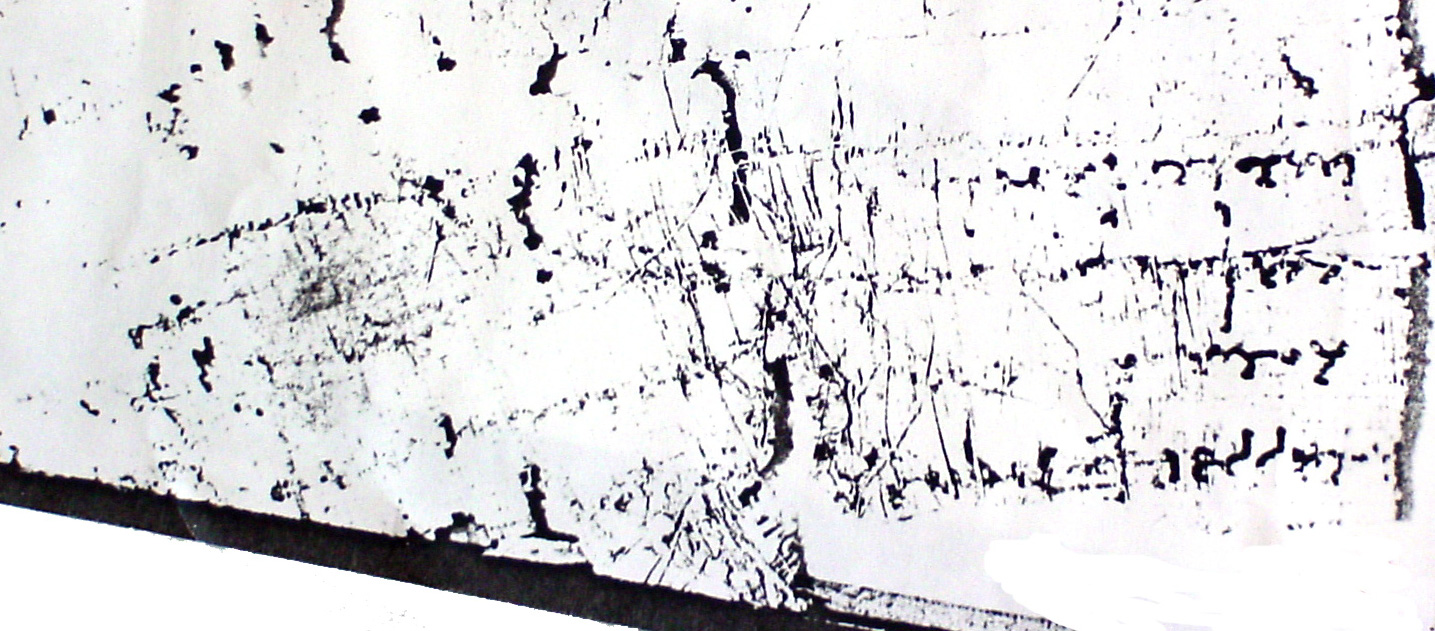
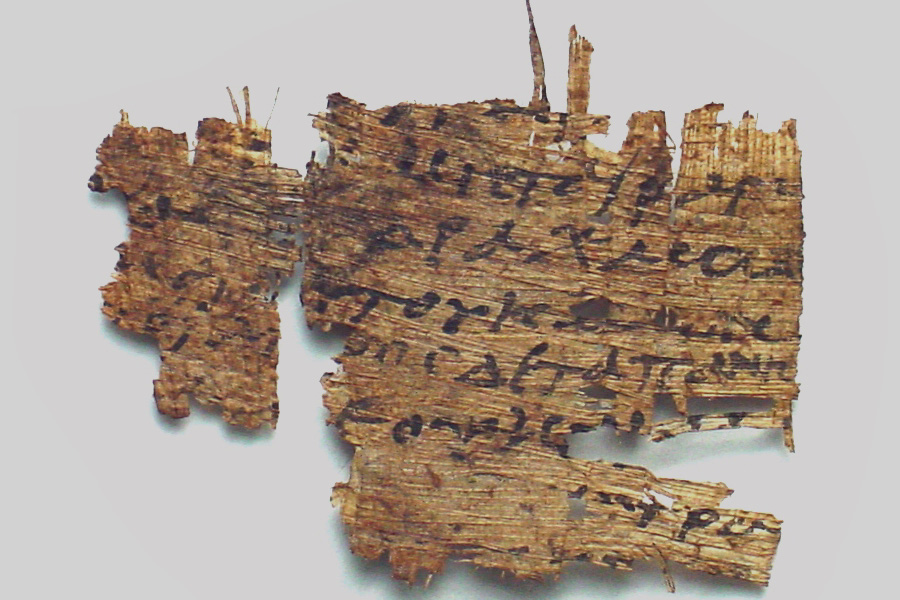
02.01b - and | (main piece) + 09.1 (smaller piece) Greek document(s) (also from the
microfilm).
between 11 and 19 lines parallel to
the reverse, writing along the fibers < - > starting on the left;
4 lines written perpendicular to
the reverse, and against the fibers < | >, to the right of the above
lines, and enlarged here;
Ptolemaic (RAK), possibly originally two different documents that
had been joined together for reuse on the other side?
conservation work performed by rak 8/96 (see above note)
[see microfilm 1A.31x for earlier state]
CD 1.003 (neg 1.04), CD 1.021 (neg 1.22), CD 3.070 (inf 1.21)
[transcription not yet attempted]
column of writing to the left, along the fibers -
01 . . . . . ODEN . . . OUN
02 . . . . . . . MAXOU
03
04
05
06
07
08
09
10
11
12
13
14
15
16
17
Four lines written perpendicular
to the reverse, and against the fibers < | >, to the right of the above
lines, and enlarged here (also from the
microfilm);
01 . . . . . . . . . . . . . . . . . . . . TI/HS . M . . THI
02 . . . . EA . . . . QR . . HSAN . [ . ] . . IDHS . . . FULA
03 . E . . . . FULAKITAI EM . [ . . ] . . . . . . . TOUTOU
04 . . . . . . . . . . . . . . [ . . ] . . . EDEBENN . .
#00x / Gk 00x
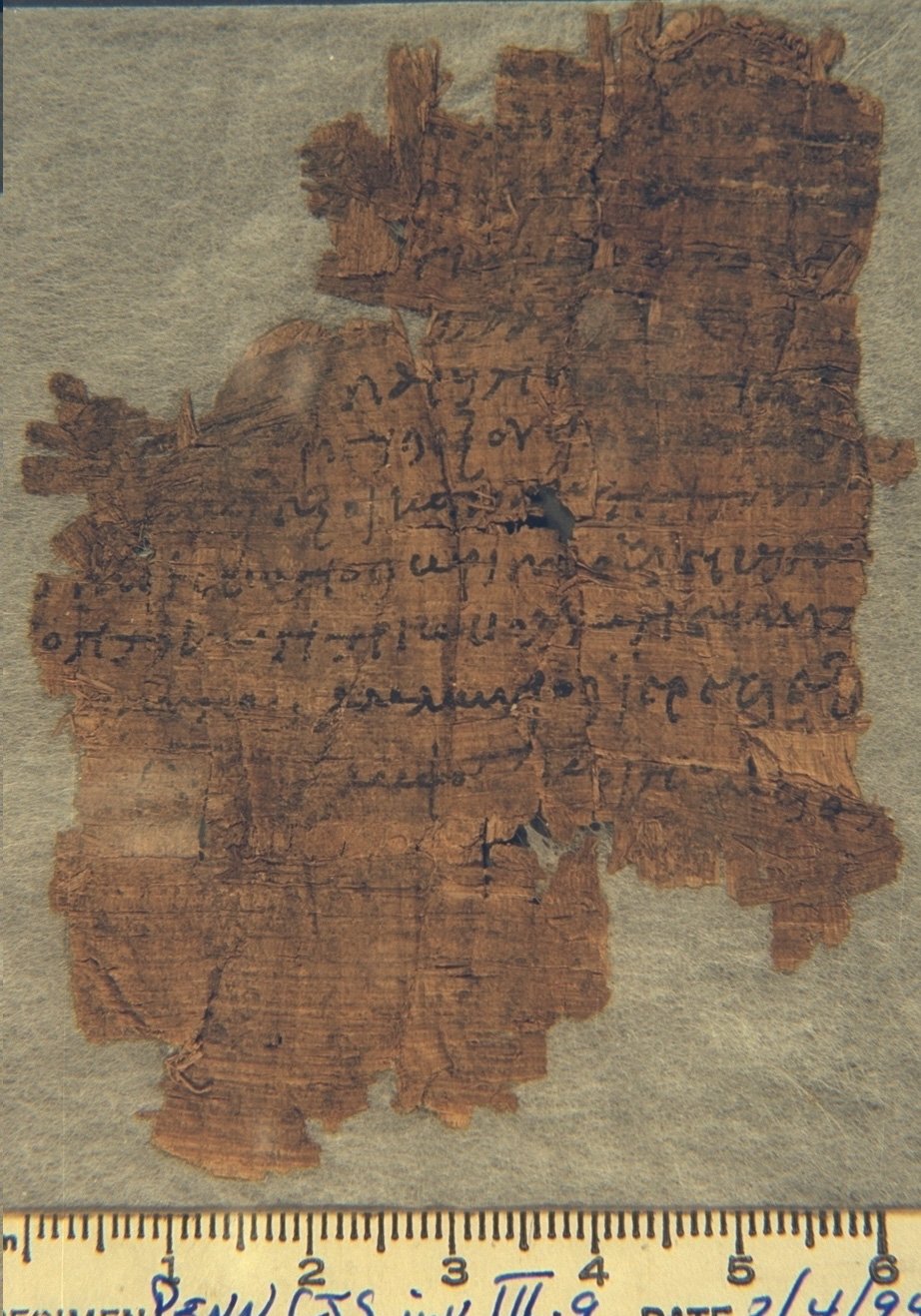
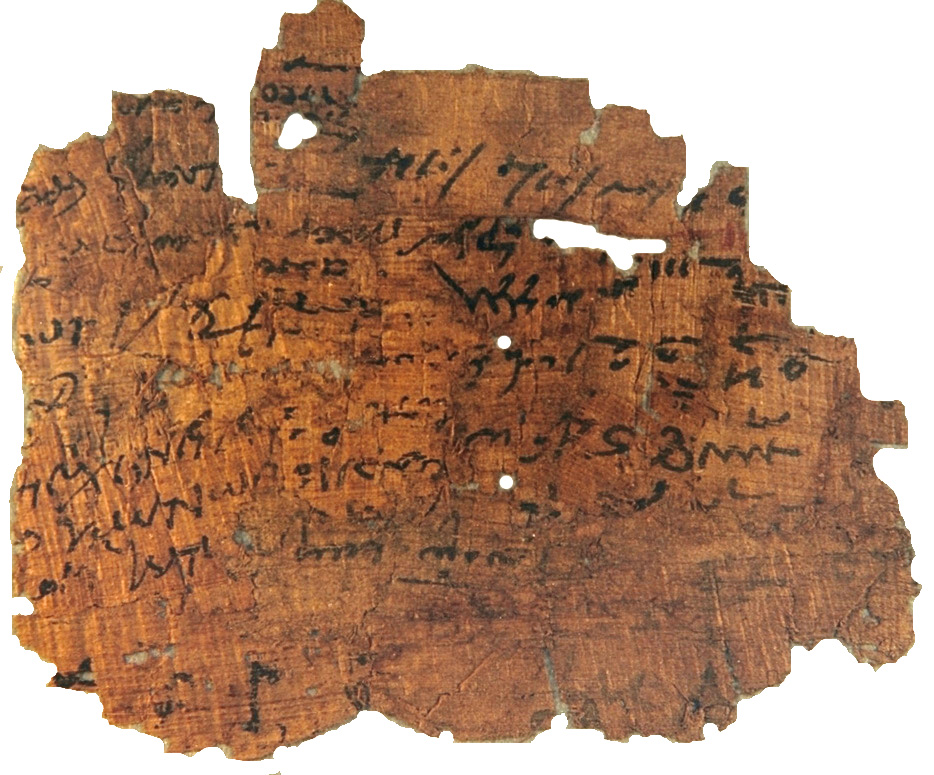
02.02 - + 09.01 - Greek document also
here enlarged.
13.5 x 13.4 cm.; 11 lines < - >;
top and left margins intact (reused as cartonnage, with 09.1 torn
away and lying ink to ink on top of the lower part of 02.2);
light colored papyrus;
Ptolemaic, 2 bce? [RAK & Sigrid Peterson];
reverse appears blank in earlier photos, with spot of reddish
plaster/paint, but additional fragments were found stuck to the back,
including two in the same Greek Ptolemaic hand, possibly from the
same document (separated by RAK in July/August 1996).
[unrestored main pieces are visible on microfilm 1A.31x]
CD 1.004 (neg 1.05), CD 3.065 (neg 2.04), 2.080-1-2-3
1
2
3
4
5
6
7
8
9
10
[break]
1
2
3
4
5
6
7
8
((transcription notes in green notebook, etc))
((conservation notes scattered))
02.02 | (contained cartonnage layering & paint)
CD 3.001 (neg 9.X), CD 3.002 (neg 9.00);
before and during separation and restoration by rak in 8/96,
numerous notes and annotated xeroxed images were made, including
a map of fiber-line patterns (see separate file)
#00x / Gk 00x
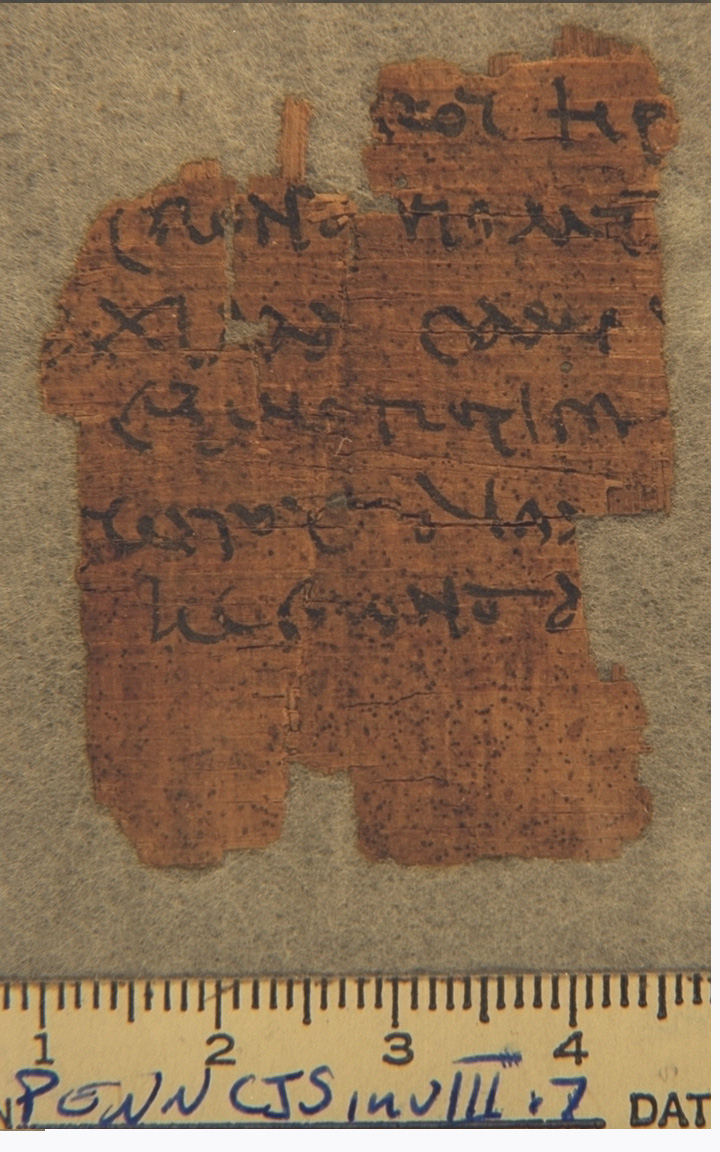
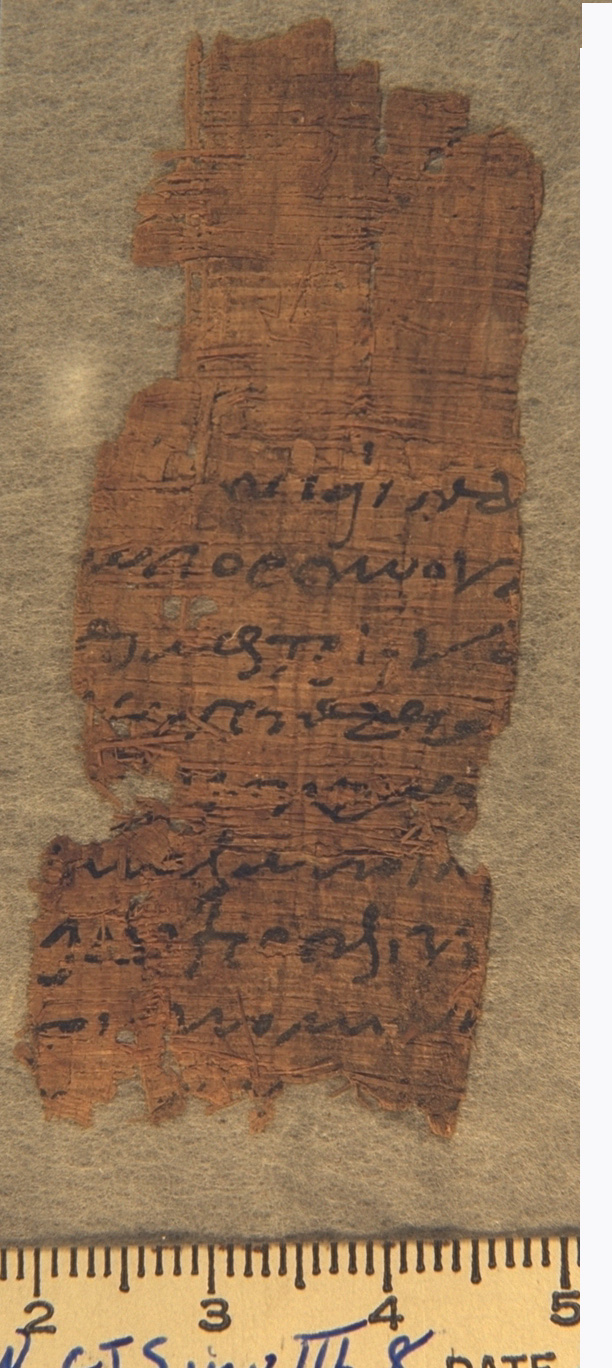
03.10 | + 01.07 | Greek grain
transaction (?).
7.5 x 5.7 cm.;
3 lines ( | ) (reverse blank);
bottom and left (probably) margins intact;
some word division;
medium-dark color;
Ptolemaic, 3-2 bce [RAK]
[visible on microfilm 1A.31x].
CD 1.053 (neg 2.21) and CD 2.036 (neg 8.10)
+new scan 2003 r&v
1 ...POD]AGRIKOU [
2 . . . . . . ]ENNIOS ?[
3 ALWNOFUL() DIAQOTORTAIO[
line 1: "gout-ridden" -- see PRyl 4 555.5 (257 bce)
line 2: personal name (Sennios, Erennios, Sbennios, etc.)
line 3: similar abbreviated forms (here "threshing-floor guard"?)
appear in the Zenon archive and at Gurob in the 3rd c bce;
the personal name
Thotortaios is attested from the 3rd c bce onward, notably at Gurob in
PPetr and at Tebtunis
((transcription notes in green notebook))
Published by RAK as PBingen 33 (plate 19).
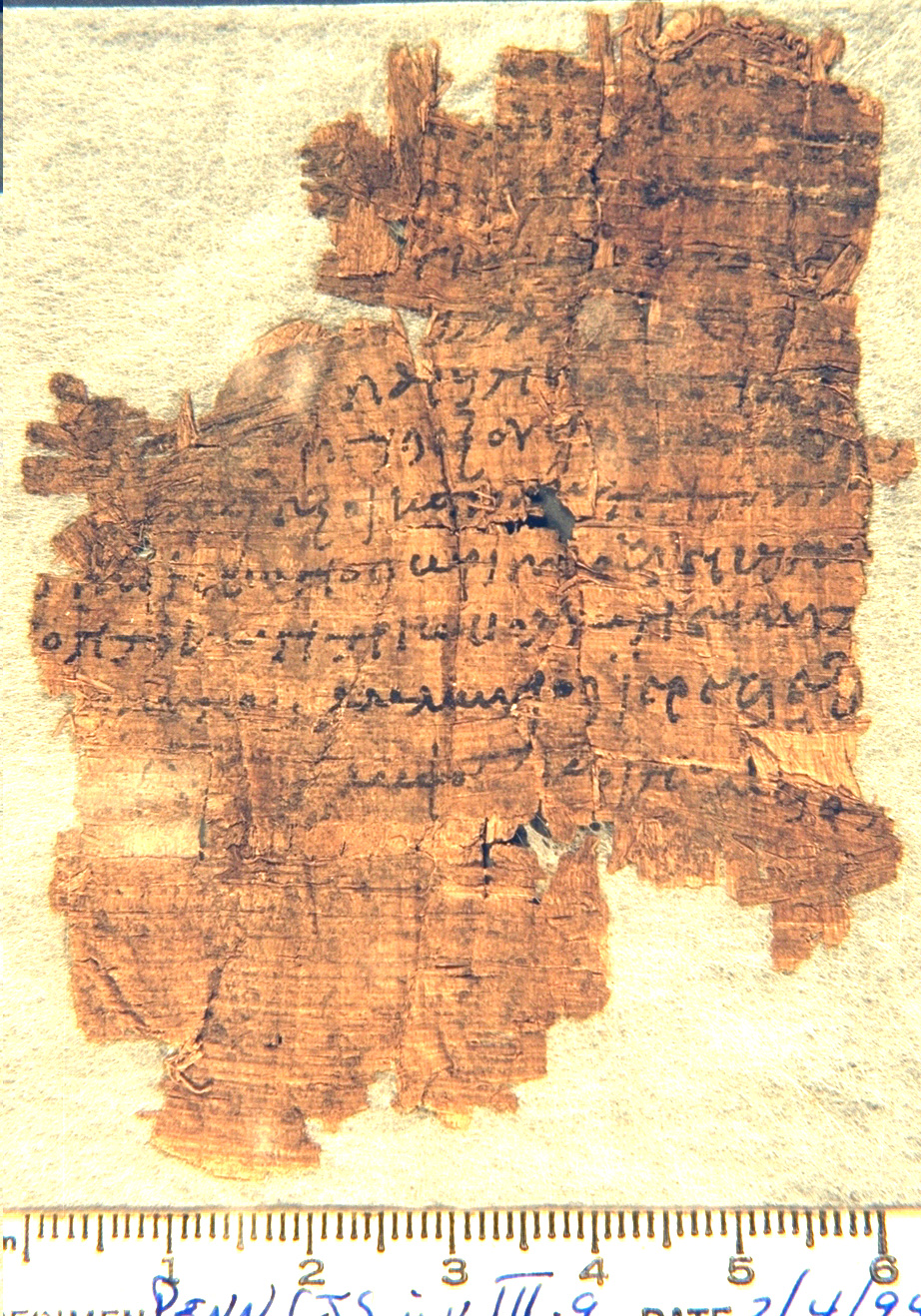
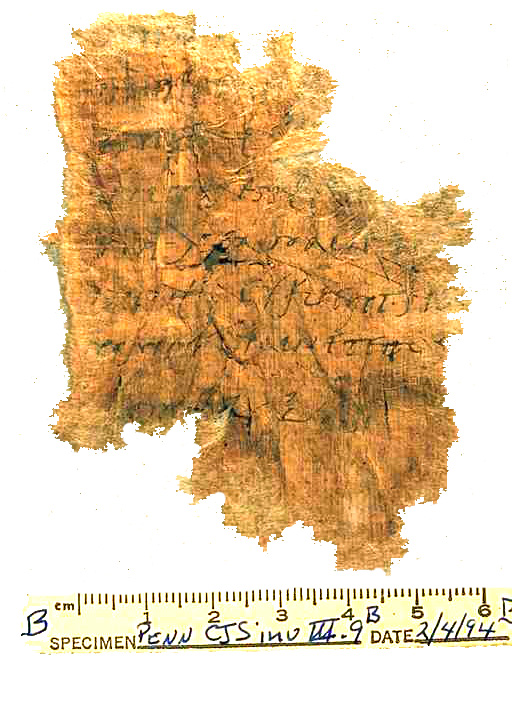
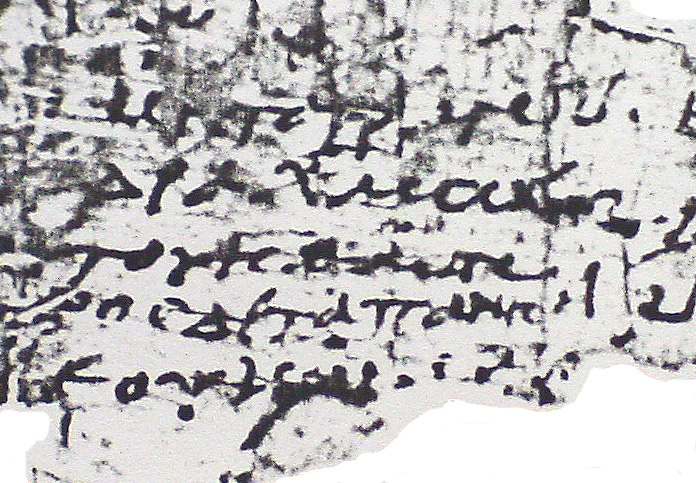
#00x / Gk 00x
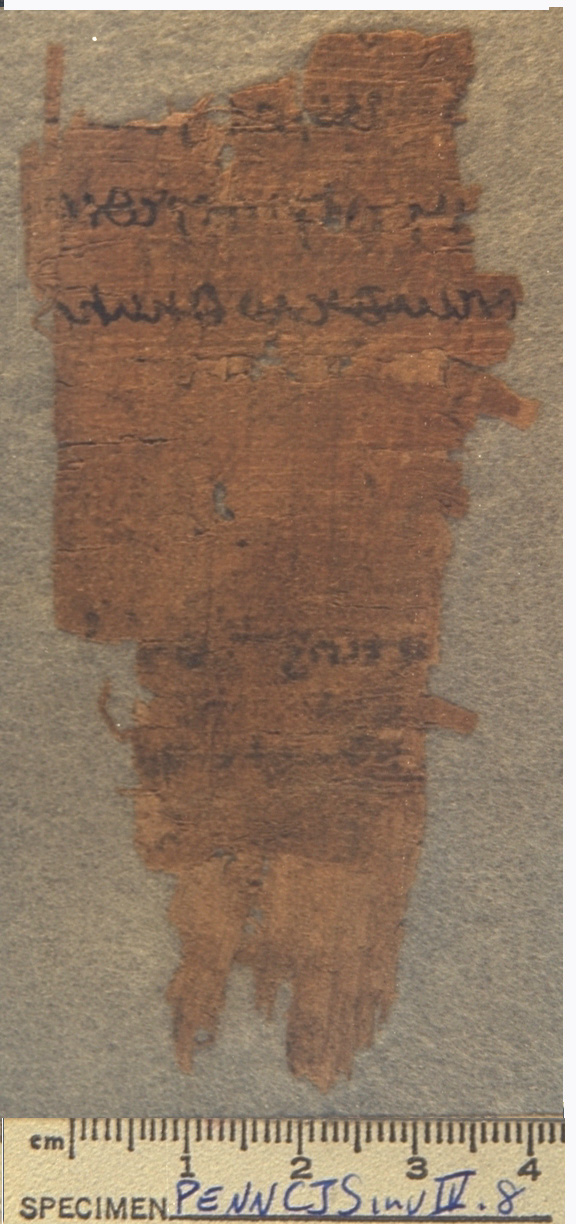
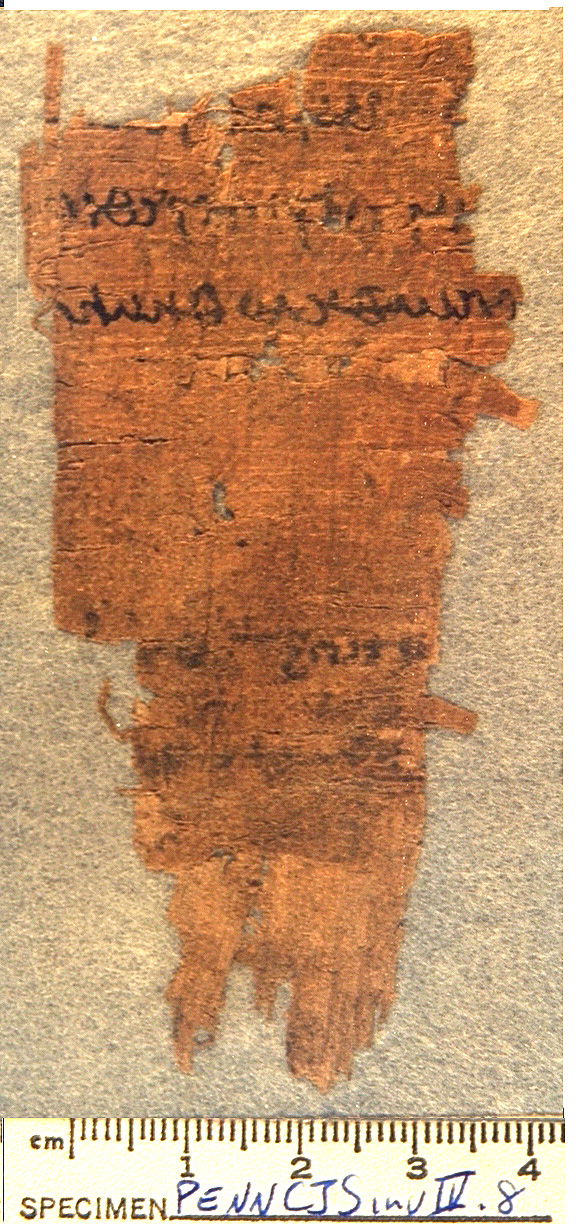
04.09 - Greek
fragment, also
enlarged, and even
larger.
3.5 x 7.0 cm.;
19 lines of tiny hand (--);
central fragment;
medium-dark color with some surface shredding;
Ptolemaic (RAK)
[[not cleanly mounted, but very fragile; needs further conservation]]
[identified on microfilm 1A.71x]
CD 1.058 (neg 2.26)
being edited by RelSt 735 group, Fall 2000
01 ] . . . . . . . [
02 ]MATIPELIN T . [
03 ]. SSW[ ]. . E . [
04 ]. .[ ] . RI . [
05 ]AS . . [
06 ] . . . . . [
07 ] . . ANDE[
08 ] . . EIPASP. [
09 ] . OI? . . . . [
10 ] . OE . OM . WN . [
11 ]. UTOISPARA . [
12 ]. WN K . . . . [
13 ]MASKAIT . . .[
14 ]NOUTEALL . . . [
15 ]. OSKRITHRIO. . [
16 ] . MENSUGGRA . .[
17 ]ISMATOSAIAXAI .[
18 ]. MESOSMELI[
19 .]ESOSMELI[
Note that the words and phrases that can be identified tend to be
typically Ptolemaic.
line 11: perhaps tou/tou toi=s para\, or possibly
au)toi=s para..., but note the slight space before the T.
line 13: possibly h(ma=s kai\ to..., or perhaps draxma\s
kai\ to\n to/kon or similarly (kw/mas kai\ to\, tima/s
kai\ to\, but also loipa/s kai\ te/taktas).
line 14: probably ou)=te a)/llo ou)de/n or the like.
line 15: krith/rion and krithri/ou are typical for
3-2 c bce documents; especially the formula e)pi\ tou= kaqh/kontos
krithri/ou diakriqw=sin.
line 16: possibly h(mi=n suggra/fhn or similarly.
lines 18-19: me/sos meli/xrws ("medium honey-colored") is
frequent from the 3rd century bce in physical descriptions.
09.01 (group).
three small fragments mounted together;
light color
[not yet identified on microfilm 1A]
Ptolemaic(?) [RAK]
#
09.01.01- (see 02.02 join).
4.5 x 7.5 cm.;
[[required further separating, conservation]]
#
09.01.02 | (see 02.01 join).
1.5 x 2.2 cm.;
[[required removal of backing]]
#
09.01.03 - Greek.
5.3 x 7.2 cm. plus two (three?) small strips;
parts of at least 2 lines < -- >, possibly lower left corner;
pale tan surface, black ink (much damage);
2. ...XRU...
[[required further separating, conservation]]
no evidence of writing on reverse
#
11.05 | Greek.
image
4.0 x 11.6 cm.;
central parts of at least 7 lines <||>, bottom margin intact;
grey and stained, almost bluish, with black ink, and papyrus
fibers stuck diagonally atop lower surface;
Ptolemaic [RAK]
CD 2.093-4-5
[[needs further separation, conservation work]]
1 ] . EGEN.OUN .
2 ] . . TOKE . . .
3 ] . . .
YA . . .
4 ] . . . [right side empty? or interlinear word?]
5 ] GW IAWRA G . [
6 ] . . OS -K- OUK
7 ] ER . . . . . . . . NOU[
8 ] . . . . . . . NNOY[
[large lower margin]
11.05 - Demotic (and plaster/paint) (6.01, 8.07.01)
at least 3 lines of writing <-->, and a large plaster/paint area
#
06.01 - Greek or Demotic.
3.1 (7.2) x 5.6 cm. plus two smaller pieces (layers);
traces of probably 4 lines (ends?);
evidence of being torn from adjacent layer
06.1 | Greek or Demotic (8.7.1, 11.5).
3.1 x 5.6 cm.;
traces of at least 2 lines <||> (with more under the plaster);
greyish cast to papyri (see 11.5), black ink;
plaster and traces of red paint on much of the piece;
08.07 Greek & Demotic collage.
CD 2.072-073
#
08.07.01 - Demotic (see 6.1, 11.5).
3.7 x 9.2 cm.;
portions of at least 6 lines at right margin <-->;
08.07.01 | Greek.
parts of 9 lines <||> badly abraded;
greyish surface with black ink, upside down to reverse(?);
#
08.07.02| Greek(?).
1.4 x 3.5 cm.;
at least 2 lines of mutilated text <||>;
no evidence of writing on reverse
#
08.7.3| Greek.
2.3 x 7.0 cm.;
parts of at least 3 lines <||>;
dirty surface, black ink;
reverse has plaster and red paint
#00x / Gk 00x
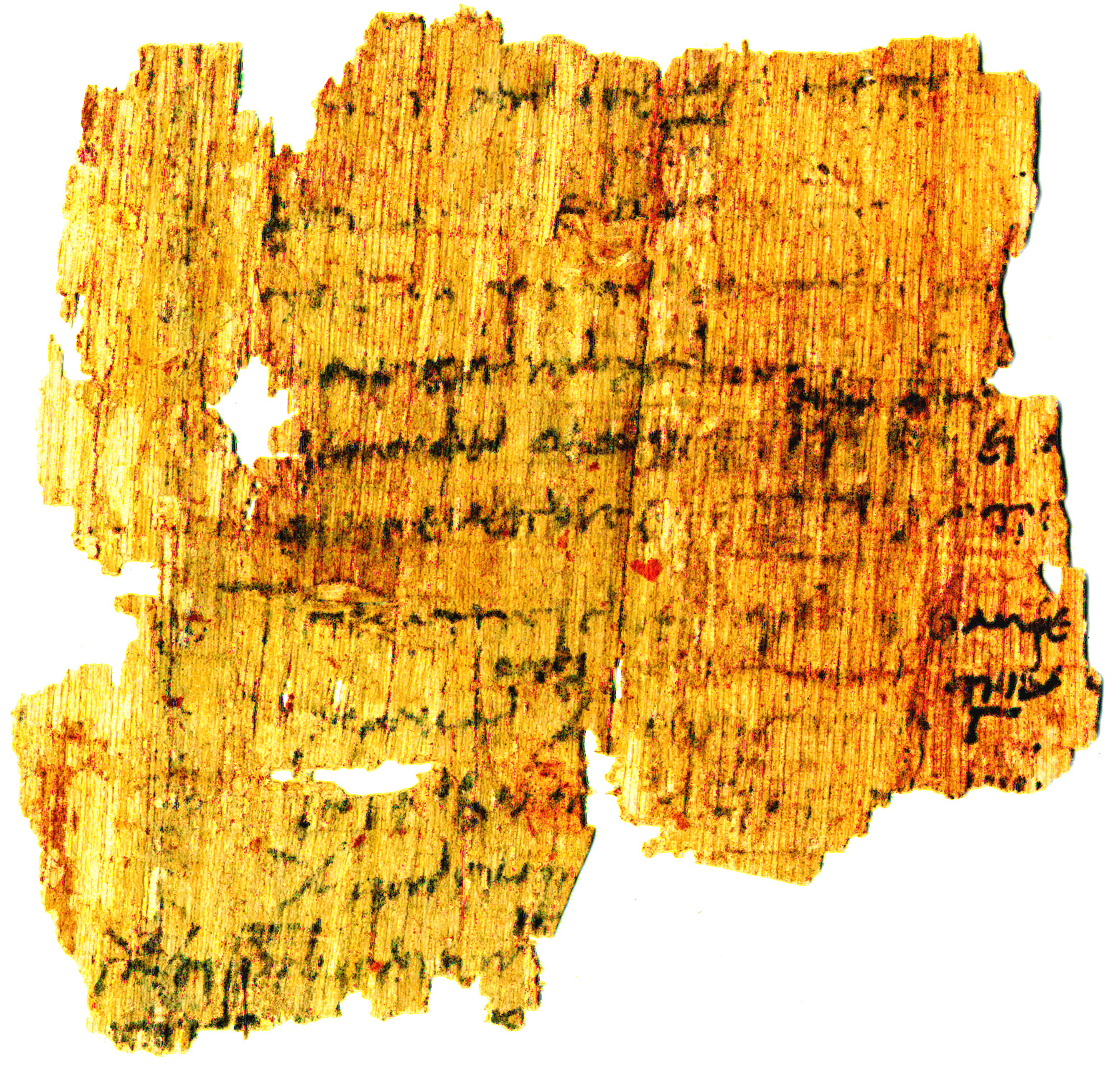
"Reich Papyrus 1" (1) - Greek
Letter, here also enlarged, and even larger.
Parts of 12 lines, written with the fibers in black ink
in a Ptolemaic hand;
large, heavy cursive with few ligatures
Right margin barely present in lines 4-5, 8-9
Published by RAK as PBingen 32.
1 [......].........A TA[...]EIN[
2 [......]WSPER KAI TON ADE[L]FON[
3 [......]QFEA KAI SOU GRAYANTO[S
4 [TWI APOL]LWFANEI EIS AQASTIN
5 [PROSA]GAGEIN AUTOUS EPE[..]EN
6 [.....A]UTWN FNEFERWS SUNEXE[
7 [.....]EN AQASTEI UPO TOU AP[O
8 [LLOF]ANOUS ACIW EAN SOI FAINH
9 [TAI SU]NTACAI GRAYAI AUTWI
10 [........] AU[TO]N KAI TOUS AL[
11 [LOUS.............]GAR ANQRWP[
12 [.......................]A. [
Translation:
1 ...
2 ...[name] and (your/his) brother
3 ...E]thfeus. And when you write
4 [to Apol]lofanes, into Athastis
5 to deliver them. He sent(?)
6 [one?] of them, Fneferos. Hold/Secure
7 [it] in Athastis by Ap[o-
8 llof]anes. I ask that if it pleases you
9 that you arrange to write him
10 ... him and the others
11 ... For a/the man/men ...
12 ...
Paleography: note especially early forms of Q H K N R W,
suggesting 2nd century bce or earlier.
Language and idiom: aciw ean (soi) fainhtai suntacai grayai (+
dative) is frequent in 3-2 bce documents;
kai sou grayantos is in a Theb doc of 2 bce;
sunexe(in, etc.) abounds in 3bce docs and later
anagagein auton also appears in 3-2bce docs
Names: Athastin, Fneferos
"Reich Papyrus 1" (1) | Greek
document.
Parts of 15 lines, written against the fibers in black ink
Sloppy appearance, Ptolemaic cursive traits, ligatured
Poorly preserved and conserved; needs special attention
Left margin seems intact for the top 13 lines, with the next two
lines extending to the left into that margin --
possibly two or more columns?
01
02
03 E
04
05
06 . EN . . OFEN D . . . . . . . . . . . . . . . EI
07 DIAIPEMEINOUS . . . . . . T
08 T . . .THUISI . . . . . . . . . . . . . . . . AMFE
09 [between lines?] ISUEN . . . . . . . . .THI
10 . . . . . . . . . . . . . . . . . . . . . . G
11 . . . . . IB . . . .
12 XIB . UN . . . . .
13 [between lines?]
14 GL . AI . . .
15 . . . . [ . . . . .] K [
#
"Reich Papyrus 1" (2) | Greek
Parts of 5 lines, written against the fibers <||> in black ink.
Separated from the next fragment by RAK.
1 D DRY N ARA[
2 ]FARA[
3 N[
4 ]USOU AF[
5 ]RHIS (blank)
(lower margin ?)
#
"Reich Papyrus 1" (3) - Greek
Parts of at least 3 lines written with the fibers <--> in black
ink. Separated from the previous fragment by RAK.
1 ] EPIRIYON TAS EK[
2
3 KEN[
(large lower margin?)
"Reich Papyrus 1" (3) | Greek
Parts of at least 4 lines written against the fibers <||> in
black ink (somewhat blurred)
(upper margin?)
1
2
3
4
(lower margin?)
Other Greek
#001r / Gk 001r
01.04 - Greek document, also
enlarged
here (other side of the Homer fragment).
2.9 x 8.3 cm.;
different hand from reverse;
about 6 lines, three faint and obstructed <-->;
[identified in microfilm 1A.31x]
CD 1.026 (neg 1.27)
1
2 OU
3
4 AIR
5
6 TLESE
7 SKAIT
8
((transcription notes in green booklet))
#
01.01- + 01.03- + 06.06- Greek document.
5.7 x 5.8 cm (joined);
7 lines; top and left margins intact;
medium color, in legible if broken conditon;
dated 1-2 ce (RAK); reverse uninscribed
[identified in microfilm 1A.31x]
CD 1.022 (neg 1.23), CD 3.063 (neg 1.24), etc
CD 1.024
(neg 1.25)
+new scan 2003 r&v
#
01.02- Greek.
3.6 x 5.4 cm.;
4 lines (3 above, then room for two more, then one);
written along the fibers;
left, and perhaps bottom margin intact;
medium-light color in good condition;
dated 2-4 ce (RAK); reverse uninscribed
[identified in microfilm 1A.31x]
CD 1.023
(neg 1.24)
+new scan 2003 r&v
01.03- (see 01.01)
#
01.05- Greek.
5.1 x 7.0 cm.;
central parts of 12 lines <-->;
dark color with abraded surface;
3rd-4th century ce?
[identified in microfilm 1A.31x]
CD 1.031
(neg 1.32)
+new scan 2003 r&v
1.
2. ... QOSAN...
3. A
4. ARGUROLOGHSAS
5. OIS
6. LLAH
7. ROUF
8. FWST
9. EIU
10.
11.
12.
((transcription notes in green booklet))
#
01.06- Greek.
3.0 x 2.1 cm.;
central parts of 4 lines (--);
light color with some abrasion;
date undetermined
[identified in microfilm 1A.31x]
CD 1.030
(neg 1.31)
+new scan 2003 r&v
[possibe traces of ink on reverse]
1.
2.
3. ORW
4.
#
01.07| Greek (see 03.10|).
2 x 2.2 cm.;
1 line (||) similar to 03.10;
might preserve bottom margin;
medium-dark color;
date undetermined
[not yet identified on microfilm 1A]
CD 1.028 (neg 1.29), CD 1.029 (neg 1.30)
#
01.08- (see 03.11- joins)
[not yet identified in microfilm 1A.31x]
CD 1.027 (neg 1.28)
#
01.09- Greek.
5.1 x 8.7 cm.;
11 lines <-->;
left margin intact (irregular), significantly abraded, holes;
medium-light color;
dated 3-4th ce (RAK);
[identified on microfilm 1A.31x]
CD 1.032
(neg 1.33)
+new scan 2003 r&v
01. ...[
02. ..IALTOS[
03. ..SOUXA[
04. .AR.A.[
05. I.RAN .[
06. PRWTHS[
07. .....[
08. LIQI.[
09. OSIRI[
10. LIQ.[
11. .[
#
01.10- + 03.12- Greek archival legal record(?).
5.7 x 8.5 cm.; 9 lines of text between guidelines <-->;
central fragment with top margin; medium brown color;
dated 1-2 ce (Humm & Treat); reverse uninscribed
[identified in microfilm 1A.31x]
CD 1.018
(neg 1.19), CD 3.064 (neg 2.03), CD 1.019 (neg 1.20)
+new scan 2003 r&v
1.
2.
3.
4.
5.
6.
7.
8.
9.
02.03 Hebrew (paper) [removed from papyri collection]
#
03.01- Greek
fragment, here greatly
enlarged (with portion repositioned).
8.4 x 3.9 cm.; 4+ lines with one interlinear word/correction;
central fragment; light color;
date undetermined (early)
evidence of some word division
unusual letter forms include A (like L), B (like P), possibly U (like
E or S)
[identified in microfilm 1A.31x]
CD 1.035 (neg 1.36)
+new scan 2003 r&v
[preliminary transcription by Beth Pollard (for Jenni Sheridan class)]
being edited by RelSt 735 (Fall 2000), coordinated by Debra Bucher
1. ... ].BON TESHIOI.EIS PROS(U?)TOS(U?)E[
2. .. ]BEIAN HSXARIN KAI THS MEGISTH.[
3. . ]SISIDOS ENTOISKINDUNOIS (blank)[
(between lines) SOI
4. . ]STATIDOSKAIAN.[
5. . . . .
#
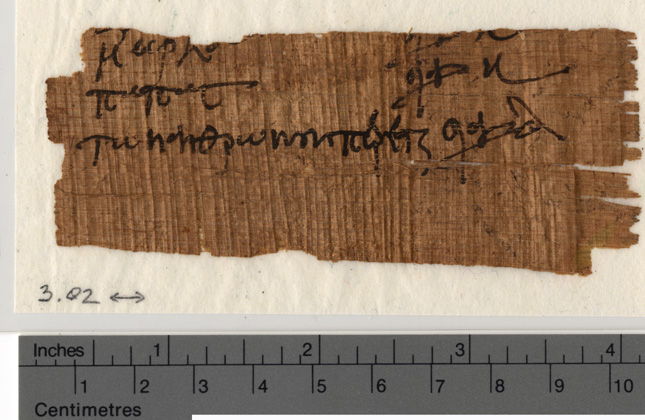
03.02- Greek
(
150 dpi image;
600 dpi image).
10 x 4.1 cm.;
3 lines (with trace of a 4th, above left) in 2 columns <-->;
bottom and right margins intact, possibly also left;
medium-dark color with brownish ink, well preserved;
date undetermined.
Judging by the numbers to the right, it is from some sort of account.
other side is uninscribed
[identified in microfilm 1A.31x]
CD 1.036 (neg 1.37)
+new scan 2003 r&v
1. MWRH . [ b l a n k ?] ###
2. PAPAS [ b l a n k
]
##K
3. TWN ANQRWPWN PER . . ##A
#
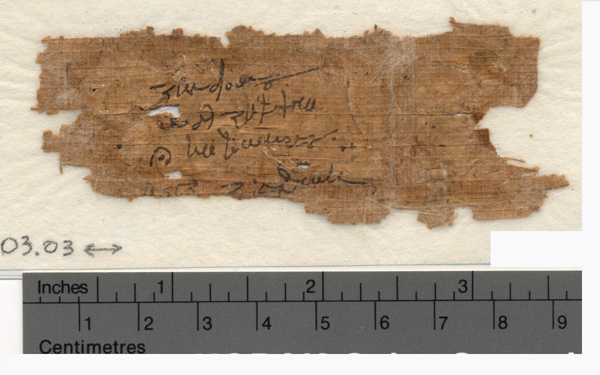
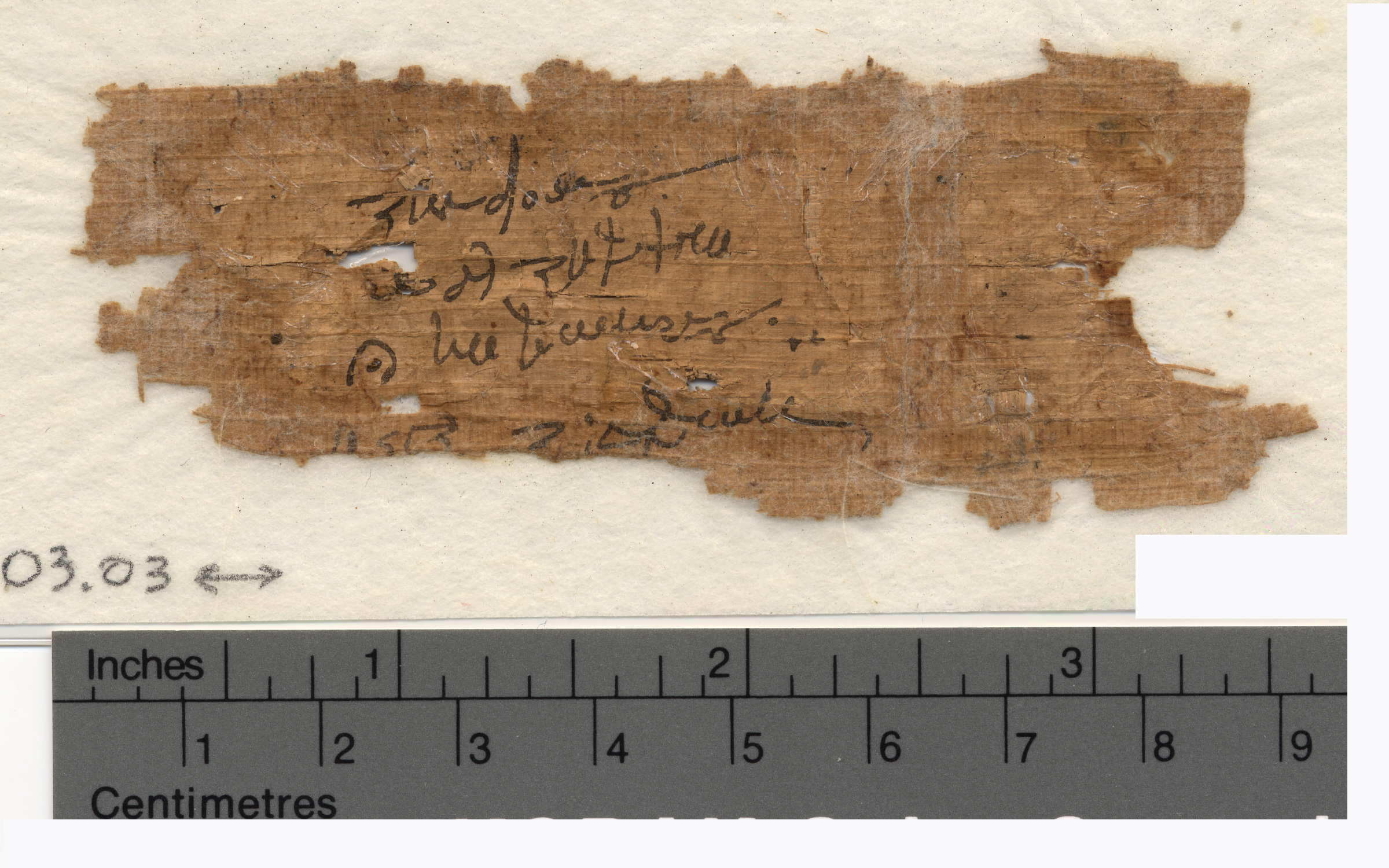
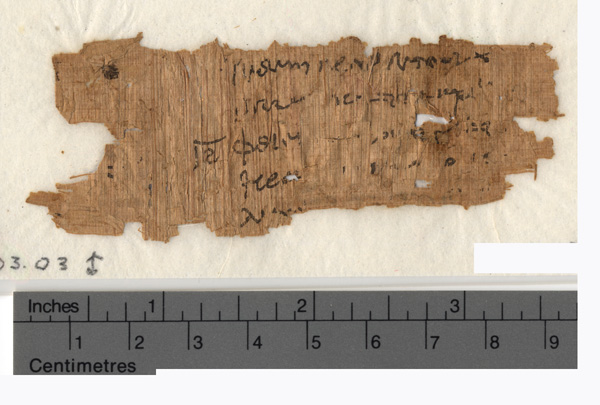
03.03- Greek.
(
150 dpi image;
600 dpi image).
4 lines <-->; top, left and right margins preserved;
medium light colored material, thin black ink strokes;
date undetermined
CD 1.044 (neg 2.12)
CD 2.033 (neg 8.07)
1.
2.
3.
4.
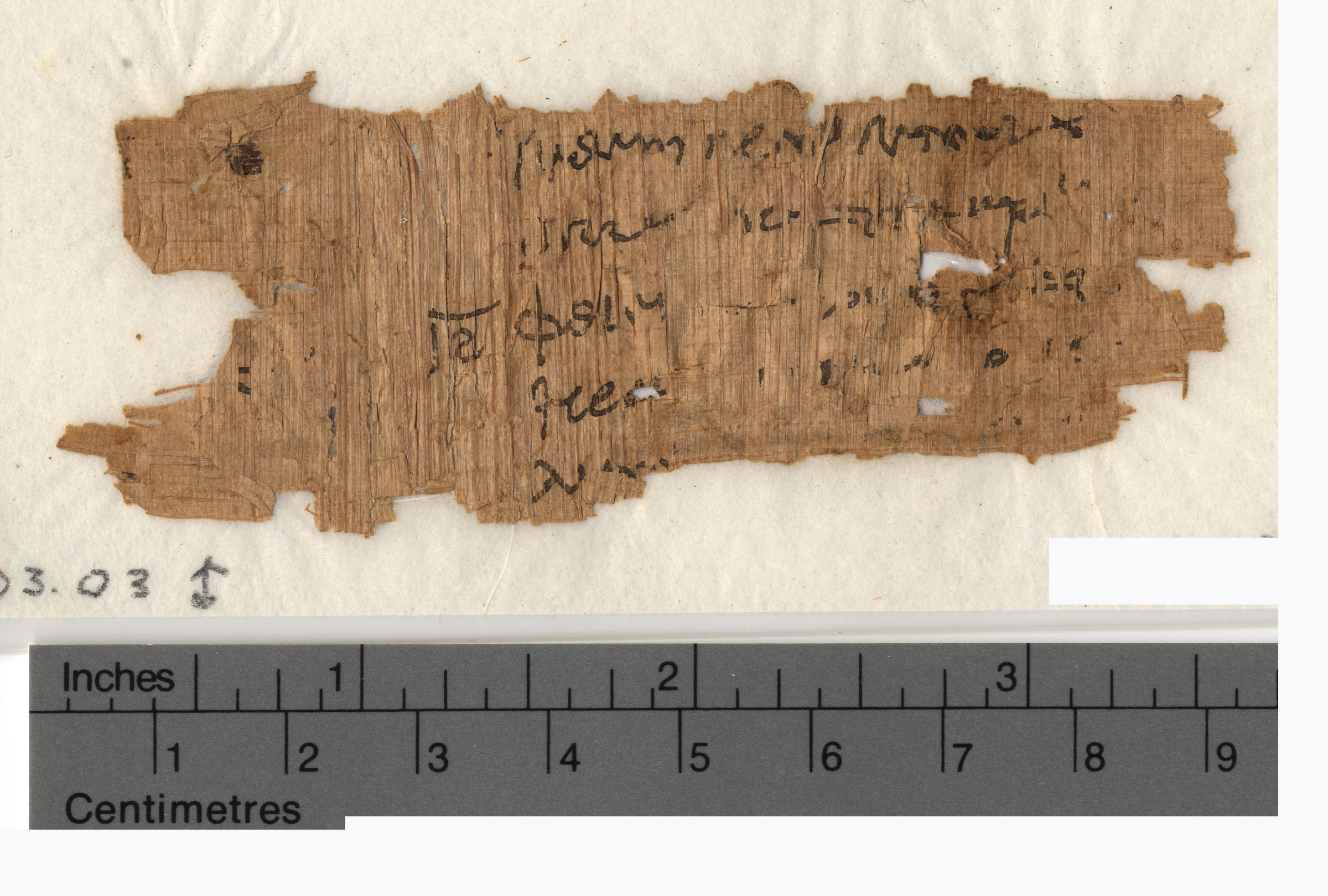
03.03| Greek.
(
150 dpi image; 600 dpi image).
9.0 x 3.5 cm.;
5 lines <||>; appears to be one column in wider page (left and right margins intact);
light color with abraded surface (needs further unfolding at bottom);
4th century?;
[identified in microfilm 1A.31x]
CD 1.043 (neg 2.11)
1. . . . .
2. . . . .
3. 16 FQIE . .
4. HW . . .
5. L . . .
#
03.04a- + 04.10a- Greek
(
150 dpi image;
600 dpi image).
4.2 x 9 cm.;
11 lines (joined) <->;
central fragment;
medium-light color, legible;
date undetermined;
[preliminary examination by Gavi Miller (for Jenni Sheridan class)]
[visible on microfilm 1A.31x] CD 1.047 (neg 2.15)
01 GOM.EKP
02 LOUKAPR
03 APLEONT ...
04 PARADOQEAL
05 ER MWNQEN
06 AUTH DI AP
[blank space of less than a line in depth]
07 AR KAIFORA. AUTHS
08 EWSXOIAKKAIAUTOU
09 W .. MISQOU
10 .IOUEISYROFASONQO
11 WN B LAXANIWN
03.04b- + 04.10b- Demotic (or Greek symbols ?)
(
150 dpi image;
600 dpi image).
3 (plus) lines of text <-->, perpendicular to reverse side writing;
[visible on microfilm 1A.31x] CD 1.048 (neg 2.16)
#
03.05- + 04.12- Greek.
5.8 x 4.6 cm.;
4 lines with top margin, 6 lines of center <-->;
top margin intact;
medium-light color;
4th century?
[visible in microfilm 1A.31x]
CD 1.049 (neg 2.17), CD 2.034 (neg 8.08)
[initial reading by Frank Chen for Jenni Sheridan class]
1. ] .UDELXW
2. ] . HLFAS DOMNINA[
3. ]ARANOU . R . OMOUS . . R[
4.
] . LIA[
03.05b
traces of ink on back (illegible; blotted?)
CD 1.050 (neg 2.18), CD 2.035 (neg 8.09)
#
03.06- (see 03.11- and joins)
[identified in microfilm 1A.31x]
CD 1.056 (neg 2.24)
#
03.07- Greek.
3.6 x 4.7 cm.;
6 lines <-->; bottom margin intact;
dark color with small brown spots all over;
date undetermined
[identified in microfilm 1A.31x]
CD 1.055
(neg 2.23); also
enhanced
+new scan 2003 r&v
1. ] . . OU HR[
2. ]. . WNA
3. ]. XILLA SA . R .[
4. ] ECW . PERISU[
5. ]. WTOU . AI . .[
6. ] K . . . WNA A[
#
03.08- Greek.
2.6 x 6.5 cm.;
8+ lines <-->; top margin intact;
dark color with prominent fibers;
date undetermined
reverse uninscribed
[identified in microfilm 1A.31x]
CD 1.057
(neg 2.25); also
enhanced
+new scan 2003 r&v
1. ]
2. ] . POREUWOU .[
3. ] . . . . TRIOU . [
4. ] . . APTADO . . [
5. ] . .
6. ]
7. ] . . . HO . IU .[
8. ] . . . . O . . . . [
9.
#xxx / Gk xxx
03.09 - Greek.
6.5 x 8.3 cm.;
12+ lines; bottom margin intact;
dark color, lumpy, and dirty [[needs better conservation]];
date undetermined;
Latin text on reverse side
[identified in microfilm 1A.31x]
CD 1.045 (neg 2.13), CD 1.051 (neg 2.19); also
enhanced
1.
2.
3.
4.
5.
6.
7. ] PAR . LI . . .
8. ] . . . COU . . .
9. ] . . . ECOIKOPO . . . . TAUTA[
10.] . . . WPOS WRIS . . .
11.]OPLAK . . TITRIWMOL . . LISIMU .[
12.] . . . . . . . .I"EREUSEC[
13.] . . . . FO . . . OIP . . . .[
#xxx / Latin 001
03.09 | Latin fragment.
8 lines <||>, bottom margin intact; very fine pen (thin lines)
[[poorly conserved and mounted]]
CD 1.046 (neg 2.14), CD 1.052 (neg 2.20)
((some transcription notes loose in green booklet))
1.
2.
3.
4.
5.
6.
7.
8.
#??? / Gk ???
03.11 - (with 01.08 -, 03.06 -, 11.03b -) Greek
Military
List, here also enlarged.
7.1 x 3.9 and 3.8 x 3.6 cm.; 5 lines and 5 lines <-->;
left and right margins are intact in parts of the larger piece
(fragment #2);
medium color;
dated late 3rd to early 4th ce (paleography and contents)
[not yet identified in microfilm 1A.31x]
CD 1.054 (neg 2.22)
fragment #1
01. OUAL()]. . . [
02. OUA]L() TUENNO[
03. OU]AL() PAXITHS[
04. OUAL()] PAPHNIS[
05. OUAL()] . . . .PIDHS (mg?)[
fragment #2
01. (mg)OU]AL() AFUG'XIS (mg)
02. (mg)OU]AL() AGRH . . . S (mg)
03. (mg) OUAL() KOLL . . . . S (mg)
04. (mg) OUAL() EUDAIMWN (mg)
05. (mg)[OUAL()] . [ . . . . . . ]TRAIS (mg)
The initial name seems to be an abbreviated form of
OUAL(erios) -- as suggested by Klaas Worp -- similar to the practice found
in P.Mich 592 (Latin, "VAL") and 593 (Greek, "OUALER"). The explanation
provided by the editor of those papyri, Gerald M. Browne is worth quoting
(PMich 10 [1970], p.55):
"The two Michigan texts employ a feature of nomenclature which deserves
special attention. In both these lists Valerius, the
gentilicium borne by all the emperors from Diocletian up to
Constantine, is prefixed to the name of every soldier. These texts are the
only examples of such a large-scale adoption of the name
Valerius, although it occurs sporadically on an individual basis
[e.g. PSI 449; see also E.Bickermann, Das Edikt des Kaisers Caracalla
in P.Giss.40 (Diss. Berlin, 1926), 35f]. From Constantine onward,
Flavius, the new imperial gentilicium, was similarly
given to the soldiery. For this there is abundant evidence."
03.12 (see 01.10)
[not yet identified in microfilm 1A.31x]
CD 1.017 (neg 1.18)
04.01-02 Arabic (paper) [removed from papyri collection]
04.03 Mostly Greek collage, also enlarged (from cartonnage?) -- see also 05.03 below.
10.8 x 6.5 cm. plus 3 loose fragments;
collage of attached fragments separated by RAK 7/96
[then mounted and numbered separately]
[identified on microfilm 1A.71x]
CD 1.069 (neg 3.06)
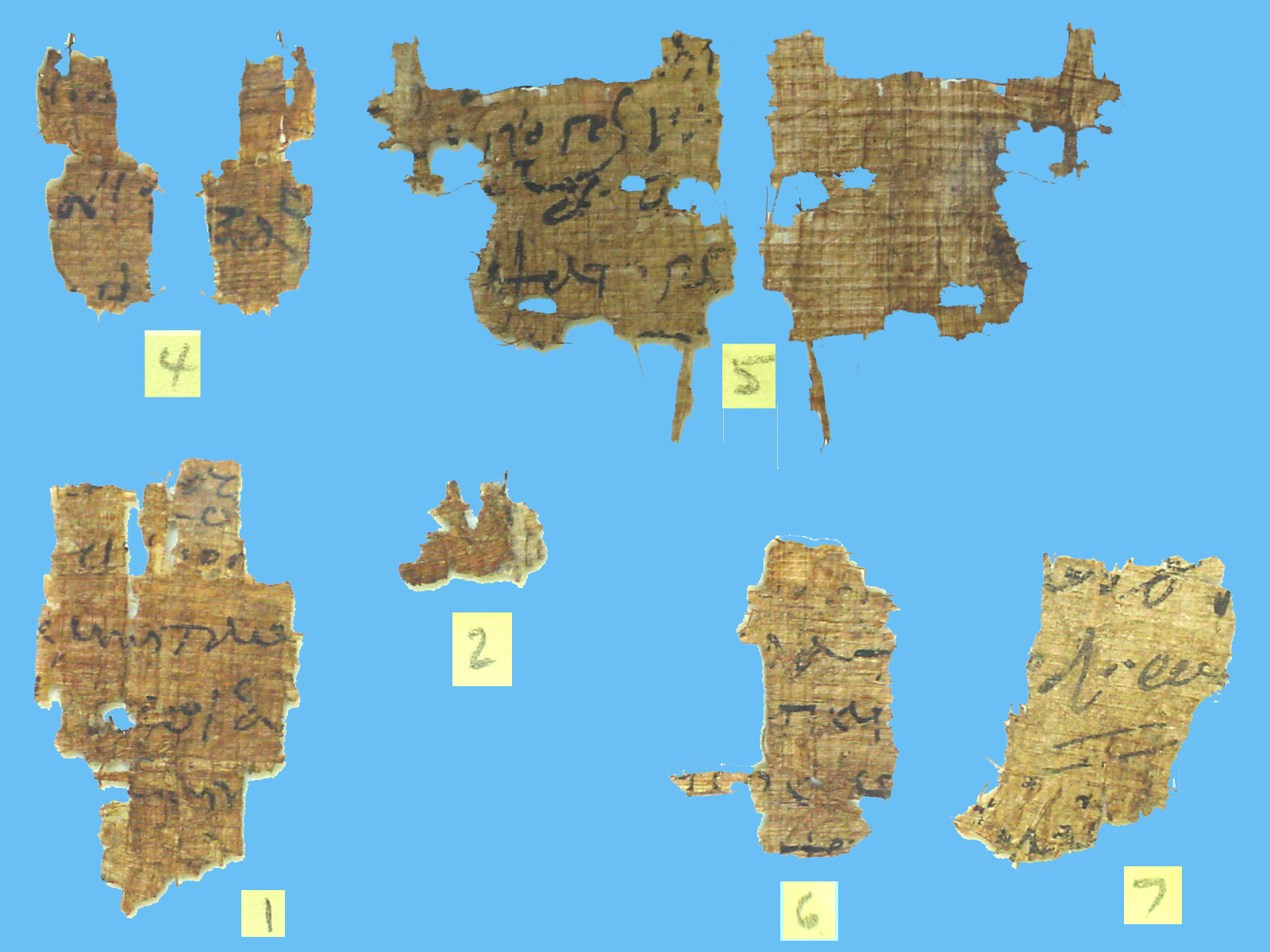
Detailed Report by Daniel Harris (11/2003)
CJS 04.03 is a collage of more than 20 pieces of papyrus and assorted scraps,
some of which might have broken off from other fragments in the collage when
it was dismantled. The collage might be from ancient cartonnage, although there
is no evidence that the various pieces were significantly larger when the layers
were glued together, nor that any plaster adhered to the surface. The fact that
the collage exposes the greatest amount of writing on the member pieces is also
suspicious. Thus it might be an artificial collage created in modern times to
enhance the value of the fractured materials, although if that were the case,
we might expect more care to have been taken in aligning the visible surfaces!
For a similar collage in the CAJS collection, see 05.03 below.
Some 23 of the pieces are inscribed or show traces of ink, though not all produce
legible letters. Some of the currently separate pieces probably were joined
together originally -- the process of separating them was not flawless. Pieces
on which letters can be deciphered are written in various documentary hands
in black ink, excepting 04.03.07 which is written in greyish ink, possibly due
to fading. The verso of 04.03.10 appears not to be in Greek (Demotic?). Dating
is difficult overall, but those fragments which can be dated paleographically
appear to belong to the pre-Constantinian Roman period. Only 04.03.08 is substantial
enough to provide any definite context (perhaps a receipt), though a context
for 04.03.09 is also suggested below (schoolpupil's notes?).
Overall, these pieces appear to have been inconsequential to their owners,
which is consistent with the liklihood that they were discarded as trash in
antiquity. Whether they were glued together in antiquity (e.g. before the 4rd
century CE, since those that can be dated fall into the 1st through 3rd century
range), and why, remain open questions.
#
04.03.01 - image
1.0 x 2.6 cm; from upper right side (as
on CD-ROM), upside down;
4 (or 5) lines <-->, small hand and format
#
04.03.02 - image
#"1"
2.1 x 3.8 cm; from right side below #1,
upside down;
6 (or 7) lines <-->
1 .U
2 ..O
3 M..O.
4 .M . . TAW
5 WOISA
6 U
Written in a small, rapid hand with a strong tendency towards cursive, consistent
with a 2nd-3rd century CE date. Some supralinear corrections appear to have
been added between some letters in line 5. The small lunate S added after the
I and slightly above the left part of the A in line 5 is probably a correction
rather than a rounded rough breathing (which it resembles) since these do not
appear regularly until centuries later.
-line 1, there are traces of another letter to the left
-line 2, the top of the O is open, and there are traces of letters to the left
-line 3, room for 2 or 3 letters between M and O (or R?), which is followed
by a damaged vertical stroke, perhaps P or U.
-line 4, M is probable (with damaged initial stroke), preceded by a damaged
letter and followed by perhaps two unread letters; the final W is damaged but
probable.
-line 5, the W could be an M, but if it is being corrected with an O, this would
support reading the first letter as W (an initial dative singular corrected
to dative plural?).
-line 6, the U has a different shape from that in line 1, but both are consistent
with 2-3 century forms.
note also small uninscribed piece from back of #2
#
04.03.03 | image
1.4 x 1.8 cm; from upper middle below #5,
upside down ?;
2 (or 3) lines <||>, medium size letters
1 .A
The letters of the verso seem to be written upside-down, relative to the recto.
There is only one clear letter. Nevertheless, the hand is obviously much less
deliberate: the letters are much less carefully formed and are strongly ligatured.
The verso appears to have been used as scrap taken from a much more carefully
written piece (note the wide spacing and neat hand of the recto).
04.03.03- image
2 lines <-->, upside down relative to the other side?
1 NA.
2 OS
Medium-small, neat round hand. Wide spacing between lines.
#
04.03.04 -
image #"5"
3.0 x 3.6 cm; from right middle below #3,
upside down;
5 lines <-->, medium-small size letters
1 [traces]
2 P'OGR?UM
3 . .
4 ?AT PO
5
The most interesting aspect of this papyrus, whose letterforms are difficult
to distinguish, is the presence of various symbols or abbreviations. In line
2, P' can be an abbreviation, representing para, per, peri or pros -- the lack
of context makes a decision between these options difficult. Line 2 also contains
a large s-shaped mark after GR, followed by two more broken letters. Line 3
contains 3 or 4 symbols/letters, perhaps including the abbreviation for aroura.
Finally, there is a large cross at the beginning of line 4, with a trace of
a vertical stroke to the left; the final letter in this line is a large rounded
form (unlike the tiny O in line 2), broken to the right.
#
04.03.05 - image
#"4"
2.4 x 1.1 cm; from upper middle above #3
3 lines <-->, small hand
1 G
2 ILO
3 TOO.
or, rotated 180 degrees
1 UOOI
2 OUIU
3 ?
Three lines of text with letterforms that can be "read" from either
orientation, exchanging "top" and "bottom." Transcriptions
for both possibilities have been provided.
04.03.05 |
2 lines? (plus mirrored ink?) <||>
Also could be read either way, but probably a single line including the letters
CA (when read in the direction of the second alternative above), or possibly
U if read the other direction.
#
04.03.06 - image
#"6"
2.0 x 2.7 cm; from left side under #7
5 lines <-->, smallish hand; reverse uninscribed
1 [traces]
2 LAT
3 PEI
4 ..E..
5 TR
Clear, round letters suggest the Roman period. Perhaps 3 CE based on the to
three-stroke (or maybe just two strokes, but at least somewhat unusual) epsilons.
Line 3 might be GEI. Line 4 has at least two broken letters to the left, and
two more to the right. Line 5 is broken at the bottom.
#
04.03.07 - image
#"7"
2.2 x 2.7 cm; from far left side above #6,
upside down?;
4 (or 3) lines <-->, with symbols?; reverse uninscribed
1 ..Q.
2 L . . W
3 ?
4 [traces]
Four lines of text written in greyish ink, perhaps due to fading (note the
darker shade at the top and bottom of the piece). The letters are written in
large, flourishing strokes. What seems to be an awkwardly slanted Q in line
1 is preceded by traces of two letters, and followed by the bottom of a hooked
vertical stroke. In line 2, two small dots separate the L (or D?) and W. Some
sort of symbol or perhaps a drawing appears in line 3, or possibly an exaggerated
C?
note two very small pieces removed from left side
#
04.03.08 - Greek, in the collage (also from
microfilm) and
separated
4.7 x 4.3 cm;
from center below #6, above #9
8 lines <-->, smallish hand and format
other side blank
[preliminary reading by RAK class, Feb 2001; improved by Daniel Harris]
1 [traces]
2 MISTAIRAG
3 DRAXMW[N]
4 UTOUKM.H
5 TOUM[E]ROSDETAPANH
6 EOUK
7 GRA
8 [traces]
This papyrus is the most substantial inscribed fragment in the 04.03 collage.
There is a large main piece, thinly attached to the left of which is a less
well preserved section. It is written in a small, clear hand with some tendency
towards cursive, typical of 1-3 CE. This is the only piece of the collage which
betrays a definite context. It appears to be an economic document of some sort
and includes words for "drachmae" (a monetary denomination) possibly
in the genitive of price (line 3), "portion" and "price"
(line 5). Although less certain, the ending -istai in line 1 could belong to
a verb referring to conveyance of goods (e.g. komizein and/or its various compounds).
line 1: originally read as AR
line 7: originally read as TRW
#
04.03.09- tiny fragment
1.2 x 1.0 cm <-->; from left center below
#8, upside down?;
4 lines, small hand and format (other side blank)
1 . BW
2 PIW
3 PAUW
4 MU .
Written in a very small hand with an interesting preponderance of what may
be first person verbal forms in a vertical column. Could this be a schoolpupil's
notes?
#
04.03.10-
1.4 x 2.1 cm; top large frg (sideways on
microfilm);
2 (or 3) lines <-->; medium sized hand;
1 I
2 OUIS
Wide spacing both between letters and lines. Written in a clear hand.
04.03.10|
2 lines <||>, symbols?
see CD 1.070
(neg 3.07)
Apparently not Greek. Could the markings be symbols? Demotic? If we assume
that the initial text was on the recto (along the fibers), the verso probably
was used as scrap. Note the swift hand compared to the clarity of recto (unless
we are dealing with non-Greek writing!).
#
04.03.11|
0.7 x 1.2 cm <||>; was attached to back of 04.3.10-
traces of ink on both sides -- see
CD 1.070 (neg 3.07)
04.03.11-
#
04.03.12-
0.6 x 1.4 cm <-->; was on surface in microfilm, but mounted separately
in CD-ROM image;
evidence of 2 letters on same line (perhaps an M)
04.03.12|
traces of ink on back -- see
CD 1.070 (neg 3.07)
#
04.03.13-
0.4 x 1.0 cm <-->; was on surface in microfilm, but mounted separately
in CD-ROM image;
part of a single letter (theta?)
or perhaps a sideways U or A? (Harris)
#
04.03.14-
0.6 x 0.7 cm <--> ; was on surface in microfilm, but mounted separately
in CD-ROM image (probably upside down);
probably letters from one line
Possibly a theta? (Harris)
#
04.03.15-
2.3 x 2.0 cm <-->; from area of frg #4;
apparently uninscribed, both sides (?)
04.03.misc
more than 14 tiny and/or uninscribed scraps (two are relatively larger than
most = 16, 17, etc.)
04.03backside (see above, fragments 04.03.10-12)
CD 1.070
(neg 3.07)
04.04-05 Arabic (paper) [remove from papyri collection]
04.06 Language unclear
(2 small papyrus fragments not from same document)
#
04.06a - (see 06.8 joins)
2.7 x 2.7 cm. 2+ lines
[not yet identified on microfilm 1A]
CD 1.062 (neg 2.30)
#
04.06b - (see 09.03).
[identified on microfilm 1A.71x]
CD 1.063 (neg 2.31)
04.06b | (see 09.03).
[identified on microfilm 1A.71x]
CD 1.064 (neg 2.32)
#
04.07- Greek official register (?).
9.7 x 11.7 cm.;
top margin and middle parts of at least 9 lines <-->;
surface layer gone at bottom;
light color, very fine texture, thin strokes in black ink;
dated 176-192 ce, Hermopolite nome (?) (Todd Hickey)
edited by Todd Hickey (Jenni Sheridan class)
[identified on microfilm 1A.71x]
CD 1.005 (neg 1.06),
CD 1.037 (neg 2.05), CD 3.004 (neg 9.01); also
enhanced
1.]OIKAIARWIABAI\L/ OITOULUPA... EPISTA\L/[
2.]TWI DWRON E . LOGIS.H.. POLISXURIWNI. .[
3.
4.
5. [single word]
6.
7.
8. ]. AI ERMOPO\L/ EDAFW[
9. ] [surface missing] IAMOIP[
#
04.08 Greek.
4.5 x 9.2 cm.;
parts of 4 lines <-->, mirror writing (blotted?) after vacat(?);
central fragment, perhaps lower margin intact;
medium brownish color with surface abrasions;
date undetermined
[identified on microfilm 1A]
CD 1.074
(neg 3.11); also
enhanced
+new scan 2003 r&v
1. [trace of bottom of rounded letter]
2.
3.
4.
#
04.10a - (see 03.04).
2.8 x 4.3 cm.;
[identified on microfilm 1A.71x]
CD 1.059 (neg 2.27), CD 2.037 (neg 8.11)
04.10b - (see 03.04b).
written perpendicular to other side;
[identified on microfilm 1A.71x]
CD 1.060 (neg 2.28), CD 1.061 (neg 2.29)
#
04.11 - Greek.
(
150 dpi image; and
600 dpi image)
3.5 x 7.9 cm.;
13 lines (--);
central fragment;
medium yellowish color, petite hand;
dated to Marcus Aurelius [late 2nd ce]
[[is a small extra layer adhering to bottom lines?]]
[identified on microfilm 1A.71x]
CD 2.038 (neg 8.12), CD 3.067 (neg 2.35) [negative image]
+new scan 2003 r&v
01 ].....[
02 ]I.....[]N.[
03 ]. Z GR.[ ]A
04 ]O SKOROUS ..[
05 ]..PROSTOKAI .L.[
06 ....MA]RKOU AURHLIOU [KOMMODOU
07 ANTWN]INOU KAISAROS LOUK[IOU
08 ].R # OEA EC[ ]IOY[
09 ]NPRO\EL/APOGR. KAI[
10 ].TWOR KW [
11 ].....[
12 ]NTW.[
13 ].[
((see green scratchbook for RAK transcription notes))
#
04.12 - Greek.
6.0 x 4.8 cm.;
parts of 6 lines <-->;
light-medium color, black ink;
4th century [hand very similar to 03.5]
[preliminary work by Frank Chan (for Jenni Sheridan class)]
[visible on microfilm 1A.71x; reverse seems blank]
CD 3.066 (neg 2.36)
[new image CJS_or_12_r.jpg]
1. ]?WNP?[
2. ]??KAIMETRIATASD?[
3. ]TISPROKOPIOUKATAME?[
4. ]ASFHME EIPEN DEOM[
5. ]USIATROF[
6. ] ?O\U/ UI+OU
[
#
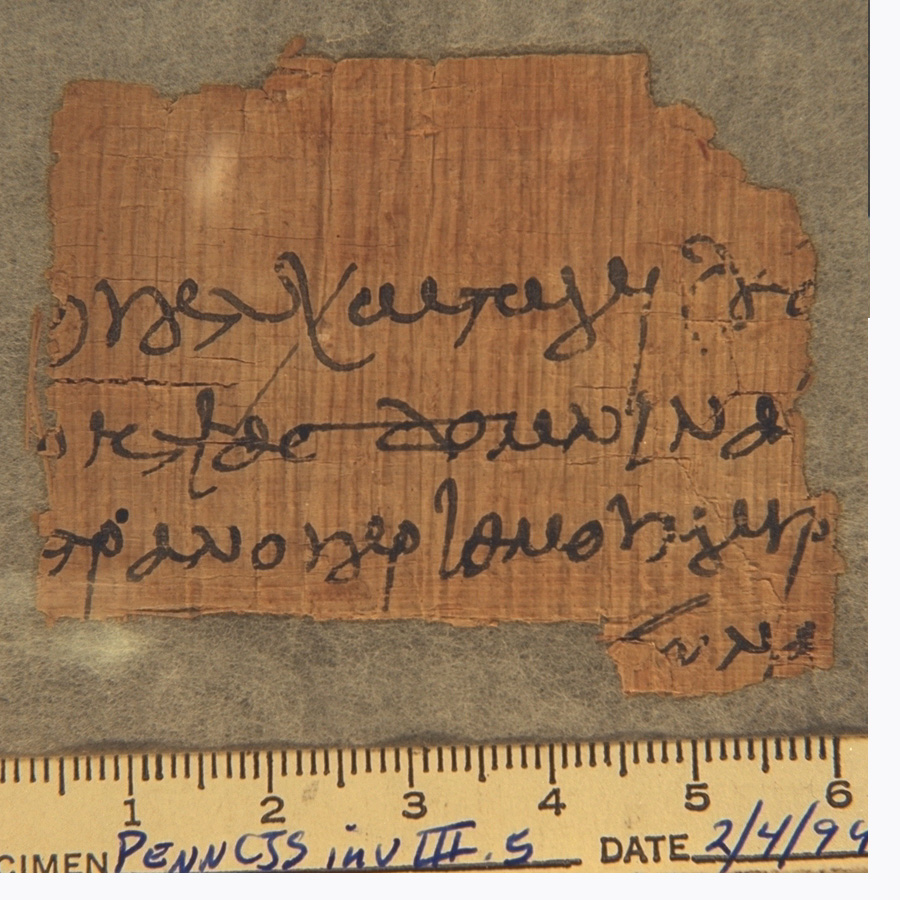
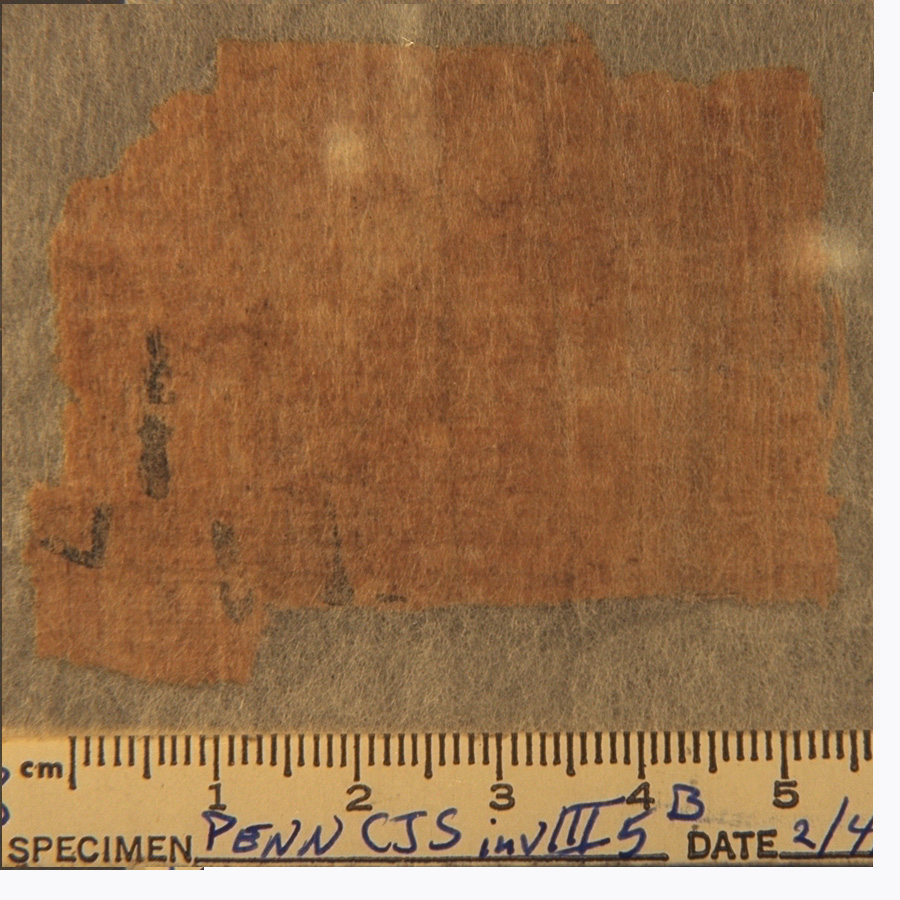
05.01 | Greek.
(
150 dpi image with color adjusted;
600 dpi
natural image, and
600 dpi
with color adjusted).
in three joined pieces (formerly a, b, c);
10.6 x 6.9 cm;
6 lines from central portion, possibly lower margin <||>;
dark reddish color, upright cursive;
late;
no evidence of writing on reverse
1.
] . AS . . . . [
2.
] ONFNEUQEWSFA . .[
3.
]OIHMERI . . . KIOIPAGIS .[
4.
]
UISXIGARTWNSTE . .[
5. ]FEA . . OUALLHNFA.FHN . . O . [
6. [about 6 letters with elongated final S]
#
05.01d blank
1.6 x .9 cm.;
no letters (a line) [not the same papyrus as 05.01a-c]
#
05.02 - Greek
5.5 x 8.6 cm.;
5 visible lines (possibly were 7), lower right corner <-->;
possibly more traces of writing beneath Japanese Paper
+new scan 2003 r&v [CJS_05_02_r.jpg]
05.02 | Greek
5.5 x 8.6 cm.;
4 lines, left margin and upper and lower (?) <||>
fine black strokes, highly abbreviated
+new scan 2003 r&v [CJS_05_02_v.jpg]
1.
2.
3.
4.
05.03 Greek & Demotic collage, alsoenlarged (from cartonnage?) -- see also
04.3 above.
10.1 x 8.1 cm.;
14 or more lines;
some 20 adhering fragments of various shapes and sizes;
treated and separated (also enlarged here)
by rak in 7/96 (see separate notes)
scanned and printed as separated pieces 8/98
CD 1.0082 (no back?)
#
05.03.01- Demotic
4.0 x 1.7 cm;
one line, possibly top margin <-->;
possible ink blot (or dirt) on reverse
05.03.02 (joined with 04)
#
05.03.03- Demotic? (perhaps joins 10)
1.1 x 1.3 cm;
two lines <-->;
some evidence of ink on reverse
#
05.03.04 - (joined with 02) Greek
1.6 x 4.0 cm;
parts of 9 or 10 lines, petite script <--> (upside down);
RAK: 3-2 bce (Ptolemaic)
1
2 ST
3 MAP
4 OU
5
6 [blank?]
7 E
8 THO
9
clear ink marking (one or two letters) on reverse
#
05.03.05 Greek or Demotic
1.0 x 1.5 cm;
parts of 3 or 4 lines, petite script <-->
no evidence of ink on reverse
#
05.03.06 Greek
1.4 x 3.1 cm;
parts of 6 or 7 lines <-->;
1
2 E
3 KO-
4
5 E
6
some evidence of ink (blotted?) on reverse
#
05.03.07a- Greek or Demotic?
1.4 x 0.5 cm;
traces of one line (?) <-->;
no evidence of writing on reverse
#
05.03.07b Greek
3.3 x 2.4 cm;
parts of 4 lines <-->;
RAK 1st ce?
1 EX
2 HMENWP
3 K(/B)AP
4
some evidence of ink (blotted?) on reverse
#
05.03.07c Demotic?
3.8 x 2.5 cm;
the ends(?) of 4 lines if <||>, or one line if <-->;
no evidence of writing on reverse
#
05.03.08 Greek
1.4 x 2.0 cm;
parts of two lines <-->;
1 D/X AI
2
parts of 3 lines on reverse <||>, different hand
#
05.03.09 Greek
1.3 x 2.2 cm;
parts of 3 lines <-->;
one line perpendicular to this on reverse (Greek?)
#
05.03.10- Demotic? (possibly joins 03)
1.0 x 1.2 cm;
two lines <-->;
some evidence of ink on reverse
#
05.03.11- Demotic
1.8 x 2.9 cm;
part of 4 lines and some red marking <-->;
some evidence of ink on reverse
#
05.03.12 Greek?
1.7 x 2.4 cm;
parts of 2 lines, with surface abraded <-->;
some evidence of ink (blotted?) on reverse
#
05.03.13 Greek
1.7 x 2.7 cm;
traces of 4-5 lines, thin writing <-->;
1
2 TH
3
4 U
5
slight evidence of ink on reverse
#
05.03.14a| Greek [incompletely separated from 14x]
parts of 2 lines (upside down)
1 TAAL
2 ER
#
05.03.14x- Demotic? [incompletely separated from 14]
parts of 3 lines
#
05.03.15 Greek?
4.0 x 1.6 cm;
part of a single line <--> (upside down);
no evidence of ink on reverse
#
05.03.16 Greek
3.5 x 2.5 cm;
parts of 3 lines, very fragile <-->;
evidence of writing on reverse
#
05.03.17 Greek?
1.5 x 2.0 cm;
parts of 4 lines (abbreviated?) <-->;
no evidence of writing on reverse
#
05.03.18- Demotic?
1.7 x 1.3 cm;
traces of start (?) of 2 lines (?) <-->;
no evidence of ink on reverse
#
05.03.19 mostly blank
3.2 x 6.3 cm;
slight traces of ink;
no evidence of writing on reverse
05.03.20 etc. miscellanous scraps
#
05.04 | Greek
8.1 x 5.3 cm.;
parts of 3 lines <||>;
left margin intact, and possibly lower;
medium color with light ink;
date undetermined;
Coptic text on back, written perpendicular to this side
+new scan 2003 r&v
05.04 | Coptic
8.1 x 5.3 cm.;
start of 5 lines <||> (perpendicular to lower part of other side);
left margin intact, and possibly upper;
+new scan 2003 r&v
05.05 (Five pieces from different texts).
+new scan 2003 [which parts?]
+new scan 2003 r&v [a second scan?]
#
05.5a - Greek fragment [ed RAK].
6.6 x 5.9 cm.;
3 legible lines, written along the fibers < -- >;
bottom intact;
medium color;
4th ce or slightly earlier (RAK)
[not yet located on microfilm 1A]
CD 1.086
1
2 HLQEN ERRWSQAI
3 (indent) SE EUXOMAI
4 (indent) KURIE PATER
((transcription notes in green booklet))
#
05.05b- Greek.
2.2 x 3.0 cm.;
parts of at least 4 lines <-->, central fragment;
light brownish color, black ink, fine material;
date undetermined
#
05.05c- Greek.
8.7 x 1.5 cm.;
at least 2 lines <--> of central fragment;
light color, fine dark ink, split surface layer?;
date undetermined
#
5.05d- Greek.
12.3 x 15.1 cm.;
right margin and parts of at least 5 lines <-->, top part badly
abraded but evidence of at least 4 more lines (room for 15 total);
light color, grey-black ink;
date undetermined
#
5.05e- Greek.
7.0 x 15.0 cm.;
left magin and parts of at least 14 lines <-->;
medium-light color, grey-black ink of varying thickness;
date undetermined
#
06.02| (see 06.08 joins)
2.0 x 4.8 cm.;
3 lines; right margin intact; medium color;
#
06.03 Greek.
3.5 x 8.0 cm.;
4+ lines; right margin intact; medium-light
color; 4th century or later
+new scan 2003 r&v
#
06.04- Greek.
(
150 dpi image;
600 dpi image)
5.8 x 5.8 cm.;
middle parts of 2 lines <-->, lower margin intact;
"left handed" orientation of letters, large neat hand
+new scan 2003 r&v
1. ETITOU.....
2. .DEEWSWSR..
06.04| Greek letter(?).
(
150 dpi image;
600 dpi image)
5.8 x 5.8 cm.;
middle parts of 3 lines <||>, top margin intact;
medium brownish color, thick black ink;
4th century;
+new scan 2003 r&v
1. HRWNEITWD?
2. I- XAIREIN
3. ?QTON
#
060.5| Greek.
6.6 x 12.5 cm.;
9 lines <||>;
top and left margins intact;
medium-light yellowish color, thick material, dark ink;
date undetermined;
traces of writing on reverse
+new scan 2003 r&v
06.05- Coptic(?)
6.6 x 12.5 cm.;
parts of 2 lines <-->, written upside down to the reverse
06.06- (see 01.01)
#
06.07 Greek.
(
150 dpi image;
600 dpi image)
12.3 x 9.4 cm.;
start of 6 lines <||>;
left margin intact;
medium-light brownish color, thick material, brownish ink;
late
no traces of writing on reverse
+new scan 2003 r&v
1. .
2. .O..EIOIBLE.OU......
3. KAIPEUQEGOSUI+OSI+W
4. ...
5. ...
6. ...
#
06.08- (joins 04.06a, 06.02, 08.06) Greek.
12.0 x 17.0 cm.;
ends of at least 6 lines <-->, with large right margin;
medium brownish color (with discoloration);
black ink, highly abbreviated content;
date undetermined
+new scan 2003 r&v
06.08| (joins 04.06a, 06.02, 08.06) Greek.
left and lower margins with beginnings of at least 7 lines <||>;
badly abraded, medium brown color with discolored areas, black
(brownish?) ink;
date undetermined
+new scan 2003 r&v
#
06.9- Greek loan of money.
16.0 x 2.4 cm.;
4 lines <-->;
left margin intact;
color varies light-medium;
dated 5-7th ce (Todd Hickey), probably 6th ce (JS);
possibly Arsinoite nome (Hickey)
[preliminary edition by Todd Hickey (for Jenni Sheridan class)]
[images?]
+new scan 2003 r&v
#
06.09b (additional piece)
dark brown color; apparently uninscribed
does not seem to be related to 06.09-
#xxx / Latin 002
06.10 - Latin fragment, also
enlarged .
10.2 x 6.5 cm.;
right portions of 7 lines <-->(?), right margin intact(?);
medium reddish color with dark spots;
date undetermined (writing identified as Latin by Sigrid Peterson)
CD 1.007
+new scan 2003 r&v
1
2 . missit ascr()o et ipse te dixit
3 . septem et dimidium quicum
4 . . . alia quos a septem
5 . . . . . . . . . . nec ferrium
6 . . . . . . . . . . . et terminum
7 . . . . . . . . . . . . . . nec
((transcription notes in green booklet))
#
06.11- Greek.
7.0 x 2.8 cm.;
parts of 6 lines from a single column (?) <-->;
medium-light color, dark ink;
date undetermined
(traces of ink on reverse; fiber layer badly damaged)
+new scan 2003 r&v
1. ARTOUWIDWRWN
2. PALEI+ PANI?.Z
3. ??????DREA?
4. WRIWSARPA????
5. AMMWPISM??W?????
6. . . .
#
07.01- Greek.
9.9 x 9.0 cm.;
parts of at least 9 lines <-->, possibly left margin;
dark color, pitted worm holes, shredding, fibers off-grain;
date undetermined;
[poorly mounted]
#
07.02- Greek.
18.0 x 13.0 cm. plus 4 smaller fragments;
at least 12 lines <--> with left margin intact (?);
dark color, pitted, worm holes, shredding, fibers off-grain;
date undetermined;
[very poorly mounted]
#
08.01- Greek.
10.3 x 9.0 cm. (irregular);
central parts of 6 lines <-->;
light color, black ink, highly abbreviated;
date undetermined;
text is visible on back
+new scan 2003 r&v
08.01| Greek
parts of 8 lines <||>, perhaps at right margin;
highly abbreviated (account?)
+new scan 2003 r&v
#xxx / Coptic #xxx
08.02 | (joined with 08.03) Coptic
fragment, also
enlarged.
about 12.5 x 7.4 cm. (badly mounted);
central parts of 6 lines < || >
medium-light color, orange-brown ink (bleeding);
date undetermined;
no evidence of writing on reverse side
08.03 Coptic (joined with 08.02).
#xxx / Gk #xxx
08.04- Greek.
5.4 x 13.4 cm.;
traces of at least 5 lines <-->, possibly left margin;
light color, black ink;
date undetermined;
no evidence of writing on reverse
+new scan 2003 r&v
08.05 Melange of small pieces.
4.2 x 5.9 cm. plus two small fragments;
#
08.05.01- [language undetermined]
1.0 x 2.1 cm.;
traces of ink (from 3 lines?) <-->;
possible traces of ink on reverse
#
08.05.02| [language undetermined]
1.0 x 1.2 cm.;
traces of perhaps 2 letters <||>;
no evidence of writing on reverse
#
08.05.03- Greek(?).
1.7 x 2.2 cm.;
parts of at least 1 (possibly 3) lines <-->;
dark brown surface with black ink (like 08.5.4);
no evidence of writing on reverse
#
08.05.04- Greek.
2.4 x 1.9 cm.;
central portions of 3 lines <-->;
dark brown surface with black ink (like 08.5.3)
#
08.05.05- or | (?) Demotic(?).
2.3 x 3.3 cm.;
appears to be a single letter <-->(?);
no evidence of writing on reverse
similar in physical appearance to 08.05.06
#
08.05.06- or | (?) Greek(?).
1.5 x 3.2(+) cm.;
perhaps one line if <||>, as seems probable;
similar in physical appearance to 08.05.05
#
08.05.07 [uninscribed]
1.9 x 2.8 cm.;
small piece removed from face, traces of ink both sides
#
08.05.08 [uninscribed]
1.1 x 2.0 cm.;
possibly some layering remains
#
08.05.09 [language undetermined]
0.7 x 0.6 cm.;
traces of ink on one side
08.05.10, 11, 12, 13
small fragments from back of 08.05.04 and 07;
some traces of ink
08.06 Greek (see 06.08 joins).
6 x 5.7 cm.; 4+ lines;
#
08.7.04- [undetermined]
1.5 x 4.0 cm.;
trace of ink <-->;
reverse has plaster and red paint, joined to 08.07.03b
#
08.7.5| [undetermined].
1.5 x 1.5 cm.;
trace of ink <||>;
reverse uninscribed
#
08.08- Greek.
5.1 x 10.4 cm.;
traces of at least 11 lines <-->, central(?);
medium color, black ink;
date undetermined;
text on back
+new scan 2003 r&v
08.08| Greek(?).
traces of at least 7 lines <||>, badly abraded;
+new scan 2003 r&v
#
08.09| Greek.
10.9 x 2.5 cm.;
2+ lines <||>, probably left margin;
medium-light color;
date undetermined;
very thick (possibly 2 or more layers)
1 XARPEUMENONMOIX
2 THNARXOU WMENOS
3 W
no ink visible on reverse <-->
#
09.02| Greek.
8.9 x 10.8 cm.;
parts of 13 lines <||>, with right margin intact;
medium-light color, many worm holes;
date undetermined;
text on back in 2 colors of ink
+new scan 2003 r&v
09.02- Greek
8.9 x 10.8 cm.;
parts of at least 9 lines <-->;
mostly redish-brown ink, but also black;
a few letters obstructed by backing
+new scan 2003 r&v
#
09.03- + 04.06b- Greek grain transaction.
7.5 x 19 cm (with 04.6b joined by RAK 7/96);
lower and left margins with parts of 15 lines <-->;
medium-light color; dated mid-2nd ce (Evans & Chan);
[not yet identified on microfilm 1A]
[being edited by Kass Evans and Frank Chan (Jenni Sheridan class)]
traces of writing on reverse in two separate areas
#
09.04| Greek.
10.9 x 5.2 cm.;
leftmost parts of 4 lines <||> with left margin intact;
medium- light color, fibers off-grain;
evidence of text on back
+new scan 2003 r&v
1. [part of one letter]
2. EFAPANT?
3. ???TOUGRIS?
4. K?????????N
09.04- Greek or Demotic
text partially covered by backing;
date undetermined
+new scan 2003 r&v
#
10.01| Greek account.
5.5 x 11.5 cm.;
7 (+?) lines <|> in one column with upper and left margins,
and possibly lower (large space);
medium color, black ink;
dated 1st-2nd ce (Kass Evans).
[preliminary work by Kass Evans (for Jenni Sheridan class)]
[images?]
+new scan 2003 r&v
10.01- Greek.
at least 8 lines <-->, with left (irregular) and lower margins;
written upside down in relation to other side, highly cursive;
1st ce ?(rak)
+new scan 2003 r&v
1, ?
2. ?
3. OUH?UI?
4. W?
5. KAI?
6. WB?
7. XAIRINQ
8. GL
#
10.02- Greek.
9.7 x 7.8 cm. (plus two smaller uninscribed pieces);
parts of 2 or 3 lines <--> with lower (and top?) margin intact;
medium color, dark brown ink (abraded surface);
date undetermined;
(no evidence of writing on the reverse)
+new scan 2003 r&v
#
10.03a| Greek?.
0.8 x 2.2 cm.;
probably the letter T <||>;
light color, black ink;
traces of ink on the reverse
#
10.03b-d- Greek?.
three small fragments, largest 2.1 x 2.0 cm;
badly preserved remnants of at least 2 lines <-->;
light color with orangish tinge, medium brown ink;
reverse seems to be blank
#
10.04- Greek.
5.0 x 25 cm.;
ends(?) of 5 lines in two columns <-->;
medium color, black ink (fine strokes, abbreviated);
date undetermined;
(actually multiple layers at the top; separated 22au1996 rak)
#
10.04b- blank (middle layer)
10.5 x 3.8 cm.;
possibly a trace or two of ink (nothing legible)
#
10.04c| blank (lower layer)
5.1 x 4.0 cm.;
no trace of ink
#
10.05- Greek.
5.0 x 2.3 cm.;
small fragment with some letters, probably 2 lines <-->;
medium dark, black ink (blurred);
some traces of ink on reverse
+new scan 2003 r&v [and "test"]
#
11.01- Greek.
7.8 x 6.3 cm.;
middle parts of 5 lines <-->, upper margin intact;
dark reddish-brown color, brownish ink;
date undetermined; small unattached piece included;
reverse side appears to be blank
[preliminary work by Brad Kirkegaard (for Jenni Sheridan class)]
[images?]
#
11.02- Greek?
(
150 dpi image;
600 dpi image;
older enhanced
image, also
enlarged).
9.5 x 5.5 cm.;
left sides of 7 lines <-->, left and lower margins intact;
medium-light color, grey undisciplined "Latin-like" hand;
date undetermined (reverse seems blank)
+new scan 2003 r&v
1. [symbols?]
2.
3. ENO
4. T
5. ANE
6. NANONO
7. T
#
11.03a- Greek.
3.8 x 5.7 cm.;
central parts of 9 lines <-->;
medium-light color;
date undetermined (reverse seems blank)
[for 11.03b see 03.11 and joins]
#
11.04 | Greek divorce (or marriage) deed.
5.4 x 20.4 cm;
30 (32) lines <-->;
top margin intact, and probably bottom and right;
medium-light color; dated first half of 4th ce (Kirkegaard & Pollard).
Note that the pattern of damage suggests that two or three
pieces had been glued together in antiquity and rolled up and/or
folded (crushed?) from below: lines 1-21 (hand 1), then two blank
lines, then 24-(29?)-32 (smaller hand 2, then larger hand at
end). Possibly two separate documents.
[preliminary edition by Beth Pollard and Brad Kirkegaard (for Jenni
Sheridan class)]
[images?]
[11.6 undetermined language (paper); removed from papyri collection]
#
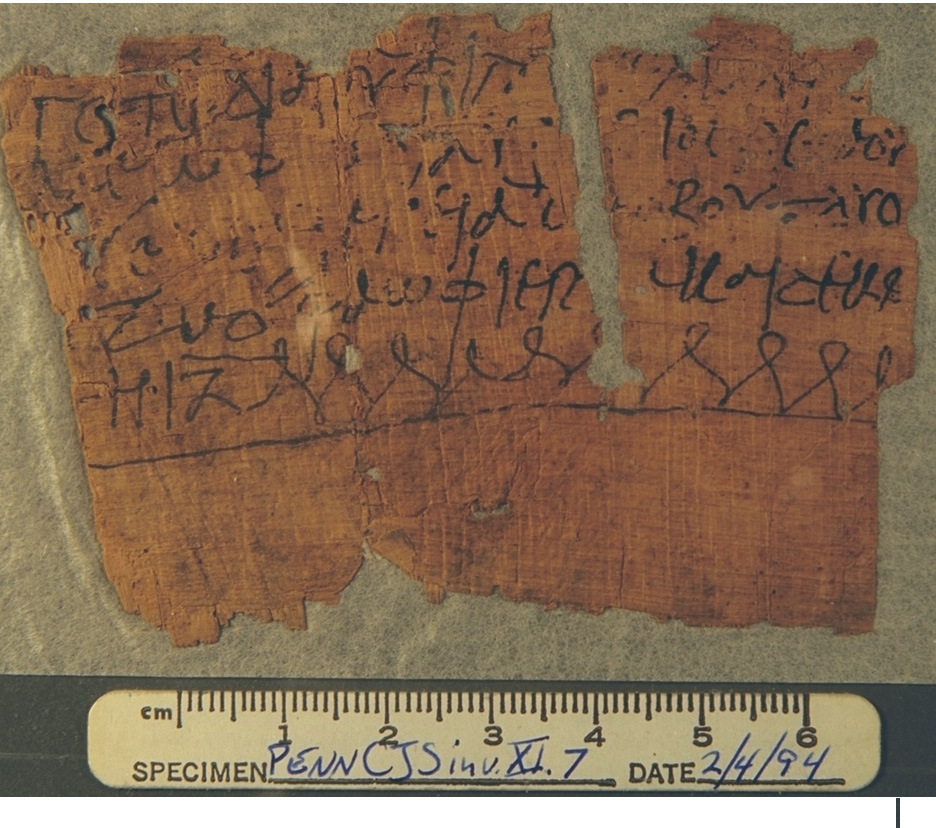
11.07- Greek
Receipt (?).
8.8(8.3) x 5.9 cm.;
center parts of 6 lines plus underline <--> bottom margin intact;
medium-dark orangish color, dark brown ink, decorated lower margin;
probably 3rd century CE
[seems to have multiple layers in upper left corner]
[preliminary work by Vance Whitesides (for Jenni Sheridan class);
suggestions from Helsinki team after 1998 Florence Papyri Congress; April
2001 examination and transcription by RAK's RelSt 735 workgroup]
[Request to publish from Michael Cottier (Toronto), 27 March 2006.]
CD 1.014,042; 2.042; microfilm 3A (in two pieces)
01. . . . . ] . [ . . . .
02. ]GS[.]T.[.]DIA[..]UFIL[..].LKLH.O[
03. ]MEMF . . . . LLYR[.].IOI DE-AO.[
04. ]. . E . . . E . EIAS[.] . BOU-.-DUO[
05. ]. Z-KD//FAWFIEP[T]AKAIDEKA[
06. ]. H-IZ (10 decorative looped strokes)[
07. (horizontal line, with lower margin below)
line 2: perhaps dia tou filadel(fiou) klhrou
line 3: badly abraded
line 4: badly abraded, especially on the left side; probably
abbreviation for artabh between ...bou and duo on the right
line 5: the first three letters are clearly visible, but are not
easily recognized forms (KD is not the only possible transcription for
those letters, although a number such as 24 might be expected); they are
followed by two supralinear
diagonal strokes (not the more expected overline as in the next line);
FAWFI is a fall month, and the 17th would be mid-October;
although we expect the final letter of the line to be A, it is only
vaguely similar to that letter form and might be an
abbreviation of some sort (the reading "seven and ten" seems obvious)
line 6: the initial H is clear, followed by a mid-point dot and the
letters IZ, with the Z overlined (thus doubtless the number 17)
#
11.08 - Greek land contract(?)
(
150 dpi image;
600 dpi image;
older enhanced
image).
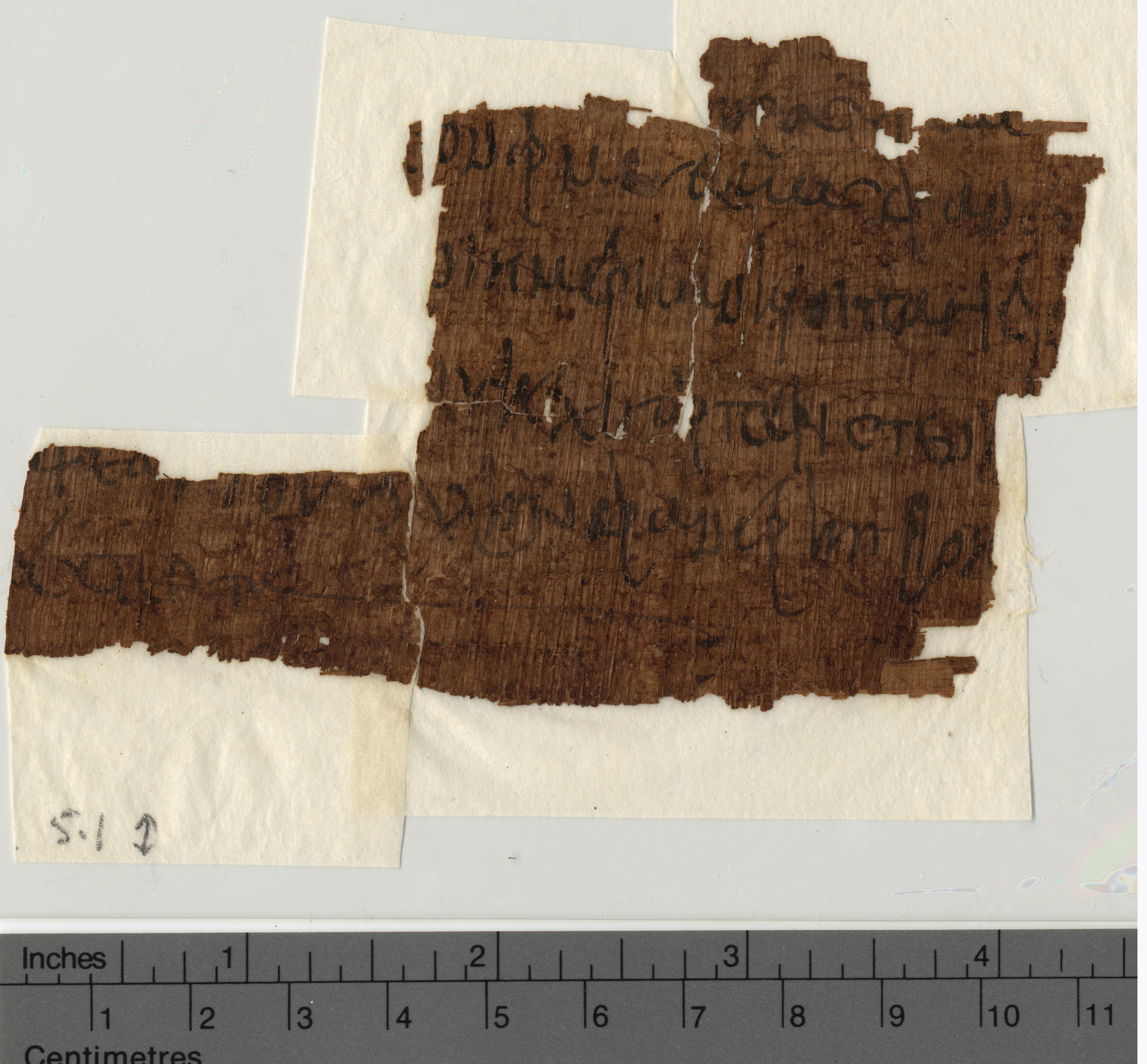
9.2 x 8.2 cm (frgs joined by RAK 7/96); 13 lines <-->;
central fragment (no visible margins); light color;
some word/phrase division;
dated 4th ce (Miller & Whitesides); provenance unknown
[preliminary edition by Gavi Miller and Vance Whitesides (for Jenni
Sheridan class)]
CD 1.013 (neg 1.14)
+new scan 2003 r&v
This text is written with the grain on two central fragments. Both are
from the same document, as evidenced by the hand, ink and fiber pattern.
The larger fragment contains a portion of one letter on the right side as
line 1, and then parts of ten more lines. The text of the larger fragment
is written over a join in the papyrus running down the center of the
fragment, roughly three centemeters from the left edge. The papyrus to the
left of the join is visibly lighter in color than the surface to the
right. Holes and missing strands of the papyrus obscure some characters in
lines 2, 3, 6, 7, and 8, and the combination of erased/abraded ink and a
missing portion of the top layer of papyrus has eradicated the ends of
lines 2 and 7, unless they were intentionally left blank.
The smaller fragment contains parts of three lines with a hole in its
top line and missing horizontal fiber surface above that line. This
fragment had been mounted with the larger fragment, but upside down at the
lower left. The color and striations of this fragment suggest that it
should, in fact, be located (right side up) at that location, with the
first line of the smaller fragment as the left part of the last line of
the larger fragment (electronically repositioned in the image).
The letters of this document are written with dark ink in bold strokes
in a cursive form that is often ligatured and difficult to decipher.
References to A)ROU/RAI in lines 3 and 6 and to
PAREU/RESIS in line 9 suggest, perhaps, a land contract.
Mention of an indiction year in line 8 guarantees that the earliest
possible dating is 313/314 CE (see R.S.Bagnall and K.A.Worp, Chronological
Systems of Byzantine Egypt, chapter 2).
While the document clearly concerns land, its precise nature cannot be
determined due to the lack of any phrases specific to a particular genre
of documentary papyri.
01. . . . . . . . . . . . . . . . . . . . . . . . . . . ]S[
02. ]ONURAU . . . . N TON[
03. ]WN ALLWN AROURWN TAIS O[
04. ]EMENHS AURHLIAS ANX[
05. ]EMM . S TALANTA DEKA .[
06. ]AROURWN EBDOMHKONTA DE[
07. ]A.RPAUSONTOIS PARUM . . . .[
08. ].AUTAS OGDOHS INDIKTWNOS TO.[
09. ]WN PAREURESI MHDEMIA ALLA KAI .[
10. . . . ]ENXRITHS PARLI[
11. ]. S TOUT][.ESI .[
12. ]. XROS .[
13. ]. SEO .[
01. ...
02. ...
03. ...of the other arouras for the...
04. ...of Aurelia Anx...
05. ...ten talents...
06. ...of seventy arouras...
07. ...
08. ...in the eighth (year) of the indiction...
09. ...under no pretext whatsoever, but even...
10. ...
11. ...
12. ...
13. ...
line 4: While several masculine names beginning with ANX are found in
the available papyri (DDBP, Namenbuch and supplement), only one feminine
name, ANXARHNIA, is attested (PLond 191.20 in Preisigke Namenbuch
37).
line 6: DEKA is perhaps possible, but not at all sure.
line 8: The initial iota of INDIKTIWNOS is marked with a bold
dieresis, as also in numerous papyri (e.g. BGU 2156, CPR 62, PHerm 42,
PLond 1781, PMichael 40, PNYU 4a, PStras 15). Since "indiction" is often
abbreviated in papyri (e.g. IN, IND, INDIK), it would be possible
to read this line differently (INDIK() TWN ...), but it is also
sometimes spelled out (usually with two omicrons, but with omega and
omicron in PCol 144). With the first year of the first indiction set at
312 CE, the earliest year eight would be 319, and then would be repeated
every 15 years thereafter into the early seventh century (Bagnall and
Worp, Chronological Systems 72ff). Unfortunately, the fragment does not
seem to provide any other dating clues to enable us to fix its date more
exactly.
line 9: The stock phrase PAREURESEI MHDEMIA is attested in
numerous papyri of various genres, almost always in the dative (see e.g.
POxy 1716, Acknowledgement of Repayment of Loan Debt; POxy 2349, Receipt
for Settlement of Rent; POxy 2583, Division of Inherited Property). The
spelling -RESI is also found in the 4th century CE (e.g. PKoeln
5, PMich 5.322). Normally the clause is preceded by a list of
counter-actions to the document's stipulations, prohibited "under any
pretext whatsoever" to the parties involved. Without further indications
of these expected prohibitions, it is impossible to know the precise
nature of the agreement represented in this document.
#
12.01 | Coptic
document (joined with 12.02 and 12.07 by RAK).
19.7 x 15.2 cm.;
11 lines <||>, left and right margins intact;
[examined by Kirsti Copeland, Chip Gruen]
text on back in different hand, upside down to reverse side
12.01 - Greek
at least 7 lines <-->, perhaps intact margins;
appears to be highly abbreviated in spots
12.02 | Coptic (joined with 12.01|).
#
12.03- + 12.04- Coptic(?).
7.2 x 3.0 cm.;
parts of 3 lines <-->, possibly on left margin;
has a small adhering layer on the back
text on back written in same direction;
2 lines; central fragment
12.04- (joined with 12.03-)
#
12.05 [multiple layers]
Coptic (?)
left margin intact; 8+ lines;
text on back has 2 lines
#
12.06 | Arabic letter(?)
fragment, also
enlarged.
6 cm (h) x 7 cm (w)
left margin (possibly top also) and parts of 5 (or 6) lines < || >;
horizontal folds visible at lines 1 (base of line), 3 (top), 4 (base);
[preliminary edition by David Hollenberg, 13 Aug 1998 (working
translation follows below)]
1. [??] the watering spot Khamal has dried up. So know firstly
2. [veil; contract] considered the matter of crossing the river [???]
3. [...] Auspicious to us [since][the camels] were in a state [of
disrepair]
4. "Help to the one who might go astray"
5. ...
12.07| Coptic (joined with 12.01|).
Appendix 1: Paper Materials [mostly Arabic]
(see also II.3 below, Appendix 2 [Hebrew])
#
IV.1 Arabic on paper [remove from papyri collection].
10.3 x 20 cm. 6+ lines;
light tan color;
left and bottom margin intact
[identified on microfilm 1A.71x]
CD 1.065 (neg 3.02)
#
IV.2 Arabic on paper [remove from papyri collection].
18.3 x 11.5 cm.; 12.4 12.3 x 15.9 cm.; 13 lines
with interlinear line; text on back has 8 lines with first 2 damaged
[identified on microfilm 1A.71x]
CD 1.066 (neg 3.03), CD 3.003 (neg 9.0 )
#
IV.2b
CD 1.072 (neg 3.09)
#
IV.4 Arabic on paper [remove from papyri collection].
10 x 20.5 cm.; 21 lines with decorative marks;
text on back has 23 lines
[identified on microfilm 1A.71x]
CD 1.067 (neg 3.04)
#
IV.4
CD 1.073 (neg 3.10)
#
IV.5 Arabic on paper [remove from papyri collection].
complete; 18.3 x 11.5 cm.; 9 lines; text on back
has 6 lines with 3 each written in opposite directions
[identified on microfilm 1A.71x]
CD 1.068 (neg 3.05)
#
IV.5b
CD 1.071 (neg 3.08)
#
XI.6 Undetermined (paper).
fragments of paper with undetermined language & symbols
#
XIII.1 Undetermined (paper);
5+ lines; back has lines of triangles;
may be palimpsest;
triangles and lines suggest may be mathematical or
magical text; same as XIII.2-3
#
XIII.2 Undetermined (paper);
1 line plus triangles
#
XIII.3 Undetermined (paper);
2 lines plus line of triangles
Appendix 2: Hebrew Materials
#
II.3 Hebrew on paper;
cursive hand;
text on back is bookhand (or printed);
German provenance;
late Hebrew paper page with a verse from Psalms and
some cursive notes (reference to Ettinger family)
[[remove from papyri collection]]
[identified in microfilm 1A.31x]
CD 1.033 (neg 1.34), CD 1.034 (neg 1.35)
#
XIV.1-2 Hebrew text of Genesis on leather, "Torah Scroll"
CD 2.020-021
2. Genesis 35.27 - 36.39 (all column margins intact)
1. Genesis 36.39 - 37.28 (all but lower column margin intact)
#
XIV.3 [is there a XV.3 ??] Biblical
#
XV.1-4 Hebrew text of Exodus on leather, "Torah Scroll"
CD 2.049-052, 2.022, 3.017-019
4. Exodus 30.8-21 (only left margin intact)
3. Exodus 30.35b - 31.17b (left and right margins intact)
2. Exodus 34.1-12a (left and right margins intact)
1. Exodus 34.26-35 (left and right margins intact)
#
XVI.1 Hebrew text of Leviticus on leather
[preliminary edition by Robert Kraft]
CD 2.043-44, 3.020
Leviticus 6.5b-14a (top and right margins intact)
#
XVI.2 - XVII.1-2 Hebrew text of Leviticus on leather
CD 2.045-046, 3.021
[preliminary edition by Sigrid Peterson; dated to 10th c]
17.1 Leviticus 14.21-36a (left and right margins intact)
16.2 Leviticus 14.45 - 15.7a (left and right margins intact)
17.2 Leviticus 15.15c - 15.29 (left and right margins intact)
[[more here?? check]]
XVII.1-2 (see above)
CD 2.053-054
#
XVIII.1-4 Hebrew text of Deuteronomy on leather, "Torah scroll"
4 Deuteronomy 24.13-19 (all but lower margin intact)
2 Deuteronomy 24.20 - 25.13 (left and right margins intact)
3 Deuteronomy 25.19 - 26.17 (all but lower margin intact)
1 Deuteronomy 27.2-18 (all but lower margin intact)
#
XIX.1-2 Hebrew text of Deuteronomy on leather, "Torah scroll"
[preliminary edition by Frederick Knobloch -- see his extensive notes
on Deut 31.1-28]
2 Deuteronomy 28.48-63 (all but lower margin intact)
1 Deuteronomy 31.1-28 midsentence (all but top margin intact;
nearly 2 feet long)
#
XX.1a-b Hebrew on paper; Shavuot Ritual (?)
[preliminary edition by Max Grossman]
black Rashi script, red pointing, highlighted headings;
sheet/page from book, written both sides;
has year 1807 written on it (later hand?)
#
XX.2a-b Hebrew on paper;
folded sheet from book with 2 pages on
front (one on left is blank) and 2 on back (one on left is blank);
Rashi type script; page number on side b
#
XX.3 Hebrew on paper; Poem for Marriage
[preliminary edition by David Sandmel]
3 columns; has German words in same ink below middle column;
very late (pertains to Amsterdam family of ca 1795)
written only on one side;
has pointing in red/brown ink;
Rashi script on lower left reads:
"The most joyous of the joyous,
Abraham son of Daniel of Abbevilla"
#
XXI.1a-b and 4a-b Hebrew on paper;
two double pages from book, written front and back;
same as XXI.4 [photos mislabeled]
#
XXI.2a-b Judeo-Arabic on paper
[preliminary edition by Frederick Knobloch];
folded double page from book;
side b has blocks drawn around text;
"Ms 332" written at bottom of a (left page)
#
XXI.3a-b Hebrew on paper; Names of Months
[preliminary edition by Sigrid Peterson];
single page with text on both sides,
"Ms 331" at bottom of a
XXI.4 (see above to XXI.1)
First draft 1994; expanded and updated 1996 (latest update
2 March 2001)
Robert Kraft (kraft@ccat.sas.upenn.edu)