[[scanned by Darren Knop and revised by R. A. Kraft, 31 March 2003
and subsequently;
permission for producing an updated electronic copy has been requested
from the publisher]]
[[instructions
for proofreading and editing may be found on the Harnack
TOC page]]
Part I: Judaism from 200 BCE to 200CE
Part II: The Books of the Apocrypha [not included in this project]
Original Foreword
Foreword to the updated edition (Robert A. Kraft)
Formatting and conventions : BCE/CE, ch.v
punctuation,
Content and footnotes:
calculated 1 silver talent = $150,000 USD value minimum (15 years
wages), to a quarter million
Supporting electronic links
The
independence of the Judeans
[see also this simpler
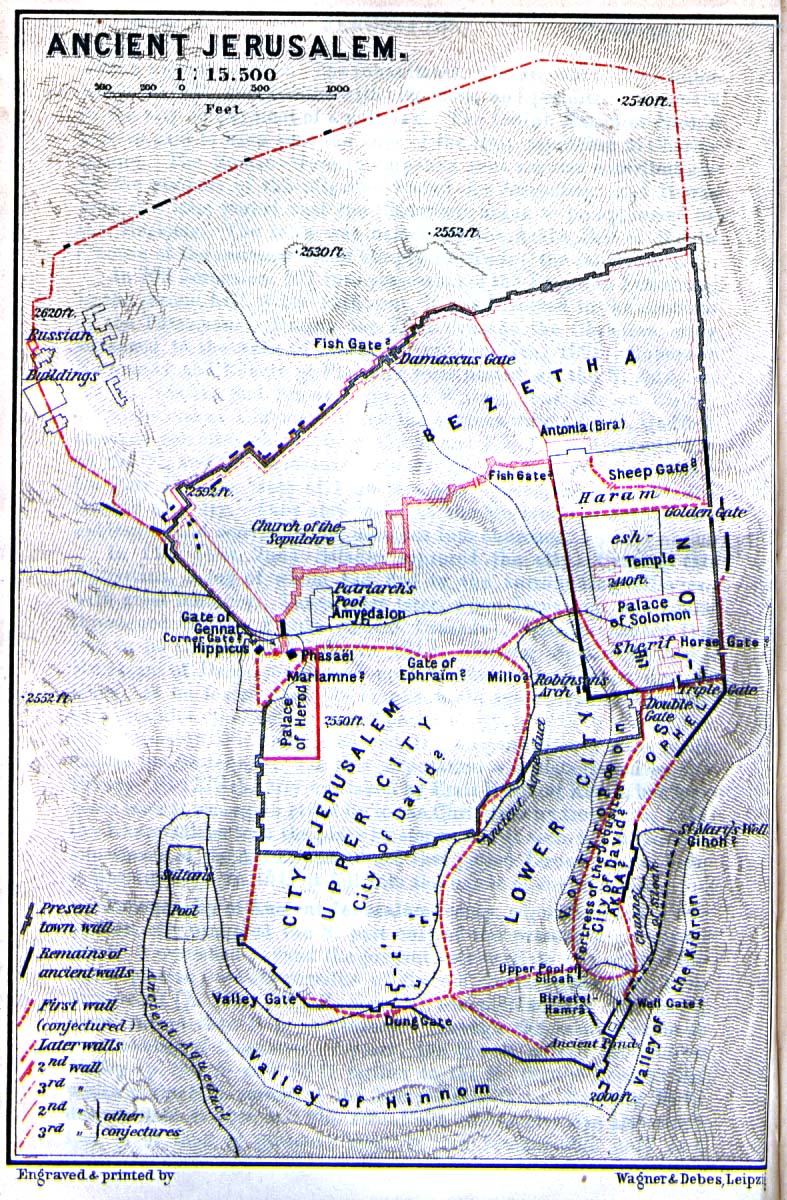
map] came to an end in 586 BCE, when Nebuchadnezzar
[for more details see this
article] destroyed Jerusalem and deprived the Davidic dynasty [from
the 10th century BCE] of its throne. Except for the brief
Maccabean interlude (141-63 BCE), the Jews never again (until 1948) had
a government of their own which was not subject to alien
authority. Nevertheless, noteworthy among ancient nations, the
Jews did not lose their sense of identity ("nationality") even when
they were deprived of land and state
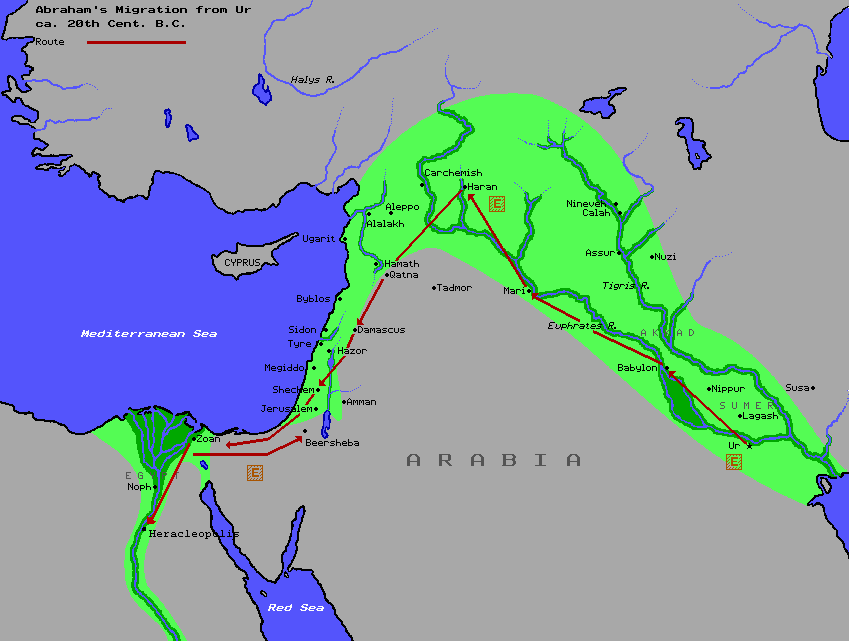
A small country on the main line of communication between the valley of the Nile and the lands of the Euphrates and the Tigris rivers [sometimes called "the fertile crescent"], Palestine \1a/ was destined to be the battleground of the great empires surrounding her: Egyptians, Hittites, Syrians, Assyrians, Babylonians fought for the possession of this buffer state, until it passed under the rule of the great empires of the Persians (538-332 BCE), of the Greeks (332-141 BCE), of the Romans (63 BCE-395 CE), of the Byzantines (395-636 CE, except for the period 614-628 when Palestine was ruled by Chosroes II, the last great Sassanian king of Persia), of the Muslim Caliphs (636-1099 CE). Following the ephemeral kingdom of the Crusaders (1099-1187), after various vicissitudes, Palestine was governed by the Muslim Ottoman Turks (1516-1917, except for the brief Egyptian rule in the years 1833-1840) and the British (since 1917; as a mandate of the League of Nations, from April 25, 1920, to May 15, 1948). It was only when no great empire had the urge and the capacity to conquer Palestine that the country enjoyed a breathing spell under its own native rulers: this actually happened only before 1500 BCE ("Canaanite" clans), then while the Israelites and Judeans were in power (ca. 1150-586 BCE) and finally under the Jewish Hasmoneans (141-63 BCE).
\a/"Palestine" is an ancient designation for the area in which early
Judaism developed, and will be retained here without any intention of
fanning contemporary sparks about the appropriateness of the term at
the turn of the 21st century.
The significance of the Jews in history (aside from their contributions to culture) is primarily due to their unparalleled success in preserving a strong ethnic selfconsciousness ("national feeling"), based on literature and religion, after the loss of political independence. We may even say that after 586 BCE the history of the Jews is primarily a process of trial and error leading to ethnic ("national") survival; at last about 200 CE all other means for the preservation of the nation were gradually subsumed by the emergence of rabbinic Judaism. Military uprisings, apocalyptic dreams of a future triumph over the gentiles, avoidance of mixed marriages, punctilious performance of the temple rites, and other [[6]] remedies eventually proved less effective than the study and observance of the law, as promoted in school and synagogue. The Jews survived primarily as a "people of the book"; their history after 70 CE is primarily known through the history of their literature. Their self-preservation as a people depended on the preservation of their national religion, the practice of which included the observance of ancient customs which originally did not always have a direct connection with the worship: thus dietary laws, sabbath, and circumcision were ancient practices the original significance of which had been forgotten for centuries; but by remaining faithful to such customs inherited from their ancestors the Jews incidentally separated themselves from "the gentiles" and in turn often were regarded with scorn or hostility by other subjects of the hellenistic and Roman rulers.
This liberalism of the Persian rulers, nay, their special manifestations of favor toward the Jews,\1/ are conspicuous in Nehemiah's work (444 BCE), when he revived the pitiful congregation in Jerusalem through restoration of the city's fortifications (apparently dismantled by a hostile neighboring people) and through social and spiritual reorganization.
\1/ See B. Meissner, Die Achämenidenkönige und das Judentum (Sitzungber. d. Preuss. Akad., Phil.-hist. Kl., 1938, pp. 6-26). A tragic illustration of Persian concern for the Jews may be detected at Elephantine in Upper Egypt, where a Jewish colony thrived during the Persian rule of Egypt but appears to have been exterminated when Egypt became independent in 404 BCE. [See Elephantine temple, papyri -- cite Grabbe?]
\1a/The debate about the historical basis of the Ezra traditions continues; see ???.
Owing to historical circumstances, two apparently contradictory tendencies appear in Judaism during the Persian period. On the one hand, the "second Isaiah" proclaimed that YHWH ("Jehovah")\1b/ was the only God in existence, hence his worship should eventually become the sole religion of mankind. On the other hand, however, the apocalypses proclaimed the future subjection of all nations to the Jews and the law served to separate the Jews from the gentiles. This contradiction appears in all religions which claim sole and absolute validity: of necessity they are utterly intolerant of other cults, but at the same time zealous in missionary work leading to the conversion of everyone to the true religion. Such attitudes, unless clothed with great tact and circumspection, inevitably provoke animosity on the part of outsiders: the hostility of many Alexandrians and others against the Jews in the hellenistic and Roman periods is in a sense the reaction to Jewish enthusiasm and conviction.
\1b/On the "tetragrammaton" or special four-lettered name of Israel's diety, see ???.
In these remarks on the Palestinian Jews during the Persian period, the familiar traditional topics of the "exile," the "return," and the "restoration" have been deliberately omitted, as also the work of Ezra. These notions we owe to the Chronicler, writing about the middle of the third century BCE. They reflect his dogmas rather than his historical information, and they have prevailed so long simply because few historical sources have been available aside from Haggai, Zechariah, and Nehemiah. These writings, however, sufficiently indicate that the actual course of events probably was far different from the idealized picture conceived by the Chronicler's vivid imagination. All that can be said is that an insignificant minority of the Judeans was exiled by Nebuchadnezzar, that even if Cyrus allowed the Babylonian Jews to return, extremely few were [[8]] sufficiently heroic to leave a prosperous country in which they were sinking roots and acquiring wealth to go to the far-from-fruitful ruined homeland around Jerusalem. Thus Judea remained destitute until after Nehemiah had come to reorganize and encourage the dejected congregation depicted in the book of Malachi.
1. Hellenistic Domination
(332-175 BCE)
With lightning speed Alexander of Maccdon conquered the Persian Empire of Darius III. His decisive victories were at the Granicus River near Troy (334), at Issus (333), and at Gaugamela near Arbela (331); Tyre was captured after a siege of seven months and Gaza fell after two months in 332; in the same year Jerusalem surrendered to the Greeks without a struggle.\2/ So Alexander "advanced to the ends of the earth, and took spoils from many peoples; and the earth was quiet before him" (1 Macc. 1.3; cf. Dan. 8.5-7). But the storm broke at the death of the young conqueror in 323. "And when he [the he-goat] was strong, the great horn [Alexander] was broken; and in its place there came up four others [cf. LXX] [Cassander, Lysimachus, Seleucus I, and Ptolemy I] toward the four winds of heaven" (Dan. 8.8; cf. 11.3f).
During this time (323-301) Palestine, like other buffer states located between contending kingdoms, passed in rapid succession from the possession of Ptolemy (who took it from Laomedon in 320) to that of Antigonus (315), and so forth. Ptolemy defeated Demetrius, son of Antigonus, at Gaza (312), but lost Palestine again a year later: the victory, however, allowed Seleucus to reconquer Babylonia and thus found the Seleucid kingdom. The year 312-311 fixes the Seleucid Era, [[9]] according to which events are dated in 1 Maccabees (1.10; 7.1; 10.1; etc.) and in later histories.
But after the battle of Ipsus, Ptolemy occupied Palestine and Phoenicia, which remained under the rule of the Ptolemies of Egypt for over a century -- until Antiochus III the Great (223-187) conquered these lands for the Seleucids of Syria (Dan. 11.13-16) through his victories at Gaza (200) and Panium or Banias (198), where Caesarea Philippi was to be built.
Jewish history under the Ptolemies is utterly obscure. The author of Dan. 11.6-12 (our best historical source, as explained by Porphyry and Jerome) knows of no events in this century other than matrimonial difficulties and mutual hostilities between Ptolemies and Seleucids. The Jews were apparently granted considerable autonomy and were allowed to develop their culture relatively undisturbed, as long as they paid the taxes and remained submissive.
2. The Maccabean Rebellion (175-142)
In a keen analysis of the historical sources, Elias Bickermann (Der Gott der Makkabäer, pp. 17-35. Berlin, 1937) discovered four conflicting explanations of the Maccabean rebellion, dictated by bias or circulated as propaganda.
1. Pagan Theories.
a. The Seleucid theory justified the oppressive measures of Antiochus
Epiphanes through a previous rebellion of the Jews, who had sided with
the Ptolemies against Antiochus during his Egyptian campaign of 168.
This version transfers the plundering of the temple in 169 to 168, when
Jerusalem was attacked and Judaism proscribed. Thus the sacrilegious
robbing of a temple was justified in the eyes of the Greeks and Romans.
This version was presented presumably [[10]] in lost parts of Polybius,
in allusions by Tacitus, and in sections of 2 Maccabees and Josephus.
b. The Anti-Semitic theory is an interpretation of the preceding one and is found in Diodorus 34.1 and Tacitus, Histories V. 8; it is attacked by Josephus (Against Apion 11.7 [90-97]). According to this version, Antiochus led a crusade against Jewish barbarism as the champion of hellenic culture.
2. Jewish Theories.
a. In opposition to the official Seleucid explanation, Daniel, 2 Macc.
1.7, and in a measure 2 Maccabees in general, regard Antiochus as
insignificant (being merely, in Isaiah's words, "the rod of God's
anger") and attribute the misfortunes of the Jews to a divine judgment
against them: not Antiochus, but the Lord punishes the Jews (cf. 2
Macc. 5.17f).
b. In contrast to the anti-Semitic theory, 1 Maccabees (which was
written to glorify the Maccabees) regards the persecution of the Jews
as an outburst of abominable pagan fury abetted by cooperative Jews:
"And there came out of them a wicked root, Antiochus
Epiphanes...there went out of Israel wicked men . . ." (1 Macc. 1.10f).
The world is rent asunder into God's righteous people and their wicked
opponents; the gulf between them is impassable. Israel, the innocent
victim of such attack, is certain that God will destroy its foes (1
Macc. 4.8-11).
These four theories, as Bickermann shows (pp. 36-49), have been variously advanced by theologians and historians through the centuries, down to our own time. On the basis of our sources, we may attempt to summarize the course of events impartially (if possible) as follows:
While in 180 Seleucus IV had failed to obtain large sums from the Jews through Heliodorus' ill-fated attempt to plunder the private funds deposited in the temple (assuming a kernel of truth in 2 Macc. 3),\3/ Antiochus IV Epiphanes\4/ found it more profitable to sell the office of Jewish high priest to the highest eligible bidder. Soon after his accession, Antiochus deposed the high priest Onias and appointed in his place his brother Joshua (who took the Greek name of Jason). Onias had faced the opposition of the Jewish Tobiads, strong supporters of the Seleucids and of the hellenization of the Jews. Onias offended his friends, the opponents of the Tobiads, by going to Antioch for help, thus making it easy for Jason, the most ardent of the Jewish hellenizers, to supplant him. Jason collaborated with Antiochus not only in raising funds but also in furthering Greek [[11]] customs among the Jews, in accordance with the king's policy to introduce a uniform Greek culture throughout his realm (1 Macc. 1.41-43). For Jason not only paid to Antiochus 440 talents of silver for the office of high priest, but he also promised 150 more if he were allowed to build a gymnasium and an ephebeum (2 Macc. 4.8f.).\5/
\3/ See E. Bickermann, "Hé1iodore au temple de Jerusalem" (Annuaire de l'Institut de Philologie et d'Histoire orientales et slaves VII [1939-44] 5-40).
\4/ "[Theòs] epifanhs" means "[the god] who manifests [or reveals] himself." Polybius (XXVI, 10; quoted by Atheneaus X, p. 439) reports the sarcastic pun "epimanhs" (madman).
\5/ It is generally assumed that the last words of 2 Macc. 4.9 mean that Jason also petitioned for the Jews of Jerusalem the title of "Antiochenes," or citizen of Antioch, the capital of the kingdom. Another explanation is that Jerusalem should be named "Antioch." E. Bickermann (Gott der Makkabäer, pp. 59-65), however, argues that these interpretations are not correct: the text means "to register the Antiochenes in Jerusalem," i.e., to organize them into a políteuma or dhmos (a corporation with certain civic rights), not merely a club or an association.
\6/ When Jason sent a gift of three hundred drachmas to Tyre on the
occasion of the quinquennial games in honor of the divinized Heracles,
the envoys refused to have the money used for the pagan sacrifices and
had it assigned to outfitting the navy (2 Macc. 4.18-20).
\7/ Simon (and consequently Menelaus) was a Benjamite according to the Greek of 2 Macc. 3.4, but a member of the Bilgah (Neh. 12.5) priestly family according to the Latin text. On the other hand, "Benjamin" may be a corruption of "Miniamin" an order of priests (cf. G. F. Moore, Judaism, vol. 1, pp. 52-58.) F. M. Abel defends the reading "Bilgah" ("Simon de la tribu de Bilga" in Miscellanea Giovanni Mercati, vol. 1, pp. 52-58 [Studi e Testi, vol. 121]. Città del Vaticano, Biblioteca Apostolica Vaticana, 1946).
A year later (168) Antiochus was achieving military success in his second campaign against Egypt when the Roman legate, Popilius Laenas, handed him an ultimatum from the Roman Senate and forced him to withdraw his troops at once (Polybius 29.11; cf. Dan. 11.29f). The bad temper of Antiochus was not improved by reports that Jerusalem was seething with tumults (2 Macc. 5.11). What actually happened is not entirely clear, but the account in 2 Macc. 5.5-8, which is our sole source of information, is probably based on fact. The Jews were divided into two parties: the great majority, opposed to hellenization and to Antiochus, was pro-Egyptian at heart; the Tobiads and their supporters, under the leadership of Menelaus, were loyal to Antiochus and consequently anti-Egyptian. Under these circumstances it was not difficult for Jason, when Jerusalem was stirred by the false rumor that Antiochus was dead, to seize the city with a force of only one thousand men. He presented himself, we may surmise, as the leader of the legitimate Oniads and forced the usurping Tobiads to seek refuge in the citadel. But, from the partisan perspective of the author of 2 Maccabees and many subsequent tellings, Jason soon threw off the mask and revealed himself as animated by self-seeking ambition rather than by a constructive national program: he soon began to slaughter without mercy the very citizens who were opposed to Menelaus (presumably because they detested Jason's ardor for hellenism). Finally driven out friendless, he wandered about for a time and died among the Spartans in Greece, who were believed to be ancient relatives of the Jews. Whether Antiochus was right or wrong in regarding these disorders as open rebellion against his rule, it is generally admitted that the commotion arose from party politics within Judaism more than from the conflict between Judaism and pagan hellenism.
\8/ The name "Apollonius" is not given in 1 Macc. 1.29, where through an error "collector of tribute" is given instead of "Mysarch" (J. Wellhausen, Nachricht. d. Gesellsch. d. Wissensch. zu Göttingen 1905, p. 161).
\9/ On the location of the Acra see E. Schürer, Geschichte, vol. 1, p. 198, n. 37; also the map Plate XVII, C in The Westminster Historical Atlas of the Bible edited by G. E. Wright and F. V. Filson (Philadelphia, 1945).
Soon after (or in 167, a year later, according to E. Bickermann), Antiochus Epiphanes, realizing that ultimately the Jewish opposition to him was rooted in religion, decided to proscribe traditional Judaism. As the Samaritan temple was dedicated to Zeus Xenios, so the temple in Jerusalem became a sanctuary of the Olympian Zeus (2 Macc. 6.1 f). "The abomination of desolation" (Dan. 9.27; 11.31; 12.11; 1 Macc. 1.54) is a sarcastic distortion of the Semitic name ("the Baal of Heaven") of the Olympian Zeus and indicates a small Greek altar in his honor erected over the large altar of sacrifices. Swine were offered thereon in December, 168. The Jewish high priest Menelaus and his subordinate staff ceased to officiate in the Jerusalem temple: the Jewish temple cultus had come to an end.
At the same time all religious observances ordained in the law of Moses were forbidden in Palestine (but not elsewhere in the Seleucid kingdom) under penalty of death -- notably circumcision, sabbath rest, and celebration of the festivals. The mere possession of a scroll of the law was a capital offense, for the edict ordered the destruction of every copy of the Pentateuch. Conversely, the worship of heathen gods became compulsory, and altars for this purpose were erected all over the land.\10/
\10/ For all these measures see especially 1 Macc. 1.41-64 and 2 Macc. 6.1-11; and also Dan. 7.25; 8.11f.; 9.27; 11.31-33; 12.11; Josephus, Antiquities 12.5, 4 (251-254).
The reaction of the observant Jews to these detestable measures and to the resulting religious persecution -- among the first in recorded history -- was three-fold. Some, either through inclination or through fear, forsook the religion of their fathers and complied with the royal edict (1 Macc. 1.43, 52). The Hasidim, or Pious (Asidaioi in 1 Macc. 7.13; 2 Macc. 14.6), on the contrary, offered passive resistance to the new law and, either secretly in the towns or openly in the wilderness, continued to obey the Mosaic statutes, preferring to die rather than violate even the least of the dietary commandments (1 Macc. 1.62f.). Their motto is well expressed in the book of Daniel (3.17 f), which a Hasid composed to [[14]] encourage loyalty to the Lord at any cost during the persecution: whether their God would deliver them from the king's hand or not, they would not serve his gods. Some of the Hasidim died valiantly as martyrs for their traditions (1 Macc. 1.60f.; 2.29-38; Dan. 11.32b-33, 35) and thus became the heroes of the earliest "golden legend" (in 2 Macc. 6.10-7.42; cf. 4 Macc.). Finally, a third group, chiefly rural, under the leadership of Judas Maccabeus decided to defy openly the royal edict and to fight for their traditions.\11/
\11/ In principle there was an irreconcilable difference between the Hasidim, relying on divine help, and the Maccabees, relying on military and diplomatic measures. Consequently, the Hasidim at first mistrusted Judas and his "little help" (Dan. 11.43), observing that he welcomed to his ranks men whose valor excelled their faith and morals. But eventually, during the emergency, the Hasidim gave their support to Judas (1 Macc. 2.42-44; cf. 7.12f.; 2 Macc. 14.6) and even consented to fight in self-defense on the sabbath (1 Macc. 2.40f.): thus, as the "Dream Visions" section of 1 Enoch (90.6-9) says symbolically, horns grew on the little lambs. But after 164 the Hasidim and Maccabees disagreed more and more.
After the king's troops had massacred about a thousand Hasidim on the sabbath (2.29-38), Mattathias and the Hasidim decided to fight for their lives on the sabbath; they went through the country attacking compromised Jews and pagans, pulling down altars, circumcising infants, and generally upholding the observance of the law of Moses (2.39-48).
The Seleucid Greek authorities underestimated the valor of Judas, who "was like a lion in his deeds, like a lion's whelp roaring for his prey" (3.4), and the difficulties of the mountainous terrain, ideally suited to the guerrilla warfare in which Judas excelled. So the Maccabees were successful in defeating the Syrians under Apollonius, whose sword Judas carried henceforth (3.10-12), and in driving back Seron at the pass of Bethhoron (3.13-24). While in 166-165 Antiochus Epiphanes was engaged in a campaign against the Parthians (3.31, 37), Lysias as his regent in Syria (3.32-36) sent Ptolemy, Nicanor, and Gorgias, at the head of a considerable army, against Judas (3.38-41). After religious and military preparations for a battle which seemed hopeless, Judas met the enemy at Emmaus (3.42-60). While Gorgias was marching against the Jewish [[15]] position with a strong body of troops, Judas suddenly attacked the enemy camp at Emmaus; Gorgias, upon his return, seeing the camp in flames and Judas ready for battle, fled into Philistia (4.1-25).
\12/ H. Ewald (Geschichte des volkes Israel, 3rd ed., vol. 4, p. 407), followed by J. Wellhausen (Israel. und Jüd. Gesch., 7th ed., p. 245, n. 1), regards Dedication (and the Geman Christmas) as a winter solstice feast. See also R. Kittel, Die hellenistische Mysterienreligion und das Alte Testament, pp. 17-24 (BWAT N.F. 7), Stuttgart, 1924. W. W. Hyde, Paganism to Christianity in the Roman Empire, pp. 249-256 (University of Pennsylvania Press, 1946).
The
achievement of religious restoration should have marked the end of the
hostilities begun for this purpose, particularly since Antiochus
Epiphanes died in 164. It appears, in reality, that the Hasidim
became again pacifists. But the Maccabees, as J. Wellhausen says,
"did not turn immediately from wolves into lambs." They soon had
occasion to wage war again because of pogroms in regions where the Jews
were a small minority, because the Acra continued to dominate
Jerusalem, and because Judea was still subject to the Seleucids.
The book of Daniel reflects only the struggle for religious
freedom before 164, the book of Judith both that and the war for
political independence ended in 141, and finally the book of Esther the
campaigns for vengeance against the enemies of the Jews following 141.
After fortifying the temple hill in Jerusalem and Beth-zur at the southern border of Judea (1 Macc. 4.60f.), Judas fought successfully [[16]] against neighboring peoples, the Idumeans, the "children of Baean" (unknown), and the Ammonites (5.1-8). The gentiles in Gilead (Transjordania) and Galilee countered by persecuting the Jews in their midst, until Simon attacked them in Galilee and Judas in Gilead. The Jews in both regions were brought to Judea for safety (5.9-54). At the same time, however, Joseph and Azarias, who had been left in command in Jerusalem, were defeated by Gorgias when they attempted to attack Jamnia (5.55-64). During a second campaign against the Edomites, Judas took Hebron and, in Philistia, destroyed the temples of Ashdod (Azotus; 5.65-68).
The hellenizing party led by Alcimus was again in control (9.23-27), but the Maccabees chose Judas's brother Jonathan as their military leader (9.28-31). For the moment, however, they could merely live as freebooters in the wilderness of Tekoa (9.32-34), as David had in his outlaw days: once when robbed, they raided in revenge (9.35-42). Bacchides was unable to cope with Jewish guerrilla bands (9.43-49), but he fortified [[17]] a number of garrison towns in Judea and took hostages (9.50-53). Alcimus tore down the wall in the temple courts separating Jews and gentiles, but died soon after; and Bacchides returned to Antioch (9.54-57). At the request of the hellenizers, Bacchides returned two years later (in 158), but could accomplish nothing against Jonathan; so made peace with him and never came back (9.58-72). Thus during five years (158-153) Jonathan was left undisturbed in Michmash and consolidated his power (9.73). Except for a few aristocrats, the Jewish nation was generally opposed to hellenization and accepted more and more the leadership of the Hasmoneans who succeeded Judas. At the same time the Seleucids, through their dynastic quarrels, only became less and less able to lend support to unpopular hellenizing priests, but were forced to make concessions to the Hasmoneans in order to obtain their help.
An Ephesian youth of low birth, Balas, pretended to be the son of Antiochus Epiphanes. Aided by the enemies of Demetrius I (Attalus II king of Pergamum, Ptolemy VI Philometor of Egypt, Ariarathes V of Cappadocia), officially recognized by the Roman Senate, and supported by the Syrians opposed to Demetrius, Balas took the name of Alexander and in 153 began his fight for the Seleucid throne. In this emergency Demetrius granted Jonathan the power to raise troops and free the hostages, withdrew the Seleucid garrisons in Judea except those at Beth-zur and in the Acra, and allowed Jonathan to fortify Jerusalem (10.1-14). But Balas Alexander offered far greater concessions to Jonathan for his help; he appointed him high priest and sent him a purple robe and a golden crown. So Jonathan, clad in the sacred vestments, officiated at Feast of Tabernacles in 153 (10.15-21) and wisely rejected all the other alluring promises of Demetrius I (10.22-47), who died fighting in 150 (10.48-50). In the same year Jonathan was greatly honored: when Balas married Cleopatra, the daughter of Ptolemy Vl, he was appointed strategos and meridarches (military and civil governor) of Judea (10.51-66).
Jonathan remained loyal to his benefactor even after a legitimate claimant to the throne, Demetrius II Nicator (son of Demetrius I), appeared in 147. When Apollonius, the governor of Coele-Syria, passed over to Demetrius and challenged Jonathan, the latter was victorious at Joppa and Ashdod (where the temple of Dagon was destroyed), and received from Balas the city of Ekron as his reward (10.67-89). But when Ptolemy VI turned against his son-in-law Balas and took away from him his daughter Cleopatra, giving her to Demetrius II in marriage, Jonathan's help could not save Balas, and he was assassinated in 145 (11.1-19).
Jonathan, however, felt strong enough to besiege the Acra and to demand of Demetrius, as the price of lifting the siege, three districts of [[18]] Samaria and complete freedom from taxation, except for a payment of 300 talents (11.20-37). Such concessions, soon to be increased, indicated how low had sunk the power of the Seleucids -- and how cleverly Jonathan took advantage of their plight.
\13/ According to 1 Macc. 11.74b-12.23, Jonathan interrupted this
campaign to go to Jerusalem and send friendly embassies to Rome and
Sparta. The dossier in ch. 12 is no less suspect to some scholars
than the one in ch. 8. On Beth-zur see: O.R. Sellers and W. F.
Albright in BASOR No. 43 (October 1931), pp. 12-13; O. R Sellers,
The Citadel of Beth-zur (Philadelphia, 1933).
\14/ The excavations on the site have disclosed a curious sidelight of Simon's occupation of Gezer. One of the gentiles in the city, obviously forced by Simon to work at the construction of a government palace, inscribed an imprecation on a stone that he placed into the wall. The incription, written carelessly in Greek, reads as follows: "(Says) Pampras, 'May fire (?) follow up Simon's palace.'" See: R.A. Stewart Macalister, The Excavations of Gezer, vol. 1, pp. 211f (London, 1912).
3. The Rule of the Hasmoneans (142-63)
The chief merits of Simon (according to 14.4f, and the ode in his honor in 14.6-15) were the securing of Joppa as a Jewish harbor and a conquest of Gazara, Beth-zur, and the Acra: thus he made Israel prosperous, pious, and strong. In September, 141, a grateful nation conferred upon Simon and his descendants the legitimate and permanent authority as ruling high priests (14.25-49):\15/ thus the rule of the Hasmonean dynasty received national recognition. As the first independent ruler of his family, Simon was probably the first to establish an era according to which documents were dated (13.42) -- possibly the era of Jerusalem as an independent city rather than of Simon's first year of rule -- indeed the first to be recognized by the Roman Senate as a friendly, independent ruler (14.16-19, 24; 15.15-24).\16/
\15/ Psalm 110 (109), which in Hebrew has the acrostic "Simeon" and contains the divine oracle, "You are a priest forever after the order of Melchizedek" (the Hasmoneans were not sons of Aaron), may have been composed for this occasion.
\16/ O. R. Sellers and W. F. Albright (BASOR No. 43, p. 13) have concluded from the excavations at Beth-zur that Simon did not coin money, despite 1 Macc. 15.6. H. Willrich (ZAW N.F. 10 [1933] 78f.) agrees with this conclusion.
When in 138 Demetrius II, after long wars with the Parthian king Mithridates I, was taken prisoner, his brother Antiochus VII Sidetes wrote from Rhodes confirming the authority of Simon (15.1-9) and besieged Tryphon in Dor, Phoenicia (15.10-14, 37). Certain of his final victory over Tryphon, Sidetes, however, refused Simon's help and ordered him to return the conquered cities of Joppa and Gazara, as also the Acra in Jerusalem, or pay for them an indemnity of 1,000 talents of silver (15.25-31). Simon offered only 100 talents (15.32-36; estimated value of around 15 million US dollars in the year 2000). So Cendebeus was sent against the Jews, but Judas and John, the sons of Simon, defeated him, and the attack was not renewed in Simon's lifetime (15.38-16.10). Like his brothers, Simon died a violent death: his son-in-law Ptolemy, governor of Jericho, assassinated him together with his two sons Mattathias and Judas in 135 (16.11-17). But John Hyrcanus, who was in Gazara, was warned in time and became high priest in the place of his father (16.18).John Hyrcanus (135-104) \17/ began his rule inauspiciously, but succeeded in ending it with the Jewish state at the height of its power. He failed [[20]] to punish Ptolemy because the latter was holding his mother as a hostage. Worse still, in the year 130 (or, less probably, 134) Antiochus VII Sidetes, who had been defied by Simon, attacked Hyrcanus in person, devastated Judea, besieged Hyrcanus in Jerusalem, and forced his capitulation and the payment of a considerable indemnity. Soon afterward Hyrcanus was forced to accompany Sidetes in his campaign against the Parthians. But Sidetes' death in 129, when he threw himself from a cliff to escape captivity, was fortunate for the Jews. Then ended, however, the rule of the Seleucids east of the Euphrates.
\17/ Our principal sources of information for Hyrcanus (since his history, mentioned in 1 Macc. 16.23f, has not survived) are Josephus, Antiquities 13.8-10 and War 1.2.
The unpopular weakling Demetrius II, who had been freed by the Parthians, now ruled in place of his late able brother, Antiochus VII Sidetes. Stupidly Demetrius began to war against Ptolemy VII Physcon, and the latter, according to accepted tactics, set up against him a fraudulent pretender who, like Balas, called himself Alexander, but in Syria was known as Zabinas (meaning "bought and paid for"). Demetrius was defeated and was assassinated on the point of landing at Tyre (125). His son Antiochus VIII Grypus (125-113, 111-96), however, succeeded in ridding himself of Zabinas (122), but was driven away in 113 by his cousin Antiochus IX Cyzicenus, son of Sidetes (113-111, 111-95). Even when Grypus occupied most of Syria in 111, Cyzicenus remained the master of Coele-Syria until his death in 95.
Such dynastic dissensions were most advantageous to Hyrcanus, who became again an independent ruler at the death of Antiochus VII Sidetes (129) and, as Josephus (Antiquities 13.10.1) says, contributed nothing to later Seleucid kings either as a subject or as a friend. Like his predecessors, he negotiated with the deceitful pretender (Zabinas) rather than with the legitimate Seleucids. In any case, Hyrcanus knew how to take advantage of the plight of that dynasty to enlarge the borders of his limited province. The Hasmoneans had progressed from the attainment of religious freedom to the elimination of the traditional high priestly aristocracy, to political independence, and, after some attempts by Jonathan and Simon with limited results, to conquest under Hyrcanus.
With the manifest intention of restoring to the Jews the kingdom of David in its whole extent, John Hyrcanus fought successfully in the east, north, and south. After conquering Medaba and Samaga in Transjordania, he captured Shechem and the Samaritan temple on Gerizim, subjugating the Samaritan sect. The Idumeans were subjected and forced to become circumcized and to adopt Jewish ways -- and "since that time they have continued to be Jews" (Antiquities 13.[9.1]258). The attack on Samaria, which was a Greek city, caused him more trouble, but after a siege of one year he razed it to the ground (fulfilling the prophecy in Mic. 1.6), in spite of the opposition of Antiochus IX Cyzicenus (whose intervention seems to have been frustrated by the Romans). At the same time he gained possession of Scythopolis (Beth-shean). [[21]]
Hyrcanus was followed at his death by his son Aristobulus (104-103).\18/ According to Josephus, the new ruler imprisoned his brothers (with the exception of Antigonus) and his mother.\19/ The lady he let starve to death in prison; his brother Antigonus, whom he dearly loved, he slew when, through a diabolical plot, he came into his presence fully armed. He is said to have died brokenhearted over this unjust execution. Notwithstanding these family tragedies (if they be historical), he is said to have been an able ruler. He was the first of his line to adopt the royal title, although his coins are inscribed in Hebrew, "Judah the high priest, and the chebar ( = senate or congregation) of the Jews." Aristobulus (or his father) must have secured a foothold in Galilee and begun to Judaize it, for he forcibly circumcised the Itureans in the Lebanon.
\18/ Chief sources of information on Aristobulus: Josephus, Antiquities 13.11; War 1.3.
\19/ J. Wellhausen surmises, not without reason, that they were his stepbrothers and stepmother.
At the death of Aristobulus, Salome Alexandra, his widow, freed the brothers from prison and married the oldest, Janneus (Hebrew, Jonathan) Alexander (103-76), who was then twenty-four years of age (thirteen years younger than she was). \20/ Psalm 2, having the Hebrew acrostic "For Janneus A. and his wife," was probably sung at the wedding and coronation ceremonies; if so, it correctly anticipated the main aim of Janneus -- to break the heathen with a rod of iron and dash them in pieces like a potter's vessel (Ps. 2.9) in order to restore David's kingdom to its full extent.
\20/ Chief sources for Janneus are Josephus, Antiquities 13.12-15; War 1.4.
He began his campaigns with an attack against Ptolemais (ancient Akko) on the coast. The inhabitants appealed for help to Ptolemy Lathyrus, who was in control of Cyprus after his mother, Cleopatra III, had driven him out of Egypt. Defeated by Lathyrus in 100, Janneus was saved from complete disaster by the forces of Cleopatra, although this queen was at first inclined to retain control of Palestine. Far from discouraged, Janneus began operations east of the Jordan, where he conquered Gadara and Amathus; continued them in Philistia, where he took Raphia and Anthedon; and destroyed Gaza after a year's siege (96). About a year later Janneus returned to Transjordania, but he came into contact with the powerful kingdom of the Nabateans in Edom (the capital was Petra). The Nabatean king, Obadas, objected to Jewish interference in the lands of Moab and Ammon, which be regarded as his own sphere of influence; he completely destroyed the army of Janneus in a ravine (94).
The bitter resentment in Jerusalem against the bellicose high priest, [[22]] whose passion was besieging cities, \21/ broke out in a violent rebellion when Janneus returned to his capital without his army. It is not certain that the Pharisees, usually pacifists, were now the instigators of violence: in any case the rebels hired the Seleucid Demetrius III Eucerus (son of Grypus) and defeated Janneus in a decisive battle (88). A patriotic reaction, at the sight of the Jewish king wandering as a fugitive in the mountains, turned the tables after Demetrius departed: six thousand Jews went over to Janneus and he was able to regain his throne and wreak bloody vengeance on his enemies.
\21/ His coins exhibit his dual function with two types of inscriptions: "Jehonathan the King" (in Hebrew) and "Of King Alexander" (in Greek); other coins have the earlier type of inscription: "Jehonathan (or Jonathan) the high priest and the cheber [senate or congregation] of the Jews" (in Hebrew). [++DSS Jonathan doc]
Hostility from without began anew after the crushing of internal opposition. In 86 Antiochus XII Dionysus (son of Grypus) wished to cross Judea in order to attack the Nabatean king Aretas in his own country. Janneus, instead of helping him defeat their common foe, built a wall fortified with wooden towers and a moat from Joppa inland, to divert the Syrians. Antiochus XII broke through anyhow, but was defeated and slain in battle by Aretas, who thus became master of the country as far as Damascus. He invaded Judea and defeated Janneus at Adida, forcing him to sue for peace. Undeterred by this, Janneus fought with success in Transjordania (83-80), where he captured Pella, Gerasa, Seleucia, Gamala, etc. During the last three years of his life (79-76) he was afflicted by an ailment due to his intemperance and seemed to seek relief in war. When he died while besieging Ragaba in Perea, he had almost restored to the Jews the area of the kingdom of Solomon.
Alexandra (76-67), now the widow of two kings, succeeded her husband Janneus on the throne,\22/ and her eldest son, Hyrcanus II, became high priest (without civil authority). Her abler and more energetic second son, Aristobulus II, she kept in check. Although we do not know whether the stories of the opposition of the Pharisees against John Hyrcanus I and especially against Janneus are historical, and whether Janneus on his deathbed actually advised Alexandra to give some authority to the Pharisees (Josephus, Antiquities 13.15.5), it is certain that under Alexandra (who was the sister of a famous Pharisee, Simon ben Shetach) for the first time the Pharisees were admitted to the Senate (Sanhedrin) and played an important role in the government. Nicholas of Damascus (quoted by Josephus, War 1.5.2), who was not overly fond of the Pharisees, said with some exaggeration that "the advantages of royalty were theirs, the cost and the troubles were Alexandra's....While she governed other people, the Pharisees governed her." Her reign was peaceful and prosperous -- the calm before the storm. By strengthening [[23]] the army and fortifying strategic points she escaped attack. When Tigranes, king of Armenia, was besieging Ptolemais and threatened to put an end to the independence of the Jews (69), she wisely refrained from war and sent him gifts. He was soon compelled to return to Armenia, which the Roman Lucullus was laying waste. Her only military expedition, led by her son Aristobulus II to Damascus, failed completely. When she died at the age of seventy-three, the power of the Hasmoneans and the independence of the Jews were also about to expire.
\22/ On Alexandra see Josephus, Antiquities 14.1-4; War 1.6-7.
Even before the death of his mother, Aristobulus II (67-63)\23/ had taken measures to rule after her. He had the support of the veterans of Janneus, who had felt slighted during the reign of Alexandra. Hyrcanus II, the high priest and legitimate successor, was weak and indolent by nature. When his forces were defeated at Jericho, he surrendered to Aristobulus all his rights to the high priesthood and to the royal crown; thus three months after his mother's death Hyrcanus II was allowed to retire peacefully to private life.
\23/ Our best sources of information on Aristobulus II are: Josephus, Antiquities 14.1-4; War 1.6-7.
The change was far from agreeable to Antipater, who was presumably, like his father Antipater, military governor of Idumea (and perhaps a Jewish Idumean, as a result of the conquest by John Hyrcanus? see Antiquities 13.[9.1]258 cited above); he was the father of Herod the Great. He saw that opportunities for attaining authority and power were far greater under a weakling like Hyrcanus than under an ambitious ruler like Aristobulus. He persuaded Hyrcanus that his life was in danger and brought him to Petra, where Aretas, king of the Nabateans, agreed to place Hyrcanus on the Jewish throne in exchange for twelve frontier towns that had been conquered by Janneus. So Aristobulus, defeated by Aretas and forsaken by many of his troops, fortified himself in the temple at Jerusalem, supported chiefly by the priests (65). The war between the Hasmonean brothers was inviting Roman intervention.
Following Lucullus, who in 69 had checked the conquests of Mithridates king of Pontus, and Tigranes, king of Armenia, Pompey had been sent to the Near East and had broken the power of Mithridates and confined Tigranes to Armenia (66). Pompey's legate Scaurus heard in Damascus of the war between Aristobulus and Hyrcanus, and went to Judea, where both sides presented their pleas and promised four-hundred talents (worth perhaps 60 million US dollars, minimum, in the year 2000). Scaurus ordered Aretas to lift the siege and, pending the decision of Pompey, left Aristobulus in power. The latter pursued the Nabateans and inflicted considerable losses on them.
Pompey came to Damascus in the spring of 63. There he listened not only to the pleas of Aristobulus and Hyrcanus, but also to those of a delegation from the Jewish people, who wished neither and preferred the abolition of the monarchy in favor of the earlier priestly government. Pompey promised to settle the matter after his campaign against the Nabateans. But [[24]] Aristobulus aroused suspicion: he promised to deliver Jerusalem, but Pompey's general Gabinius found the city's gates locked against him. So the Jewish king was placed under arrest. The followers of Hyrcanus opened the gates to the Romans, but their opponents fortified themselves on the temple hill. Pompey, after a siege of three months, made a breach in the northern fortifications, and a horrible butchery ensued. Pompey entered the holy of holies area in the temple, but he ordered the continuation of the services and did not plunder the temple. The Jewish community thus passed under Roman rule and lost all non-Jewish cities conquered by the Hasmoneans: the Mediterranean coastal harbors, the Transjordanian towns (Pella, Gadara, Hippus, etc.), and Samaria, Scythopolis, as also other districts. The reduced Jewish state was placed under Hyrcanus II, as high priest without the royal title. In 61 Aristobulus was forced to march in Pompey's triumph at Rome. Numerous Jews had been brought there as slaves and, after their manumission, became part of a flourishing Jewish community in Rome.
4. The Rule of the Romans (63 BCE-66 CE)
Antipater was the power behind the throne, while Hyrcanus II was the high priest and ethnarch (ethnic ruler) of the Jews (63-40 BCE).\24/ Antipater, as well as his son Herod later, carried out punctiliously the Roman policies. At the same time, if we may judge from Psalms of Solomon 8, the Pharisees seemed pleased with the passing of bellicose high priests and did not object to Roman rule.
\24/ Our best sources for the rule of Hyrcanus II are: Josephus, Antiquities 14.5-13; War 1.8-13.
After a few years of peace, the storm broke again in 57, when Alexander, the son of Aristobulus II, having previously escaped from Pompey on the way to Rome, took possession of the strongholds of Alexandrium, Hyrcania, and Machaerus. The new proconsul of Syria, Gabinius, sent Mark Antony against him and personally forced his surrender at Alexandrium. Then Gabinius deprived Hyrcanus of civil power and divided the Jewish territory into five districts (Jerusalem, Gazara, Amathus, Jericho, and Sepphoris). The following year (56) Aristobulus (with his son Antigonus) attempted to seize the Jewish state, but was easily recaptured at Machaerus and sent to Rome. In 55 another rebellion of Alexander's was put down by Gabinius on his way back from Egypt. In 54 the successor of Gabinius as proconsul of Syria, M. Licinius Crassus, plundered the treasures in the temple at Jerusalem (valued at about 10,000 talents of silver, roughly 1.5 billion US dollars minimum), but he soon fell at Carrhae (53) in battle against the Parthians. While C. Cassius Longinus was governor of Syria (53-51), Pitholaus (a veteran of the [[25]] rebellion of Aristobulus) attempted a revolt in Galilee; the only result was the sale of a multitude of Jews into slavery.
The Roman civil war that began in 49 with Julius Caesar's crossing of the Rubicon determined the policy of the Jewish leaders, decided primarily by Antipater. Caesar freed Aristobulus in Rome, that he might fight against Pompey, but Aristobulus was poisoned at once, while his son Alexander was beheaded in Antioch on Pompey's orders. But after Pompey's defeat at Pharsalus (48) and his assassination in Egypt the same year (cf. Ps. of Sol. 2), Hyrcanus II and Antipater passed over to Caesar's side and in 47 came to his help while he was fighting in Egypt. Their reward came the same year when Caesar, turning a deaf ear to the pleas of Antigonus (the last surviving son of Aristobulus II), appointed Hyrcanus II again as hereditary high priest and ethnarch of the Jews and made Antipater a Roman citizen free from taxation, and governor of Judea. The harbor of Joppa and other districts were added to Jewish territory. The Jews in the dispersion ("diaspora") were also favored; so that Julius Caesar's death, on the ides of March of 44, was mourned by Jews everywhere under Roman rule as much as by any other non-Roman nation or group.
Antipater, who had gained Caesar's favor for the Jews, was not thanked by them, for they knew that he was concerned chiefly about himself and his sons, Phasael and Herod, whom he appointed prefects of Judea and Galilee, respectively. Herod (the later king of the Jews), though only twenty-five years of age, proved himself a man of energy and initiative: he executed a bandit chief (or perhaps a political rebel) named Hezekiah, together with many of his followers. This perceived or imagined abuse of authority provoked an immediate reaction in Jerusalem: it was argued that legally only the Jewish sanhedrin could impose the death penalty in such cases. But when Herod appeared before that supreme court, be came clad in purple, with a bodyguard, and Hyrcanus (upon the instructions of Sextus Caesar) adjourned the meeting when it seemed that Herod would be condemned. Herod came back with an army, but refrained from violence upon his father's and brother's entreaties: he thought it sufficient for his future to have made a show of strength before the leaders of the Jews, and returned to Galilee. Sextus Caesar appointed him military governor of Coele-Syria at this time (47-46).
Sextus Caesar was assassinated in 46, and C. Bassus, who belonged to the party of Pompey, made himself master of Syria; the war between Caesar's and Pompey's followers continued unabated. As has been noted, Antipater had become an adherent of Caesar. After Caesar's assassination in 44, Mark Antony took up his cause against the assassins, M. Brutus and C. Cassius. Cassius came to Syria and received the support of both contending parties there; he raised an enormous sum for the ongoing civil war (Antipater paid 700 talents). But Antipater was poisoned by the butler of Hyrcanus, bribed by a certain Malichus [[26]] who wished to become master of Judea. Herod promptly avenged his father's death.
The departure of Crassus in 42 left Syria, which had been forced to supply great sums, in a state of anarchy. Antigonus thought the time ripe for another attempt to reconquer Palestine, but Herod frustrated his efforts. When Brutus and Cassius were defeated at Philippi by M. Antony and Octavian in the late fall of 42, Roman Asia passed under the dominion of Antony. With great alacrity Herod -- a protégé of Cassius -- offered his services and allegiance to Antony who, in spite of Jewish objections, eventually appointed Phasael and Herod as tetrarchs of the Jewish state, with the approval of Hyrcanus who had been ruler in name only (fall of 41).
In 40, while Antony was enjoying the hospitality of Cleopatra in Egypt or was occupied with the problems of Italy, the Parthians under Pacorus (son of King Orodes) and Barzaphranes invaded Syria. The Jews welcomed them as deliverers from the Romans and gave their support to Antigonus, who had made an agreement with the Parthians. When Hyrcanus and Phasael went to Barzaphranes to negotiate, they were thrown into a dungeon: Phasael killed himself, and Hyrcanus was taken to Babylonia after Antigonus had bitten off his ears to make him unfit for the high priesthood. Herod succeeded in placing his family in the fortress of Masada and went to Rome to seek help from Antony.
Thus Antigonus became king and high priest of the Jews for three years (40-37), \25/ the last of the Hasmonean line to sit on the throne. Personally he could evoke little enthusiasm,\26/ but so deep was the hatred for Herod and the Romans that he had the backing of Jews of all classes. Through the good offices of Mark Antony and Octavian (Augustus), who recognized Herod's ability and loyalty to Rome, Herod was appointed king of the Jews by the Roman Senate, and left Rome a week after his arrival (late in 40). In 39 Ventidius had driven the Parthians out of Syria, but had left Antigonus unmolested when the latter had made payment of tribute. Herod, through the help of Silo, the lieutenant of Ventidius, conquered Joppa and delivered his family, still besieged in Masada. But the Roman troops went into winter quarters, and in 38 could not help Herod, owing to a new Parthian invasion; Herod was busy pacifying Galilee at the time. After the victory of Ventidius over the Parthians (June, 38), Herod went to see Antony at Samosata. During his absence his brother Joseph had been defeated and killed by Antigonus, and the Galileans had [[27]] rebelled. Nevertheless, Herod succeeded, before winter, in conquering all of Palestine except Jerusalem. Finally in 37, after a laborious siege, Jerusalem was taken with the help of Sosius. At the request of Herod, Antigonus was executed by order of Antony -- apparently the first captured king the Romans had ever put to death.
\25/ On the rule of Antigonus see: Josephus, Antiquities 14.14-16; War 1.14, 1-18, 3. The inscription on his coins reads: "Of king Antigonus" (in Greek) and "Mattathias the high priest" (in Hebrew).
\26/ To gain the throne Antigonus had not only pledged to the Parthians 1,000 talents, but also 500 Jewish women.
Thus, after three years, Herod could ascend his throne; and he ruled from 37 to 4 BCE\27/ Herod proved himself a ruler of ability and energy, although he did not succeed in gaining the respect and affection of the Jews -- who, alluding to his father's Idumean origin, sarcastically called him "half-Jew." From the Roman point of view Herod earned the title of "Great," for he carried out in his corner of the Roman world the great plans of Augustus. His position was that of a rex socius, or allied king, enjoying full autonomy and freedom from tribute, but entirely subservient to Rome in matters of foreign relations and particularly war, when he was expected to furnish military contingents.
\27/ The biography of Herod given by Josephus (Antiquities, books 15-17) is derived for the most part from the lost history of Nicholas of Damascus, Herod's secretary and friend. It is therefore an excellent contemporary source, even though usually showing Herod in the best light. A much briefer, and earlier account of Herod is given by Josephus in War 1.18-33. It is believed that in Antiquities, book 15, Josephus used, in addition to Nicholas, a source unfriendly to Herod, while in War 1 Nicholas was his only source. See H. St. John Thackeray, Josephus: the Man and the Historian, pp. 65-67 (New York, Jewish Institute of Religion, 1929).
Early in his reign Herod was faced by the opposition of the aristocracy in Jerusalem, of the surviving Hasmoneans (especially the ladies), Cleopatra, and of the Jewish nation in general. In 37 he frightened the aristocrats by executing forty-five of the richest and noblest among the supporters of Antigonus, and confiscating their patrimony -- thus providing some of the funds needed to preserve Antony's favor. In the spring of that year, after a five-year engagement, Herod married Mariamne, the granddaughter of Hyrcanus II and Aristobulus II. His mother-in-law Alexandra (mother of Mariamne and daughter of Hyrcanus) gave him serious trouble. Herod, who had appointed an obscure Jew from Babylon, Ananel, to the high priesthood (since Hyrcanus after his return from Parthian captivity was not available, having lost his ears), was forced by Alexandra to make her 17-year-old son Aristobulus (III) high priest (early in 35). Herod discovered that Alexandra was planning to flee with Aristobulus to Cleopatra (who had supported her claims) and had prepared caskets in which to get out of Jerusalem; he arranged to have Aristobulus "playfully" drowned by his companions in a swimming pool at Jericho (late in 35). Through Cleopatra, Alexandra induced Antony to summon Herod to explain this murder, but at Laodicea Herod was completely exonorated by Antony, partly through his arguments and partly [[28]] through cash payments (34). Antony told Cleopatra that it was not proper to investigate too closely the official acts of a king, lest he cease to be really a king (Josephus, Antiquities 15.[3.8]76). During his absence Herod had left his wife Mariamne in the charge of his uncle Joseph (the husband of his sister Salome), with instructions that she should be killed if he did not return alive -- so great was his jealous love for her. Upon his return, Salome accused Joseph of illicit intercourse with Mariamne; when Herod discovered that his wife knew of his secret instructions, he had Joseph executed (34).
As for Cleopatra, she obtained from Antony the coastlands south of the Eleutheros (except for Tyre and Sidon), and the region of Jericho, rich in palm trees: Herod was thus obliged to pay tribute to the Egyptian queen from the latter district, which was part of his kingdom (34).
Finally, in regard to the fourth hostile group -- the people -- Herod used a variety of remedies. Knowing of the great influence of the Pharisees on the Jews, he cultivated the friendship of two famous rabbis, Pollio (Abtalion) and his pupil Sameas (Shemaiah), who during the siege of Jerusalem had advised the people to receive Herod.\28/ The Pharisees had no objection to foreign rule, provided the Jews could freely practice their religion and the Pharisees could inculcate the meticulous observance of the law of Moses -- both written and unwritten. Herod showed his favor to the people and tried to gain their loyalty by remitting taxes in years of scarcity and by distributing imported grain in times of famine. On the other hand, Herod instituted drastic repressive measures against his opponents and organized an elaborate secret police.
\28/ The famous last "pair" of teachers of the law, Hillel and Shammai, flourished during the reign of Herod.
Herod's position, however, was not threatened by these four enemies, but by the war between Octavian and Antony. When Antony had given to Cleopatra certain Nabatean districts in 34, she made Herod responsible for the collection of the tribute from the recalcitrant Malichus, thus arousing open hostility between the two strongest rulers on Egypt's Asiatic border. When Herod was preparing an expedition against Malichus, who had refused to pay the tribute, the Roman civil war broke out. Herod wished to bring help to Antony, but (fortunately for him!) Cleopatra forced him to march against Malichus instead and, when Herod had prevailed, she even helped Malichus continue the fight to "destroy one of those kings by means of the other" (Josephus). When in the spring of 31 an earthquake killed, according to Josephus (War 1.19, 3), 30,000 subjects of Herod (10,000 according to Antiquities 15.5, 2), the Nabateans refused to negotiate and were thoroughly beaten by Herod, but with a desperate effort. Antony's downfall at Actium (September of 31) seemed fatal to his friend Herod, but after executing the aged Hyrcanus II, who willy-nilly might become a rival, Herod [[29]] appeared before Octavian (Augustus) at Rhodes and was confirmed as king of the Jews (spring of 30). In the fall of 30, after Antony and Cleopatra had committed suicide following Octavian's invasion of Egypt, Herod saw Octavian in Egypt and received from him, besides Jericho, additional territories: Hippus, Gadara, Samaria, Gaza, Anthedon, Joppa, and Strato's Tower (later called Caesarea on the Sea). At the end of 29 Herod ordered the trial and execution of his favorite wife Mariamne, accused of infidelity by his mother Kypros and his sister Salome. A passionate nature driven to extremes, Herod after Mariamne's death longed desperately for her, seeking comfort in orgies and hunts until he fell seriously ill. Alexandra his mother-in-law plotted to gain the kingdom if he died, and was executed in 28. The elimination of the relatives of Hyrcanus II was completed when his sister Salome reported that her second husband, the Idumean Kostobar, was sheltering some distant relatives of the Hasmoneans, the sons of Babas (corrected to Sabba by Niese), and Herod had them all executed.
The importance of Herod in the history of the world consists in his successful realization of the plans of Augustus, principally in two spheres. First of all, he brought some order into the wild regions east of the Jordan (lying between the two Arab kingdoms of the Nabateans and the Itureans), inhabited by Bedouins who recognized no alien government. These raiders in Trachonitis hindered the communications with Damascus. In 23 Augustus gave Herod not only Trachonitis, but also Batanea and Auranitis, and three years later even the Iturean tetrarchy of Zenodorus.\29/ Herod proved himself worthy of Roman confidence, in spite of the difficulties of the task, which was continued by his son Philip. This work made possible the organization of the Roman province of Arabia, which became the gateway between East and West.
\29/ Josephus, Antiquities 15.10, 1 and 3; War 1.20, 4.
In the second place, Herod furthered the cultural plans of Augustus, who wished to encourage the development of a uniform Graeco-Roman civilization in the whole empire. Herod was a great admirer of hellenism and profoundly devoted to Augustus his overlord. So he supported the emperor cult and built temples to the divine Augustus in non-Jewish cities. Samaria, destroyed by Hyrcanus I and rebuilt by Gabinius, Herod beautified after renaming it Sebaste (the present name is still Sebastiyye) in honor of Augustus (Greek, Sebasto/s): there the ruins of the Herodian temple to Augustus are still impressive. For the quadrennial (or quinquennial) games in honor of Augustus he built hippodromes, amphitheaters, stadia, and theaters. In Jerusalem he built a theater, and in its vicinity an amphitheater; later (in about 24) he built the fortified royal palace, one tower of which (the so-called David's tower) is still extant, and the Tower Antonia north of the temple.
More important was the rebuilding of Strato's Tower, begun in 22 and [30]] dedicated as Caesarea (on the Sea) in 10-9 BCE The artificial harbor was made safe for ships by means of a long wide breakwater made of heavy stones brought from a considerable distance (Antiquities 15.9, 6). Two of the enormous pillars of the local temple to Augustus now stand in the Piazzetta near the Piazza S. Marco in Venice.\30/
\30/ This is stated by E. Renan (Histoire du peuple d'Israe%l, vol. 5, p. 273. Paris, 1894), but I have been unable to discover his sources of information. The pillars unquestionably were brought from the Near East and were set up in 1180.
Within his kingdom Herod built lavishly. New cities or restored towns were named in honor of his relatives: Antipatris (formerly Kapharsaba), Kypros (a stronghold near Jericho), Phasaelis; or of himself (two fortresses were called Herodeion); or of the family of Augustus (Agrippeion, formerly Anthedon). The old Hasmonean fortresses destroyed by Gabinius were rebuilt on a larger scale: Alexandreion, Hyrcania, Machaerus, and Masada; new ones rose at Gaba in Galilee and Esbon in Perea.
Far beyond his borders Herod left tokens of his building activity: at Rhodes, Nikopolis (near Actium), Antioch, Ashkelon, Tyre, Sidon, Beyrouth, Tripolis, Ptolemais, Damascus, and even at Athens and elsewhere, he contributed to the construction of temples and palaces.
But by far the most famous of his edifices is the rebuilt temple in Jerusalem. The reconstruction began in 20 BCE and was still continuing forty-six years later, in the time of Jesus (John 2.20); it was not actually finished until after 62 CE -- a few years before its destruction in 70 CE. Its magnificence became proverbial, even though in reality (as in the case of the temple of Solomon) the royal palace surpassed the temple in size and luxury (Josephus, War 1. 21, 1).\31/ The rebuilding, done mostly by priests and Levites, did not interfere in the least with the sacred services.
\31/ The temple of Herod is described in Josephus, Antiquities 15.11; War 5.5; Philo, De Monarchia II, 2 (II, 223 M.); Mishna Middoth.
The cultural aims of Augustus were likewise furthered in the literary realm. Herod surrounded himself with men having a good Greek training in rhetoric and philosophy. Chief among them was Nicholas of Damascus, whose universal history in 144 volumes was utilized by Josephus, who derived from it most of the biography of Herod (cf. note 27, above). Nicholas was sent by Herod on diplomatic missions. Other well-educated courtiers are mentioned by Josephus.
As in the case of David, the last years (13-4 BCE) of Herod's reign were embittered by family troubles and court intrigues. Herod had ten wives, although not all at one time (according to Mishna Sanhedrin II, 4, a king may have eighteen wives). The members of Herod's family and his descendants may be listed concisely as follows. \32/ [[31]]
\32/ Josephus is our source of information as follows: for the parents, brothers, and sisters of Herod, see Antiquities 14.7, 3; War 1.8, 9; for the wives and children of Herod, see Ant. 17.1, 2-3; War 1.28, 4; in particular, for the descendants of Mariamne, see Ant. 18.5, 4; 19.9, 1; War 2.11, 6.
I.Children of Antipater (d. 43 BCE) and Kypros I\33/
\33/ Abbreviations: b. (brother); d. (date of death); da. (daughter);f (father); h. (husband); m. (mother); s. (son).
1. Phasael (d. 40 BCE). His s. Phasael was h. of Salampsio (da. Of Mariamne I) andf of Kypros III (w. of Agrippa I).
2. Herod the Great (see II, below).
3. Joseph (d. 38 BCE).
4. Pheroras (d. 5 BCE).
5. Salome I (d. ca. 10 CE), her husbands were: a. Joseph (d. 34 BCE), her uncle, b. of herf Antipater; b. Kostobar (d. 25 BCE),f of Berenice I (w. of Aristobulus, s. of Mariamne I); c. Alexas. II. Wives (and descendants) of Herod (d. 4 BCE)
1. Doris (da. of Antigonus s. of Aristobulus II), m. of Antipater (d. 4 BCE).
2. Mariamne I (granddaughter of Hyrcanus II and Aristobulus II) m. of: a. Alexander (d. 7 BCE; h. of Glaphyra, da. of Archelaus, king of Cappadocia); b. Aristobulus (d. 7 BCE); c. Salampsio (w. of Phasael); m. of Kypros III. d. Kypros II. Aristobulus was the h. of Berenice I (da. of Salome) andf. of Herod of Chalcis (h. of Berenice II), of Agrippa I (d. 44 CE; h. of Kypros III), and of Herodias (w. of: a. Herod s. of Mariamne II; b. Antipas). Agrippa I was thef of: a. Agrippa II (d. 100 CE); b. Berenice II (w. of: a. Herod of Chalcis; b. Polemon of Cilicia); c. Drusilla (w. of: a. Azizus; b. Felix).
3. Mariamne II, m. of Herod (h. of Herodias, andf of Salome II who asked for the head of John the Baptist and later married her uncle Philip).
4. Malthace, m. of Archelaus (third h. of Glaphyra, widow of Alexander [2. a. above] and Juba, king of Lybia) and of Antipas (second h. of Herodias).
5. Cleopatra, m. of Philip (d. 34 CE; h. of his niece Salome II).
Since Herod's family (including his brother and sister) lived in the immense royal palace at the western edge of Jerusalem, together with many courtiers and attendants, and since the ladies moved about the palace at will, jealousies and gossip were rampant. Herod was strongly attached to his kin and yet suspicious of any encroachment on his supreme authority; he wished to hear all the gossip, but was unable to check on its validity.
Within the family, the proud bearing of Mariamne and her sons, who despised those in whose veins did not course the noble Hasmonean blood, aroused the hostility of the rest, particularly of Salome -- although [[32]] one of the sons of Mariamne, Aristobulus, had married Salome's daughter Berenice. Accusations against these two sons, Alexander and Aristobulus, began in 14 BCE, three or four years after they had returned from Rome, where they had received their higher education. To counterbalance their arrogance Herod recalled from exile his oldest son, Antipater (14 BCE) and even named him heir apparent. A year later Antipater went to Rome with Agrippa to be introduced to Augustus. From there he continued to sow suspicion against Alexander and Aristobulus in Herod's mind, until the king of the Jews appeared before Augustus, who set his mind at ease (12). But Antipater returned to Judea and there, while pretending to defend his half brothers, he was secretly inciting others to slander them. Herod was again suspicious of them and markedly cold toward them; but he did not fully trust the other side, except Antipater. When Alexander was arrested, his father-in-law Archelaus, king of Cappadocia, succeeded in restoring friendly relations between father and son -- but not for long. Finally Herod accused the sons of Mariamne (Alexander and Aristobulus) before Augustus and received permission to deal with them as he wished, although he was advised to have a tribunal of friends and Roman officials meet at Beyrouth to judge the two young men. Almost unanimously a court so constituted condemned them to death, and they were executed at Samaria (ca. 7 BCE). Antipater began to plot with his uncle Pheroras, tetrarch of Perea, but was accused by Salome. Antipater went to Rome, still the heir apparent by Herod's testament (6), but his plots came to light after the death of Pheroras (5). Without arousing his suspicions, Herod summoned him back: unable to clear himself, he was kept in prison. Herod made a second testament, naming Antipas as his successor (5). Seriously ill, Herod, having received permission from Augustus, executed Antipater five days before his own death.\34/ Herod had previously made a new will in which he designated Archelaus as king of Judea, Antipas as tetrarch of Galilee and Perea, and Philip as tetrarch of Trachonitis, Batanea, and Gaulinitis. So Herod died at Jericho in 4 B,C., not long after the birth of Jesus of Nazareth (6 or 5 BCE).
\34/ Augustus (according to Macrobius, Saturnalia 2.4, 11) coined the Greek pun, "It is better to be Herod's pig (hy^n) than his son (hyio/n)."
A verdict on Herod, as on most of the great political personalities in human history,\35/ depends on one's point of view and personal preferences. For the Romans Herod was a trustworthy and able vassal king, a liberal patron of the arts, and a strong champion of law and order; for the Jews, conversely, he was a self-seeking tyrant, a hypocritical "half-Jew" [[33]] wholly pagan at heart, a bloodthirsty oppressor and robber of the people.
\35/ Thus, for instance, A. Manzoni began his ode on Napoleon (Cinque Maggio), composed upon receiving the report of his death, with the words "Fu vera gloria? Ai posteri l'ardua sentenza" (Was it true glory? To posterity [belongs] the difficult verdict). But posterity is almost as prejudiced as the contemporaries!
Although Herod had the right to decide the succession, he stipulated that Augustus should approve his testament. After crushing a rebellion at the cost of many lives, Archelaus went to Rome, followed by Antipas, Salome their aunt, and finally Philip. All, except the last, were animated by mutual jealousy. At the same time an embassy from Jerusalem recited Herod's crimes and begged for self-government under Roman supervision.
While Augustus deliberated, riots broke out again in Judea.\36/ P. Quintilius Varus, the governor of Syria, had left a legion in Jerusalem after Archelaus had departed and the procurator Sabinus had been sent by Augustus to take charge. Sabinus, however, misused his authority and illicitly entered Herod's palace to examine his estate. Attacked by the Jews, particularly by the pilgrims who had come to celebrate Pentecost, Sabinus plundered the temple after setting fire to one of its porches, and was besieged in Herod's palace. The flames of rebellion spread to Idumea, Jericho, Galilee, and Perea. In various places adventurers put themselves at the head of masses which apparently expected the Messianic age imminently. The prompt intervention of Varus at the head of two legions stopped all riots and brought death or slavery to thousands of Jews (4 BCE).
\36/ For the disturbances following Herod's death, see Josephus, Antiquities 17.9-11; War 2.1-6.
Finally Augustus approved Herod's testament, except that he made Archelaus ethnarch until he proved himself worthy of the royal title. Thus the realm of Herod was divided into three parts, each of which now experienced vicissitudes of its own.
Archelaus (4 BCE-6 CE)\37/ was the least liked of Herod's sons; his rule was recklessly despotic. His marriage with Glaphyra (the widow of his half brother Alexander), being illegal according to the Mosaic law because she had three children by Alexander, shocked the faithful, as also his arbitrary removal of high priests. His extensive building operations did not make him popular. Finally, after a delegation of noblemen from Jerusalem and Samaria had complained of his misgovernment to Augustus, he was exiled in 6 CE to Vienna (south of Lyons) in Gaul. Thus Judea became a Roman province ( 6-41 CE).
\37/ On Archelaus, see Josephus, Antiquities 17.13; 18.1-4; War 2.7-10; Philo, Embassy to Gaius.
Herod Antipas (4 BCE-39 CE)\38/ was the tetrarch of Galilee and Perea (territories separated by Samaria and the Dekapolis). Like his father he was clever (Jesus called him a fox, Luke 13.32) and vainglorious, [[34]] although more easygoing and indolent. He rebuilt Sepphoris (burned to the ground by Varus) and fortified it for the defense of Galilee. Bethramphtha (renamed Livias in honor of the empress, and later called Julias) was likewise strengthened for the protection of Perea. To secure himself from Nabatean attacks, he married the daughter of their king Aretas. His most ambitious and important building operation was Tiberias, named in honor of Tiberius (14-37). In spite of its magnificence, pious Jews refused to settle there on account of the ancient cemetery on which it was built, and it was occupied by a very mixed population.
\38/ See, on Antipas, Josephus, Antiquities 18.2, 1 and 3; 18.4, 5; 18.5, 1-3; 18.7, 1-2; War 2.9, 1 and 6; Matt. 14.1-11; Mark 6.14-28; Luke 3.19f.; 9.7-9; 13.31f; 23.7-12.
His marriage to Herodias (the former wife of his brother Herod), in whose veins flowed the Hasmonean blood of her grandmother Mariamne I, seems to have been a union based on real affection, but brought much trouble to Antipas. The Nabatean king, Aretas, father of his (repudiated) first wife, engaged in guerrilla warfare against him, and in 36 inflicted a serious defeat on his troops. Vitellius was ordered to punish Aretas, but upon hearing of the death of Tiberius (March of 37) he was glad to leave in the lurch his enemy Antipas (who seems to have acted as a spy in the Near East for Tiberius). The people saw in Antipas's defeat a divine punishment for the previous execution of John the Baptist, who was beheaded for having denounced his marriage with Herodias. \39/ Antipas did not enjoy the favor of Gaius Caligula (37-41) as formerly that of Tiberius. When the new emperor gave to Herodias' brother Agrippa I the tetrarchy of Philip, with the royal title (37), the sister's jealousy knew no bounds. Only a few years before, the young wastrel, pursued by creditors, had gladly accepted from Antipas the position of market overseer (agorano/mos, cf. Josephus, Antiquities 18.6, 2 [=A7149]) at Tiberias; now he surpassed her husband in rank and authority! She gave no rest to Antipas until he reluctantly consented to go and request the royal title from Caligula. But as the two appeared before the emperor, a letter from Agrippa accusing Antipas of plotting with the ruler's enemies was delivered to Caligula. Since Antipas could not deny that he had collected a large supply of weapons, he was exiled to Lugdunum (Lyons on the Rhone, or in the Pyrenees); Herodias chose to go with him. His tetrarchy was added to Agrippa's domains.
\39/ So according to the well-known Gospel story (cf. the preceding note). Josephus (Antiquities 18.5, 2), however, attributes the execution to the king's fear of a rebellion, resulting from John's great influence on the masses.
Philip (4 BCE-34 CE) \40/ is called "the tetrarch of the region of Iturea and Trachonitis" (Luke 3.1); Josephus omits Iturea, but adds Batanea, Auranitis, Gaulanitis, and Panias. In these northeastern parts of Herod's kingdom the Jews were in the minority and, to some extent, were recent colonists. Philip is praised for the justice and benevolence of his rule, [[35]] which gained him the affection of his subjects. He married his niece Salome, the daughter of Herodias. He built his capital, Caesarea Philippi (Matt. 16.13; Mark 8.27), near one of the sources of the Jordan, not far from the site of Panias, the ancient sanctuary of Pan. \41/ Bethsaida, where the Jordan enters Gennesareth, he rebuilt and called Julias in honor of the daughter of Augustus. His coins, bearing the head of Augustus or of Tiberius, are the first ones struck by a Jewish ruler which have a human image on them. At his death in 34 his tetrarchy was incorporated into the Roman province of Syria, but a few years later (in 37) it was given by Caligula to Agrippa I as his kingdom, to which were added eventually the tetrarchy of Antipas (in 39) and (under Claudius) the ethnarchy of Archelaus (in 41) so that finally Agrippa until his death in 44 ruled over the kingdom of his grandfather Herod except for Iturea.
\40/ See on Philip, Josephus, Antiquities 18.2, 1; 18.4, 6; 18.6, 10; War 2.9, 1 and 6.
\41/ See G. A. Smith, The Historical Geography of the Holy Land, pp. 447-451, 473-476.
From 6 to 41 CE the ethnarchy of Archelaus (i.e., Judea, Samaria, and Idumea) was governed by Roman procurators. \42/ The new prefect of Syria, P. Sulpicius Quirinius ("Cyrenius") came to Judea in 6 CE to enroll the inhabitants as provincials, and thus took a census for purposes of taxation. \43/ This humiliating evidence of Roman rule provoked a violent reaction on the part of the patriots but did not disturb the pious. The Jewish authorities in Jerusalem succeeded in calming the spirits, at least for the moment, but in Galilee -- which, being ruled by Antipas, was not included in the census -- Judas the Galilean (usually regarded on insufficient evidence as the son of Hezekiah whom Herod had executed in 47-46 BCE [Josephus, Antiquities 14.9, 21) called the people to arms against the Romans and the Herods, but he was soon killed (Acts 5.37). \44/ It is by no means certain (although not impossible) that this Judas, together with a Pharisee named Sadduk, founded the party of the Zealots: Josephus (Antiquities 18.1, 6) calls Judas's movement "the fourth sect of Jewish philosophy" but reserves the term "Zealot" (cf. [[36]] Luke 6.15; Acts 1.13; the Aramaic form "Cananean" occurs in Matt. 10;4; Mark 3.18) for the rebels of 66. In any case, we may say that as the Pharisees are the heirs of the Hasidim so the Zealots are the heirs of the Maccabees: intolerant of foreign rule, they did not expect, like Daniel and the Pharisees, the Kingdom of God miraculously from heaven, but endeavored to achieve it by fighting the Romans.
\42/ The procurators for this period are the following: Coponius (6-9), Marcus Ambibulus (9-12), Annius Rufus (12-15), Valerius Gratus (15-26), Pontius Pilate (26-36), Marcellus (36-37), Marullus (37-41).
\43/ Josephus, Antiquities 17.13, 5; 18.1, 1; War 7.8, 1. The reference to the "first census made when Quirinius was governor of Syria" in Luke 2.2 has caused much discussion (See E. Schu%rer, Geschichte, vol. 1. pp. 508-543; cf. E. Klostermann, Lukas, in Handbuch zum Neuen Testament, vol. 2, pp. 392-395. Tu%bingen, 1919). It seems probable that in Luke 2.1-5 the reference is to the historical census of Quirinius in 6 CE, but that an error was made in dating it more than ten years too early (when Herod the Great was still alive) and in assuming that it embraced the whole Roman world; in any case Joseph and Mary would not have been required to go from Nazareth to Bethlehem to be enrolled in the census. According to M. S. Enslin (Christian Origins, pp. 409f [cf. p. 155, n. 1]. New York, 1938) the census of Luke 2 is imaginary, and probably "the account is his [Luke's] own creation."
\44/ See J. Spencer Kennard, Jr., "Judas of Galilee and his Clan" (JQR N.S. 36 [1946] 281-286).
Judea (as also all of Palestine after the death of Agrippa I in 44) was an imperial province under a procurator of equestrian rank: he was not subject to the legate of Syria, but directly responsible to the Roman emperor. The procurator resided ordinarily in Caesarea on the Sea, in the praetorium of Herod (Acts 23.35), and came to Jerusalem ordinarily only on the occasion of the annual festivals, to keep order, residing in Herod's palace. The taxes, for which the Sanhedrin was responsible, together with the tolls and customs collected by the publicans, flowed into the fiscus (imperial treasury) not the aerarium (senatorial treasury): "render unto Caesar" (Matt. 22.21 and parallels) had therefore a literal meaning in Judea. Augustus changed the procurators often; Tiberius left them for many years -- out of consideration for the subjects, so that they be not repeatedly fleeced by newly arrived avid procurators (Josephus, Antiquities 18.6, 5).
Josephus has almost no information about the first four procurators (Antiquities 18.2, 2). The best known is the fifth, Pontius Pilate (26-36), who crucified Jesus (ca. 30) to please the mobs. In a letter to Caligula, Agrippa I judged him to be "of nature inflexible, and, owing to stubbornness, harsh" (Philo, Embassy to Gaius 38 [II, 590 M.] ). In contrast with the customary Roman respect for Jewish religious feelings, Pilate smuggled military insignia bearing the emperor's image into Jerusalem by night, but had them removed when the Jews showed themselves ready to die rather than tolerate this violation of the Ten Commandments. Later they even forced him to remove from Herod's palace in Jerusalem some golden shields inscribed with the emperor's name. \45/ On another occasion Pilate was forced to attack and disperse a crowd that protested against the use of temple moneys to pay the costs of an aqueduct for Jerusalem.\46/ Other instances of Pilate's ruthless massacres are recorded (Mark 15.7; Luke 13.1; 23.19). Finally he brought about his own downfall through his harshness; he fell upon large crowds of credulous Samaritans gathered to witness the discovery of the sacred objects allegedly hidden by Moses on Mount Gerizim ( 35 CE). Vitellius, the legate of Syria, sent Pilate to Rome to justify himself of his unwarranted executions (36) and appointed Marcellus in his place (Josephus, Antiq-uities 18.4, 1-2). On this and on later occasions Vitellius showed [[37]] consideration for the feelings of the Jews: thus, for instance, he released to the temple authorities the garments of the high priest, which had been kept in the Tower Antonia.
\45/ Josephus, Antiquities 18.3, 1; War 2.9, 2-3; Philo, Embassy to Gaius =A738 (11, 589f M.).
\46/ Josephus, Antiquities 18.3, 2; War 2.9, 4.
Herod Agrippa I \47/ now took the center of the Jewish stage for a few years (37-44). An inveterate spendthrift in serious financial trouble in his youth, Agrippa was beloved of the patriotic Jews as the heir of the Hasmoneans (through his grandmother Mariamne I), and the favorite of the Pharisees for his observance of the divine ordinances, and allegedly also for his hostility against the early Christians (Acts 12). After many adventures and difficulties, some of which he overcame through the help of his devoted wife and cousin Kypros, his luck changed when Caligula followed Tiberius on the throne (37). The first act of the new emperor was to free Agrippa from prison, giving him the tetrarchy of Philip with the title of king. A year and a half later (38) Agrippa left Rome and went to his kingdom by way of Alexandria. There, innocently or through his grand airs, he became the object of the sarcastic mockeries of the pagan mobs. With insane anti-Semitic hatred, which the Roman governor, A. Avillius Flaccus, did nothing to check, the enemies of the Jews demanded that statues of Caligula be set up in all synagogues and that the Jews be deprived of civic rights. Then a horrible pogrom broke out. Flaccus was exiled and executed; his successor, C. Vitrasius Pollio, restored order. The Jews sent an embassy to Caligula in 40, under the leadership of the famous philosopher Philo; but their enemies sent a rival embassy led by Apion (cf. Josephus, Against Apion), a demagogic orator and anti-Semitic writer. After many humiliations the Jews returned, having accomplished nothing. The civic rights and religious freedom of the Jews were, however, restored by Claudius (41-54) at the beginning of his reign, \48/ and the chief anti-Semitic rabble-rousers were eventually executed.
\47/ See on Agrippa I, Josephus, Antiquities 18.6; 19.5-9; War 2.9, 11; Acts 12 9where he is called Herod). For the anti-Semitic outbreaks in Alexandria after Agrippa's visit there, see Philo, Against Flaccus and Embassy to Gaius.
\48/ Cf. H.A. Wolfson, "Philo on Jewish Citizenship in Alexandria" (JBL 63 [1944] 165-168).
But the Alexandrian outrages had produced serious repercussions in Palestine. When the Jews in Jamnia destroyed an altar in honor of Caligula, the emperor decided that a statue of himself should be erected in the temple. The legate of Syria, Publius Petronius (who later wrote the Satiricon) was ordered to execute this insane commission (winter of 39-40). The reluctant legate did his best to delay matters. He ordered the statue in Sidon and went to Ptolemais. Innumerable Jews came to him there, lamenting and weeping. He wrote to Caligula asking for more time. In November he was still in Tiberias, where thousands of wailing Jews during forty days implored him not to desecrate the temple. Finally Petronius wrote Caligula recommending that his plan be [[38]] abandoned. But before receiving this letter Caligula, upon the entreaties of Agrippa I, had rescinded the order and sent instructions to Petronius not to change anything in the temple, but to allow altars for the emperor's worship to be erected outside of Jerusalem. When Caligula received the letter of Petronius (January of 41), he ordered him to kill himself; but since the news of Caligula's death (January 24, 41) reached Petronius before this letter, he disregarded the order.
When Agrippa I arrived in Palestine after the tumults in Alexandria (38), his first public acts were pious deeds: he presented to the temple the golden chain that Caligula had given him in exchange for the iron chain of his imprisonment, and made other donations. In Palestine Agrippa was a strict Jew. The Pharisees, Josephus, and the Talmud sang his praises; the Jews were devoted to him. But he foolishly dabbled in foreign affairs, as when he started building a mighty wall north of Jerusalem and when he called a conference of Roman vassal princes at Tiberias. In both instances the Roman authorities intervened at once, and he lost their confidence. When he died suddenly (in 44) at the age of about fifty-four, \49/ Claudius reorganized the kingdom of Agrippa into a Roman province (44-66).
\49/ The two independent accounts of his death (Acts 12.19-23; Josephus, Antiquities 19.8, 2) differ in the details, but agree in some of the basic facts. The procurators\50/ failed to reconcile the Jews to Roman rule; even the wisest and best intentioned among them unwittingly offended the religious scruples of the Jews, while the worst of them contributed to precipitate the disastrous war of 66-70.
\50/ These are the procurators from 44 to 66. Cuspius Fadus (44-ca. 46), Tiberius Alexander (ca. 46-48), Ventidius Cumanus (48-52), Antonius Felix (52-60), Porcius Festus (60-62), Albinus (62-64), Gessius Florus (64-66). For the history of this period, see Josephus, Antiquities 20.1 and 5-11; War 2.11-14.
Fadus claimed again the custody of the high priestly vestments, which had been in Roman care from 6 to 36. Granting a petition of the Jews, however, Claudius entrusted Herod of Chalcis and, after his death in 49, Agrippa II with the vestments, and with the appointment of the high priests. A prophet named Theudas attracted a crowd when he promised to cross the Jordan on dry land, but Fadus promptly executed him. \51/
\51/ Josephus, Antiquities 20.5, 1. In Gamaliel's speech (Acts 5.36), allegedly pronounced before the death of Theudas, the movement of Theudas is wrongly dated before that of Judas the Galilean in 6 CE.
Under Tiberius Alexander (a nephew of the philosopher Philo), who had forsworn Judaism, a serious famine caused great suffering in Judea (Josephus; and Acts 11.28-30). Alexander crucified two rebel leaders, James and Simon, the sons of Judas the Galilean.
Tumults continued under Cumanus (48-52). During the Passover celebration, a Roman soldier offended the Jews by an indecent gesture; some [[39]] persons were killed in the ensuing riots. On a plundering expedition, a Roman soldier tore up a scroll of the law: a multitude of Jews came to Caesarea and gave Cumanus no rest until the offender had been executed. Some Galilean Jews were murdered in a Samaritan village and, since Cumanus took no measures, Eleazar and Alexander, at the head of a strong band, laid waste villages and massacred defenseless people in Samaria. Quadratus, the legate of Syria, executed the culprits and sent the leading Jews and Samaritans together with Cumanus to Rome. Claudius, upon the plea of Agrippa II, freed the Jews and executed the Samaritans; Cumanus, however, was exiled.
The time of Felix (51-60) marks the beginning of that constant tension and open hostility between Jews and Romans which inevitably led to war. Even though he was a freedman, he married in succession three royal princesses; Suetonius, however, exaggerates when he calls him "husband of three queens." One of them was Drusilla, daughter of Agrippa I and sister of Agrippa II, whom he persuaded to divorce Azizus, king of Emesa. His drastic measures against the Zealots who advocated war against Rome not only increased their popularity with the masses, but resulted in the rise of the Sicarii, or Assassins, \52/ the most fanatical and homicidal among the Zealots. The high priest Jonathan (like many others) fell by their daggers, being considered (to use modern language) a "collaborationist." It is said that Felix hired Sicarii for this murder. Religious fanaticism was flaming by the side of patriotic ardor, and was similarly repressed by Felix. A Jewish prophet from Egypt gathered a multitude in the wilderness, promising to lead them to the Mount of Olives to see the walls of Jerusalem fall to the ground at his word. But this credulous mob was attacked by Felix, and the Egyptian disappeared in flight (Josephus, Antiquities 20.8, 5; War 2.13, 2; Acts 21.38). Such measures tended to unite both types of fanatics (patriotic and religious), as well as the mass of the people, into a single party pledged to fight Rome through terrorism, plunder, and assassination until final victory was achieved.
\52/ Josephus, Antiquities 20.8, 5 and 10; War 2.13, 3; Acts 21.38.
While the Apostle Paul was a prisoner of Felix in Caesarea (Acts 23-24) about 58-60, riots broke out in that city between Jews and gentiles after the Jews had tried to curtail the civic rights of the gentiles, because the city had been founded by Herod.
Festus (60-62) was an able and honest administrator, but the situation was beyond cure. Nero (54-68) decided the quarrel at Caesarea in favor of the "Hellenes," the masters of the city according to his verdict. The resulting bitterness of the Jews was one of the causes of the war in 66-70. Festus, after several hearings, sent Paul to Rome at his own request (Acts 24.27-27.2). In spite of the efforts of Festus to pacify the country, [[40]] the Sicarii and the religious fanatics were as active as ever. Military forces had to be used against an "impostor" who promised salvation and deliverance from woes to those who followed him into the wilderness.
After Festus died in office, anarchy prevailed in Jerusalem until the arrival of his successor, Albinus (62-64). The high priest Ananus (son of the Annas mentioned in the Gospels) had several of his enemies stoned -- including (according to the report in Josephus, Antiquities 20.9, 1, which may be a Christian interpolation) James "the brother of Jesus called the Christ." Agrippa II deposed Ananus after three months, appointing Jesus the son of Damneus. When the latter was deposed in favor of Jesus the son of Gamaliel, street battles were fought between the followers of the two rival high priests. The avarice, nepotism, and cruelty of the high priests of this period \53/ are denounced in the Talmud (Pesahim 57a, where four families are mentioned: those of Boethus, Annas [or Ananus], Cantherus, and Ishmael son of Phabi): "They are high priests, and their sons are treasurers, and their sons-in-law are superintendents (of the temple), and their servants beat the people with sticks."
\53/ A list of the high priests from 37 BCE to the last one elected by the people in 67 CE, with dates and references to ancient sources, is given in E. Schu%rer, Geschichte, vol. 2, pp. 269-273.
Far from attempting, like Festus, to restore law and order, Albinus deliberately stirred the trouble to his own gain: he arrested indiscriminately the followers of the former high priest Ananias, who was favorable to the Romans, and their enemies the Sicarii, but he released all who paid the required bribe. When Albinus was recalled, he executed convicted criminals, but freed all the other prisoners and thus (according to Josephus) filled the land with robbers.
Gessius Florus (64-66), if we believe Josephus, was so wicked and violent that by comparison Albinus seemed to be a public benefactor: at least Albinus sinned in secret, but Florus ostentatiously exhibited his crimes publicly. He did not limit himself to robbing individuals, but plundered entire towns; and, upon payment of bribes, he allowed robbers full freedom of action. The situation became so intolerable for the Jewish nation that (as Josephus says) it preferred to be destroyed at one stroke rather than bit by bit; and so from 66 to 70 it fought heroically in a war that was doomed to end in tragic defeat. Four years before the war (in 62) a farmer named Jesus the son of Ananus appeared in Jerusalem during the celebration of the Feast of Tabernacles and cried aloud continuously, "A voice from the east, a voice from the west, a voice from the four winds, a voice against Jerusalem and the holy house, a voice against the bridegrooms and the brides, a voice against this whole people!" (Josephus, War 6.5, 3). No prophecy was ever fulfilled more tragically. [[41]]
5. The War Against the Romans (66-73)
The spark that started the conflagration, as frequently happens, was an event which did not seem particularly significant at the time. In Caesarea the gentiles had humiliated the Jews by achieving, through Nero's decision, superior civic rights; to this detriment, derision was soon added. The "Hellenes" hindered the access to a synagogue in Caesarea by building shops in front of it and once, during the sabbath services, sacrificed a bird near the entrance of the synagogue. The Jews obtained no satisfaction from Florus, in spite of their bribes (Josephus, War 2.14, 4-5). Jerusalem restrained its fury, but when Florus took 17 talents from the temple treasury, baskets were passed around sarcastically to raise a collection for that indigent Florus! The procurator took bloody vengeance for the insult. When the Syrian legate Cestius Gallus sent to Jerusalem the tribune Neapolitanus, the city was bitter but calm. Agrippa II made an impression when he showed how futile rebellion against Rome would be, but when he was forced to admit that obedience to the emperor meant obedience to Florus he lost his hold on the people (War 2.14.6 ff.). The war party, led by Eleazar, the son of the former high priest Ananias Nedebai (an aristocrat carried away by the movement), gained the upper hand: by stopping the sacrifices in behalf of Nero in 66, Eleazar openly rebelled against Rome. Meanwhile Masada fell into the hands of the rebels, and its Roman garrison there was massacred to the last man (War 2.17, 2).
The authorities and the leaders of the Jews (the Sadducees, the Pharisees, and the Herodians) joined in an effort to save the people from war and ruin. Their appeals for help brought insufficient forces from Agrippa, but none from Florus. Defeated by the rebels, the Jewish higher classes withdrew into Herod's palace, while the insurgents captured the tower Antonia, and were reinforced by Menahem, the son of Judas the Galilean, with his band of Zealots well provided with weapons from Masada. The Jewish leaders and soldiers were allowed free exit from Herod's palace; but the Roman troops, after some resistance in the three strong towers of the palace, capitulated and were butchered on the spot. The aristocracy thus lost all authority, but strife broke out between Jerusalem's rebels, led by Eleazar, and the provincials, led by Menahem (who had slain the high priest Ananias, the father of Eleazar); soon the latter were driven out or killed, and Menahem was slain (Josephus, War 2.17, 3-10).
Riots like these spread to other cities: where the Jews were in the majority, as at Machaerus and Jericho, they dispersed or slew the Roman garrisons; where the gentiles prevailed, as at Caesarea, Ashkelon, Scythopolis, Damascus, and Alexandria, horrible pogroms broke out; only in the [[42]] domains of Agrippa and a few other districts were the Jews safe (War 2.18, 1-8).
In October of 66, Cestius Gallus, the legate of Syria, began the siege of Jerusalem. Apparently convinced that he lacked the necessary forces, he turned back and when the Jews surrounded him at the pass of Beth-horon he abandoned his war material and fled in panic (War 2.18, 9-2.19, 9).
This victory united all the Jews for war against Rome: the influential men -- the former authorities -- now regained the helm and organized the nation for war. Joseph son of Gorion and the high priest Ananus were put in charge of Jerusalem's defense; Jesus son of Sapphias and Eleazar son of Ananias were sent to Idumea. Joseph son of Matthias (the later historian Flavius Josephus) became the governor of Galilee (War 2.20), where John of Giscala son of Levi stirred up the people against him (War 2.21).
Nero chose his most experienced military commander, Vespasian, to crush the rebellion in Judea. In the spring of 67 Vespasian was at Ptolemais, in command of three legions (the 15th had been brought by his son Titus from Alexandria) and of auxiliary troops, reaching a grand total of 60,000 men (War 3.1-4). During the good season of 67 Vespasian conquered Galilee (War 3.6-4.2), but John of Giscala (i.e., gu^sh halab [mass of milk], a village in Galilee) and his band of Zealots succeeded in escaping to Jerusalem (War 4.2, 2-5). Their arrival plunged the city into a bloody civil war during the winter of 67-68. Through Idumean help, John became the master of Jerusalem, and the former leaders and aristocrats were executed or assassinated (War 4.3-5; 4.6, 1). \54/ Vespasian decided to let the Jews destroy themselves through civil war within the walls of Jerusalem, and in March of 68 began operations in Perea, which was conquered by his lieutenant Placidus, and later he subjected western Judea and Idumea, thus gaining the mastery of the whole territory around Jerusalem, which could now be besieged (War 4.6, 2-8, 1; 4.9, 1). But upon receiving the report of Nero's death (June, 68) Vespasian interrupted the operations for a year. In June of 69, however, he was forced to fight in Judea and became master of all Palestine except Jerusalem, Herodium, Masada, and Machaerus (War 4.9, 2-9). During these operations, the chief of a band of Zealots, Simon Bar-Giora ("son of the proselyte"), who had become master of Idumea during Vespasian's inactivity, found it expedient to enter Jerusalem. In the spring of 69 he was welcomed there by the enemies of John of Giscala, who had been terrorizing the population. As a result the city now had two mutually hostile tyrants instead of one (War 4.9, 10-12). [[43]]
\54/ The Christian community in Jerusalem left the city at this time, or shortly before (Eusebius, Hist. Eccl. 3.5, 2-3; Epiphanius, Haeres. 29, 7; de mensuris 15).
When the legions on the Rhine proclaimed Vitellius as emperor, following the ephemeral rule of Galba and Otho, the legions in Egypt and the Near East acclaimed Vespasian as the emperor in July of 69. So, after placing his son Titus in command, Vespasian went to Alexandria, where he heard that Vitellius had been murdered (December 69), and arrived in Rome early in the summer of the following year (War 4.10-11).
In Jerusalem a third leader had sprung up in the meantime: Eleazar the son of Simon. In the battles among the three, considerable amounts of provisions were consumed by fire (War 5.1, 1-5). Titus, at the head of four legions (in addition to the 5th, 10th, and 15th, also the 12th) and auxiliary troops (5.1, 6), arrived at Jerusalem in April of 70; at the time of the Passover celebration John of Giscala overcame Eleazar in the temple court, and henceforth only two masters remained within the city (5.2; 5.3, 1).
The topography of Jerusalem and the siege operations are described by Josephus (War 5.4-5 and 5.6-13; 6.1-3) with considerable detail; it is clear from his account that famine contributed to the fall of the city no less than military operations. Finally the gates were burned on the 9th of Ab (ca. August) of 70, and the following day the battle raged within the temple courts. The sacred buildings were accidentally set on fire -- contrary to the orders of Titus, if we believe Josephus -- and the ensuing butchery of helpless Jews was horrible (War 6.4-6). John of Giscala and his band escaped to Herod's palace, where after a weak resistance they were captured together with Simon and his men. After a siege of five months, all of Jerusalem, plundered and burning, was occupied by Titus on the 8th of Elul (ca. September): only the three towers of Herod's palace were left standing in the leveled city (War 6.7-9; 7.1-2).
Titus celebrated his triumph in Rome in 71. As we can still see sculptured on his triumphal arch, the golden seven-armed candlestick and the table of showbread from the temple were carried in the triumphal procession; later they were deposited in Vespasian's temple to Peace (War 7.5, 3-7). But the war in Palestine was not yet ended. Lucilius Bassus, the successor of Vettulenus Cerealis as governor of Judea, conquered Herodium without great difficulty but Machaerus only after a long siege (War 7.6, 1-4). Finally Masada -- the strongest position of all -- fell to the successor of Bassus, Flavius Silva, in April of 73 after the defenders, on the exhortation of Eleazar, killed their families then themselves (War 7.8-9). Some of the Jewish rebels fled to Alexandria, where the resulting agitation in 73 caused the closing of the Jewish temple founded by Onias at Leontopolis about 163 BCE (War 7.10); others caused riots at Cyrene (7.11).
In the midst of the bewilderment, misery, and chaos that followed [[44]] the destruction of the temple and the ruin of Judea, Jonathan ben Zakkai, after escaping from Jerusalem before its destruction, obtained permission to reopen at Jamnia his school for the study of the law. There he established a rabbinical council of scholars (Be^th Di^n, High Court) which was purely Pharisean in. membership but continued some of the functions of the defunct Sanhedrin (which had, conversely, been mainly Sadducean in character). Thus the Pharisees preserved the Jewish national religion to the present day by identifying it substantially with the observance of the written and the oral law.
The loss of the temple in 70, which ended all public and private sacrifices for the expiation of sins, at first seemed to some Jews a calamity without remedy. It is related, however, that Johanan ben Zakkai told a grieving disciple of his that deeds of mercy were an atonement as good as the temple sacrifices, as Hos. 6.6 makes clear. Soon the study of the ritual laws became a substitute for the cult, and repentance followed by good works took the place of sacrifices offered in expiation of sin. For two or three centuries the synagogue had been a far more significant institution than the temple for the majority of the Jews, and thus the transition from a religion of cult to one of observances had been anticipated and came to pass without a serious crisis.
Agrippa II, who ruled before and after the war, may claim our attention at this point. He was seventeen years of age at the death of his father Agrippa I in 44, and remained in Rome until after 50, when he succeeded his uncle Herod as king of Chalcis in the Lebanon. At the same time he appointed the high priests and had charge of their vestments (until 66). In 53 he exchanged Chalcis for the tetrarchies of Philip and Lysanias. Nero added to his dominions parts of Galilee and Perea (Tiberias, Tarichea, and Julias). According to gossip (Josephus, Antiquities 20.7, 3; Juvenal, Satires VI, 156-160), Agrippa had incestuous relations with his sister Berenice, the widow of Herod of Chalcis. The Apostle Paul made his defense before Agrippa and Berenice (Acts 25.23-26.32). From a high tower which Agrippa built by his palace in Jerusalem he enjoyed watching the priests in the temple, until they shut off his view with a wall. He was more Roman than Jew, and helped Titus in the war against the Jews. After the war he was rewarded with additional territory in the north. But at his death in 100 his kingdom was incorporated by Trajan into the province of Syria, and the rule of the Herods came to its end.
Twice again, after the war against Vespasian and Titus, did the Jews fight disastrously against Rome. Under Trajan (98-117) rebellions broke out in Egypt and Cyrene (115-116) and brought death to thousands of Jews. Rebellions were likewise crushed with great loss of life in Cyprus and in Mesopotamia. [[45]]
Far more serious was the war in Palestine in the days of Hadrian (117-138). \55/ Two reasons for the rebellion are recorded: Hadrian's law forbidding circumcision (rescinded for the Jews, but not for other nations by Antoninus Pius), according to Spartianus; Hadrian's order in 130 to rebuild Jerusalem as Aelia Capitolina and erect a temple to Jupiter Capitolinus (Zeus) on the site of Jehovah's temple, according to Dio Cassius. To the Jews who hoped to rebuild their temple, this prospect was doubly shocking: first, because the erection of the temple to Jupiter would make it impossible to rebuild the temple; and secondly, because the holy place would be profaned by an "abomination of desolation" as defiling as that of Epiphanes.
\55/ See for the literature on the subject J. Juster, Les Juifs dans l'empire romain, vol. 2, pp. 190-194. Paris, 1914.
The leader of the rebellion (132-135) was "Simon, Prince of Israel" (according to the legend on the coins), called usually Bar Kozibah (presumably meaning "native of Kozibah"). Rabbi Akiba saluted him as "the Star out of Jacob" (Num. 24.17), and his name was accordingly punned as Bar Cocheba (son of the star, star-man), and so he is called in Christian writings. That the ruins of Jerusalem were occupied by the Jews at the beginning of the revolt is indicated by coins of the first year bearing the name of the city, and others bearing the inscription "of Jerusalem's liberation." After three years and a half, the last refuge of Bar Cocheba, Bether (really Bethther, presumably the modern Bittir, a few miles southwest of Jerusalem) was taken and the war was ended. Jerusalem, called now Colonia Aelia Capitolina (or Aelia), became a Roman colony. The temple to Jupiter was erected on the holy site. No Jew could enter Aelia under penalty of death. Even in the fourth century the Jews were allowed to enter the city only once a year, on the anniversary of its destruction by Nebuchadnezzar (9th of Ab), to weep on the site of the temple.
The revolt of Bar Cocheba marks the last flaming outburst of militant Messianic hope. \56/ Normative Judaism relinquished the utopian dreams of apocalyptic writings to the Christians, and retrenched itself increasingly within the citadel of the written and the oral law, thus separating itself more and more from the gentiles. The final break between the Christian Church and the synagogue took place at this time when the Nazarenes -- a Jewish-Christian group worshiping in the synagogues but teaching that Jesus was the Messiah -- were forced to become a sect, equally repudiated by the Rabbis and by the Bishops. Henceforth the teachers of the law -- scribes and Pharisees, Tannaim, Amoraim, Geonim, rabbis -- became the leaders of Israel.
\56/ On later apocalyptic literature, see M. Buttenwieser, Outline of Neo-Hebraic Apocalyptic Literature. Cincinnati, 1901.
"Moses received the Torah [the written and unwritten law] from Sinai and delivered it to Joshua, and Joshua to the Elders, and the Elders to the Prophets, and the Prophets delivered it to the men of the Great Synagogue." This famous utterance at the beginning of the Sayings of the Fathers (Pirqe^ Abo^th, a treatise of the Mishna dating from about 200 CE) stresses the basic Jewish conviction that the true religion was revealed to Moses and was transmitted intact to later generations by an unbroken chain of reliable witnesses. The revelation to Moses embodied in the Pentateuch -- perfect and definitive -- was neither supplemented (except for the reading of Esther at Purim) nor changed by the inspired prophets who followed him. At last the Scriptures were completed in the time of Ezra and the "Men of the Great Synagogue," after whom divine inspiration ceased forever. These convictions of the Jews in the period we are considering (200 BCE-100 CE) must be kept in mind in order to understand their religion and literature; modern notions about historical development and evolution of religion, had they not been entirely alien to their thought, would have been regarded as perniciously heretical.
The Jews were thus aware of a new era beginning after Ezra and Nehemiah and the last inspired prophets. Modern historians agree in regarding that time, when the Pentateuch was codified (about 400 BCE), as the beginning of a new religious epoch. The only difference is that the Jews believed that the whole Hebrew Bible was canonical at the time and that nothing was added later, while modern critics limit the Scriptures in 400 to the Pentateuch. In either case, after 400 BCE divine revelation was believed to be embodied in a book (the Pentateuch) on which the pious meditated day and night (Ps. 1.2). This sacred book of the law, the delight and joy of the Jews, united the nation, which was scattered in many lands and no longer independent (except in 142-63 BCE), into a divine commonwealth, the holy congregation, whose ruler was Jehovah, the only God. Jehovah is the "refuge and strength" (Ps. 46) of the congregation; for the individual, even though he walk through the valley of death, he is a shepherd (Ps. 23), a "father in fidelity and righteousness" (Jub. 1.25). [[47]]
In its various manifestations, Judaism in the period under present may be understood an the basis of these premises. The religion of Israel had been purely national in scope, but since the sixth century it had been developing in two directions, without, however, discarding the notion that Jehovah, now the sole God in existence, was still as in earlier times the God of the Jews in a peculiar sense. But more and more, as the implications of monotheism were apprehended, Judaism overflowed the national limitations to become a universal faith for all peoples and a personal religion for every individual. The principal factors in this development are negatively the end of the monarchy in 586 and positively the resulting transformation of the nation into the holy congregation. But the same tendencies may be noted, during the Persian period, among other nations. \1/ Without political independence, nationality could have only a religious and cultural meaning.
\1/ E. Meyer, Geschichte des Altertums, vol. III, pp. 167-174. Stuttgart, 1901. The time about the sixth century, as has often been noted, saw a remarkable spiritual awakening in widely separated areas. It is enough to mention Jeremiah, Zoroaster, Buddha, Confucius, Thales.
The universalistic and individualistic tendencies were grafted on the ancient national religion of Israel in the sixth century, if not earlier. After 500 BCE, Judaism is characterized by the interplay of all three tendencies.
The ancient religious nationalism of Deborah and the J document, created by Moses at the crossing of the Red Sea -- Jehovah is the God of Israel, Israel is the people of Jehovah -- was moralized in the Deuteronomic Code (621 BCE) under the influence of the reforming prophets. This relationship between the national deity and the people now is no longer inevitable, but morally conditioned: Jehovah made Israel his own peculiar nation through a formal covenant, requiring on Israel's part the observance of the law.
During the following centuries the religious nationalism of Israel developed in three directions: devotion to the present, past, and future commonwealth of the Jews.
The longing for political independence did not become militant and successful until after 164 BCE A Jewish kingdom in the present became ideal of many Jews at that time. The historical summary in the preceding chapter has shown how, after Judas Maccabeus had achieved religious liberty in 164, war was continued for political independence, attained in 142 and preserved until 63 BCE While some of the Hasmonean rulers and many of their followers pursued purely mundane aims with mundane means (an attitude illustrated in the canonical Book of Esther and later by the Zealots), others regarded the Hasmonean kingdom as the result of divine intervention. Thus the author of 1 Maccabees (5.62) [[48]] does not hesitate to regard the Hasmoneans as "the seed of those by whose hand deliverance was given unto Israel" (by God), exactly as in the case of the Judges of old. This point of view is also illustrated in the Book of Judith and in some Psalms. Psalm 2 actually speaks of Alexander Janneus in terms of a Messiah in the flesh, and Ps. 110 emphatically states that the Lord had made Simon high priest (and ruler) according to the order of the (legendary) priest-king Melchizedek of Gen. 14. In general, however, the Hasidim (Pious), like their successors, the Pharisees, looked askance at this realized commonwealth and preferred the theocratic rule of God as revealed to Moses, or God's future miraculous kingdom on earth. The Hasmonean rulers were far from realizing the ideal of the ruler of the golden age to come, so nobly described in Is. 9.6f. (Hebr. 9.5f.); 11.1-5.
According to the Priestly Code in the Pentateuch (fifth century), through the covenant with Abraham and the law revealed to Moses, the universal God established the Jewish theocracy in the dim past. \2/ Its divine ruler had placed at its head Aaron and, after him, his first-born descendants -- the high priests. The temple worship was the most important function of the holy commonwealth. The temple is God's dwelling on earth (Tob. 1.4; Syr. Bar. 7.1), prepared since the creation of the world (Ass. of Mos. 1.17f). God will punish the Jews if they allow it to be profaned (Jth. 8.21), but when God decided that Nebuchadnezzar should destroy it, first he had the angels hide the sacred vessels underground and breach the walls, then after God had forsaken the temple the enemies were invited to enter (Syr. Bar. 6-8; cf. 2 Macc. 2.4-8).
\2/ Paul, in Rom. 9.4, alludes to the holy commonwealth in the past, as well as to the future Kingdom of God promised in the prophetic oracles.
The temple services were considered by many as essential to the preservation of the right relation between Israel and Jehovah; their interruption by Epiphanes (168-165) was regarded in Daniel and I-2 Maccabees as a supreme disaster. Sirach becomes lyrical when he remembers the high priest Simon officiating in the temple (Ecclus. 50), although he is primarily interested in wisdom and Torah. The zeal in the payment of the temple tithes (Tob. 1.4-8; cf. Jth. 11.13), the enthusiasm animating the hymns on Jerusalem and its temple (Tob. 13), and the paramount role assigned to the temple in the future restoration (Tob. 14.4-7) indicate the reverence of many Jews for their sanctuary. In Jubilees and in the Testaments of the Twelve Patriarchs, Levi (the ancestor of the priests) is the most honored of the patriarchs; both books disclose an intense interest in the sacrificial worship. \3/ And yet from the [[49]] sources that have survived we gain the impression that between 200 BCE and 70 CE the temple worship played a minor and decreasing role in the religion of the Jews (the Psalter, composed in the course of several centuries, is particularly significant in this regard). Consequently, the shock of the Jews when the temple was destroyed in 70 CE was far less acute than could have been expected.
\3/ Jub. 6.3f; 7.2-6; etc. Test. Levi 9. For references in the Apocrypha to the temple and its service, see R. Marcus, law in the Apocrypha, pp. 93-112. New York, 1927.
As the temple rituals tended to become a survival from ancient days and were gradually losing their significance, the law became central in Judaism (after 400 BCE) and there was a shift from ritual to observance, from sacrifices to good deeds. While the study and fulfillment of Torah tended to stress the personal type of religion, it also strengthened the sense of solidarity among the Jews and gave to "the congregation of the righteous" (Ps. 1.5) an extraordinary cohesion, a sense of isolation in the midst of heathenism, and the power to withstand the utmost buffets of the world.
Specifically, during the period under consideration the law built up the divine commonwealth (believed to have originated in the time of Moses) in three ways. First of all by ordaining the observance of certain ritual practices not connected with the temple, and which characterized the Jews in the eyes of the Greeks and Romans. Chief among them are circumcision (1 Macc. 1.14, 48; 2.46; Jub. 15.25-34; Ass. of Mos. 8.3), sabbath (1 Macc. 2.34, 41; Jub. 2.25-33; 50.6-13), and the horror of idolatry (Bel; Epist. of Jer.; Jub. 11.4, 16; 12.3-8; 20.8; Enoch 46.7) and of swine's meat (1 Macc. 1.47; 2.23). \4/ In general, the other legal prescriptions regulating the conduct of individuals -- notably those intended to preserve the purity of the race (prohibition against mixed marriages) and separation from the heathen -- contributed to strengthen the national self-consciousness of the Jews.
\4/ References to passages in Graeco-Roman authors alluding to sabbath and circumcision will be found in Schu%rer, Geschichte, vol. 3, pp. 153, 552f and in Th. Reinach, Textes d'auteurs grecs et romains relatifs au Judai%sme, Paris, 1895. It is manifestly impossible to give more than a few selected references to the Jewish apocryphal writings in this summary. Full references for every topic will be found in the detailed index at the end of R.H. Charles, Pseudepigrapha.
The conviction that God has revealed in the Pentateuch and in other parts of Scripture his mind and will, the assurance that national (and individual) hopes would not be realized until the people lived in accordance with God's law, made it imperative to teach to all Jews the divine revelation. The need for general education created two distinct in institutions, the synagogue and the school; their importance in strengthening and perpetuating the spiritual commonwealth of the Jews cannot be overestimated. Nothing is known of the beginnings of these two institutions, but they were flourishing at the beginning of the period we are [[50]] concerned with (200 BCE). \5/ The synagogue, even if ultimately derived from the addresses of Ezekiel to the Babylonian Exiles, was (after 400) the place where the Pentateuch was read and studied by local congregations; later, readings from the Prophets and other books, as well as prayers, were added. The oldest preserved synagogue prayers are the Eighteen [Shemoneh Esreh] Benedictions. At least as early as the first century of our era, as we know from Philo and the New Testament, an expository sermon abounding in scriptural quotation and allusion helped to familiarize the laity with the Bible. The Bible was also taught in the schools, together with wisdom. Ecclesiasticus consists mainly of the classroom lectures of Ben Sira: wisdom, for him, was both the Jewish religion and its revealed charter, the Pentateuch. After 70 CE the Jewish academies were organized, in which scholars discussed with great subtility and erudition the juristic interpretation of the law and codified the unwritten law in the Mishna (the extant codification, by Judah ha-Nasi, dates from about 200 CE). The subsequent learned discussions on points of law were added to the Mishna and produced the Jerusalem and Babylonian Talmuds, finally edited about 500 CE.
\5/ Strangely no reference is made to synagogues in the literature of Palestinian Jews before the Christian Era, unless they are called "the meeting places of God" in Ps. 74.8. Some scholars have discovered allusions to the synagogues in Enoch 46.8; 63.6. The earliest reference to a school is in Ecclus. 51.23 (Hebr.), "lodge in my house of instruction [beth midrashi]," dating from ca. 180 BCE
Thus Judaism strove to realize the ancient pattern of its invisible commonwealth revealed to Moses. At the same time another commonwealth, to be realized by God in the future, kindled the hopes of the Jews after their loss of political independence: the Kingdom of God in the Messianic Age. This miraculous glorification of the Jews in the future assumed several forms. In texts of the Old Testament later than Jeremiah (23.5; cf. 33.14-33) in 586, the restoration of David's dynasty and kingdom is repeatedly predicted. In the Palestinian literature later than 200 BCE, the figure of the Messiah \6/ is lacking from the apocalyptic visions in Daniel, Jubilees, Enoch 1-36 and 91-108, Assumption of Moses, Slavic Enoch; conversely, the Messiah plays an important role in Enoch 37-71, Test. of Judah 24, Test. of Levi 18, Ps. of Sol. 17 and 18, 2(4) Ezra 7.28f, 11.36-12.3, 31-34, Syr. Bar. 29.3; 30.1; 36-40; 53; 72-74, Apocalypse of Abraham 31.
\6/ "Messiah" is the transcription of the Aramaic Meshiach (anointed), translated into Greek as Christ=F3s (Christ).
In accordance with earlier promises, contained in the Old Testament, the Messiah will deliver Israel from its foes and restore the kingdom of David (Ps. of Sol. 17; cf. Ecclus. 45.25; 47.11, 22; 48.15; 1 Macc. 2.57). However, the tendency was more and more to regard the Kingdom of God as universal (or as celestial) and the Messiah's rule as merely a passing phase in the transformation of the world at the end of time. [[51]]
Thus we have reached the universalistic tendency of Judaism, which is manifest in apocalypses as also elsewhere. The future salvation of all mankind (through the mediation of Israel) was first proclaimed enthusiastically by the poet whom we call the Second Isaiah, for want of better name, in Is. 40-55, about 540 BCE He recognized that if there is only one God there can be only one religion. \7/ In a future day "Jehovah shall be King over all the earth" (Zech. 14.9). The gentiles will partake the joys of the coming golden age, provided they become converted to the religion of Jehovah; and this conversion is confidently expected (Tob. 13.11; 14.6f.; Ps. of Sol. 17.34 [31] Enoch 10.21; 48.4f.; 90.30-36) and occasionally attributed to the Messiah (Enoch 48.5; Test. of Judah 24). In fact at times the sinful and apostate Jews are definitely classed with the heathen (Syr. Bar. 41-42). Such a point of view comes to light even more clearly in the teaching about individual retribution after death, to which we now turn.
\7/ Many of the Psalms, at a later period, express the same conviction, particularly the Psalms which exalt Jehovah as the lord of all creation.
The glorious utopian future, as has been briefly noted, was variously conceived with or without a Messianic king, for the exclusive benefit of the Jews or for all men believing in the one true God. But the strong individualistic trend in Judaism (which begins, like universalism, in the the sixth century) inevitably colored the visions of future national or universal bliss. This appears already in Dan. 7 (cf. Enoch 90.20-42): after the destruction of the heathen governments (represented by beasts), world-wide dominion is given in perpetuity to the holy people of the Most High (represented as "one like a son of man," i.e., a figure resembling a human being). Here the writer is still concerned with nations and rulers, not with individuals. But in a later chapter (Dan. 12.1-4), after the death of Antiochus Epiphanes, Michael will arise to defend the Jews; the distress at that time will be unprecedented, but finally the faithful Jews, whose names are inscribed in the book, will be delivered, and the martyrs who laid down their lives for their faith will be raised from the ground to everlasting life; conversely, the deceased apostate Jews and the hellenizers, who had saved their lives by obeying the decrees of Antiochus Epiphanes instead of God's law, will be raised from their graves to eternal contempt (cf. 2 Maccabees). Here the best and the worst individual Jews receive their reward or punishment after death; this individual retribution (confined to Jews) has no connection with the universal judgment of nations in Dan. 7. Going a step further, Enoch 90.20-42 (written not long after Daniel) describes a final judgment of individual angels and Jews, and their final rewards and punishments. In Enoch 21-27 the judgment is not the aftermath of the persecutions of Antiochus Epiphanes and the deliverance of the Jews from the heathen, [[52]] but comes at the end of time. In Enoch 45-57 Daniel's "son of man" is identified with the Messiah ("My Anointed" in 48.10; 52.4) who sits in judgment over the living and the dead raised from the underworld and ushers in the golden age on earth. Another picture of the final fate of the righteous and the wicked after death is given in Enoch 91-105.
In the Parables of Enoch (chs. 45-57) the old hope of national restoration under a Davidic king and the following golden age, which has been called earlier in this chapter the commonwealth of the future, is combined in a confused manner with the purely individualistic final judgment and personal retribution following the resurrection. The national and the individual future glorification had been kept separate in the Book of Daniel. In the later apocalypses, written about twenty years after the destruction of Jerusalem in 70 CE (2[4] Ezra 7.26-44; 12.34; Syr. Bar. 40.4; see also Rev. 19.11-21.8, which is substantially a Jewish apocalypse of the same date), the Messianic period belongs to "the present age" (ha-'olam ha-zeh) and lasts 400 years (2[4] Ezra 7.28) or 1,000 years (the "millennium," Rev. 20.3). Then come the Last Things, the eschatological determination of the eternal fate of each individual in the "future age" (ha-'olam ha-ba'; see Enoch 71.15, the New Testament, etc.): the new heaven and the new earth, the general resurrection, the last judgment, through which each individual is assigned for all eternity to the bliss of Paradise (Eden) or to the fiery torments of Gehenna.
The individualistic trend does not merely add eschatology to national apocalyptic hopes, but is apparent in every aspect of Judaism after 400 BCE Sin, retribution, and repentance were collective notions, national in scope, as late as the Deuteronomic Code of 621 BCE, but they were individualized by Ezekiel. As amply shown in the Psalter, religion tended to become personal piety, either an almost mystical relation of the individual to his God, or a passionate eagerness to do God's will as revealed in his law. Prayer, rather than sacrifice, becomes the true worship. The Wisdom literature and the schools were concerned with the individual rather than with the nation. Fiction writing deals with personal matters (Tobit) as well as with national affairs (Judith).
Although the individual tended to become the center of gravity in Jewish worship and practice, the nation remained, despite the succession of foreign rulers and the wide dispersion outside of Palestine, an inspiration and an ideal, a commonwealth of the spirit or a revived Jewish state in Palestine. In spite of the fact that soon after the rise of Christianity the missionary zeal gave way to the effort of the Jews to entrench themselves within the citadel of the law, the universality of Judaism, being implicit in its monotheism, could never be obliterated. Thus in the centuries around the beginning of our era even in Palestine -- leaving [[53]] out of consideration here the Jews in the Dispersion -- manifold tendencies and conflicting aspirations are manifest, far more indeed than the four philosophical schools described for Greek and Roman readers by Josephus (Antiquities 18.1, 2-6; cf. 13.5, 9; 13.10, 5-6; War 2.8, 2-14): Pharisees, Sadducees, Essenes, and Zealots. \8/ The New Testament lists scribes, Pharisees, Sadducees, Herodians, Zealots, Galileans, Sicarii, Samaritans, and the Disciples of John the Baptist; but such a list is far from comprehensive. For Judaism in the period under consideration was so alive, so progressive, so agitated by controversies, that under its spacious roof the most contrasting views could be held -- until a greater uniformity was reached after 200 CE.
\8/ At about 375 CE, Epiphanius (Panarion I, 1) lists seven sects (Sadducees, Scribes, Pharisees, Hemerobaptists, Osseans, Nazarenes, and Herodians), and adds four Samaritan sects (Essenes, Sabouaei, Gortheni, and Dositheans), but his information is notoriously unreliable. The Osseans are probably the Essenes. Two other Jewish sects are mentioned elsewhere: Ebionites and Sampsaeans (cf. J. Hastings, Encyclopedia of Religion and Ethics, vol. 5, pp. 139-145 and 267 f).
The scribes were first mentioned by the Chronicler as one of the professional guilds of Judaism, together with the priests, the temple singers, and the various Levitical guilds. Ezra is considered by the Chronicler as the founder of the guild of the scribes (Ezra 7. 10f), probably with more justification than David's alleged organization of temple music. Jesus the son of Sira (about 180 BCE) is the first scribe whose name is known, although the profession had its beginnings between the canonization of the Pentateuch in 400 and the time of the Chronicler, about 250 BCE Sirach has given us a good description of the work of the scribes, students of the law and of life in general, and as teachers of the young (Ecclus. 38.24-39.11). To the scribes, in their threefold capacity of judges, teachers, and jurists, is addressed the motto of the Men of the Great Synagogue: "Be deliberate in giving judgment, and raise up many disciples, and make a barrier about the law" (Sayings of the Fathers [Abo^th] 1.1).
The Hasidim (Pious; also called Assideans from the Greek transcription asidai^oi) are the earliest group of Jewish laymen bearing a distinctive name. When Antiochus Epiphanes proscribed Judaism (168 BCE), the Hasidim (in accordance with Dan. 3.17f, which expresses their attitude exactly) preferred to die rather than to violate the law and the tradition of the elders (or oral law) by defending themselves on the sabbath (1 Macc. 2.29-38; cf. 1.62f.). \9/ They were intensely zealous in their [[54]] observance of the law, and eventually they were willing to fight in the ranks of Judas Maccabeus for religious freedom; but after the end of the religious persecution in 164 they refused to keep on fighting for political independence.
\9/ These passages manifestly refer to the Hasidim, although they are not specifically named; their name occurs only in 1 Macc. 7.13 and 2 Macc. 14.6; also in 1 Macc. 2.42 in codex A (codices Aleph and B read "Jews"). The author of the Book of Daniel was presumably a leader of the Hasidim. The martyrdom of Assideans (hasi^dhe-kha-, "thy saints") is probably alluded to in Ps. 79.2, a prayer for help during the persecution by Antiochus.
The Pharisees were presumably the successors of the Hasidim, although we lack all information about their origin. Their name means "separated," but has been variously interpreted. \10/ They are first mentioned, somewhat irrelevantly, in the time of Jonathan (161-143) by Josephus (Andiquities 13.5, 9), but actually appear in the flesh as antagonists of John Hyrcanus (135-104) in Antiquities 13.10, 5-6; in the Talmud (Kiddushin 66a) the story is placed in the time of Janneus (104-76). Quoting Nicholas of Damascus, who was no friend of the Pharisees, Josephus has given us a brief description of the Pharisees as seen by outsiders: "a body of Jews who profess to be more religious than the others, and to explain the laws more accurately" (War 1.5, 2). If we disregard the polemic against hypocritical members of the movement, such is the impression we gain from the first three Gospels and from Acts.
\10/ See G. F. Moore, Judaism, vol. 1, pp. 60-62. Cambridge, U.S.A., 1927.
In explaining the doctrines of the Pharisees to his Greek and Roman readers, Josephus (possibly quoting Nicholas of Damascus) misleadingly used Greek philosophical terminology (he even compares the Pharisees to the Stoics, in Life 2, end) when he said that the Sadducees believed in free will, the Essenes were absolute determinists, and the Pharisees took a middle path, teaching that divine foreknowledge does not prevent the exercise of human free will and that fate and free will are concomitants in human life (Antiquities 13.5, 9; 15.10, 4; 18.1, 3; War 2.8, 14; Life 2, end). The teaching of the Pharisees on the matter of man's free will and God's providence is probably expressed in more accurate terms in Ecclus. 15.11-20; 36.10-15 and especially in Ps. of Sol. 9.7; 5.6, for the Ps. of Sol. were written by Pharisees. As Rabbi Akiba said, "All is foreseen [by God], but free will is given [to man]" (Sayings of the Fathers [Abo^th] 3.19). Similarly Josephus, in describing the difference between Pharisees and Sadducees with respect to the future life, uses terms appropriate to the Platonic doctrine of the immortality of the soul rather than to the Pharisaic resurrection of the body: "All souls are imperishable, but only the soul of the good passes into another body, while the souls of the bad are punished with everlasting punishment" (War 2.8, 14); ". . . souls have an immortal vigor, and under the earth there are rewards and punishments =2E . . [virtuous souls possess] the capability of returning to life" (Antiquities 18.1, 3). In Palestinian language, the Pharisaic doctrine of the resurrection is expounded in Ps. of Sol. 3.11-16; 13.9-11. [[55]]
The most important characteristic of the Pharisees is their punctilious observance of the law, both written and unwritten (Josephus, War 2.8, 14; Antiquities 17.2, 4; Life 38). The oral law (later codified in the Mishna and the Talmud) or "tradition of the ancients" (Mark 7.3; Matt. 15.2; etc.) consisted of numerous ordinances which interpreted or supplemented the Pentateuch, and consequently embraced a far more extensive and detailed body of legislation. The observance of both types of law on the part of the Pharisees is illustrated in the New Testament in regard to wearing conspicuous tassels (cf. Num. 15.37) and phylacteries (Matt. 23.5), missionary zeal (23.15), gradation in the force of oaths (23.16-22), tithing of wild herbs (23.23; Luke 11.42), straining drinking water for fear of swallowing an impure gnat (Matt. 23.24), ritual washing of cups and dishes (23.25; Mark 7.4; Luke 11.39), ritual ablutions before meals (Matt. 15.2; Mark 7.1-5; Luke 11.38), fasting (Matt. 9.14), long prayers (Mark 12.40; Luke 20.47), abstention even from the appearance of work on the sabbath (Matt. 12.1f; Luke 14.1-6), large donations to the temple at the cost of the welfare of one's parents (Matt. 15.3-6; Mark 7.8-13), and the like.
The Pharisees were progressive not only in their constant reinterpretations of the law to adapt it to new conditions, but in all religious fields. They advocated the enlargement of the canon of Scriptures, adding the Prophets (200 BCE) and the Writings ( 90 CE) to the Torah; they developed exegetical methods by which a scriptural basis could be given to new law or doctrine; they did not object to new rites in the temple worship, and new festivals (Hanukkah [Dedication] and Purim); they favored the baptism of the proselytes and the hallowing of the Paschal meal; they were responsible, to a considerable degree, for speculations about wisdom, angels, and demons, as for the flowering of the Messianic hopes and the belief in the resurrection of the body. Certain members of the movement may well have deserved the criticism in the Gospels and in the Talmud, but let us not forget that "Judaism is the monument of the Pharisees" (G. F. Moore, Judaism, II, 193).
The Pharisees are often contrasted with two other groups, the uneducated masses and the Sadducees. A man of the common people is called in rabbinical literature 'am ha--'a-res (literally, "people of the land"), \11/ plural of which ('amme- ha--'a-res) means "the masses." The educated classes were naturally more refined and more pious (since Judaism involved a study of the Scriptures and traditional law) than the "common man," ignorant of the observances and doctrines of his religion; and they treated him with contempt (cf. John 7.49). Jesus and the disciples were [[56]] regarded by the scribes and Pharisees as belonging to the 'amme- ha--'a-res because they did not observe the rules of washings before meals, the refinements in the observance of the sabbath, and other prescriptions of the oral law.
\11/ See G. F. Moore, in F. J. Foakes Jackson and K. Lake, The Beginnings of Christianity (Part I, The Acts of the Apostles). vol. I (Prolegomena), pp. 439-445. London, 1920.
The Sadducees \12/ are regularly described as the opponents of the Pharisees. Their name probably means "Zadokites" (descendants or partisans of Zadok, Solomon's priest [I Kings 2.35] ). In general, the Pharisees belonged to the middle class, the Sadducees to priestly aristocracy. The Pharisees claimed the authority of piety and learning, the Sadducees that of blood and position; the Pharisees were progressive, the Sadducees conservative; the Pharisees strove to raise the religious standards of the masses, the Sadducees were chiefly concerned with temple administration and ritual, and kept themselves aloof from the masses.
\12/ On the Sadducees see: Josephus, Antiquities 13.5, 9; 13.10, 6; 18.1, 4; 20.9, 1; War 2.8, 14; Mark 12.18-27; Matt. 3.7; 16.1-12; Luke 20.27-40; Acts 4.1; 5.17; 23.6-9. It is worthy of notice that after 70 CE heretical movements in Judaism usually advocated a return to the Scriptures interpreted strictly and literally, after the manner of the Sadducean interpretation of the Pentateuch.
In contrast with the Pharisees, the Sadducees recognized the Pentateuch alone (without other parts of Scripture and without the oral law) as binding, interpreting it more literally and (in criminal law) less leniently than the Pharisees; consequently they denied the resurrection, the judgment, and eternal life, as also (Acts 23.8) the existence of angels and spirits. With the loss of the temple in 70 CE the Sadducees became a small sect without influence on the people.
The third "philosophical sect" of Josephus is that of the Essenes -- in reality a monastic order, an ascetic and esoteric brotherhood. \13/ About four thousand of them lived in Palestine, in various villages (not merely west of the Dead Sea, where their settlement known to Pliny was located). They practiced community of goods, avoided the company of women (although Josephus says one group allowed marriage), and lived under an overseer in the strictest discipline. Novices received an ax (to bury their excrements), an apron (to wear when bathing), and a white garment (their favorite wearing apparel). After one year the novices were admitted to the ablutions, and after two more years on trial they became members of the order. Josepbus speaks of four classes, meaning probably children, first-year novices, second- and third-year novices, and members. Slavery, anointing with oil, and oaths were unknown among them; ritual ablutions were de rigueur after any kind of pollution (War 2.8, 9-10); the sabbath was observed so rigorously that ordinary bodily [[57]] needs were disregarded (ibid.); they considered their own sacrifices as more valuable than those in the temple, to which they sent only votive gifts. Their common meals, following ablutions, were prepared by priests (to ensure their ritual purity?) and were their chief form of worship. Before dawn they prayed turning toward the east, as if supplicating the sun to rise (War 2.8, 5). Josephus compares their teaching to that of the Pythagoreans; he says that they believed that bodies are corruptible but souls irnmortal, and that the good souls came to lands across the sea similar to the Elysian Fields while the bad went to a murky and cold den for their punishments.\14/
\13/ Our information on the Essenes is based on the following sources: Josephus, Antiquities 13.5, 9; 15.10, 4-5; 18.1, 5; War 2.8, 2-13; Philo, Quod omnis probus liber =A7=A712-13 (II, 457-459, M.); Philo, in Eusebius, Praeparatio Evangelica 8.11 (II, 632-634 M.); Pliny, Natural History 5.17.
\14/ The Therapeutae described in the De vita contemplativa attributed to Philo (II. 471-486, M.) were ascetics of both sexes living all over Egypt in individual houses or cells, meeting only on the sabbath and on the fiftieth day (following upon the seventh sabbath), the Pannychis ["all night"] festival. They devoted themselves chiefly to meditation and contemplation, after renou ncing the pleasures of the world. Eusebius (Ecclesiastical History 2.17; cf. 2.16, 2) identifies the Therapeutae with Christian monks. Scholars are divided on the question whether Philo is really the author of this tract.
The accidental discovery (in 1896) of the Hebrew documents of the Covenanters of Damascus (called, incorrectly, the Zadokite Work) shows how limited and fragmentary is our knowledge of sectarian movements in Judaism around the beginning of our era. \15/ Scholars are much at variance in their dating of the schism that occurred twenty years after the end of the 390 years of wrath following the destruction of Jerusalem in 586 (1.5f): at that time the "Covenanters" went from Judea to Damascus (6. 1; 8.6, 15; 9.28, 37) under the leadership of a teacher called "The Star" (9.8) whose coming was predicted in Num. 24.17 and, according to 9.5, in Am. 5.26f; 9. 11. If, like R. H. Charles, we regard the figure "390" as exact and if we assume on the part of the author a chronological accuracy unparalleled in ancient Jewish literature for the period from 586 BCE to 175 BCE, we may date the schism and the journey to Damascus soon after 176 BCE These assumptions have been seriously questioned. The documents themselves were manifestly written some time after the schism; the dates suggested for them are ca. 170 (E. Meyer), in the Maccabean period (W. E. Barnes), after the time of Janneus (104-76), when the schism took place (L. Ginzberg), about 80 BCE (W. H. Ward), about 63 BCE (A. Bertholet), in the years 18-8 BCE [[58]] (R.H. Charles), near the end of the second century of our era (M. J. Lagrange), and even in the seventh-eighth (A. Bu%chler) or eleventh (A. Marmorstein) centuries of our era. It seems fairly certain to the present writer that these documents were composed before the fall of Jerusalem in 70 CE and well after 200 BCE, when the eight volumes of the Prophets (Joshua-XII [Minor] Prophets) were canonized (cf. 9.7). \16/ Apparently the author of this work was familiar with the Book of Jubilees and the Testaments of the XII Patriarchs (the title of the former is mentioned in 20. 1, but L. Ginzberg regards the verse as a gloss) and, in view of the remarkable development of the oral law (Halakah), a date before 100 BCE is hardly conceivable. We may therefore tentatively assign the work to the period 100 BCE-70 CE.
\15/ The editio princeps of these documents, discovered in the ruins of a genizah (cellar repository for worn-out manuscripts) of old Cairo (Fostat), is that of S. Schechter, Documents of Jewish Sectaries, vol. 1. Fragments of a Zadokite Work (Cambridge, England, 1910). English translation in R. H. Charles, Pseudepigrapha, 785-834. See also: G. F. Moore, Judaism, vol. I, pp. 200-204; Louis Ginzberg, Eine unbekannte ju5dische Sekte. New York, 1922. For other publications, see J. Juster, Les Juifs dans l'empire romain, vol. I, pp. 26-31; L. Rost, Die Damaskusschrift (H. Lietzmann, Kleine Texte). Berlin, 1933; R. Marcus, in Proceedings of the American Academy for Jewish Research 16 (1947) 142. See also, H. H. Rowley, The Relevance of Apocalyptic, pp. 71-74. London and Redhill, 1944.
\16/ The law is quoted as Scripture ten times, the Prophets eleven times, and the Hagiographa once (14.1 refers to Prov. 15.8); see R. H, Charles, Pseudepigrapha, 789.
Aside from the obscure account of the origin and migration of the sect, written in allegorical and apocalyptic language, abounding in Biblical reminiscences (1-9), the work is particularly interesting for its testimony to the early development of the oral law, as expounded in the constitution and the laws of the sect (10-20). The oral law is basically identical with that of the rabbis of the first two centuries of our era, and the teaching of the sect resembles that of the Pharisees -- not in the least that of the Sadducees. The oral law, obviously limited here to a selection for laymen from the complete corpus (called Sefer ha-Ha-go-, Book of the Hago; see 11.2; 15.5; 17.5) deals chiefly with lost property, court procedure, ritual bathing, sabbath observance, defilement of the sanctuary, relations with gentiles, dietary prescriptions, uncleanness and purifications, the duties of inspectors, oaths, vows, etc. The law is interpreted more strictly than in normative Judaism: marriage with a niece (7.9-11) and bigamy (7.2-7) are classed with incest and fornication, respectively, on the basis of Biblical analogies and interpretation but contrary to the views of the rabbis; the sabbath laws (13.1-27) and the dietary laws are far stricter than in orthodox Jewish practice: thus, for instance, contrary to Luke 14.5, it is forbidden to rescue an animal which has fallen into a pit on the sabbath (13.23).
The Covenanters resembled the Pharisees not only in their observance of a body of traditional law, already organized and recorded in writing, but also in a number of doctrines, such as the coming of the Messiah (2.10; 8.2; 9.10, 29; 15.4; 18.8), angels and spirits, \17/ "eternal life" (5.6), [[59]] the reconciliation of divine foreknowledge (2.6, 10) with the freedom of the human will (3.1f,\18/ 7; 4.2, 10).
\17/ Two names for Satan are used: Belial (6.9f; 7.19; 9.12; 14.5) and Mastema (20.2). In the Jewish literature of our period Belial (or Beliar) occurs in Jubilees, Testaments of the XII Patriarchs, Martyrdom of Isaiah, and Sibyllines 3.63; Mastema occurs only in Jubilees, unless (as suggested by A. Condamin and C. C. Torrey) Betomasthem [variously spelled] in Judith 4.6 is to be interpreted as Beth-Mastem (House of the Devil), a pseudonym of Samaria.
\18/ Note here the reference to man's evil impulse (yeser), on which see G. F. Moore, Judaism, vol. I, pp. 479-493.
"The fourth sect of Jewish philosophy," described briefly by Josephus in Antiquities 18.1, 6, is often identified, without warrant in the sources, with the party of the Zealots. Similarly its founder, Judas the Gaulonite (Judas the Galilean in Acts 5.37), who led a rebellion when Quirinius was preparing to take the census ( 6 CE), is gratuitously assumed to be the same as Judas, the son of the "bandit" Hezekiah executed by Herod about 47 BCE, a rebel leader whose uprising ten years earlier, immediately after Herod's death (4 BCE), was crushed by Varus. The Zealots, according to Josephus, are the followers of John of Giscala and appear first in 66 CE; they are distinct from the Sicarii, or Assassins, in the time of Felix ( 52-60 CE). The fourth philosophy agreed with the Pharisees in religious matters, but they recognized God alone as their Ruler and Lord, and consequently could not recognize foreign rulers. In all probability, like the Maccabees before them, these various patriotic parties and their leaders advocated a war to the finish against foreign domination; none of them, however, regarded its leader as the Messiah (as Bar Cocheba was regarded later). \19/
\19/ See on these movements, F. J. Foakes Jackson and Kirsopp Lake, The Beginnings of Christianity, Pt. I, vol. 1, pp. 421-425. London, 1920.
These Palestinian sects, parties, schools, and movements flourishing during the centuries about the beginning of our era attest, by their contrasting aspirations and tenets, the vitality of Judaism and its manifold variety. We gain the same impression by a perusal of its literature, to which we may now turn our attention. \20/
\20/ After this chapter was set in proof, the discovery of another "Sectarian Document" apparently similar to that of the Covenanters of Damascus (see above, note 15) was made public. Full discussion must await the publication of the complete text; see provisionally: J. C. Trever and Millar Burrows in The Biblical Archaeologist (XI:3; September, 1948); Trever in BASOR No. III (October, 1948); and H.L. Ginsberg in BASOR No. 112 (December, 1948). See, however, the article of S. Zeitlin in JQR N. S. 39 (1949) 235-247.
During the three centuries from 200 BCE to 100 CE, Palestinian Jews wrote their books either in Hebrew or in Aramaic, while those living in the lands of the Dispersion, and chiefly at Alexandria, wrote in Greek; this hellenistic-Jewish literature will be considered in a later chapter.
The Palestinian writings (and a few hellenistic ones in the Apocrypha) are classified somewhat artificially as canonical, apocryphal, pseudepigraphic, and rabbinical (i.e., sources of rabbinical books actually written later). From a purely Jewish point of view (eliminating Christian preconceptions), a more correct classification \1/ would be, canonical, normative, and "extraneous," or "outside," books (the Apocrypha [with the possible exception of Sirach] and Pseudepigrapha).
\1/ Cf. G. F. Moore, Judaism, vol. 1, pp. 125-134.
In an investigation concerned with literary history, doctrinal distinctions are irrelevant. The dogma that certain writings are divinely inspired and therefore canonical is based on faith, and its validity is the subject of theological debate, not of historical research. The latter traces the development of such doctrines without deciding whether they are true or false.
Leaving aside, therefore, the canonical status of these writings in Judaism or Christianity, and the official attitude of the rabbis in their regard, we may classify them in tabular form, according to their date, original language, subject, and style, as follows:
1. PALESTINIAN WRITINGS
A. Written in Hebrew
1. 200-100 BCE a. Lyric poetry. Maccabean and Hasmonean psalms in the Psalter. Other psalms: Ecclus. 39.12-35; 42.15-43.33; 51.1-12 (and the liturgy after 51.12, in the Hebrew); Tob. 13 (possibly written in Aramaic); Jth. 16; Bar. 4.5-5.9. b. Wisdom poetry. Ecclesiasticus; Ecclesiastes; Bar. 3.9-4.4. c. History. 1 Maccabees. [[61]] d. Fiction. Dan. 1.1-2.4a; Judith; Esther. e. Legends and exhortations. Testaments of the XII Patriarchs; Bar. 1.1-14; 1.15-3.8. f Apocalypse. Dan. 8-12.
2. 100-1 BCE a. Lyric poetry. Psalms of Solomon; Prayer of Manasses. b. History. The lost life of John Hyrcanus (?).
3. 1-100 CE. a. Wisdom. Sayings of the Fathers (Pirke- Abo-th), in part; published ca. 200 CE. b. History and law. Documents of the Covenanters of Damascus. c. Legends. The Lives of the Prophets.
B. Written in Aramaic
1. 200-1 BCE a. Fiction. Dan. 2.4b-6.28; Tobit; Susanna; Bel and the Dragon; Greek Esther (?). The Story of the Three Youths (1[3] Esd. 3.1-4.63) is probably earlier than 200. b. Legends. Jubilees; 2 Macc. 1.1-2.18; the Testament of Job. c. Wisdom. Tob. 4.3-21; 12.6-10. d. Apocalypse. Dan. 7; Enoch (for the most part). e. Polemic. Epistle of Jeremy.
2. 1-100 CE. a. Legends (all containing Christian additions). Martyrdom of Isaiah; Paralipomena of Jeremiah; Life of Adam and Eve (or, in Greek, Apocalypse of Moses). b. Apocalypse. Assumption of Moses; Syriac Baruch; 2(4) Esdras; Apocalypse of Abraham (partly Christian). c. History. History of the Jewish War Of 66-70 CE, written by Josephus in Aramaic (now lost, except for its rewriting in Greek).
II. JEWISH-hellenistIC WRITINGS
1. 200-75 BCE a. Legendary history. Demetrius (shortly before 200)?; Eupolemus; Artapanus; Aristeas; Cleodemus or Malchus; Jason of Cyrene (condensed in 2 Macc.). b. Epic and drama. Philo the epic writer; Theodotus; Ezekiel. c. Philosophy. Wisdom of Solomon; Aristobulus. d. Propaganda purporting to be written by gentiles. The Letter of Aristeas (Pseudo Aristeas); Sibylline Oracle III:97-808; Pseudo-Phocylides; Pseudo-Hecateus.
2. 75-1 BCE [[62]] Legendary history. 2 Maccabees (beginning with 2.18); 3 Maccabees.
3. 1-100 CE. a. History. Josephus (Antiquities of the Jews; War of the Jews); Philo of Alexandria (Against Flaccus; Embassy to Caligula); Justus of Tiberias (lost history of the Jewish War of 66-70 CE). b. Autobiography. Josephus (Life of Flavius Josephus). c. Philosophy. 4 Maccabees; Philo of Alexandria. d. Apologetics. Josephus (Against Apion); and, to some extent, what has been listed above under 1.a, c, d; 3.a, c. e. Apocalypse. Slavic Enoch (partly Christian); Greek Baruch (partly Christian; possibly later than 100 CE).
If the preceding conspectus of Palestinian literature is reasonably correct, at least in its main lines, it is clear that the literature in Hebrew was either canonical (Psalms, Ecclesiastes, Esther, Daniel) or a conscious imitation thereof. The influence of the Psalter on noncanonical Psalms, of Proverbs on Ecclesiasticus and Bar. 3.9-4.4, of Kings on 1 Maccabees, of the Song of Deborah (Judg. 5) on Judith, of Gen. 49 and Dent. 33 on the Testaments of the XII Patriarchs, needs no comment. Only Daniel, the first real apocalypse, represents a new trend in literature. The Sayings of the Fathers, in spite of echoes of Scripture and resemblance to Proverbs, are in a measure a new type of wisdom book.
Conversely, the Aramaic literature was less bound by the Scriptures, more free, unpretentious, and fantastic; as the use of the vernacular shows, it was far more popular. Parts of Daniel alone attained canonical status. For the rest we have popular tales for entertainment and instruction, Biblical legends, apocalypses, and mockery of pagan religions. Josephus wrote his Aramaic history of the Jewish War for "the upper barbarians" (War, Preface =A71), presumably the Babylonian Jews, but apparently did not attain there as much popularity as he hoped for.
During the second century before our era the persecutions of Antiochus Epiphanes (168-165), the Maccabean rebellion, the achievement of independence under Simon in 142, and the successful wars of conquest in the reign of John Hyrcanus (135-104) were epoch-making events which exercised a decisive influence on the literature written in Hebrew (except on the books of wisdom and legends), but curiously (aside from Daniel) very little on the Aramaic writings.
The dramatic events from the accession of Antiochus Epiphanes to the death of Simon (175-135) were related soberly and objectively, though with considerable pride in the Hasmonean dynasty, in 1 Maccabees (ca. 100 BCE). The whole gamut from utter despair during the persecution to triumphant exultation after the victories is sounded in the Psalter. In the tragic days of persecution the congregation wept bitterly and cried unto [[63]] God de profundis in Pss. 44, 74, 79, 8a, and others. The achievements of Judas Maccabeus in battle are apparently extolled in Pss. 118, 149. Simon's achievement of independence and the nation's bestowal of the hereditary high priesthood upon him are celebrated in Ps. 110 (which has the acrostic "Simeon" in the Hebrew). The coronation and marriage of Alexander Janneus in the year 104 are commemorated in Ps. 2 (the Hebrew acrostic of which reads, "For A. Janneus and his wife").
A later situation is reflected by the eighteen psalms of the Pharisees known as the Psalms of Solomon, composed in Hebrew but extant only in a Greek translation and in a Syriac version made from the Greek text. The author of the 17th of these psalms denounces (in contrast to Pss. 2, 110) the Hasmonean monarchy as illegal, and regards Pompey as the divine agent for its overthrow (as also in Ps. of Sol. 8). After Pompey had taken Jerusalem (63 BCE) and led away Jewish captives (Pss. of Sol. 2, 8, 17), he was murdered in Egypt (48 BCE) and his corpse was left unburied (Ps. of Sol. 2). In all probability the other psalms in this collection are likewise to be dated about the middle of the first century BCE In form there is little to distinguish them from the Psalms of David; some are even supplied with the technical musical notations ("For the Chief Musician," 8.1; "Selah," 17.31 [29]; 18.10 [9]). A sharp distinction between the pious and the sinners (usually interpreted as Pharisees and Sadducces, respectively) dominates most of these psalms. Ps. of Sol. 4 is the portrait of a hypocrite belonging to the upper classes, possibly inspired by a contemporary rascal. Typically Pharisaic teaching about the resurrection (3.16 [12]; 13.9 [11]; 14.6 [9f]), free will (9.4), and the Messianic hope (17; 18) are presented as if they were familiar to the Jews of the time, without the fervor and passion of Daniel, penned a century earlier.
The Book of Daniel was written in the very midst of the persecution of 168-165 BCE, while the "abomination of desolation" stood in the temple: it was an appeal to the faithful to remain steadfast even unto death, a promise that their God would soon destroy miraculously the heathen empires and give world dominion to the Hasidim -- including those slain for their faith, who would be brought back to life. While the psalms of this tragic period were pathetic laments, Daniel unveiled the vision of God's final triumph over the enemies of his law. Daniel's concern was purely religious; the campaigns of Judas Maccabeus, in contrast with 1 Maccabees, were deemed insignificant in the sight of God (Dan. 11.34). A few years later Judith expressed an entirely different mood: while the religious fervor of the Hasidim in time of persecution was not yet forgotten, Judith's purpose was to secure the independence of the Jews from the heathen tyrant through a bold coup de main. The point of view [[64]] in Esther seems to be even later: as in the time of John Hyrcanus, the Jews did not fight for their religion nor for political independence any more, but for vengeance against their heathen enemies, who, like the Idumeans under Hyrcanus, adopted Judaism out of fear of the Jews (Esth. 8.17).
The Wisdom Literature (Ecclesiasticus, Ecclesiastes, Bar. 3.9-4.4) did not reflect these stirring events, either because it was written before the accession of Antiochus Epiphanes (Ecclesiasticus, dated about 180), or because it was concerned with individual rather than with national affairs, and thus often had a timeless character. As early as the third millennium in Egypt, wisdom was the summum bonum through which man attains happiness and success. When the Israelites adopted this Egyptian (and later international) notion, they tended more and more to regard wisdom as a peculiar possession of Israel: first they identified it with their own religion and ethics (Proverbs), then with the law of Moses or the Pentateuch (Sirach and Baruch). After Sirach, no Jewish wisdom book (except Ecclesiastes -- if it is later, as seems likely) \2/ fails to regard the law of Moses as Israel's wisdom and as the divine norm of human conduct. The identification of Wisdom and Torah is stressed also in hellenistic-Jewish writings, but particularly in Sayings of the Fathers (Abo-th) and other rabbinical books.\3/ Ecclesiastes is the only dissenting voice: possibly through some vague acquaintance with popular Greek philosophy, he became a skeptic and questioned the value of wisdom and righteousness, for God does not reward and punish human conduct either in this life or in the next. The attribution of Ecclesiastes to Solomon and the pious annotations added to it made possible the canonization of the book, confirmed after some discussion, in 90 CE.
\2/ Eccl. 12.13 is of course an editorial addition to the book.
\3/ See J Fichtner, Die Altorientalische Weisheit in ihrer israelitisch-ju%dischen Auspra%gung (Beih. ZAW 62), pp. 79-97. Giessen, 1933. G. F. Moore, Judaism, vol. 1, pp. 263-269.
The Testaments of the XII Patriarchs (probably written in 140-110 BCE) teach morality not by precept, as the preceding wisdom books, but primarily by example (to which precept is added). Each of the sons of Jacob, when he knew that his death was near, gave to his descendants his parting advice, drawn from his own experience: he dwelt on his own sin or sins, described the resulting misfortunes, and recommended the opposite virtue or virtues. Only Joseph and Issachar could illustrate the value of virtue from their own lives. All, except Gad, add to wise counsel some apocalyptic predictions. [[65]]
The noble moral teaching is in the best tradition of orthodox Judaism. It is derived from the letter of the Scriptures by the subtle allegorical and analogical interpretation of scribes and rabbis. Man's moral nature is explained as follows: God created man in his own image (Naphtali 2.5), but gave him a choice of opposite alternatives: "Two ways has God given to the sons of men, and two inclinations (Asher 1.3) -- the good inclination (yeser ha-to-b, alluded to here for the first time) and the bad (yeser ha--ra'). Consequently, sin is universal; sins against which the patriarchs warn urgently are: fornication, envy, anger, hatred, covetousness, intemperance, deceit, falsehood, and gossip. Inducement to sin comes not only from the evil impulse but also from coquettish women, who caused the fall of the angels (Reuben 5; cf. Gen. 6.1-4), and from the evil spirits whose prince is Beliar. The seven spirits of deceit (Reuben 2.1f; 3.3-6) -- the counterpart of the seven archangels -- are (as in Zoroastrianism) personifications of sins and should not be conceived as actual persons. Beliar, the counterpart of God, however, is a real person: he will eventually be bound (Levi 18.12) and cast into the fire for ever (Judah 25.3) by the Messiah descended from Levi. The Messianic era, on this earth, following the general resurrection, the last judgment, and the punishment of Beliar to which reference has just been made, will consist of an eternal residence of the saved in Eden and the New Jerusalem (Dan. 5.10-13). The author is manifestly a Pharisee and identifies virtue with the observance of the law (Judah 26.1; Issachar 5; 1; etc.). Without disregarding the external observances of a ritual character, \4/ the author stresses the more spiritual side of religion and morality. He values particularly patience, prayer, and humility in connection with fasting (Joseph 10.lf; cf. Naphtali 8.8; Joseph 4.8; Benjamin 1.4), repentance after sin (Reuben 1.9; 2.1; Simeon 2.13; Judah 15.4; Joseph 1,0.6; Benjamin 5.4), trust in God (Joseph 1;5f. [cf. Matt. 25.35f.]; 2.4), fear of the Lord (Levi 13.1, Zebulon 10.5; etc.), and love for God and man. The earliest combination of Deut. 6.5 and Lev. 19.18 (cf. Matt. 22.37-39; Luke 10.27) is in Issachar 5.2; 7.6; Dan. 5.3; cf. Benjamin 3.4. The author's sense of the inwardness of morality appears in his contempt for good actions performed for an evil purpose and for the illusion that evil actions may be canceled by good ones (Asher 2; cf. Ecclus. 34.20 [Gr. 31.24]); in his condemnation of sins of thought (Issachar 7.2; Joseph 9.2; Benjamin 8.2 [cf. Matt. 5.28]); in his notion of a moral conscience (Reuben 4.3; Judah 20.5; Gad 5.3); and in his emphasis on the motives of actions (Naphtali 2.9; Gad 5.3) -- although he goes too far when he implies that the end justifies the means (Asher 4). Many resemblances between the moral teaching of this book and [[66]] that of Jesus have been noticed. Particularly striking is the exhortation not only to forgive those who offend against us -- seeking full reconciliation, and in any case banishing resentment (Gad 6; cf. Matt. 18.15, 35; Luke 17.3) -- but to do good unto them and pray for them (Joseph 18.2; cf. Benjamin 5.4; Luke 6.28). Brotherly love, compassion (as God has compassion, Zebulon 5.3; 8.1-3) almsgiving, humility are virtues particularly stressed (also single-mindedness, patience, and temperance) -- as illustrated in the description of the good man in Benjamin 4-6. While the Testaments present many close parallels with the Book of Jubilees, they differ radically from it in advocating a friendly attitude toward the gentiles, whose final salvation is clearly expected. \5/
\4/ Reuben 1.10; Sirneon 3.4; Levi 9.4, 7, 11-14; Issachar 3-6; Joseph 3.4; 4.8; 10.1. On good works, see Reuben 4.1; Levi 13.5; Naphtali 8.5 (cf. Matt. 6.20).
\5/ The Hebrew original of the Testaments is lost, but we have a complete Greek translation (in two redactions), and an Amenian translation from the Greek, which is useful for the elimination of late glosses (which it still lacks) occurring in the Greek. These glosses are partly Jewish and partly Christian: attempts to identify the Christian additions have been made by R. H. Charles (The Greek Versions of the Testaments of the Twelve Patriarchs, edited from nine manuscripts together with the variants of the Armenian and Slavonic Versions and some Hebrew Fragments. Oxford, 1908; also in his English version in his Apocrypha and Pseudepigrapha, vol. 2, pp. 296-360; cf. The Testaments of the Twelve Patriarchs, translated...and edited=8A.London, 1908); F. Schnapp (in Kautzsch, Apokryphen und Pseudepi-graphen, vol. 2, pp. 458-460); and W. Bousset (ZNW 1 [1900] 141-175, 187-209, 344-346).
The little book entitled The Lives of the Prophets is another Jewish collection of legends, originally written in Hebrew during the first century of our era. It is preserved in a Greek text extant in various recensions and in a Syriac version from the Greek as also in Latin and Ethiopic texts based on the Greek. All extant versions are edited by Christians, one of the best known being included among the Greek works of Epiphanius, Bishop of Salamis in Cyprus (ca. 315-403); another text is attributed to Dorotheus of Tyre. Conceivably, either Epiphanius or Dorotheus could have prepared the Greek translation from the original Hebrew text. \6/
\6/ The most important critical editions of the Greek text are the following: I. H. Hall, in JBL 6 (1886) 29-39. E. Nestle, Marginalien und Materialen. Tu%bingen, 1893. Th. Schermann, Prophetarum Vitae Fabulosae, etc. Leipzig, Teubner, 1907. C.C. Torrey, The Lives of the Prophets. JBL, Monograph Series 1. Philadelphia, 1946. The Syriac text was published by E. Nestle in the second edition of his Syrische Grammatik. Berlin, 1888; English translation, 1889 (an incomplete text appeared in the first edition, 1881). I. H. Hall published an English translation of a Syriac text of the Lives in JBL 7 (1887) 28-40. For a study of his work, together with an English translation of the Greek critical text, see Torrey's monograph mentioned above; cf. his treatment in The Apocryphal Literature, pp. 135-140, and the much longer investigation by Th. Schermann (Propheten- und Apostellegenden nebst Ju%ngerkatalogen. Texte and Untersuchungen, vol. 31, pp. 1-133. Leipzig, 1907).
The book contains the legendary lives of the four Major (Isaiah, Jeremiah, Ezekiel, and Daniel) and Twelve Minor Prophets; and of [[67]] Nathan, Ahijah, Joed (Neh. 11.7; identified with Jedo or Iddo in II Chron. 9.29, etc., and with the unnamed prophet of I Kings 13.23-32), Azariah (II Chron. 15.1-15), Zechariah the son of Jehoiada (II Chron. 24.20-22; cf. Matt. 23.35; Luke 11.51), Elijah, and Elisha. The Biblical data on these prophets are alluded to briefly, while legendary embellishments are given more fully. Some of these additions may be summarized here: Before Isaiah was sawn asunder (cf. Martyrdom of Isaiah; Hebr. 11.37) he received water miraculously from a spring which was henceforth called Siloah (sent; cf. John 9.7). Jeremiah, according to a Christian story (the only one included in the original work), told to the author by an Egyptian who had heard it from "children of Antigonus and Ptolemy, aged men" announced the end of Egyptian idolatry "when a virgin bearing a child of divine appearance [Jesus] would arrive in Egypt." Jeremiah had hidden the ark of the covenant (cf. 2 Macc. 2.5) until the Lord would come and "all nations would worship a piece of wood [the cross]." Jeremiah destroyed the poisonous snakes of Egypt ('epho-th, "vipers," in Hebrew) by means of the argo/lai (hargo-l, Hebr. locust; but in the LXX of Lev. 11.22, snake killer) presumably ichneumones. Ezekiel saved many Jewish exiles in Babylonia by drying up the Chebar canal (Ez. 1.1, etc.) so that they could cross over, and causing its waters to return and drown the Chaldeans; and from that canal he supplied starving exiles with fish which came willingly to be caught. Daniel prayed for Nebuchadnezzar, who had been turned into a beast half bull and half lion. Amos was killed by the son of Amaziah, the priest of Bethel. The mother of Jonah was the widow of Zarephath (I Kings 17.8-24). Habakkuk brought food to Daniel in the den of lions (cf. Bel and the Dragon). When Elisha was born, the golden calf's bellow could be heard in Jerusalem.
The literature in Aramaic is generally freer, more popular, less immediately concerned with urging the Jews to observe the written and unwritten law, more under the influence of pagan literature, than the Hebrew writings mentioned above. This is particularly obvious in the fiction written before the beginning of our era. In most cases a gentile theme (or themes) has been utilized to produce a Jewish book. The Story of the Three Youths (1[3] Esdras 2-4) is apparently of Persian origin; the story of Tobit exhibits some well-known folkloristic motifs and is influenced by the earlier tale of Ahikar, which is certainly not of Jewish origin. Even for the stories of Daniel (Dan. 2-6) and Susanna pagan influence cannot be doubted. Of course Greek Esther and Bel and the Dragon are thoroughly Jewish and strongly antiheathen-like the sarcastic lampoon of idol worship in the Epistle of Jeremy. These Aramaic toles exhibit remarkable imagination in the portrayal of the characters, [[68]] in the description of their vicissitudes, and in carrying out the plot to a happy ending through divine or human agencies.
The same imagination of these story-tellers was at work on the Hebrew Scriptures (the law and the Prophets, before the Christian Era) and began to produce the haggadic legends which have been collected and made accessible through the vast learning and literary art of Louis Ginzberg in The Legends of the Jews (7 vols., Philadelphia, 1913-1938). Perhaps the earliest as well as the classical example of the imaginative elaboration of Biblical stories is I-II Chronicles (middle of the third century BCE). After 200, the earliest examples are the Book of Jubilees and the slightly later Testaments of the XII Patriarchs (written in Hebrew).
Jubilees is so called from the chronological scheme for dating the stories related in Gen. I-Ex. 12. Events are dated according to years, weeks of years, and jubilees, beginning with the creation of the world, thus: "And Leah his [Jacob's] wife died in the fourth year of the second week of the forty-fifth jubilee" (36.21); i.e., 4+7+2156 [=3D44x49]=3D year 2167 of the era of creation. Often the day of the month is added for greater exactness. The author also proposed a reform of the calendar. The Jews adjusted twelve lunar months (354 days, 8 hours, 48 minutes) to the solar year (365 days, 5 hours, 48 minutes) by adding a thirteenth month whenever necessary, obtaining about 384 days for this intercalary year. The author proposed instead a solar year of 52 weeks (364 days, more than one day too short) divided into four seasons of 13 weeks each, each season consisting of three months, the first presumably of 31 days and the other two of 30 (6.23-38; cf. 4.17; 5.27; 12.16), or four intercalary days (at the beginning of each season) in addition to twelve months of 30 days (as in Enoch 75.1, which was known to the author, according to Jub. 4.17f; in 5.27 months have 30 days). The erroneous calendar of the Israelites, in the author's opinion, has prevented them from keeping each annual festival at the proper time, "on the day of its fixed time" (49.14f), as specified long before the time of Moses "on the heavenly tablets" (6.35). Like Enoch 72-82, Jubilees wishes the Jews to have a calendar entirely different from that of the gentiles (i.e., the Greeks).
In form Jubilees is a revelation made on Sinai to Moses by "the angel of the presence" (2.1, etc.), who constantly refers for information to "heavenly tablets" (3.10, 31; 4.5, 32; and so forth to the end) which the author ostensibly wished to be considered no less inspired than the Scriptures. In this way he could trace back to the beginnings of human history, long before Moses, some of the traditional observances of Judaism which the Pentateuch and the rabbis regarded as first revealed to Moses. Thus the Feast of Weeks (Pentecost), for instance, was celebrated in [[69]] heaven from the creation to Noah (6.18); and on earth by Noah (6.17) and Abraham (6.19). The ritual of the festivals is described in minute detail (e.g., Tabernacles, 16.21-31; 32.27-29; Passover, 49), and otherwise unknown features are occasionally recorded (as in 16.31). In a number of instances the oral law that the book presents as valid differs from the later practice attested by Philo, Josephus, and the Talmud: \7/ the remnant of the first-fruits of the fourth year is to be eaten by the servants of the temple (7.36) and not by the worshiper himself (Philo and Josephus); olive-tree wood is allowed among other kinds of wood for the sacrifices (21.12-15), but the Mishna (Tamid II, 3) forbids the use of olive trees and grapevines; the tithe of cattle is given to the priests (32.15; so Tob. 1.6, cod. Aleph, and Philo), and must not be consumed by the worshiper; and so on.
\7/ See E. Schu%rer, Geschichte, vol. 3, pp. 377f.; L. Finkelstein, "The Book of Jubilees and the Rabbinic Halaka" (HTR 16 [1923] 39-61).
Jubilees is important not only as a record of early Halakah or formulation of traditional oral law, but also for its Haggadah or religious and moral instruction of a non-legal character; here the Haggadah consists chiefly of Biblical legends and apocalyptic hopes. The book follows the narratives of Gen. 1 - Ex. 12, but freely omits incidents which seem worthy of oblivion and adds legendary elaborations to others, exactly as Chronicles forgets David's affair with Bathsheba and invents the repentance of Manasses. Like the Chronicler (I Chron. 21.1; cf. II Sam. 24.1), the author attributes to Satan, called Mastema ("the Enemy" in Aramaic), certain actions attributed to God but deemed unworthy of him, such as the suggestion of the sacrifice of Isaac (17.16; 18;9, 12) and the attack on Moses (48.2-4); see also 48.9-12, 15-19; 49.2. \8/ Among other haggadic embellishments we may note that Abraham at the age of fourteen successfully stopped the ravens seventy times from eating the seed (11.18-21) and a year later invented a seeder attached to a Plow for deep sowing, thus ensuring protection from the ravens' depredations (11.23f.). \9/ Apocalyptic promises are not greatly stressed: Abraham predicted that a period of great sinfulness (when human life would become limited to less than seventy-five years) will be followed after the judgment by a golden age when men will again approach the age of one thousand years of peace and happiness; the bones of the righteous dead will remain in their graves, but their spirits will have much joy (23.11-31).
\8/ Beliar (the name for the devil in the Testaments of the XII Patriarchs) is a mere abstraction in Jub. 1.20; 15.33. Satan (10.11) will eventually be eliminated from this earth (23.29; 40.9; 46.2; 50.5). \9/ Such a plow with seeder is portrayed on a Babylonian seal of the Kassite Period published by A. T. Clay; see J. A. Montgomery in JBL 33 (1914) 157f
The author was a Pharisee, deeply devoted to the law, even though he held some original views on its interpretation. He was strongly opposed [[70]] to any compromise with the heathen (i.e., hellenism), over whom God appointed spirits who led them astray while He was the ruler of Israel (15.31f); and he regarded intermarriage and community of meals with the heathen as apostasy (22.16-20; 30.7-17). Two characteristic Jewish rites, circumcision (15.33f) and sabbath observance (2.25-31; 50.6-13), are sacrosanct and must be strictly kept at all costs. Even the higher ranks of angels have always observed them (2.18; 15.27).
The original Aramaic text seems to have been lost soon after its translation into Greek, which survived only in some patristic and Byzantine quotations. The book is preserved completely only in an Ethiopic version made from the Greek; more than one-fourth of a Latin translation from the Greek has been published. Jubilees was probably written in the second half of the second century BCE, although other dates from the fifth century BCE to 60 CE have been suggested by various scholars. \10/
\10/ See H. H. Rowley, The Relevance of Apocalyptic, pp. 81-85. London and Redhill, 1944; cf. HTR 36 (1943) 19-24.
The Testament of Job is likewise a pre-Christian legendary biography written in Aramaic, though now extant only in a Greek version; it was probably written early in the last century before our era, and translated soon after. \11/ The book seems to be the source of the words addressed by Job's wife to her suffering husband in the Greek Bible (Job 2.9, LXX): "How long will you be steadfast, saying 'Lo, I shall wait yet a short time expecting the hope of my salvation?' Behold, your memorial has vanished from the earth: (your) sons and daughters, the pangs and labors of my womb, for whom I labored in vain with agonies. As for you, you sit in the rottenness of worms, remaining all night outdoors. And I, a wanderer and a slave, go about from place to place and from house to house, waiting for the sun to set at last, that I might find relief from my pains and sorrows, which now oppress me. But say a certain word [i.e., blaspheme or curse God] to the Lord and die!" In view of the fact that the Greek text of Job was known to Aristeas, an Alexandrian Jewish historian whose account of Job was excerpted by Alexander Polyhistor (ca. 50 BCE) and preserved by Eusebius (Praeparatio evangelica IX, 25; text and translation in C. Mu%ller, Fragmenta historicorum graecorum, vol. 3, p. 220), the Testament of Job cannot be later than 75 BCE, being earlier than the LXX of Job. The notes at the end of the Greek Job contain the misinformation about the ancestry of Job given by Aristeas: Job is identified with [[71]] Jobab, king of Edom, and his mother is erroneously called Bosorra or Basarra (i.e., the city of Bozrah) through a misunderstanding of Gen. 36.33 ("And Jobab the son of Zerah of Bozrah reigned in his stead"). The same identification of Job with Jobab occurs in the Testament of Job, as also in a fragment of a Targum (i.e., Aramaic version or paraphrase) of Job (cf. E. Schu%rer, Geschichte, vol. 3, p. 406; L. Ginzberg, Legends of the Jews, vol. 5, p. 384). The view that the Testament of Job was written in Greek by a Christian is defended by Schu%rer (op. cit., p. 407) on the basis of some stylistic parallels with the New Testament, but this evidence (carefully collected by M. R. James, op. cit. in note 11, above) is by no means conclusive: the prohibition of Jewish-gentile marriages (Test. of Job 45) is hardly conceivable in a Christian book, and the linguistic parallels are for the most part Aramaic idioms reproduced in Greek, for which parallels occur in Jewish literature.
\11/ Cardinal Angelo Mai published the Greek text for the first time in Scriptorum Veterum Nova Collectio, vol. 7, pp. 180-191 (Rome, 1833). The text was reprinted and translated by K. Kohler in Semitic Studies in Memory of Alexander Kohut, pp. 264-338 (Berlin, 1897); cf. his valuable article in Jewish Encyclopedia, vol. 7, pp. 200-202. A slightly different text, with a long introduction, was printed by M. R. James, Apocrypha Anecdota, 2nd Ser., pp. lxxii-cii, 104-137. Cambridge, 1897. See also, C. C. Torrey, The Apocryphal Literature, pp. 140-145.
The contents of the Testament of Job may be summarized as follows: Shortly before his death, Job assembled the children from his second life, Dinah (daughter of Jacob, cf. Gen. 34), and (after the manner of Gen. 49 and Deut. 33; cf. the Testament of the XII Patriarchs) in his farewell address reviewed his past life and gave them his final recommendations. Like his ancestor Abraham, Job forsook idolatry and worshiped the one true God, but by destroying the idols he engaged in a lifelong battle against Satan. Job had set aside a portion of his enormous earth for the benefit of the needy, but Satan obtained permission from God to reduce Job to wretched poverty, yet could not undermine his faith. When he was smitten with leprosy, Job sat for seven (48 in the James edition) years on a dunghill, while his wife Sitidos (from the Greek Ausi/tidos, of the land of Aus=ED/tis [Job 1. 1, LXX]; Hebr. Uz) became a water carrier to support him. Finally Satan induced her to invite Job to curse God and die (cf. above, Job 2.9, LXX). Job rebuked her and challenged Satan to battle, but he said, weeping, "I yield to you, who are the great wrestler." Job's three royal friends came to see him and were horrified by his condition. Sitidos appealed to them to bury the bodies of her children, but Job declared that they had been taken up heaven; they were seen eastward, near the divine throne. Sitidos died comforted by this vision. Elihu, inspired by Satan, denounced Job. God forgave Job's three friends, but not Elihu, "the evil one, the son of darkness, the lover of the Serpent," who was cast into the underworld. Job celebrated his restoration to health with a feast of thanksgiving, became rich again, married Dinah, and had seven sons and three daughters from her. Through divine girdles the daughters became able to sing heavenly hymns. While they glorified God, Job's soul was taken to heaven in a chariot. The multitude of the poor who had been helped by Job, together with his family, sang the funeral dirge as his body was taken to the grave. [[72]]
The religious teaching of the book is characteristic of the Hasidim (Assideans), or strict Jews, living some years after the publication of Daniel in 164 BCE: emphasis is placed on the resurrection and eternal life, and on such precepts as these: "Forsake not the Lord! Be charitable to the poor and do not disregard the feeble! Take not unto yourselves wives from strangers."
During the first century of the Christian Era the legends about Biblical characters remained popular, but near the close of the century the rabbinical authorities finally fixed the canon of Scriptures and discarded as futile, if not as unsafe, the popular books of legend and apocalypse. Presumably they were classed at the time with the "outside books" (which included Christian and sectarian writings), the readers of which, according to Rabbi Akiba (d. ca. 132), have no part in the World to Come (Jer. Sanhedrin x, 1, 28a; cf. Bab. Sanhedrin 100b). Later it was said that whoever brings into his house more than the twenty-four books (of the Hebrew Scriptures) brings confusion (Midrash Qoheleth 12, 12). After 100 CE, in any case, this literature was completely ignored by the rabbis; the Aramaic texts have totally disappeared, and the surviving remnants, in various translations, have been preserved by Christians, for the most part outside the main current of Greek and Latin Christianity.
The Jewish collections of sacred legends must now be reconstructed from extant Christian editions, which are translations, sometimes at several removes from the Aramaic originals written in the first century. Consequently no unanimity of opinion prevails among scholars with regard to these originals.
There are numerous Christian lives of Adam and Eve in a variety of languages. The supposed Jewish book on the subject has been reconstructed chiefly from the Latin Vita Adae et Evae and a Greek book closely parallel to it, published by C. von Tischendorf in Apocalypses apocryphae (Leipzig, 1866) under the erroneous title of "Apocalypse of Moses," and also by A. M. Ceriani (Monumenta sacra et profana, V:l. Milan, 1868). \12/ The story begins (chs. 1-17 of the Latin, not in the Greek) with Adam and Eve's repentance after their expulsion from Eden: Adam did penance by standing on a stone in the Jordan with the water up to his neck for forty days, but Eve, deceived by the devil, did not complete her thirty-seven days in the Tigris. Eve gave birth to Cain, who at once ran and brought a blade of grass to his mother (18-21). After the birth of Abel the parents, assailed by premonitions of murder, [[73]] kept them separated, but Cain slew Abel; then Seth was born (22-24). In a vision related to Seth (25-29, not in Greek), Adam, after eating of the fruit of knowledge, beheld the vicissitudes of the Jews until postexilic times and the Last Judgment. When Adam fell ill, Eve and Seth tried in vain to obtain a drop of the oil of life from the tree of mercy in Eden; on the way Seth was bitten by a beast (30-44). In the Greek (Apoc. of Mos. 15-34), Eve gave a full account of the fall and told the vision of a heavenly chariot at the time of Adam's death. The rest of the book (45-51) deals with the death of Adam and God's mercy for him, at the Recession of the angels, and with the death and burial of Eve.
\12/ See the critical introduction and English translation of L. S. A. Wells, in R. H. Charles, Apocrypha and Pseudepigrapha, vol. 2, pp. 123-154; cf. M. R. James, The Lost Apocrypha of the Old Testament, pp. 1-8. In German: E. Kautzsch, Apokryphen und Pseudepigraphen, vol. 2, pp. 506-528 (by C. Fuchs).
The book is not particularly important, but it discloses a vivid and poetic imagination, as for instance when we read that when Eve ate of forbidden fruit all the trees, except the fig tree, lost their leaves; but when God entered Eden on his cherubim chariot, all the trees blossomed forth (Apoc. of Mos. 20.4; 22.3). It is generally inferred from the little apocalypse in ch. 29 that the temple of Herod was still standing (29.6f), that the book was written in Aramaic between 20 BCE and 70 CE. A date in the first half of the century is probable from other indications as well.
The so-called Martyrdom of Isaiah is a legendary work comprising with two other tracts a composite Christian book on Isaiah, called the Ascension of Isaiah. This book consists of the Martyrdom (1.1-2a, 6b-13a; 2.1-3.12; 5.lb-14; the rest in these chapters is Christian); the Vision of Isaiah (3.13-4.18, Christian). The work as a whole is extant only in Ethiopic. \13/ The extant Ethiopic text was translated from the Greek; it is only for the parts of chs. 1-5 listed above that we may postulate a Jewish original written in Aramaic, but C. C. Torrey regards this assumption as extremely questionable. In brief, chs. 1-5 (omitting 3.13-4.18) tell how Isaiah prophesied to Hezekiah that his son Manasses would serve Beliar instead of Jehovah, and so it actually happened. Isaiah and his followers fled to the wilderness, but a certain Balkira (in Greek and Latin texts Bechira, meaning "the chosen one" in Aramaic) accused Isaiah and the prophet was "sawn asunder" (Hebrews 11.37) with a [[74]] wood (not a "wooden") saw. The interpolated Vision of Isaiah (3.13--4.18) reports that Balkira had been inspired by the devil (Beliar), who was indignant with Isaiah because he had prophesied the coming redemption through Jesus Christ, as also the history of Christianity to the Neronian persecution and the Last Judgment. The Ascension (chs. 6-11) reports that Isaiah was translated in a vision to the firmament, the six lower heavens, and finally to the highest heaven, where he saw the righteous dead and God himself. God announced the coming of Jesus, and Isaiah returned to the firmament. There (ch. 11) he witnessed the future birth, life, crucifixion, and resurrection of Jesus Christ; after which Isaiah took possession again of his earthly body.
\13/ The Ethiopic text was first published with Latin and English translations by R. Laurence (Ascensio Isaiae vatis. Oxford, 1819), and in a critical edition, together with the remnants of the Latin text by A. Dillmann (Ascensio Isaiae. Leipzig, 1877). The Vision (chs. 6-11) was known long before, having been printed at Venice in 1522 (reprinted by Gieseler at Go%ttingen in 1832) according to the text of the Old Latin version. A papyrus sheet of the fifth or sixth century gives 2.4-4.4 in Greek (Grenfell and Hunt, The Amherst Papyri, Pt. I, pp. 1-22. London, 1900). All this material, and also the Slavic version of chs. 6-11, was collected by R. H. Charles in his book, The Ascension of Isaiah translated from the Ethiopic Version (London, 1900); see also E. Tisserant, Ascension d'Isaie (Paris, 1909) and E. Hennecke (ed.), Neutestamentliche Apokryphen, 2nd ed., pp. 303-314 (Tu%bingen, 1924).
As preserved in Greek, Ethiopic, Armenian, and Slavic, the so-called Paralipomena \14/ of Jeremiah the Prophet are manifestly Christian (cf. ch. 9), but a Jewish legendary work may have been utilized. The content is briefly as follows: God, shortly before the fall of Jerusalem in 586, ordered Jeremiah to bury the temple vessels and go to Babylonia, leaving Baruch in Jerusalem (1-4). Abimelech the Ethiopian, sent by Jeremiah to gather figs in the orchard of Agrippa (sic!), went to sleep there and did not awake until sixty-six years later; an old man then informed him of the intervening events (5). Baruch met Abimelech and, according to God's command, wrote to Jeremiah to drive away the foreigners from the midst of the Jews before the nation would return to Jerusalem; the letter and some figs, still fresh after sixty-six years, were delivered to Jeremiah by an eagle (6), which convinced Jeremiah by resurrecting a corpse. When Jeremiah led the Jews back, the men who would not divorce their Babylonian wives were excluded both from Jerusalem and from Babylon, and thus founded the city of Samaria (7-8). Jeremiah fainted while offering sacrifice; regaining consciousness after three days, he praised God for the redemption through Jesus Cbrist (9). While the last chapter (9) is manifestly Christian, the zeal for the dissolution of mixed marriages is typically Jewish and contrary to the Christian point of view (I Cor. 7.12f; I Pet. 3. 1). We may regard chs. 1-8 as basically Jewish.
\14/ Paralipomena (in the title given in Greek manuscripts) means "omitted (or remaining) acts."
Great imagination is also disclosed in a third type of Aramaic literature, apocalypse, which flourished from 165 BCE to 90 CE, after which it was ignored by normative Judaism, although Daniel -- the earliest and best specimen -- had been included in the Scriptures. Apocalyptic writings purport to be divine revelations made to a noted Biblical character of long ago (from Adam to Ezra, after whom prophecy was said to have [[75]] ceased). They are usually in the form of visions interpreted by an angel, or in the form of conducted tours through the heavens and other inaccessible parts of the world. The actual date of such books can be determined fairly exactly when they contain a history of the past up to the author's own time, in the form of a prediction of future events. When the author began to predict events which were still in the future, he inevitably became vague or mistaken, and thus unwittingly disclosed his own date.
The Book of Enoch (Ethiopic Enoch or I Enoch) is a library rather than a book, probably written in the course of a century (163-63 BCE). The main divisions of the book are: I. 1-36; II. 37-71; III. 72-82; IV. 83-90; V. 91-105; VI. 106-107; 108. Their contents may be summarized as follows:
I. Introduction (1-5); angels and universe (6-36). A. The angels revealed to Enoch God's appearance in judgment, to punish the sinners and reward the elect (1-5). B. The fall of the angels (cf. Gen. 6.1-4): the fallen angels procreated the giants and taught men the wicked arts of civilization (6-8), but their punishment was imminent and would be followed by the golden age (9-11). Enoch interceded for the fallen Angels, but was ordered to proclaim their doom (12-16). Enoch's first journey through the extreme parts of the earth brought him to the place where the fallen angels would be punished (17-20). Enoch's second journey led him from the prison of the angels to the underworld, to the tree of life, to the holy mountain in the middle of the earth (Zion), to the eastern end of the earth, and to the northern, western, and southern ends (21-36).
II. The Parables (or Similitudes) of Enoch (37-71). A. The first parable (38-44): the judgment of the wicked (38); the dwellings of the righteous (39); the millions of angels and the four archangels, Michael, Raphael, Gabriel, Phanuel (40); the "secrets of the heavens" or the mysteries of meteorology and astronomy (41-44). B. The second parable (45-57): the lot of apostates (45); the coming of the Messiah, "the Son of Man" (the elect one), and his wisdom (46-49), the triumph of the righteous (50), the resurrection and the judgment (51), the destruction of the seven metal mountains (52), the valley of judgment and the destruction of mankind through the Flood (53-54), the punishment of the fallen angels and of the heathen kingdoms (55-57). C. The third parable (58-71): the bliss of the saved (58), the secrets of lightning and thunder (59), Leviathan and Behemoth (60), the Messiah's judgment of the elect (61) and his triumph over the rulers of the earth (62-63), the punishment of the fallen angels (64), the prediction of the Flood and of Noah's escape (65.1-67.3), the punishment of fallen angels and earthly rulers (67.4-69.25), conclusion (69.2.6-29). Enoch taken to heaven and his description of what he saw (70-71).
III. The astronomical book entitled "The Book on the courses of the [[76]] heavenly luminaries" (72-82): the sun (72), the moon (73), the lunar and solar years (74-75), the twelve winds (76), the four quarters, the seven mountains, the seven rivers, and the seven islands (77), the sun and the moon (78), general summary (79.1-80.1), nature's degeneration as a result of human sin (80-2-8), the heavenly tablets (81.1-4), Enoch's return to his home (81.5-10); the calendar (82).
IV. Two visions (83-90). A. The vision of the Flood (83-84). B. The vision of the history of Israel under the allegory of oxen, sheep, shepherds, and wild beasts (85-90): Adam and Eve (85), the fall of the angels (86) and their punishment by the seven archangels (87-88), Noah and the Flood (89.1-10), from the death of Noah to the Exodus (89.10-27), Moses and Joshua (89.28-40), the Judges and the Kings, to the building of the temple (89.41-50), decadence to the destruction of the temple (89.51-67); the four subsequent periods (according to the scheme 12+23+23+12=3D70): 1. the Exile (89.68-71); 2. from Cyrus to Alexander (89.72-77); 3. from Alexander to Antiochus Epiphanes and the Maccabean revolt (90.1-12); 4. the Hasmonean rule and the heathen onslaught on the Jews (90.13-19), the final judgment of the wicked (90.20-27), the Messianic age (90.28-42).
V. MisceIlaneous. A. Introductory exhortations (92.1-5 and 91.1-11, 18f). B. The Apocalypse of Weeks (93. 1-10 and 91.12-17, in this order; 93.11-14 seems to be intrusive). Human history is divided into ten weeks, seven actual and three apocalyptic, as follows: 1. Enoch; 2. Noah; 3. Abraham; 4. Moses; 5. building of the temple; 6. Elijah; 7. an apostate generation (93.3-10); 8. the attack on the wicked; 9. revelation of the judgment; 10. the judgment and the Messianic age (91-12-17). C. Exhortations to the righteous and denunciations against the sinners, whose opposite fates will be determined at the Last Judgment (94-105). D. Appendices: the birth of Noah (106-107); the torments of the sinners and the bliss of the righteous (108).
The dates of the several sections cannot always be determined with accuracy but for general orientation may be set down approximately as follows (all dates are BCE): \15/
\15/ The latest discussions on the dating of the parts of Enoch are in H. H. Rowley, The Relevance of Apocalyptic, pp. 75-80; and C. C. Torrey, The Apocryphal Literature, pp. 111-114 (New Haven, 1945). Both reject the theory of R. H. Charles, according to whom chs. 6-39 and 93.1-10; 91.12-17 are pre-Maccabean (so also O. Eissfeldt, Einleitung in das Alte Testament, p. 674, for the Apocalypse of Weeks in 93;91) and therefore earlier than Daniel. Torrey dates the whole book about the year 95.
I. A Introduction (1-5): 150-100. I. B. Angels and Universe (6-36): 100. II. Parables or Similitudes (37-71): 100-80. III. Astronomical Book (72-82): 150-100. [[77]] IV. A. First Dream Vision (83-84): 163-130. IV. B. Second Dream Vision or Apocalypse of the Seventy Shepherds (85-90): 163-130. V. A. Introduction (92.1-5; 91.1-11, 18f.): 100-80. V. B. Apocalypse of Weeks (93.1-10; 91.12-17): 163. V. C. Final judgment (94-105): 100-80. V. D. Appendices (106-108): 100-80.
In its entirety the Book of Enoch is extant only in Ethiopic, a version made from the Greek version of which only a part has survived, \16/ made from a Semitic text which, according to Charles, was partly Hebrew (1-5, 37-104) and partly Aramaic (6-36), while C. C. Torrey has convincingiy argued that the whole was written in Aramaic (JAOS 62 [1942] 52-60; The Apocryphal Literature, p. 114).\17/
\16/ Chapters 1.1-32.6, in an eighth century Greek manuscript, were discovered in a Christian tomb at Akhmim in upper Egypt (1886-1887) and published by M. Bouriant (1892) and others. Besides some fragments preserved by Syncellus and in manuscripts, chs. 97-107 (ch. 105 is missing) were published from Egyptian papyri by Campbell Bonner, The Last Chapters of Enoch in Greek. London, 1937.
\17/ F. Perles (OLZ 16 [1913] 481 ff.) argued for a Hebrew original. F. Zimmermann (JBL 60 [1941] 159-172) has maintained that chs. 1-5, 37.1-90.12, 98-104 were written in Hebrew, and the rest in Aramaic.
The various parts of Enoch dealing with apocalyptic and eschatological matters are far from uniform in their notions of the future. The earliest parts are probably the Apocalypse of Weeks (in 93 and 91) and the Apocalypse of the Seventy Shepherds or of Symbolic Animals, as it is called in German (85-90, together with 83-84). Both sections, like Daniel written shortly before (164), present the panorama of history down to the time of the writer and beyond, culminating in the Last Judgment. But in contrast with Dan. 12.2, neither document clearly proclaims the resurrection from the dead (which R. H. Charles and others erroneously infer from 90.33). It should be perhaps stated that in Daniel, as in these two sections, the glorious future promised to the Jews is terrestrial, not celestial, in spite of the fact that the fallen angels, the seventy shepherds, and the apostate Jews are cast into the fiery abyss (90.20-27): for this abyss is in the midst of the earth (90.26). The New Jerusalem is likewise on this earth (90.28-36), and the Messiah -- the white bull with great horns -- is a terrestrial ruler (90.37 f). The Final Judgment is likewise depicted in chs. 1-5, not as a courtroom scene (such as Dan. 7) but as an appearance of the Lord in glory, without any thought of the resurrection: the outlook there is likewise purely terrestrial. There is no reason for assuming that Daniel's new doctrine of the resurrection was immediately adopted by the majority of the Jews -- quite the contrary: Ecclesiastes takes pains to deny it. [[78]]
As in 1-5, so in 6-36 there is no mention of a Messiah. The judgment in 6-36 is not in the immediate future (as in Daniel and in Enoch 85-90) and it is not a vindication of the Jews through their triumph over the gentiles. It is still far in the future, for a special abode is provided for the souls of the dead in the interim (22.2f) and righteous and wicked are separated therein (22.8-13); and after the resurrection (20.8), the wicked Jews will be condemned to eternal torment, while the righteous Jews will enjoy a happy life on earth -- after partaking of the fruit of the tree of life. This tree was transplanted from Eden to a high mountain of God (where it was inaccessible) and thence to the temple for the benefit of the righteous and elect (25.4-6); whether they will also partake of the tree of knowledge (32.3-6) is not stated, but is not to be excluded.
Of the so-called Similitudes or Parables of Enoch (37-71), the first (38-44) gives a general description of the eternal abodes of the wicked and the righteous, after the judgment, while the second (45-57) is important for its development of the theme of the "Son of Man" (cf. Dan. 7.9-14). But while in Daniel the one like a son of man was a symbol of the congregation of the pious Jews, here this figure is definitely an individual, the supernatural Messiah, \18/ as sometimes in the New Testament, where the expression may also mean "a human being" or "I" (Jesus). Elsewhere "the Son of Man" occurs in the sense of a superhuman Messiah only in 2(4) Esd. 13.3, 5, 12, 25, 51, cf. 32; and Sibylline Oracles 5.414. In the presence of the Messiah the powerful men of this earth who have not acted justly will be consumed as straw in the flames (48.8-10), while others who witness this will repent (50). Then the (Jewish) dead will rise out of their graves and the righteous will inherit the earth (51). In a deep valley, Enoch saw the angels of punishment preparing instruments of torture and enormous chains for the punishment of the unrighteous rulers and the fallen angels, respectively (53; 54.1-6; 55.3f; 56.1-4). The heathen hordes ("Parthians and Medes") will invade Palestine but destroy one another (56.5-8), and the Jews will return from this dispersion (57). Similar is the picture of the Messianic age in the third parable (see chs. 58, 61-64; 67-69).
\18/ On the Son of Man, see Enoch 46.2-4; 48.2 (in the second parable) and Enoch 62.5, 7, 9, 14; 63.11; 69.26f., 29; 70.1; 71.14, 17 (in the third parable). Other tems for the Messiah are: [God's] Anointed (52.4); the Elect One (39.6; 40.5; 45.3f; 49.2, 4; 51.3, 5, 13; 52.6, 9; 55.4; 61.5, 8, 10; 62. 1); the Righteous One (38.2; 53.6).
Such a picture of the judgment and of the final fate of the righteous and the wicked (but without the coming of the Messiah) is painted in chs. 91-105 (omitting the Apocalypse of Weeks in 93; 91, and ch. 105) [[79]] in a hortatory rather than descriptive style. The skeptical teaching of Ecclesiastes, according to which there is no difference in the fate of the righteous and the wicked either before or after their death (102.6-11), is here disproved by a series of woes against the wicked and assurances to the righteous that even if they die before receiving a reward for their piety they shall be raised from the dead (91.10; 92.3-5) and their spirits will enjoy all joy and prosperity on this earth forever (103.1-4). There is no resurrection for the wicked: after the judgment their spirits will be eternally tormented in the underworld by means of darkness, chains, and fire (103.7f), or be actually annihilated there (99.11).
Just as Enoch is explicitly quoted in the Epistle of Jude (vv. 14f; cf. Enoch 1.9), so, according to Origen (De principiis 3.2, 1), Jude v. 9 refers to the dispute between Michael and the devil for the body of Moses, described in the Assumption of Moses. What appears to be the first part of such a work (lacking this dispute) was published by A. M. Ceriani in 1861 in an old Latin version, based on a Greek translation made from the Aramaic original. If such was the case, the first part of this book (Ceriani's text) was apocalyptic, and the second (now lost except for a few quotations) was legendary. It is not certain, as R. H. Charles believes, that the two parts were originally two separate books -- the Testament and the Assumption of Moses, respectively.
The contents of the book, as published by Ceriani, is as follows. In Transjordania, after the exodus from Egypt, Moses gave to Joshua the following revelation of the future (1.1-9): Since his life was approaching its end, Moses delivered to Joshua the esoteric books, to be hidden until God's visitation at the end of time (1.10-18). Israel will occupy the land of promise, and twenty kings will rule over Judah (2). But Nebuchadnezzar will destroy Jerusalem and the temple, and the captives whom he will exile will remember that all this had been predicted by Moses (3). Through the intercession of Daniel the Lord will again have mercy on them and through Cyrus send the exiles back to Jerusalem, but some of them will lament because they cannot offer sacrifices in the rebuilt temple -- presumably because it stood under the authority of pagan kings and was served by worldly priests (4). Under such hellenizing high priests ("slaves sons of slaves") as Jason and Menelaus the Jews will be divided on the issue of hellenism (5). \19/ Antiochus IV Epiphanes will then persecute the Jews and force idolatry upon them (8). But "a [[80]] man of the tribe of Levi named Taxo" (i.e., Mattathias), \20/ will persuade his seven sons to defy the despot's edict and to choose death rather than transgression of the law (9). But the Hasmonean rulers will illegally become high priests, only to be wiped out eventually by Herod the Great, who will reign harshly during thirty-four years; his sons (Archelaus, Antipas, and Philip) will rule shorter periods (Which is not true of Antipas and Philip). Varus (4 BCE) will take many captives (6). Then will come the end of time (i.e., the time of the author). It is a time of wickedness, gluttony, iniquity, rapacity (7). But God will manifest himself, Satan will be destroyed, the earth will shake, the sun will be dark, water will disappear, and God will destroy the heathen and Israel will triumph (10). Joshua was greatly perturbed at these words of Moses (11), but Moses reassured him that his own strength was sufficient and that Israel would never be rooted out (12).
\19/ Chs. 8-9 should be read between chs. 5 and 6, as C. C. Torrey convincingly suggests: a leaf of the Latin text was accidentally misplaced. R. H. Charles regards the transposition as deliberate. C. Lattey (Catholic Biblical Quarterly 4 [1942] 11-21), followed by H. H. Rowley (The Relevance of Apocalyptic, p. 87), prefers to transfer only ch. 8 after 5.
\20/ On the identity of "Taxo" see H. H. Rowley, The Relevance of Apocalyptic, pp. 128-132. The most plausible suggestion is that of C. C. Torrey (JBL 62 [1943] 1-7; 64 [1945] 395-397; cf. Rowley, in JBL 64 [1945] 141-143), who sees in this cipher a gematria of the Aramaic form of "The Hasmonean" (i.e., Mattathias, the father of Judas Maccabeus and his successors). S. Zeitlin ("The Assumption of Moses and the revolt of Bar Kokba" in JQR N.S. 38 [1947] 1-45) identifies Taxo with Greek t=F3xon (bow, Hebr. kesheth), cf. Zech. 6.12, and refers it to Rabbi Joshua, who opposed the revolt of the Jews against Hadrian ( 132-135 CE).
The date of this book is clear from ch. 6. The author wrote after the death of Herod the Great and the war of Varus (4 BCE), but before the end of the rule of Antipas ( 39 CE) and Philip ( 34 CE): we may say after the deposition of Archelaus in 6 CE and before 30 CE, while Jesus was alive.
In this book (ch. 10) the Kingdom of God is no longer terrestrial; there is neither Messiah nor resurrection. The picture presented bere, seems to be a development of that in Enoch 91-104 (omitting the Apocalypse of Weeks). Without human assistance, the Lord, when he appears in glory, will annihilate Satan; Michael will avenge Israel of its enemies (10.2); God will himself punish the gentiles, and Israel will, in addition to heavenly bliss, have the unceasing pleasant spectacle of the torments of its enemies in Gehenna (10.10) -- a form of eternal amusement which may not appeal to everyone.
The latest Aramaic apocalypses written in Palestine, still extant, date from the tragic aftermath of the war against the Romans in 66-70 CE. The national ruin not only gave to these writings an extremely pessimistic tone, but naturally stressed the eternal fate of the individual in the invisible world, rather than the Messianic triumph and dominion of the Jews in the visible world. The two books that now engage our attention are 2[4] Esdras and the Apocalypse of Baruch (both written in Aramaic about 90 CE). The Revelation of St. John is a Christian writing [[81]] from about the same time, but it incorporates with slight revisions Jewish apocalyptic writings (notably in Rev. 19.11-21.8 and 21.9-22.20) seem to be earlier than the destruction of Jerusalem by Titus in 70 and depict at the end of time a golden age on this earth, with the New Jerusalem as the center of the theocracy in which death, sorrow, and wailing will disappear forever.
2(4) Esdras, or the Apocalypse of Ezra, is extant in an old Latin version (in which chs. 1-2 and 15-16 have been added by a Christian hand), printed at the end of the editions of the Vulgate Bible; and in some Oriental versions (Syriac, Ethiopic, Arabic, Armenian, Georgian; also a Coptic fragment) lacking these Christian chapters at the beginning and at the end. The original Aramaic text of the book was lost soon after it was translated into Greek. The Greek version also is lost, but all extant ancient texts were translated from it. Disregarding the four Christian chapters, the book consists of six visions of Shealtiel (Salatiel), the father (Ezra 3.2; 5.2; Neh. 12.1) or uncle (I Chron. 3.17) of Zerubbabel; and of Ezra's report on the restoration of the sacred books (ch. 14). A redactor identified Shealtiel with Ezra (3.1; cf. the references to Ezra in 6.10; 7.2, 25; 8.2), although the latter lived a century after him. Shealtiel allegedly saw these visions thirty years after the destruction of Jerusalem in 586 BCE (i.e., in 556). The first three visions (3.1-9.25) deal with the problem of theodicy, or the reconciliation of God's justice, goodness, wisdom, and power with the evils besetting human life. The last three visions bring comfort to those troubled by that insoluble problem through the assurance that the present age is at its end and a golden age without evil and sorrows is at hand. We may summarize briefly these six parts and ch. 14 as follows:
I. Sin and Israel's misery contradict divine justice (3.1-5.20). In Babylonia in 556 BCE, Shealtiel was troubled by Jerusalem's desolation and Babylon's prosperity (3.1-3) and addressed his complaint to God. God's interventions from the creation to the revelation of the law to Moses did not remove the evil impulse that Adam passed on to all men (3.4-22). Sin continued in Jerusalem after the building of Solomon's temple and the city was delivered by God into the hands of his enemies: why did he destroy his people and preserve his enemies (3.23-36)? The angel Uriel answered that the human mind could not comprehend the ways of God (4.1-11). To the complaint that it would have been better for man not to have been created than to sin and suffer without understanding why, the angel replied that it was foolish to attempt to defy the laws of nature and understand what was beyond one's experience (4.12-21). To the objection that the question was not beyond daily experience, since it sought the reason for Israel's ruin at the hand of [[82]] triumphing heathen, the angel replied that the seed of evil must produce evil fruit; but the age of evil was near its end (4.22-32). "When?" When the treasuries where the souls of the righteous dead were housed became full to the bursting point (4.33-43). In any case the evil time that was past was much longer than the remaining period (4.44-50). The age to come will be preceded by dreadful cosmic signs and great panic (4.51-5.13). The prophet awoke from his trance greatly shaken and fasted for seven days (5.14-20).
II. Renewed complaints about Israel's affliction (5.21-6.34). After those seven days, the seer addressed God again in prayer. Why did he deliver unto the heathen the nation of his choice (5.21-30)? Again the angel demonstrated man's inability to understand God's judgment and his love (5.31-40). The seer inferred that the last generation of men, who would witness the coming of the new age, would be the most fortunate and wondered why all generations could not have lived at that time. The reply is that the generations must follow one another (5.41-49); Mother Earth has become old and the last generations are inferior to the early ones (5.50-55). God alone created the world, and he will bring about its end by himself alone (5.56-6.6). The age to come will follow the present one without any perceptible interval (6.7-10) and will be preceded by the signs of the end (6.11-24; cf. 4.51-5.13) \21/ which usher in a time of conversion and salvation (6.25-29). The seer should be of good cheer (6.30-34).
\21/ Worthy of notice are here the sealing of this world and the opening of the book of judgment (6.20), and the blowing of the trumpet (6.23).
III. The few righteous will be saved in the age to come, but the multitude of the wicked will perish (6.35-9.25). After seven days of fasting (6.35-37) the seer reminded God that he had created the world in six days (6.38-54, cf. Gen. 1) for the benefit of Israel: why then did not the Jews possess the earth (6.55-59)? The angel replied: after Adam's transgression the ways of this earth became narrow and painful for the Jews, who needed to traverse them to reach the future world, which belonged to them alone, leaving this corruptible world to the heathen (7.1-16). Is the bliss of the future age only for the righteous Jews or for all the Jews (7.17f)? Reply: for righteous Israel; the Jews have sinned, but the heathen have blasphemed God and his law as no Jew has done (7.19-25). At the end of this age the Messiah ("My Son") will rule for four-hundred years and die with his generation: then will the primeval silence prevail seven days (7.26-30). The general resurrection, and the final judgment (lasting seven years), will inaugurate the age to come, when Gehenna and Paradise will be revealed (7.31-44). \22/ Again it was [[83]] stated (cf. 7.17-25) that, though all men were sinful, the Jews alone deserved salvation; a handful will thus be saved, while the heathen, having rejected the law, must perish (7.45-61). The seer lamented for human race, but the angel assured him that it deserved its lot (7.62-74). After death, the souls of the wicked did not occupy dwellings, like those of the righteous (cf. 4.35, 41), but wandered about, suffering seven types of torture (7.75-87), while the souls of the righteous were gathered in their chambers and were happy for seven reasons (7.88-101). No intercession of the righteous for the wicked availed anything on the day of judgment (7.102-115). The seer objected that Adam was the cause of human sinfulness, but was assured that each man must wage his own contest in his lifetime and was responsible for his eternal perdition (7-116-131); therefore, despite God's mercy, many were created but few saved (7.132-8.3). Why should God fashion and sustain human beings with such care, only to destroy them -- notably in the case of his own people (8.4-19a)? The seer prayed for God's mercy toward Israel (8.19b-36), and God replied that he rejoiced in the righteous and forgot the sinners (8.37-40): the seer should do likewise, for his lot is with the saved (8.41-62). The signs of the end were described a third time (8.63-9.13; cf. 4.51-5.13; 6.11-24), and the small number of the saved were explained a last time (9.14-22). The seer should fast and pray seven more days (9.23-25).
\22/ The verses numbered here 7.36-105 (as in the Revised Version) are missing from the standard editions of the Vulgate and from the Authorized Version. Consequently 7.36-70 in the Vulgate and the A.V. are here numbered 7.106-140.
IV. The vision of the Mourning Woman (i.e., Zion) and the New Jerusalem (9.26-10.60). After seven days (9.26-28), the seer lamented that Israel, the receptacle of the law, must perish, while the law was eternal (9.29-37). He suddenly saw at his right a mourning woman (9.38). She told him that after thirty years of marriage she gave birth to a son, but he fell dead upon entering his bridal chamber on the wedding night: having fled, she would now fast until she died (9.39--10.4). The seer rebuked her for not weeping over the ruin of Zion (10.5-24). Then her countenance lit up and after a loud cry she disappeared, and a city stood in her place (10.25-28). The angel Uriel explained the vision: the weeping woman, Zion, was barren thirty years, meaning the three-thousand years from the creation to the building of Solomon's temple; the death of her son was a symbol of the destruction of Jerusalem in 586 BCE; and the city which appeared, the New Jerusalem, was shown to him for his encouragement (10.29-60).
V. The vision of the Eagle (11-12). In a dream the seer beheld an eagle rising from the sea: it had twelve wings and three heads; from the wings eight "antiwings" (wings with contrary feathers) grew, but they became small. The heads, of which the central was the largest, were at rest. The eagle dominated the whole earth. A voice from within the eagle ordered the wings to rule in succession before the three heads, [[84]] and so they did, the second ruling more than twice as long as the other eleven. Then two little wings ruled, and nothing was left except the three heads and six small wings: two little wings separated themselves and remained under the head on the right; two others ruled briefly in succession, and the last two were eaten by the heads. The middle head ruled over the earth and disappeared; the two other heads ruled until the one on the right devoured the one on the left (11.1-35). Then a lion shouted at the eagle that it was the fourth beast to which God had given universal dominion, but that now it must disappear to free the earth of its violence (11.36-46). So the remaining body of the eagle was burned (12.1-3a). The angel then gave the interpretation of this vision: the eagle was the fourth of the world kingdoms in Daniel (Dan. 7.7f, 23), i.e., the Roman Empire \23/ (not the Seleucid kingdom, as in Daniel), and the wings and heads were Roman emperors (a total of 23. 12 wings, 8 "antiwings," and three heads). The most probable interpretation is that Julius Caesar is the first wing and Augustus the second (whose rule was reckoned at fifty-six years from his first consulate in 43 BCE); that the three heads are Vespasian, Titus, and Domitian and that the book was written during the rule of the last (A.D, 81-96). But it appears that the text as we have it has been so supplemented and altered after Domitian that it is no longer comprehensible (12.3b-30). The lion is the Messiah under whose rule the Jews will rejoice until the day of judgment (12.31-34). The seer is to write these things in an esoteric book and teach them to the wise only (12.35-51).
\23/ The same interpretation of Dan 7.23 is given in the Babylonian Talmud (Aboda Zara 1b).
VI. The Man (Son of Man) coming from the sea (13). The seer saw in another dream a storm at sea and a figure of a man (i.e., the Messiah) emerging from the depths of the sea and flying "with" the clouds of heaven (cf. Dan. 7.13). A multitude gathered to fight him, but, flying upon a mountain, he annihilated it through fire proceeding from his mouth; then he gathered a peaceful multitude (13.1-13). The interpretation is that the man from the sea is the one through whom God will redeem his creation after destroying the hostile powers, gathering his subjects (i.e., the ten tribes of Israel), and defending the remnants of the Jews in Palestine (13.14-58).
VII. Ezra's restoration of the sacred books (14). Ezra received a revelation from the Lord: he should instruct his people, and prepare to be taken up from this world to be with the Messiah, for of twelve periods of the world nine and a half have passed (14.1-17); he is ordered to withdraw with five scribes from his people for forty days (14.18-26) and after a final admonition to the people (14.27-36) he dictated ninety-four books to the five scribes, twenty-four (the Hebrew Bible or Old Testament [[85]] he was to publish, but seventy (esoteric and apocalyptic) books are intended only for the wise among the people (14.37-48). Then he was taken to heaven ( 14.49f).
This apocalyptic work of the latter part of the first century of our era one of the most notable and brilliant of the lot. The problem of theodicy in its individual aspect had previously disturbed the author of the Book of Job: if God is almighty and just, why do so many upright persons go through life tormented by sickness and poverty, while they see godless and wicked people prospering and enjoying good health and happiness? The author of Job had concluded that the problem had no rational solution but, except for a few moments, he refused to let his imagination provide an irrational explanation based on belief in the unreal. The author of 2(4) Esdras differed from the author of Job in two respects: he debated the problem of theodicy not only from its individualistic aspects (both Jewish and gentile), but also from the national point of view, according to which Israel was God's chosen people and suffered beyond its deserts, as shown by the contrast between Jerusalem and Babylon; in the second place, the brilliant author fully realized, like Job, that rational solutions are impossible, and deliberately sought comfort in the world of make-believe. In the years following 70 CE it could seem that God had abandoned his people into the bands of heathen plunderers; the situation seemed hopeless unless God miraculously intervened in behalf of his people, and somehow rewarded the righteous Jews who strove to do his will.
The author's doubts were aroused by the following facts: Babylon (i.e., Rome) had triumphed over Zion (3.1-3), Israel had been delivered by God into the hand of the heathen (4.23; 5.23-29; 6.57 f) instead of being punished by God himself (5.30); Israel's sinfulness (3.25f, 34; 8.16f) was incomparably less serious than that of the heathen (3.31-36), but God had spared his enemies and had destroyed his own people (3.30); if Israel was unworthy of God's mercy, would his law perish together with Israel, would his holy name be blasphemed by the heathen (4.23-25)? If Israel was God's only chosen people (5.23-27; 6.58), for whom the world was created (6.55; 7.11), why could not Israel possess the earth (6.59)? If it was answered that Adam's fall had brought sin (3.21f.; 4.30), sorrow, and pain into the world (7.11f.), and Israel's woes were those common to all mankind (3.7-10), why did God (God alone, 3.4f) create Adam with the evil impulse, when he sowed in him "a grain of evil seed" (4.30)? And why did God not restrain its evil fluence on Adam's descendants (3.8, 20-22)?
Human conditions in general (as in Job) and Israel's in particular (assuming that it was God's chosen nation) were so tragic and unexplainable that the author sought refuge first in the rational conclusion [[86]] that God's ways were incomprehensible to man (4.2-11, 21; 5.36-40) -- but why, then, was man endowed with intelligence (4.22)? -- and secondly in an irrational mirage of a future golden age: the present age was nearing its end (4.26-50), the age to come was at hand and would follow it without interruption (6.7-10), bringing perfect bliss (6.25-28). First would come the rule of the Messiah for 400 years at the end of this age (7.26-30), then the resurrection and the judgment (7.31-44). The contrasting fate of the souls of the wicked and the righteous after death (7.75-101), in their intermediate state before the judgment, anticipated in a way their eternal bliss in Paradise and their eternal perdition in Gehenna (7.36-38). Such eschatoIogicaI outlooks failed, however, to comfort the seer (i.e., the author), who, though assured of his own salvation, could not overcome his preference never to have been bom (5.35). He even wished that mankind had never been created, when he realized that the great mass of mankind -- and even the majority in Israel -- would perish without having a part in the bliss of the future world. None of the explanations given by the angel (7.49-61; 8.1, 3; etc.) really solved the difficulties in the author's mind.
2(4) Esdras is a work of a truly great writer and thinker, an utterly sincere and candid spirit, who strove honestly and earnestly to solve ultimate problems but finally admitted sadly his failure to explain the tragic lot of his nation -- and of all human beings. \24/
\24/ On the various attempts to analyze 2(4) Esdras into its sources and to determine the contributions of redactors, see in particular: R. Kabisch, Das vierte Buch Esra auf seine Quellen untersucht (Go%ttingen, 1889). G. H. Box, The Ezra Apocalypse (London, 1912) and in R. H. Charles, Pseudepigrapha, pp. 549-553. W. O. E. Osterley, II Esdras (Westminster Commentaries. London, 1933). C. C. Torrey, The Apocryphal Literature, pp. 116-123. New Haven, 1945; "A Twice-buried Apocalypse" (Munera Studiosa, edited by M. H. Shepherd, Jr. and S. E. Johnson, p.p. 23-39. The Episcopal Theological School, Cambridge, Massachusetts, 1946). The latest commentary on this apocalypse is that of W. O. E. Oesterley in the Westminster series (London, 1933).
The Apocalypse of Baruch, or Syriac Baruch (II Baruch) was written about the same time as 2(4) Esdras (ca. 90 CE) and presents such similarities of thought and expression with that book that it is generally recognized that one of them was influenced by the other, although there is no agreement as to which one came first. Since it can hardly be disputed that the author of 2(4) Esdras was by far the more original, more brilliant, and more profound of the two, the present writer (like O. Eissfeldt and others) is inclined to regard the author of Baruch as the imitator of a greater thinker. Although both books were soon forgotten by the Jews, Baruch enjoyed far less popularity than Esdras among the Christians, as shown by the fact that it has survived only in [[87]] a Syriac version (extant complete in a single manuscript) from the Greek text of which a papyrus from Oxyrhynchus preserves parts of 12-14 (printed and translated in R. H. Charles, Pseudepigrapha, pp. 487-490). Like Esdras, the Apocalypse of Baruch was originally written in Aramaic and is divided into seven parts, which may be summarized as follows:
I. The fall of Jerusalem in 586 BCE (1.1-12.4). In the twenty-fifth year of Jeconiah (or Jehoiachin, who ruled three months in 598-597, when he was eighteen years old) -- a fantastic date by which the author apparently meant 586 (unless he meant the twenty-fifth year of Jeconiah's life, or 592); contrast the date in 2(4) Esd. 3.l -- God revealed to Baruch, Jeremiah's secretary, the coming destruction of Jerusalem (1-4). Baruch complained and was comforted by God (5). On the following day, as the Chaldeans surrounded the city, Baruch saw the earth, obedient to an angelic command, swallow the sacred objects of the temple (6). The same angel ordered four others, stationed with torches at the four corners of the city, to destroy Jerusalem (7). After they did so, the Chaldeans entered the city and took Zedekiah to Babylon (8). After Baruch's first fast, God sent Jeremiah to Babylonia but Baruch to Zion, where he lamented over its ruin (9.1-12.4).
II. Misgivings of Baruch and divine answers (12.5-20.6). After a second fast lasting seven days, the divine judgment upon the heathen was revealed to Baruch (12.5-13.12). Baruch, however, was troubled by the fact that the righteous Jews failed to save Zion through their merits, and that God's ways were incomprehensible (14). God replied that on account of his sins man failed to understand God; this world was made for the righteous Jews, to give them trouble, and the world to come for their glorification (15). The briefness of this life did not prevent man from acquiring eternal glory if his years were devoted (like those of Moses) to obedience to God's commands (16f). If only few followed his example, God is not to be blamed, for he placed life and death before man (18f.). The fall of Jerusalem hastened the coming of the final judgment (20).
III. The signs of the end and the age to come (21-34). After a third fast of seven days, Baruch prayed (21.1-10) for enlightenment on some disturbing puzzles. Why was human life so miserable (21.11-18)? When would the righteous be rewarded in the age to come (21.19-26)? God replied that until the destiny of the world be accomplished, Baruch should not be troubled by what he failed to understand (22.1-23.2). The total number of mortals who must be born was fixed, and would soon be complete (23.3-7); then would come the judgment (24), preceded by great tribulations (25). These troubles (26) would comprise [[88]] twelve periods of woes (27f.) \25/ and extend over the whole earth with the exception of Palestine, where the Messiah would be revealed (29.1-3), as also Behemoth and Leviathan -- the meat for the Messianic banquet (29.4; cf. 2[4] Esd. 6.49-52; Enoch 60.6-9) -- and where the soil would yield miraculous crops, supplemented by the manna from heaven (29.5-8). Then the Messiah would return to heavenly glory or (according to B. Violet, op. cit., p. 246) to rule gloriously on this earth, and the righteous would be raised to happiness, but the wicked consigned to torments (30.2-5). Baruch exhorted the Jews to prepare themselves by observing the law (31.1-32.1). The temple would be destroyed again, but would rise again more glorious than ever for all time to come (32.2-4). Let them not be downhearted for the present calamity, for future tribulations would be even more severe (32.5 f). As Baruch departed, the people complained of being forsaken by him (32.7-33.3), but he promised to return (34).
\25/ The reckoning of the time of the end in 28.2 ("two parts a week of seven weeks") is cryptic, and conjectural interpretations vary (cf. E. Kautzsch, Apocryphen und Pseudepigraphen, vol. 2, p.422, n. e). B. Violet (Die Apocalypsen des Esra und Baruch, p.243. Leipzig, 1924) understands two weeks of seven weeks of years each (98 years in all) from the Augustan principate (corresponding to ca. 100 CE).
IV. The vision of the cedar (35-46). After weeping on the ruins of Zion (35), Baruch saw this vision in his sleep. A vine sprang up in front of a forest surrounded by high rocky mountains. A spring came forth from under the vine and near the forest became a stream which uprooted most of the forest and overthrew the mountains surrounding it, leaving only one cedar still standing. After the vine rebuked the cedar, it was consumed by fire while the vine was thriving in the midst of unfading flowers (36f; cf. Ez. 17.1-10). In answer to prayer (38), the interpretation was given to Baruch: the forest was the fourth world empire, i.e., the Roman (following the Chaldean, cf. 39.3, the Persian, and the hellenistic; in Dan. 7 the fourth was the Seleucid kingdom), and the cedar was its last king, executed by "My Messiah" represented by the vine, while the spring represented his dominion (39f). Baruch inquired about the fate of apostate Jews and gentile proselytes (41), and received the desired information (42). He was warned to prepare for further revelations (43) to be made after he had announced to his intimates and to the elders his impending death, assuring them of the glories of the age to come (44-46).
V. The tribulations at the end of this age, the resurrection, and the final lot of the righteous and of the godless (47-52). After another week of fasting (47) and another prayer (48.1-24), the Lord revealed that in the final days of this age the wise would be few and silent; disgrace and strife, oppression and violence, godlessness and weeping would prevail (48.25-41). So Baruch lamented the ruin wrought by Adam and Eve [[89]] (48.42-47), and since all men would receive their due, he preferred to think of the final bliss of the righteous (48.48-50). In answer to his plea (49), God described the future resurrection (50) and the final fate of the saved and the damned (51f).
VI. Vision of the twelve outpourings of dark and bright rain (53-76). From a cloud rising from the sea, which Baruch saw in a dream, there poured alternatively six black and six bright rainfalls followed by another darker and more devastating than the rest, mingled with fire; finally a clear flash destroyed the cloud and healed the earth, ruling over it and over twelve new rivers ascending from the sea (53). In answer to Baruch's prayer (54), the angel Ramiel was sent to interpret the vision (55), as follows: the black and bright waters represented twelve periods of history from Adam to the Messiah.
Dark Waters Bright Waters 1. Adam's sin (56). 2. Abraham (57). 2. Sinful Egyptians (58). 4. Moses, Aaron, Joshua (59). 3. Amorite soothsayers (60). 6. David and Solomon (61). 4. Jeroboam 1, Jezebel (62). 8. Hezekiah (63). 5. Manasses (64f.). 10. Josiah (66). 6. The temple destroyed (67). 12. The temple rebuilt (68).
The final dark waters were the tribulations at the end of this age (69-71). The flash of lightning was "My Messiah." He would subjugate all nations which did not know Israel, but destroy those which ruled over the Jews, thus inaugurating the golden age (72-74). Baruch sang a song of thanksgiving (75); he was ordered to instruct the people, and to be ready on top of a mountain forty days later to contemplate the earth in all its details and to be taken alive from among men (76).
VII. Final admonitions of Baruch (77-87). Baruch encouraged the Jews to obey the law in spite of their present calamity; he wrote a letter to the Babylonian Exiles, sending it by three men; and one to the nine and a half northern tribes, sending it by means of an eagle (77). The text of the latter is given in chs. 78-86. Baruch bound this letter to the neck of the eagle and sent it (87).
The date and the unity of the Apocalypse of Baruch are still discussed by scholars (cf. H. H. Rowley, The Relevance of Apocalyptic, pp. 133-135. London, 1944). To the present author the attempts at dissecting it into a number of various works of different date (such as the analysis of R. H. Charles, in The Apocalypse of Baruch. London, 1896) are not convincing. Discrepancies in the book are not serious and may be due to the use of divergent sources. The date is close to that of 2(4) Esdras, or about 90 CE (32.3 refers to the destruction of the temple in 70 CE). The close parallels between the Baruch and the Esdras [[90]] apocalypse \26/ prove that one book was influenced by the other -- unless both were written by the same author (which is incredible). Critical opinion is divided on the problem; \27/ Esdras is probably the earlier work, chiefly because of its far greater originality and brilliance. Baruch is a veritable thesaurus of Jewish Haggadah known also from rabbinical works of a later date; for numerous typical instances see L. Ginzberg in The Jewish Encyclopedia (vol. 2, pp. 552f).
\26/ Cf. R. H. Charles The Apocalypse of Baruch. The passages blaming Adam for human misery (2[4] Esd. 3.7, 21f; 4.30; 7.118; Syr. Bar. 17.3; 23.4; 48.42; 54.15, 19) are printed in parallel columns in E. Schu%rer, Geschichte, vol. 3, p. 310.
\27/ Cf. R. H. Charles, Pseudepigrapha, p. 477.
The destruction of Jerusalem by Titus in 70 CE, and the dreadful suffering of the Jews that followed, produced in the author of Syriac Baruch, as shortly before in the more profound and distinguished writer to whom we owe 2(4) Esdras, a mood of despair, bewilderment, and pessimism (see, e.g., 85.10). The triumph of pagan Rome over holy Zion was inexplicable, and God's reasons and intentions in the matter seemed utterly mysterious. As in an earlier dark period of Jewish history, during the persecutions of Antiochus Epiphanes in 168-165 BCE (see Daniel), thinkers troubled by these problems could find comfort for the holy congregation of Israel only in utopian dreams. They announced the intervention of Jehovah to destroy the godless ruling empire and to save his people at a not too distant date, either by giving his people the dominion of the whole world (Daniel) or by ushering in the age to come in which the enemies of the Jews would be eliminated from this earth while the pious, living or dead, would enjoy eternal bliss in a land of fantastic fertility (cf. 73-74). With inconsistencies typical of similar eschatological writings, the glorification of the nation under the leadership of the Messiah -- involving the reconstruction of Jerusalem (44.7; 71.1), the gathering of the Ten Tribes (78.7; 84.10), and the destruction of the heathen (82.2-9; 85.9) -- is loosely connected with the final judgment, the resurrection, and the eternal reward or punishment for each person, the righteous going to Paradise (51.3, 7-14) and the wicked to Gehenna (44.15; 51.1-6). The author was a Pharisee who occasionally, in lamenting the miserable present and in envisioning a glorious future, attained true poetic inspiration and impassioned feeling.
/end/