Marc Leprêtre
Language
Policies States: a brief assessment on language, linguistic rights and national
identity
SUMMARY
This paper gives an overview on the different
language policies implemented in Russia and in
the Soviet successor states, stressing the importance of the historical background,
the relations between language and nationalism, and language promotion as a
tool for preventing inter-ethnic conflicts and for ensuring a peaceful and
balanced linguistic diversity. The text is structured in six sections:
historical overview: language policy and nation-building in the USSR;
interethnic tensions in the Russian Federation in the post-Soviet context; the
awakening of national groups in Russia and linguistic legislation; linguistic
rights in the constitutions of the former Soviet republics of Central Asia;
basic features of language policy in Lithuania and Latvia; and strategies for a
peaceful and balanced management of linguistic diversity in the Russian
Federation and the Soviet successor states.
LANGUAGE POLICIES IN THE SOVIET SUCCESSOR STATES: A BRIEF ASSESSMENT ON
LANGUAGE, LINGUISTIC RIGHTS AND NATIONAL IDENTITY[1]
Marc Leprêtre[2]
mlepretre@retemail.es
Historical overview: language
policy and nation-building in the USSR
The processes of language planning and language policy
carried on since 1991 in the Soviet successor states can't be explained without
a short reference to the historical, political and social outcomes raised by
the nationality and language policies implemented during decades in the USSR.
Nevertheless, insofar as the topic of this paper is what is going on nowadays
regarding the management of language diversity, I will try to summarize this
historical background[3].
The ideological bases of the Soviet nationality
policies and the process of nationalization[4] implemented in the republics had a
rather paradoxical character as far as on the one hand the Soviet regime
entitled the nationalities with a well-defined political and territorial status
-even for those which had not yet reached a pre-capitalist state of
development- which led to a process of nation-building where political and
territorial units were created on the basis of nations that constituted
themselves as historical cultural communities during the Tsarist period,
contrary to what had been the usual pattern in Western Europe. On the other
hand, these processes took place in a parallel way with a gradual policy of
repression of national historical cultures that only preserved the most
ethnographic and folkloric elements. Furthermore, and according to the analysis
proposed by Gellner regarding the formation of nations during the processes of
modernization[5], we can
argue that Soviet Marxism did not consider the peripheral nationalities has
deep rooted societies in the modern economic and politic structures, but as
'folkloric' or 'ethnographic' nations. Noneless, the logical ground of
Bolshevik policy towards nationalities after the Revolution - the korenizatsiia[6]-
constituted a formula according to which those nations whose collective rights
had been denied and repressed during the Tsarist period should have access to
the free exercise of these rights within the general framework of the building
of socialism in order to reach by themselves the conclusion that national
sovereignty was not by itself a solution to all the national, cultural, social,
politic and economic problems of development. The final goal was therefore the
merger of all nations into a single socialist community, once all national
cultures had had the opportunity to bloom during the period of construction of
socialism. All this was stressed by Stalin at the XVI Congress of the CPSU (b)
in 1930:
Il
faut laisser les initiatives nationales grandir et se déployer en manifestant
toutes leurs vertus potentielles pour leur permettre ensuite de se fondre en
une seule culture avec une seule langue commune. L’épanouissement des cultures, nationales par la forme et socialistes
par le contenu, sous le régime de la dictature du prolétariat dans un seul
pays, pour leur fusion en une seule culture socialiste par la forme comme par
le contenu, avec une seule langue commune au moment où le prolétariat
triomphera dans le monde entier et où le socialisme entrera dans les moeurs,
voilà précisément où est l’essence dialectique de la conception léniniste du
problème des cultures nationales.[7]
This policy was likewise aimed to be a lenitive for
the social, political and national tensions that emerged successively in the
cities, the rural areas and the periphery of the State during the Revolution,
the Civil War and the process of building of the Soviet state. In order to
solve these tensions, the Bolsheviks implemented three kinds of policy:
a)
the application of the principle
of national-territorial autonomy as the cornerstone of the recently created
Socialist Federative Soviet Republic of Russia;
b)
the formation of autonomous
territorial units in peripheral regions; and
c)
the implementation of korenizatsiia at large scale.
At the same time, these policies were followed by two
corollaries to ensure full support from peasants and urban workers to the
regime: the NEP and the massive enlistment of proletarians into the Party.
From a sociolinguistic point of
view, the outcomes of the Soviet nationality policies can be summed up as
follows:
La politique linguistique est sans aucun doute le plus
original de l’action menée par le pouvoir en matière nationale. C’est
aussi, cela est certain, sa plus parfaite réussite[8].
Actually the different language policies implemented
in the Soviet Union are for sure one of the most salient achievements of the regime
insofar as we can't detach them from the political, social and economic events
which took place during seven decades neither from the changes in the
correlations of forces within the top ranks of the State and of the federated
republics. The changes in the demographic structure of the population during
the process of modernization of Soviet economy and society contributed likewise
to strengthen, especially in the urban areas, the tensions raised by the
contacts between languages together with other factors as the size of
linguistic and national groups, the experience (historical o recent) of
contacts with other ethnic groups, the geographic location or concrete
linguistic, religious and cultural kinships. Insofar as the policies
implemented by the State in order to ensure the equality between nations were
based on the Marxist-Leninist interpretation of the dialectical relations
established between the different nationalities, the underlying motivations of
linguistic and national policies were that the modernization of the different
ethnic groups of the USSR could not be achieved if the autochthonous
populations didn't manage to reach a high
level of literacy, culture and social and political consciousness. At the same
time, the new needs of the Soviet society (industrialization, technologic
challenges, building of socialism) required the creation of a new society with
an adequate critical mass of individuals able to deal with new technical and
intellectual tools in order to implement and make real the projects designed by
the State.
On the other hand, the Socialist
Revolution happened in a country which didn't possess the objective conditions
for its consolidation - the structure of the
population was overwhelmingly formed by peasant, the urban proletariat was
scarce, the level of industrialization still low according to Western standards
as well as the political and cultural development of the population- although
the new regime managed to set up new structures of power after a long civil
war. Nevertheless, the strengthening of the new State and the building of
socialism required a radical change in the social, political, cultural and
economic composition of the country. As far as the industrialization of the
USSR was a sine qua non condition for
its own survival, the most effective and fast way to gain the support (or
neutrality) of the non-Russian nationalities, as well as to inculcate into them
the new political culture was to use the autochthonous languages as one of the
main tools of this process of learning and change. It was therefore necessary
to set up a new educational system and new cultural, ideological and
communicative domains in different languages. This is the reason why language
policy was from the very beginning one of the main cruxes of the Soviet policy
towards nationalities.
Language policy was carried on by the Narkomnats[9] by means of four main activities:
a) the selection of a standard code for every
autochthonous language and its dissemination as a common language of
communication for the populations of the autonomous territorial units;
b) the
modernization of the lexicon according to
the needs of a modern industrial society;
c) the reform or creation of new alphabets for the autochthonous
languages; and
d) the large-scale literacy campaign in the peripheral regions by
means of the teaching of the autochthonous languages in new national school
systems.
As a long term result of this kind of policies, at the
end of the Soviet Union the overall picture of the sociolinguistic situation of
both the autochthonous languages and Russian as the common language of
communication between all the parts of the State was as follows:
Table
1. Ethnic groups, knowledge of Russian and of the language of the titular
ethnic group (1989)
|
Republic |
Majority groups (%) |
% Knowledge of Russian |
% Knowledge of language of titular ethnic group |
Armenia
|
Armenians
(93) Azeris (3) |
45 19 |
-- 7 |
|
Azerbaijan |
Azeris (83) Russians (6) Armenians (6) |
32 -- 69 |
-- 15 7 |
|
Belarus |
Belorussians
(78) Russians (13) |
80 -- |
-- 27 |
|
Estonia |
Estonians
(62) Russians (30) |
35 -- |
-- 15 |
|
Georgia |
Georgians
(70) Armenians (8) Russians (6) Àzeris (6) |
32 52 -- 35 |
-- 26 24 10 |
|
Kazakhstan |
Kazakhs (40) Russians (38) |
64 -- |
-- 9 |
|
Kyrgyztan |
Kyrgyz (52) Russians (22) Uzbeks (13) |
37 -- 39 |
-- 12 4 |
Latvia
|
Latvians (52) Russians (34) |
68 -- |
-- 22 |
|
Lithuania |
Lithuanians
(80) Russians (9) Poles (7) |
38 -- 67 |
-- 38 21 |
|
Moldova |
Moldavians
(65) Ukrainians
(14) Russians (13) |
58 80 -- |
-- 14 12 |
|
Tajikistan |
Tadjiks
(62) Uzbeks
(24) Russians (8) |
31 22 -- |
-- 17 4 |
|
Turkmenistan |
Turkmen’s
(72) Russians (10) Uzbeks (9) |
28 -- 29 |
-- 2 16 |
|
Ukraine |
Ukrainians
(73) Russians (22) |
72 -- |
-- 34 |
|
Uzbekistan |
Uzbeks (71) Russians (8) |
27 -- |
-- 5 |
Source:
Own elaboration from the data provided by Natsionalnij
Sostav Naselenija SSSR (1991).
In short, Soviet language policy
not only promoted the Russian language as the ‘lingua franca’ used for
All-Union and inter-republican communications, but also improved and
strengthened the position of the titular nations of the republics as well as
that of their respective languages. At the same time, the gradual decline of
the percentage of ethnic Russians in the USSR and a birth rate dramatically
lower than that of the populations of Central Asia and Caucasus contributed to
create a latent feeling of insecurity within the majority group which provoked
the raising of a new type of Russian nationalism as a reaction towards the
intensification of nationalists movements in the borders and the core itself of
the Union. Finally, the outcomes of the Soviet language policy reflect the
contradictions inherent in the processes of centralization and decentralization[10],
of promotion and repression which constituted the main characteristics of
Soviet nationalities policies splitted between the class strategy and the
nationalist tacticism:
Thus when Gorbachev came to power in March
1985, Russian was being vigorously promoted as the language of inter-ethnic
communication, the language od the Great Russian nation [...] The other
languages of the Soviet Union were under varying degrees of pressure and many
of them were in decline [...] That the policy of ‘national-Russian’
bilingualism seemed to be effective was reflected in census returns which
regularly recorded high (if declining) retention rates for the mother tongue
among the non-Russian nationalities (in many cases over 90%) and rising rates
of acquisition of Russian as a second language (with, admittedly, quite widely
ranging percentages...) [11]
Interethnic tensions in the
Russian Federation in the post-Soviet context
The
break-up of the Soviet Union and the increase of interethnic tensions within
the very same Russian Federation implied the intensification of the Russian
identity crisis that had been taking place during the process of construction
of the Soviet patriotism from the mid 30’s. The first signs of tension
coincided with the declaration of sovereignty of the Autonomous Republics of
Mari El, Komi and Tatarstan during the summer of 1990. These declarations of
sovereignty meant an attempt to force the federal authorities into granting
them a higher level of autonomy that would allow local authorities to control
and manage their natural resources (diamonds, petroleum, gas, wood industry) in
order to have direct access to foreign markets.
The
initial negotiations aiming at the signature of the Union Treaty of 1991
accelerated this process in such a way that, not only the sixteen Autonomous
Republics of the RSFSR declared their sovereignty, but also the Autonomous
Regions of Birobidzhan, Karachaevo-Cherkessia, Khakassia, Gorno-Altay and
Adygea, which claimed their conversion into Autonomous Republics, also did the
same. In addition, as was the case at the beginning of the 20’s, new
territorial entities with no legal basis emerged, constituted from the
unilateral decisions taken by local Soviets: the Greater Volga Association; the
Greater Ural Association; the Far East Association; the Association of the
Towns of Southern Russia; the aforementioned old Autonomous Regions reconverted
into Autonomous Republics; the de facto
independent Republic of Chechnya; and finally, the Tiumen District. Thus,
Russia faced, throughout the entire Soviet State, a process of territorial,
economic and social disintegration which had marked consequences on the
configuration of a new national identity which, for the first time since the
Middle Ages, had to dissociate the concepts of Empire and State.
The
Russian nation nowadays faces likewise an acute crisis of national identity and
is looking for its own self-definition. In contrast with the classical paradigm
according to which the national and identity issue is mainly the preoccupation
of ‘incomplete nations’[12] that are struggling to reaffirm
themselves in the face of larger and more ‘complete’ nations, in today’s Russia
it is the dominant ethnic group who is looking for its self-definition. Broadly
speaking, the existence of a Russian State (Rossiiskoe
Gosudartsvo) was previous to the Russian nation(ality) (Russkaya narodnost) and, at the same time, the Russian Empire
preceded the Russian State. According to this, the emergency of Russia as a
nation was infallibly linked to the continuous process of expansion of the
Empire towards the territories inhabited by alien ethnic groups. Another
feature of the Russian Empire, later on shared with the Soviet Union, was found
in the relations that were established between the Russian Nation and alien
peoples. During Tsarism, the dominant classes of the peripheral societies were
progressively assimilated by the elites of the center, such as was the case of
the Tatars, the Georgians, the Germans, the Balts or the Poles. During some
specific periods of the Communist regime, this same type of relationship was
established, insofar as class or ideological considerations prevailed over
ethnic identifications. In addition, during the period of the korenizatsiia to be Russian or to belong
to a Russified national elite implied a curb on individuals who aspired to
holding important positions in the national Republics. On the other hand, the
very same Russians did not consider themselves as a particularly favoured
nation by the previous regime: the economic indicators of the RSFSR were not
substantially better than those of the other Republics, the purges of the 30’s
had caused more victims there than anywhere else, the Russians had contributed
more than any other people to the Second World War, the environmental situation
was awful, ethnical minorities identified them with Soviet totalitarianism,
their contribution to the maintenance of the Centro-Asiatic Republics was
considerable, etc. Finally, from the political point of view, the RSFSR was in
no way privileged since it shared same rank with a great number of smaller
ethnical groups and it was even underrepresented from the institutional point
of view, insofar as many All-Union institutions took the place of Russian
institutions. From this point of view, the coming of independence has not
implied an improvement in the situation. While the loss of territories included
in the Russian Empire and later on in the Soviet Union (especially Central Asia
and Transcaucasia) was not a very traumatic experience, the secession of
Belorussia and Ukraine was interpreted as an historic, identity and cultural
amputation. In addition, the new map of the borders has turned almost 25
million ethnic Russians into foreign citizens in the old Federated Republics
that many had long since considered to be their homeland. Although the
disappearance of the Soviet State has allowed the Russians to go from being a
little bit more than 50% of the USSR’s population to represent more than 80% of
the Russian Federation, the reinforcement of the Russians as an ethnic majority
in stark contrast with a multiplicity of ethnic minorities has even more
highlighted the idea that Russia is not only the State of the Russians but that
the Russian identity must also integrate alien elements. As a last resort, the
present Russian Federation reproduces, on a smaller scale, the traditional
contradiction between the ethnic and cultural groups and the political and
territorial variables of the Russian national identity. This situation becomes
more complex because the Russian Federation is made up of 89 subjects (of which
32 are defined in ethnic terms) between old Autonomous Republics, regions,
districts and federal towns, all with equal rights and obligations according to
the 1993 Constitution. But given the fact that the 1992 Federal Treaty appears
to be more generous towards the
Republics, there exists a duplicity of interpretations as regards the
responsibilities that must be assumed by the federal institutions and those
corresponding to the Republics. Therefore, after the break-up of the Soviet
State, Russia has made its first steps along the path towards the recovery of
its national identity and the reconstruction of its nationality. This new
Russian identity is based, broadly speaking, on the Orthodox religion and a
nationalism that reproduces, for lack of other models, the egalitarian,
authoritarian and communitarian schemata of the traditional Russian society.
This search for a new identity takes place within the framework of the
traditional contradiction of a Russia split between its western aspirations and
its tendency towards isolation. Being used to living within its own myths,
Russian society looks for new social and moral points of reference to find a
new position as a nation, given the fact that the pre-Revolutionary myths based
on religion, Empire and autocracy were eliminated by the Bolshevik Revolution
and were replaced by the new Bolshevik myths (proletarian internationalism,
construction of socialism), now also disappeared.
However,
significant changes took place gradually in the subjective perception that the
Russians had their own identity, mainly as a consequence of the increase and
the radicalization of alien peoples’ defense of their rights which provoked an
unavoidable confrontation between the center and the periphery. The Russians
entered into direct competition with alien groups when claiming the solution of
inequalities and grievances; from becoming aware of the huge financial aids
granted to the Federated Republics, the delicate environmental situation, the
moral corruption of the Soviet society as a whole, to the real extension of the
Stalinist regime of terror and the arbitrariness’s of the previous decades,
which resulted not only in an explosion of nationalist feelings in the
Republics, but also encouraged the leaders of the periphery to elude their
responsibilities by means of systematic attacks on the center and the federal
authorities identified with the Russians. The latter, seeing that they were
associated with a policy and authorities that for seven decades had not treated
them in any way substantially different from the way they treated other
Republics and, in addition, seeing themselves as being deprived of national
political, economic and cultural institutions because of the overlapping of the
Soviet and Russian institutions, launched a revival of a deeply ethnical
Russian nationalism. The emerging of nationalist movements at the heart of the
RSFSR (Tatarstan, Yakutia-Sakha, Chechnya, Tuva, Buryatia, Dagestan, Northern
Ossetia, etc.) provoked a chain reaction in the Russian population, in such a
way that many Russian nationalist movements that arose under the protection of
the perestroika started, unlike their
predecessors of the 70’s, to employ the centrifuge tactics of the peripheral
nationalist movements. In such a situation, faced with the intensification of
the anti-Russian xenophobe feelings in the Transcaucasian and Centro-Asiatic
Republics and the establishment of new legislations as regards languages and
education that benefited autochthonous languages, the Russian nationalists
organized themselves by creating popular fronts, as was happening in the Baltic
countries or in Transcaucasia. This radicalization of Russian nationalism
provoked a double confrontation between the RSFSR and the Federated Republics,
on the one hand, and between the very same RSFSR and the federal authorities,
on the other. The fact that after the break-up of the USSR the Russian
Federation still existed as a sole territorial entity with such a complex
multiethnic composition gave rise among the Russian population to a feeling
that their country, now an orphan of reference points on which to draw and
construct a new identity, had simply become what was left of the USSR, once any
influence on the other Federated Republics, some of which (Belarus and Ukraine)
constituted some of the symbolic references of Great Russia since the X
century, had been lost.
The
following graph states the ethnic composition in the autonomous republics of
the Russian Federation.
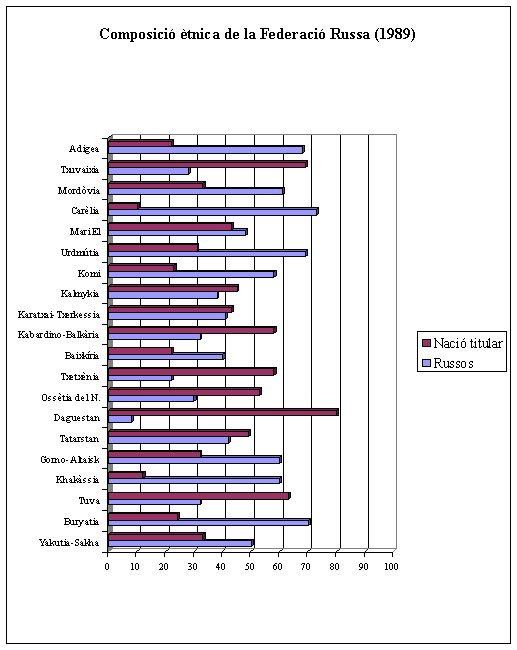
Graph 1. Ethnic composition of the Russian Federation (1989)
Source:
Own elaboration from the data provided by Natsionalnii
Sostav Naseleniia SSSR (1991)
The
future articulation of the Russian national identity and State is extremely
complex insofar as, until now, it does not seem that they have planned either
any coherent plan for development or any precise orientations on economic,
social and national policies that would allow for the consolidation process of
democracy in the Russian Federation. Faced with the outbreak of national and
identity cohesion of post-Soviet Russia, the foundations on which the new
identity and the new State should be based contain major contradictions, while
the general context hinders the articulation of a civil society traditionally
underdeveloped, given the fact that, neither the concept of an ethnic Russia
nor that of the imperial Russia can mobilize or unite the Russian citizens
under the same national project; that the intensification of the economic and
regional particularities threaten to dislocate the territorial structure of the
Federation; that the moral and social disorientation has become generalized
among a population lacking in points of reference and identification due to the
disappearance of the old pre- and post-Communist values; and that the endemic
economic crisis has driven tens of millions of people to subsist below the
poverty level. In short, the facts and circumstances made explicit throughout
these pages constitute a complex network that Russia will have to solve in
order to begin the process of democracy, political, social and economic
stability and national reconstruction.
The awakening of national groups
in Russia and linguistic legislation
The
Russian Federation is made up of 176 national groups and an almost equal number
of languages spoken. These minority communities represent approximately 28
million people, 20% of the total population[13]. This ethnic, linguistic and
cultural diversity is reflected in the Federal Statutes of the country, with 21
National Republics, to which we have to add the Autonomous Regions and
Districts. Minority areas are characterized by a very strong interweaving of
peoples. The Russian population represents between 30 and 80% of the population
of the Republics in Siberia, between 30 and 70% of the central and northern
regions, and between 10 and 40% in the Caucasus. To it we have to add the
presence of other national groups which represent between 5 and 40% of the
Republics’ population. Besides, the titular nationality (eponym of the
Republic) is only majority in 7 of the 21 Republics. Taking this
multiculturalism into consideration has implied the acknowledgement of a
considerable political power in the titular minorities, although this power
often has to be relativised due to the absence or scarcity of financial means
and that Moscow still keeps an important influence through the subsidies (that
may reach 90% of some Republics’ budget) and the granting of credits for the
acquisition and provision of energy supplies. In addition, the important
sociocultural crisis that provoked the fall of communism still perpetuates.
Letting aside the North Caucasus, the UNESCO
Red Book on Endangered Languages only reports in Russia on three minority
languages that are not endangered[14]. All the others are considered
as being “on the verge of extinction” or “threatened”. This contrast between
the will of reconstructing national identity and the real situation may imply a
feeling of urgency that sometimes force titular nationalities to take radical
action in order to protect their language and their identity, while often at
the same time political and social tensions feed on ethnical and cultural
tensions.
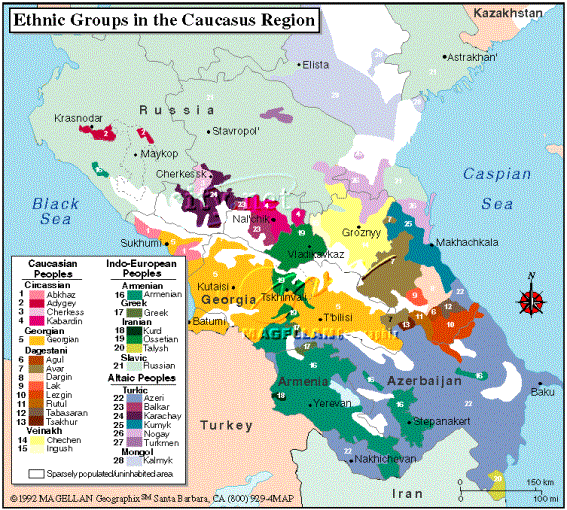
Map 1. Ethnic groups in Caucasus region
Within
this context, the linguistic issue crystallizes in the demand for the
recognition of the identity of the different peoples of Russia, while this
constitutes in itself a source of tensions. In the territories of the old
Soviet Union, linguistic decrees and laws have very significantly contributed
to the worsening of the tensions in Moldova and language issues still mark the
agenda of political action in the Baltic States, especially in Estonia and
Latvia. In Central Asia, Russian minorities are in a delicate situation because
the use of national languages has become an important indicator of the
citizens’ political loyalty, although very often they lack the necessary
structures from which to learn them. The situation seems less serious in
Russia, where Russian still is globally accepted as a lingua franca and where each Republic can add one or more official
languages. But quite often the problem is found in the criteria for choosing
the official languages. All the Republics, excepting four of them, have adopted
linguistic laws that give priority to the language of the titular nationality.
In Bashkiria, the official status of the national language together with
Russian is the object of major controversy given the opposition of the Tatars
-the second most important community in demographic weight after the Russians
and before the Bashkirians- because of the refusal of the Bashkirians to
proclaim the official status of Tatar in the Republic. The situation is
especially complex in Dagestan where 80% of the population is Dagestanian but
more than 30 languages cohabit. Also, some decrees establishing the adoption of
the Latin alphabet instead of the Cyrillic one (for instance, the Decree of
July 1999 in Tatarstan) are usually interpreted as an overt challenge which
aims to increase the distancing from Moscow. In addition, the adoption of
constitutional clauses that limit and even impede the access to political or
administrative responsibilities for citizens that do not know the national
language of the titular ethnic group, as in the case of Adygea, Northern
Ossetia, Bashkiria and Mari El, also represent a danger for the stability of
interethnic relationships. There also exists the temptation on the part of some
titular nationalities to use the linguistic issue to provoke demographic
changes that would imply a higher representation of their community: what the
French call “le vote avec ses pieds” (“the
vote with one’s feet”) is also a reality in Russia, despite the fact that the exodus
of Russians towards Republics with a majority Russian population is mainly due
to economic problems. The lack of local structures for mediation to look after
the legitimate interests of the Russophone communities and of the other
minority groups is even more dangerous if we take into account that Moscow does
not always have enough capacity or legitimacy to play this role.
As
regards the development of linguistic legislation within the Russian Federation
after the disintegration of the USSR, the 1993 Constitution marked a change
concerning the previous situation, for it starts with the following Preamble:
“We, the
multinational people of the Russian Federation, united by a common destiny on
our land, asserting human rights and liberties, civil peace and accord,
preserving the historic unity of the State, proceeding from the commonly
recognized principles of equality and self-determination of the peoples,
honoring the memory of our ancestors (...)”[15]
Consequently,
the old Soviet Republics started to adopt a series of legal measures that
proclaimed the official status of the autochthonous language[16]. Russia also promulgated the
first linguistic law of its history on October 25, 1991 (Law on the Languages
of the Peoples of the Russian Federation), where the languages of the Republic
were mentioned as an integral part of national patrimony and of its historical
and cultural heritage. According to Article 2.2., “On the territory of the
RSFSR the State shall guarantee language sovereignty of each people irrespective
of its number and legal position and language sovereignty of a person
irrespective of the origin of a human being, his or her social and material
position, racial and national belonging, sex, education, relation to religion
and domicile area.”
All
the same, Article 3.2. establishes that: “The Russian language, being a main
means of cross-national communication of the peoples of the RSFSR according to
the established historical and cultural traditions, has the status of the state
language on the whole territory of the RSFSR”. Because of their importance, two
other legal texts also stand out: firstly, the Federal Law on the General
Principles of the Local Self-Government Organization, passed on August 28, 1995
and modified on April 22, 1996, for it grants competencies in the field of
education in the autonomous territorial entities (Article 6.2.6.). The second
text, the Federal Law on National and Cultural Autonomy of June 17, 1996,
proclaims the right to maintain and develop the autochthonous languages of the
Republics and autonomous territorial bodies (Article 9), recognizes the right
to be educated in Primary School in the mother tongue of the pupil and to
choose the language of education (Articles 10, 11, 12).
The
Constitution and the federal laws that regulate the rights of the speakers of
the languages of the autochthonous communities have been followed by a long
series of linguistic legislations approved by the different Republics. Thus,
practically all the Constitutions of the Republics proclaim the official status
of Russian and of the autochthonous language, except for those of Dagestan,
Kabardino-Balkaria, Mordovia and Northern Ossetia, where other languages or
even dialects of the autochthonous language can be added to them. As regards
the legal texts of lesser importance, such as decrees or linguistic
regulations, the Republics of Karelia, Udmurtia, Dagestan and
Karachaevo-Cherkessia still have not adopted any as such, while this is not the
case in the Republics of Tatarstan, Adygea, Kabardino-Balkaria, Chuvashia,
Tuva, Buryatia, Kalmykia, Khakassia, Yakutia-Sakha and Bashkiria where they
have done so.
The
fundamental elements common to the legal dispositions as regards the languages
proclaimed in the different Republics of the Russian Federation are found in
the desire for conservation, development and promotion of the autochthonous
language, its introduction or extension in the educational system, the training
of teachers, the promotion of literature, of science and arts, as well as the
use of these languages in the audio-visual media. Parallel to this, each
Republic takes care of regulating the use of the official languages in the
administration, in the legislation and official documents, in the juridical
system and in the relations between the administration and the citizens.
The
linguistic and cultural processes that take place in the Russian Federation are
determined by a combination of factors reported on in the previous pages: a)
the great cultural, linguistic and religious diversity of the population
throughout the entire territory; b) the demographically predominant presence of
the Russians in most of the Autonomous Republics; c) the influence of the
national-territorial criteria established by the Soviet regime in order to
manage linguistic and ethnical diversity; and d) the processes of economic
restructuring that are taking place in a disorderly fashion.
I
have already mentioned that in only 7 of the 21 national territorial entities
the titular nationality constitutes the majority of the population[17]. In addition, most of these
entities reproduce on a microscale the mosaic of nationalities, languages,
cultures and religions present throughout the entire Federation. In the same
way, Russian constitutes the language of communication between the center and
the periphery, while the Russification process which started, with some pushing
and pulling movements according to the interests and legitimization strategies
of the Soviet regime, in the mid 30’s, still has its effects on minority
languages. As we have already seen, the application of a national-territorial
criteria allowed for the development of the languages of the titular
nationalities by means of the creation of some regional elites, and cultural,
social and economic structures that made them turn into almost-States, even
before the disappearance of the Soviet State. But from 1992 onwards, and in
contrast with what was happening previously, the Federal Law on the
National-Cultural Autonomy also allowed the national and linguistic communities
that did not have their own politico-administrative structures to also enjoy
the right to constitute themselves as autonomous territorial entities and to
create the necessary conditions for the preservation and promotion of their own
languages.
The
economic situation derived from the chaotic transition from a planned economy
to a free market economy also constitutes another hindrance for the peripheral
ethnic and linguistic communities, given the fact that the majority of them
depend on the subsidies granted by the authorities to avoid the total collapse
of their economic structures; this leaves little margin for financing policies
to promote autochthonous languages, if we consider the urgent priorities as
regards social welfare, education, public health care and modernization of the
economy.
In
spite of everything, the main risk of interethnic tensions is concerned less
with the relationships that may be established from now onwards between the
federal authorities and the peripheral Republics, than with the capacity of the
nationalities to take into consideration the situation, the needs and the
interests of the other national communities present in their territory; to
conciliate their desire to promote the autochthonous language with the
awareness of the complexity and the slowness of the processes of transition and
change in deep-rooted linguistic habits; and to establish operational
structures that allow titular nationalities and minority groups to have access
to the learning of the autochthonous language, very often only recently turned
into the official language along with Russian. In short, it is fundamental and
urgent that the nationalities can assume and successfully face this challenge
in order to avoid a true disaster and an intensification of interethnic
tensions:
It is obvious that the
languages of all the peoples in Russia including Russian are in a state of
crisis. Many of them are on the verge of extinction. It is without a doubt, a
humanitarian catastrophe although the socio-economic calamities of the last
years have hidden it. The fact that the languages of indigenous peoples in the
republics are decreed as state languages makes no difference. The crisis has
gone so far that in many cases it seems irreversible[18].
Linguistic rights in the constitutions of the former
Soviet republics of Central Asia
The long disintegrating
process experienced by the Soviet successor states allows to have a wider
perspective on the actual developments and, therefore, to make a brief review
of how linguistic rights -and human rights in general- have been dealt with in
the new independent states' policies. The former Soviet republics of Central
Asia -Kazakhstan, Kyrgyzstan, Tadjikistan, Turkmenistan and Uzbekistan- are
clear instances of the way in which linguistic policies were applied during the
soviet period and, later on, from their independence onwards. On the other
hand, it is important to see how the role of the Russian language as the mean
of interethnic communication in the former Soviet Union -and, as a matter of
fact, as the language of the administration and the educational system-, along
with the diverse promotion of the autochthonous languages and their literacy
policies, have decisively affected the linguistic and social development of the
other spoken languages in the former USSR. and, consequently, their linguistic
demography.
Despite the fact that the
following data might have changed as a consequence of the revitalizing
processes as regards national languages and cultures, which have occurred
parallely to de-russifying policies, they are still valid indicators of the
effects resulting from the policies carried out during the last decades.
Table 2. Percentage of Russian speakers and of
Russian speaking the autochthonous language in Central Asian republics (1989)
|
Republic |
Autochthonous population |
Russian-speaking population |
% of Russian speakers |
% of Russian speaking the autochthonous language |
|
Kazakhstan |
6,531,921 |
59.4 |
6,226,400 |
0.9 |
|
Kyrgyztan |
2,228,482 |
36.9 |
916,543 |
1.2 |
|
Tadjikistan |
3,168,193 |
30.0 |
386.630 |
3.5 |
|
Turkmenistan |
2,524,136 |
27.6 |
334,447 |
2.5 |
|
Uzbekistan |
14,123,626 |
22.3 |
1,642,179 |
4.5 |
Source: Own elaboration from the data provided
by Natsionalnij Sostav Naselenija SSSR
(1991).
Similarly, the percentages
corresponding to the ethnic composition of each one of the republics are also
extracted from the 1989 census, that is to say, during the last general
available data for the former republics of the USSR.
Table 3. Ethnic composition of the Central Asian
republics (1989)
|
Republic |
Russians |
Autochthonous |
Ukrainians |
Tatars |
Uzkeks |
Others |
|
|
|
|
|
|
|
|
|
Kazakhstan |
41% |
36% |
6% |
4% |
3% |
10% |
|
Kyrgyztan |
26% |
48% |
3% |
2% |
12% |
9% |
|
Tadjikistan |
12% |
60% |
-- |
3% |
23% |
2% |
|
Turkmenistan |
15% |
68% |
-- |
-- |
8% |
9% |
|
Uzbekistan |
11% |
70% |
-- |
4% |
-- |
15% |
Source: Own elaboration from the data provided by
Natsionalnij Sostav Naselenija SSSR
(1991).
The Declaration of
Alma-Ata of December 21st, 1991, signed by nearly all of the federated
republics after a referendum (March 1991), and according to which, the former
USSR. disappeared in order to create the new Community of Independent States
(CIS), carried the full capacity of decision and political sovereignty of these
states:
The independent states, the Azerbaijan
Republic, the Armenian Republic, the Belarus Republic, the Republic of
Kazakhstan, the Republic of Kyrgyzstan, the Republic of Moldova, the Russian
Federation, the Republic of Tajikistan, the Republic of Uzbekistan and Ukraine
Intending to create democratic states with
the rule of law, which mutual relationships be developed under the following principles:
reciprocal recognition and respect towards the sovereignty and sovereign
equality, the vested right to self-determination, the equality of rights and
the non-interference in internal affairs, the non-recourse to threats or the
use if force, the refusal of economic pressures or others, the peaceful
resolution of discordances, the respect towards human rights and freedoms
including the rights for ethnic minorities, the scrupulous application of
compromises, other norms and principles universally recognized by international
law.
Recognizing and respecting the territorial
integrity and the immutability of the existing borders between them;
Considering the friendly and neighbourhood relationships and the mutually
advantageous cooperation, which are deeply and historically rooted, respond to
the essential interest of peoples and serve to the cause of peace and security;
Being conscious of their responsibility for the preservation of civil peace and
interethnic relationships; Adhere to the objectives and principles of the
agreement on the creation of the Community of Independent States.[19]
After 1991, the new
Central Asian states started to promulgate their new constitutions, which
reaffirmed the officiality of their national languages. The Russian language,
although still basic in relevant social domains and functions, has now fallen
victim of the discontent piled up for years in the Central Asian republics for
political and economic reasons which are not related to the language itself.
For this reason, the new constitutions of these republics, despite giving
Russian a special role as a mean for interethnic communication, offer a glimpse
of a certain anti-Russian hostility -which is also evident in everyday life- in
terms of linguistic exclusiveness.
For example, the
Constitution of Kazakhstan states as follows:
Article
7
1. "In the Republic of Kazakhstan, the state language is Kazakh".
2. "In governmental organizations and in organs of local self-government,
Russian may be officially employed on a par with Kazakh".
Article 12
1. "The Republic of Kazakhstan respects and guarantees its citizens rights
and freedoms of the person in accordance with the Constitution".
Article 14
2."No one may be subjected to any sort of discrimination because of
origin, social, official, or property status, gender, race, ethnicity,
language, religious preference, convictions, place of residence, or any other
circumstances".
Nevertheless,
on the other hand, some restrictions have been introduced in order to ensure an
autochthonous structure of power in the republic:
Article
41
2. "A citizen born in
the Republic, no younger than forty years of age, with fluent command of the
state language, who has been residing in Kazakhstan for no less than fifteen
years may be elected President of the Republic".
As for Kyrgyzstan, the
Constitution states that:
Article 5
1. "The state language of the Kyrgyz Republic is the
Kyrgyz language".
2. "The Kyrgyz Republic guarantees the preservation
of, equal rights of, and the free development and functioning of Russian and
all other languages which are used by the population of the republic".
3. "Abridgment of the rights and freedoms of
citizens on the grounds of lack of knowledge of or inability to speak the state
language is unlawful".
It is
worth noting that since May 28, Russian language has been assigned the status
of official language by the Parliament of Kyrgyzstan, following the policy on
national integration carried out by the president Akayev. This measure intends
to widen the legislative basis for the Russian speaking community, and seems to
be aimed at the prevention of out-migration of ethnic Russians after the
adoption, seven years ago, of the new constitution. Therefore, from now on
Russian will be more that merely one official language of the Kyrgyz Republic,
but rather the language for inter-ethnic communication. During the
parliamentary discussions, some MPs manifested Uzbek should become official
instead of Russian as far as approximately 14% of the Kyrgyz population speak
Uzbek, whereas in the case of Russian the percentage is of 13%.
The
Constitution of Tadjikistan allows more rights to the citizens as a whole and
to minorities in particular:
Article 2
"The state language of Tadjikistan is Tadjik.
Russian is a language of inter-ethnic communication. All nations and peoples
residing on the territory of the republic have the right to use freely their
native languages".
Article
6
"In Tadjikistan, the
people are the possessors of the sovereignty and are the only source of state
power, which is exercised both directly and also through the people's
representatives. The people of Tadjikistan are the citizens of the Republic of
Tadjikistan regardless of their ethnicity.".
Article
8
"In Tadjikistan,
social life develops on the basis of political and ideological pluralism. No
state ideology or religion may be established. Social associations are formed
and operate within the framework of the Constitution and laws. The state
provides them with equal possibilities in their operations. Religious organizations
are separate from the state and may not interfere in governmental affairs. The
formation and operation of social associations which advocate racial, ethnic,
social, or religious animosity or which incite violent overthrow of the
constitutional system, as well as the organization of armed groups, are
forbidden".
Article 17
"All
persons are equal before the law and the courts. The government guarantees the
rights and freedoms of every person regardless of ethnicity, race, sex,
language, faith, political beliefs, education, or social or property status.
Men and women have equal rights".
The Constitution of
Uzbekistan doesn't present significant difference with respect to those of the
other above-mentioned republics:
Article 4
"The state language
of the Republic of Uzbekistan is the Uzbek language".
"The Republic of Uzbekistan ensures a respectful attitude towards the
languages, customs, and traditions of the nationalities and peoples living on
its territory and ensures conditions for their development".
Article 57
"It is forbidden to
form or operate political parties, as well as other social associations, that
have as their goal violent change of the constitutional system; protest against
the sovereignty, integrity, or security of the republic or the constitutional
rights and freedoms of its citizens; advocacy of war, social, national, racial,
or religious animosity; encroachment on the health or morality of the people;
or that are militaristic formations or ethnically or religiously based
political parties".
Article 90
"A citizen of the
Republic of Uzbekistan who is not younger than thirty five years of age, who
has fluent command of the state language, and who has constantly resided on the
territory of Uzbekistan for no less than ten consecutive years directly prior
to the election may be elected President of the Republic of Uzbekistan. The
same person may not be President of the Republic of Uzbekistan for more than
two consecutive terms".
The case of Turkmenistan
is radically different as far as despite what the Constitution of Republic
states, for example, in its Article 17:
"Turkmenistan
guarantees the equality of the rights and freedoms of its citizens and,
likewise, the equality of citizens before the law regardless of nationality,
ethnic origin, property holdings, official status, place of residence,
language, religious preference, political convictions, or political party
membership"
The situation is critical
for linguistic minorities. In contrast to the protective policies regarding the
Russian-speaking minorities undertaken in other ex-soviet republics, such as
Kyrgyzstan or Kazakhstan, where Russian has been given a privilege status, the
new political leaders in Turkmenistan have been long ago supporting a campaign
contrary to the interest of this community, among others. It is estimated that
25% of the Russian-speaking population has left the country ever since 1994 as
a result of such measures. The obligatory knowledge of the current national
language, Turkmen, prevents members from other linguistic communities to have
an access to posts of political responsibility. Besides, they must all go
through a selection which takes into account their genealogical origins.
Amongst the other measures there is the reduction of radio broadcasts in Russian
or the confiscation of journals and books edited abroad.
Basic features of language
policy in Lithuania and Latvia
In the
case of Lithuania, national identity is first and foremost related to the
autochthonous language and its preservation. Official authorities therefore
consider that only the status of Lithuanian as the official language can
protect it from decline. These status was first legitimised by the Constitution
of the Lithuanian Republic adopted by the Constituent Seimas [Parliament] in
August 1922, whose legal foundations were reconstructed in 1988.
When
independence was restored in 1990 the primary concern was a more rapid
integration of the nationals of the republic who did not speak Lithuanian. The
government’s stance towards the ethnic minorities has been very moderate
compared to the policies applied in Latvia (see below). In 1990 the resolution
“On the terms of the Official Language” passed by the Constituent Seimas
stipulated that minimal requirements of the knowledge the official languages
were applied for executives and workers in the public sector until January 1st,
1995.
In 1995
the Law on the Official Language of the Republic of Lithuania and the Law on
the Enforcement of the Official Language of the Republic of Lithuania were
passed. The laws regulated the use of the official language in the main spheres
of public life, its protection and control as well legal responsibility for
violations of the language law.
This
law recognises the Lithuanian language as the official language of the state:
all records are kept in Lithuanian; the state guarantees that Lithuanian should
be the language of education and instruction. All nationals of the Republic of
Lithuania have the right to receive information and to be attended to in
Lithuanian. The regulations on the official language are applied to public
servants and teachers; to the workers of communications, transport and
healthcare; policemen and shop assistances; to all those who have to deal with
people.
The law
also provides for the correct use of the official language: the mass media and
publishers must adhere to the standardised norms.
The Law
on the Official Language does not interfere with the use of languages of the
ethnic minorities, mainly Russian, Polish, Belarusian and Yiddish, which are
protected by the Law on the Ethnic Minorities of the Republic of Lithuania.
In the
same year the government approved the Programme for the Use and Promotion of
the Official Language in a period from 1996 to 2005. The programme consists of
four chapters which provide for the most important work to be carried out in
the following fields:
·
studies of Lithuanian
(create a computer database for the Academic Dictionary of the Lithuanian
Language; work out and implement a programme for the creation of technical
terms; write dictionaries and texts in dialects);
·
language promotion
(introduce the teaching of correct use of Lithuanian and courses on technical
terms in all special schools and schools of higher education; write new books
and other means of teaching Lithuanian);
·
use of the language
(various organisational means are planned); and
·
publication (books on
theory and practical language: schoolbooks, dictionaries, monographs,
bibliographical books; their computerised versions).
The
resolutions passed by the Language Commission on the practical use of the
language are obligatory to all institutions: offices, companies and
organisations as provided by the Law on the Status of the State Lithuanian
Language Commission passed by the Seimas in 1993.
The law
empowers the Language Commission to deal with the issues of the codification,
standardisation and the enactment of the Law on the Language. The Commission
implements the language projects and is in charge of the use of the funds
allotted by the government. The members of the Commission are appointed and
dismissed by the Chairman of the Seimas on the nomination by the Seimas
committees for Education, Science and Culture.
Resolutions
passed by the Commission are obligatory for all enterprises offices and
organisation all well as the mass media, violation of which incurs
administrative responsibility. Many other laws of the Republic of Lithuania
regulating different areas (laws on Education, Courts, Citizenship, Public
Servants and others) include the requirements for the use of the official
language.
One of
the prerequisites of the intergration of Lithuania into the EU is the usability
of the Lithuanian language along with the other languages of the EU. It can be
achieved only with the help of modern informational technologies and joint
efforts of researchers producing machine translation, speech recognition and
generation systems for the Lithuanian language. With these aims in mind the
program for 2000 – 2006 called as The Lithuanian Language in Information
Society, has been prepared.
As
regards Latvia, the language policy carried on by official authorities is
certainly the most polemic of all the processes of language promotion in the
Soviet successor states, especially if we take into account the ethnic
composition of the republic.
Table 4. Ethnodemographic
composition of Latvia
|
Latvians |
57.6 |
|
Russians |
29.6 |
|
Belarusians |
4.1 |
|
Ukrainians |
2.7 |
|
Poles |
2.5 |
|
Lithuanians |
1.4 |
|
Jews |
0.4 |
|
Roma |
0.3 |
|
Germans |
0.2 |
Source: Latvian census of the year
2000
The implementation of rather
restrictive language policy and citizenship law is due to the high level of
linguistic assimilation among speakers of languages other than Latvian and
Russian. For example, according to the year 2000 census only 2.1% of
Belarusians, 3.7% of Ukrainians, 9.5% of Poles declared the respective
languages as their native languages. The
population census also shows that 62% of Latvia’s inhabitants have indicated
Latvian as native language, although Latvians are only 57,6% of population.
36,1% inhabitants of Latvia have indicated Russian as native tongue, although
Russians are 29,6% of all inhabitants of Latvia. In Latvia representatives of
minorities have more desire to identify
themselves with Russian minority.
From
the independence onwards, there has been a considerable progress in Latvian
language skills among minorities. In 1989 census the Latvian language skills
were declared by 18-20% of minority representatives. According to the 2000
Census 59% of Russians, 55% of Belarusians, 54% of Ukrainians, and 65% of Poles
declared Latvian language skills. The number of minority representatives having
no Latvian language skills at all is diminishing: 78-80% in 1989, 22% in 1996,
9% in 2000[20].
After
50 years of incorporation into the USSR the independence of the Republic of
Latvia (founded in 1918) was re-established in 1991. The 1922 Constitution is
in force now including the article about the Latvian language as the official
state language. In 1989 the first Language Law aimed to re-establish lost
sociolinguistic functions of Latvian was adopted (with amendments in 1992). The
Law on State Language adopted on 9 December 1999 is in force now. The purposes
of the present Law are: the preservation, protection and development of the
Latvian language, the integration of national minorities in the society of
Latvia while observing their rights to use their mother tongue or any other
language.
Nevertheless, after
signing the Council of Europe’s Convention for the Protection of Ethnic
Minorities in 1995, there is still in Latvia an ongoing political discussion on
the ratification of this international instrument. Latvian Nationalistic party
“For Fatherland and Freedom” has continually opposed the proposals put forward
by pro-minority movements, whereas moderate parties tend to consider a possible
ratification, due to international pressure, though with reservations.
Another
example of the problems faced by minorities in Latvia is the fact tha after the
criticism for the unconstitutionality of the State Language Law from the Organization
for the Security and Cooperation in Europe (OSCE), as well as from local human
rights organizations, the Latvian government has introduced several changes
previous to the law’s effective implementation. These changes, which are
insuffucient according to these organizations, mainly deal with the categories
of state language knowledge demanded to professionals and public authorities.
The OSCE has already criticized the new regulation in considering it still runs
counter to the Latvian constitution. Some of the criticism is specifically
aimed at undermining the so-called administrative “latvianization”, such as the
official recognition of Latvian names and surnames, which, according to the
OSCE, would not meet the Council of Europe’s Framework Convention for the
Protection of National Minorities.
Conclusion: strategies for a peaceful and balanced
management of linguistic diversity in the Russian Federation and the Soviet
successor states
The
events taking place since 1991 in the Russian Federation and the Soviet
successor states prove the absolute necessity of solving and preventing
interethnic conflicts in order to guarantee a minimum level of well-being in
the local populations and to satisfy their aspirations. In addition, it is also
urgent to guarantee a correct management of the ethnic, linguistic, religious
and cultural diversity so as to prevent violent vindications from spreading and
interethnic conflicts in the periphery of the Russian Federation from
multiplying[21].
Some
positive developments have to be stressed, as for example the signature by
Russia on May 10th, of the Council of Europe's European Charter for Minority or
Regional Languages, which is an important step involving a change of
attitude toward the protection of the more than one hundred minority languages
spoken in Russia. The great Russian linguistic diversity have been object of
different seminars and meetings organized by the Council of Europe, aimed to
grow the Russian Government’s awareness about the importance of the protection
of the European cultural heritage.
It is also
worthnoting that on July 19, Moldova adopted a Law on Ethnic Minorities, as far
as the multiethnical and multilingual situation in this country is a quite
complex one since there exist six officially recognized minority groups
(Russian, Ukrainian, Gagauz, Jews, Bulgarian and Rom) which nearly make up half
of the state’s total population. The linguistic issue is neither an easy one:
Russian was the official language for 45 years until, in 1989, Romanian (Moldovan)
was again recognized as the state’s official language following the approval of
a “law on linguistic transition” (Law on the Functioning of Languages) which,
although it was not generally refused by that time, it became increasingly
criticized by the diverse groups in Moldova. The Moldovan constitution
establishes in its 3rd article that the Moldovan language (with latin script)
is the national language whereas the state respects and undertakes to promote
Russian and the other languages spoken within its territory. It also envisages
the regulation of this article by means of a law, although it has not been yet
developed.
The recent developments
in Azerbaidjan are also rather encouraging: the republic has signed the
European Framework Convention for the Protection of National Minorities on June
26[22]
and the document has come into force on October 1. Furthermore, the Parliament
of Azerbaidjan is preparing and discussing a new draft law which should define
the legal basics for the protection of national minorities. The text guarantees
the equality of rights and freedoms for the individuals that belong to minority
groups. The draft law’s third article states that “no one shall be forced to
change its ethnic affiliation”, apart from stressing the fact that “the state
will not permit any action aimed at forced assimilation of national
minorities”.
Nevertheless, there are
still many controversial issues which can easily lead to the raising of new
inter-ethnic conflicts. For example, on October 22, the Estonian Parliament
decided not to discuss the amendments of the electoral laws which require a
certain linguistic knowledge in both local and general spheres for candidates
to occupy public posts. The opposition “People’s Union” party has proposed to
postpone the discussion whereas the Center Party has suggested that the
Minister of Foreign Affairs should report on such amendments. These amendments
are part of the Estonian actions aimed at convincing the OSCE, which has
criticised its linguistic policy in their last report on this state
Consequently, it is fundamental to involve Russian
linguistic and cultural minorities in the formulation, adoption, application
and evaluation of protection policies, as well as policies fostering their
rights at international, national and local levels. The effective participation
of these communities constitutes a necessary element for a better management of
the human, social and economic resources of the area, as well as for the exercise of a better control of
the actions of the local governments in order to guarantee the equality of
rights and the non-discrimination for all the parties involved. Obviously, the
great variety of aspirations and the huge ethnic and cultural complexity of the
area demand that the most suitable mechanisms to create the necessary
conditions for stimulating a real and effective participation of the local
populations in public affairs, according to the peculiarities of each of the
Republics, are identified in the most rigorous and proper way. However, this
participation will only be possible within a context that respects the
universal values of human rights, including cultural, social and economic
rights, as a sine qua non condition
for the exercise of these and other rights. It is therefore extremely urgent,
among other things, that the peripheral regions of Russia can begin to design
and apply relevant strategies in the areas like the promotion of autochthonous
languages and cultures, the construction of civil societies and the prevention
of interethnic conflicts in order to guarantee the development of minority
languages, the increase in economic activities and the improvement in living
conditions, the strengthening of local social networks, the consolidation of
some emergent civil societies and a sustainable local development. As I see it,
the promotion of autochthonous languages and the strengthening of civil
societies must mainly aim at increasing the relationships between democracy and
national identity: the promotion of values such as tolerance, the setting-up of
educational systems that disseminate messages of pacific cohabitation and
mutual understanding, based more on cultural identities than on national
identities, and the implementation of policies which stimulate local
development constitute essential elements to reinforce the prevention of
conflicts and the improvement of the well-being of the peripheral populations
of Russia.
In
short, fostering a peaceful cohabitation, an harmonic multiculturalism and a
sustainable development are the main challenges that the regions of Russia have
to face today, very specially those of the North Caucasus. In order to
guarantee their development, credible and effective policies have to be set in
motion so as to reinforce the links among the autochthonous populations and the
European regions and institutions (very especially the European Union and the
Council of Europe), as well as with the NGO’s that may develop a twofold role
as mediators and promoters to help the local social partners to design and
apply flexible and realistic initiatives using their own resources. Only in
this way may we help to prevent Russia and all the former Soviet republics from
undergoing new wars such as those of Kosovo and Chechnya.
REFERENCES
ALLWORTH, Edward, ed.
(1973) The Nationality Question in Soviet
Central Asia. New York: Praeger.
AZIZ-al Ahsan, S. (1987)
'Soviet Nation-Building in Central Asia (1917-1979)'. In: Canadian Review of Studies in Nationalism, XIV/ 2:317-329.
BALDAUF, Ingeborg (1991)
'Some thoughts on the Making of the Uzbek Nation'. In: Cahiers du monde russe et soviétique, XXXII/1:79-96.
BARRETT,
Thomas M. (1995), “Lines of Uncertainty: The Frontiers of the North Caucasus”.
In: Slavic Review, Fall 1995.
BENNIGSEN, Alexandre
(1979) Muslim National Communism in the
Soviet Union: a Revolutionary Strategy for the Colonial World. Chicago:
Chicago University Press.
BGAZHNOKOV,
B. (2000), "The Crisis of National Languages in Russia". Minority Languages in Russia: Perspectives
for Development. Acts of the International Seminar. Elista.
BOGRDANOVA,
Tatiana (2000), “From Confrontation to Harmonization of Language Relations”. Minority Languages in Russia: Perspectives
for Development. Acts of the International Seminar. Elista: 2000.
BRUBAKER,
Rogers (1996), Nationalism Reframed. Cambridge:
Cambridge University Press.
BUTTINO, Marc (1991)
'Turkestan 1917. La révolution des Russes'. In: Cahiers du monde russe et soviétique, vol. XXXII/1:61-77.
Constitution of the Russian
Federation as Approved by RF President Boris Yeltsin and Submitted to National
Referendum in December 1993.
COOPER, R. L. (1989) Language planning and social change.
Cambridge: Cambridge University Press.
DRUVIETE, Ina (2001) Policy and
Dynamics of Language Situation in Latvia: 1989-2001. [Courtesy of the author]. Unpublished.
FIERMAN, William, ed.
(1991a) Soviet Central Asia: Failed
Transformation. Boulder: Westview Press.
FIERMAN, William (1991b) Language Planning and National
Development: the Uzbek experience. Berlin: Mouton-DeGruyter.
GELLNER,
Ernest (1964) Thought and Change. London:
Weidenfeld & Nicholson.
GELLNER,
Ernest (1983) Nations and Nationalism.
Oxford: Basil Blackwell Publishers.
GREENFELD,
Liah (1993), Nationalism. Five Roads to
Modernity. Cambridge: Harvard University Press.
HALE,
Henry E. (1998) 'The Regionalization of Autocracy in Russia'. In: Program on New Approaches to Russian
Security, Policy Memo Series, 42.
HROCH,
Miroslav (1985) Social Preconditions of
National Revival in Europe. A Comparative Analysis of the Social Composition of
Patriotic Groups among the Smaller European Nations. Cambridge: Cambrige
University Press.
GUBOGLO, M. (1998)
Languages of ethnic mobilization [Yaziki
etnicheskoi mobilizatsii]. Moscow.
KHRUSLOV, G. (1998)
'Language policy in Russia'. In Barbel Fink (ed), Modern language learning and teaching in central and eastern Europe:
which diversification and how can it be achieved? Proceedings of the second
colloquy of the European Center for Modern Languages, Graz, 13-15 February
1997. Council of Europe, 121
KIRKWOOD,
Michael, ed. (1989) Language Planning in
the Soviet Union. London: MacMillan.
KIRKWOOD,
Michael (1997) ‘Language Ecology in Post-Soviet Russia: Problems and
Prospects’. In: Actes del Congrés Europeu
sobre Planificació Lingüística/Proceedings of the European Conference on
Language Planning. Barcelona: Generalitat de Catalunya.
KORNOUSSOVA,
Bossia (2000), "Language Policy in Russia: Scopes and Challenges".
Paper submitted at the Conference Lesser
Used Languages and the Law in Europe, Academy of European Law, Trier (Germany),
September 7-8, 2000. [Courtesy of the author]
LEPRÊTRE,
Marc (1999) De l'internacionalisme
proletari al patriotisme soviètic: marxisme, nacionalisme i
"nation-building" a la Unió Soviètica. Ph.D. submitted at the
University of Barcelona.
LEPRÊTRE,
Marc (2001) The promotion of minority languages
and the prevention of inter-ethnic conflicts in the Russian Federation. Mercator Legislation Working
Papers, 1.
LIBER,
George O. (1991) ‘Korenizatsiia: restructuring Soviet nationality policy in the
1920s’. In: Ethnic and Racial Studies,
vol. 14/1:15-23.
MIKULÉNIENÉ, Danguolé
(2001) 'Language Laws and Planning in Lithuania'. Paper submitted at the 2nd
European Conference on Language Planning. Andorra, November 14-16, 2001.
[Courtesy of the author].
Natsionalnii Sostav Naseleniia SSSR. Moskvá:
Finansi i Statistika, 1991.
NEROZNAK, V.P. (2000)
‘Language laws of the peoples of the Russian Federation and programming
language development’ [Zakoni o yazikah
narodov Rossiiskoi Federatsii I programmirovanie yazikovogo rasvitiya]. In:
Minority
Languages in Russia: Perspectives for Development. Acts of the International
Seminar. Elista.
NIMNI,
Ephraim (1991), Marxism and Nationalism.
Theoretical Origins of a Political Crisis. Boulder: Pluto Press.
Red Book of the Languages of Russia. [Krasnaya
kniga yazykov narodov Rossii]. The Encyclopaedia. Editor-in-Chief V.P.
Neroznak, Moscow: Academia, 1994.
SALMINEN,
Tapani (1999), UNESCO Red Book on
Endangered Languages: Europe. In: http://www.helsinki.fi/~tasalmin/europe_report.html.
SUNY,
Ronald (1992), ‘State, Civil Society and Ethnic Cultural Consolidation in the
USSR - Roots of the National Question’. In: Gail W. Lapidus et al. From Union to Commonwealth. Nationalism and
Separatism in the Soviet Republics. Cambridge: Cambridge University Press.
SUNY,
Ronald Grigor (1993), The Revenge of the
Past: Nationalism, Revolution and Collapse of the Soviet Union. Stanford:
Stanford University Press.
SZPORLUK,
Roman ed. (1994), National Identity and
Ethnicity in Russia and the New States of Eurasia. London: M.E. Sharpe.
TISHKOV,
Valery (1997), Ethnicity, Nationalism and
Conflict in and after the Soviet Union. Oslo: International Peace Research
Institute.
TZYRENOVA, Z. U. (2000)
Russian peoples' languages development is a priority of state national policy [Razvitie yazikov narodov Rossii -
prioritetnoe napravlenie gosudarstvennoi natsionalnoi politiki]. In: Minority
Languages in Russia: Perspectives for Development. Acts of the International
Seminar. Elista.