"The
Gestation of the Codex"
or, "From Scroll and Tablets to Codex and
Beyond"
by Robert A. Kraft (spring
term 2008, University of Pennsylvania; 14ap08 draft)
The following depends heavily on the previous studies by Colin
Roberts ("The Codex" 1954) and Theodore C. Skeat (The Birth of the Codex, 1983), and on
Joseph van Haelst "Les
Origines du Codex" (1989) with
several significant revisions as well as much additional material.
Desiderata Noted in Reviews of Roberts & Skeat:
Review
by Eldon Jay Epp, Journal of Biblical Literature
105 (1986) 359-361 -- Mostly a report, with some
emphasis on
the speculative nature of the relationship to early Christianity.
Review
by G. D. Kilpatrick, Vigiliae Christianae 38 (1984) 409-412
--Problem of Pauline authorship
of
Pastorals; early use of Mark; connection of (Greek) Roman Christianity
with Latin Roman evidence; simplistic argument for nomina sacra unity;
place of the epistles in canon formation. Kilpatrick himself is
inclined to emphasize Christian desire to differentiate from Judaism in
both codex and nomina sacra choices.
Review by Rosamond McKitterick [Oxford
Journals page] Library
(1985) 360-363 --
The codex, however, antedates
the
formation of the Gospel canon and is very difficult to link with it.
This part of the discussion would have been enriched had the possible
ownership of the surviving books, the market for the new format and the
question of who would have been reading these books been considered,
for the manuscripts and their proposed context seem to have significant
implications for levels and use of literacy among the Christian
communities of the ancient world. (363)
[also qustions the actual isolation of Egypt in bookmaking, arguing for
possible imports having much effect]
Review
by Peter J. Parsons, Classical Review (1987) 82-84
Offers several queries and
corrections,
noted in the appropriate places in the electronic file. Also
check:
"P. 13 The reference, Asc., In Mil.
29, has dropped out" [presumably was present in the earlier CHR
version?].
Note by J. David Thomas in his obituary for T.C.Skeat:
Skeat's other
major
contirbution to
palaeographical and codicological studies was the book he produced with
Colin Roberts, The Birth of the Codex
( based in part on a previous article by Roberts in the Proceedings of the British Academy).
Although in some respects controversial and by no means the last word
on the subject, this book is fundamental for any examination of this
extremely complicated problem, and has been reprinted more than once.
Also of enormous value is the chapter on Early Christian Book-Production
[[1969, reprinted in Elliott]], which he contributed to the Cambridge
History of the Bible (an Italian translation appeared as a separate
volume in 1976).
Contents:
- Introduction
- Materials
(Rigid, Flexible) and Languages (Greek, Latin, etc.)
- Tablets
and Codexbooks, ancient Schools and Recordkeeping
-
Rigid and Flexible Codexbooks
-
Defining "Books" -- Legal Considerations
- Codices,
Contents and Commerce
- Scroll
and Codex in Greco-Roman Literary Circles
- Scroll
and Codex in Jewish and
Christian Contexts
Tablets
and Codexbooks [vocabulary? gk δέλτοι? δελτάριον, γραμματεῖον --
Lat
tabulae, pugillares, codices]
For persons in almost every walk of life in the Greco-Roman world, as
well as long before and long after, codices composed of rigid tablets
of wood and/or other materials were commonplace. Individual tablets
were bound together on one edge with some sort of hinging (e.g. leather
strips, cord), so as to open either vertically (hinged at the top or
bottom) or horizontally (hinged at the side). The hinged tablets could
also be arranged accordian (or concertina) style, to emulate more
closely the equally common scroll format. [[What constituted "front" or
back??]] The tablets themselves often were coated with wax in a framed
and slightly hollowed out area
and thus could be reused when older markings were smoothed over with a
flat
ended tool. Sometimes wooden tablets were painted white or a
light shade (or even reddish),
and writing
in ink or chalk was sometimes placed directly on the
painted or unpainted wood. [[e.g. Vindolanda]]
The tablet was one of the oldest, if not the
oldest,
recipient of writing known to the Greeks, who may have borrowed it from
their neighbors to the east.\1/ Homer knew of it, for it was
on a folded tablet or
diptych [["two piecer"]] that
Proitos scratched the 'deadly marks' that were
intended to
send Bellerophon to his death; in
Sophocles, Agamemnon orders the
muster roll
[list] of the Greek princes to be read from a tablet, and it is on a
tablet
that Zeus,
in a fragment of Euripides, records the sins of men.\2/ In later
Greece tablets were
the familiar recipient of anything of an impermanent or informal nature
-- letters,
bills,
accounts, school exercises,
memoranda, writers' drafts. Already by the
fifth century bce tablets
of two or more leaves were in use, but the thickness and rigidity
of the material limited the number of leaves that could be included,
and in fact no specimen surviving from Greco-Roman antiquity
has
more than ten. [[add rabbinic
reference to 12?]] The earliest surviving Greek tablets,
seven
in
number, date
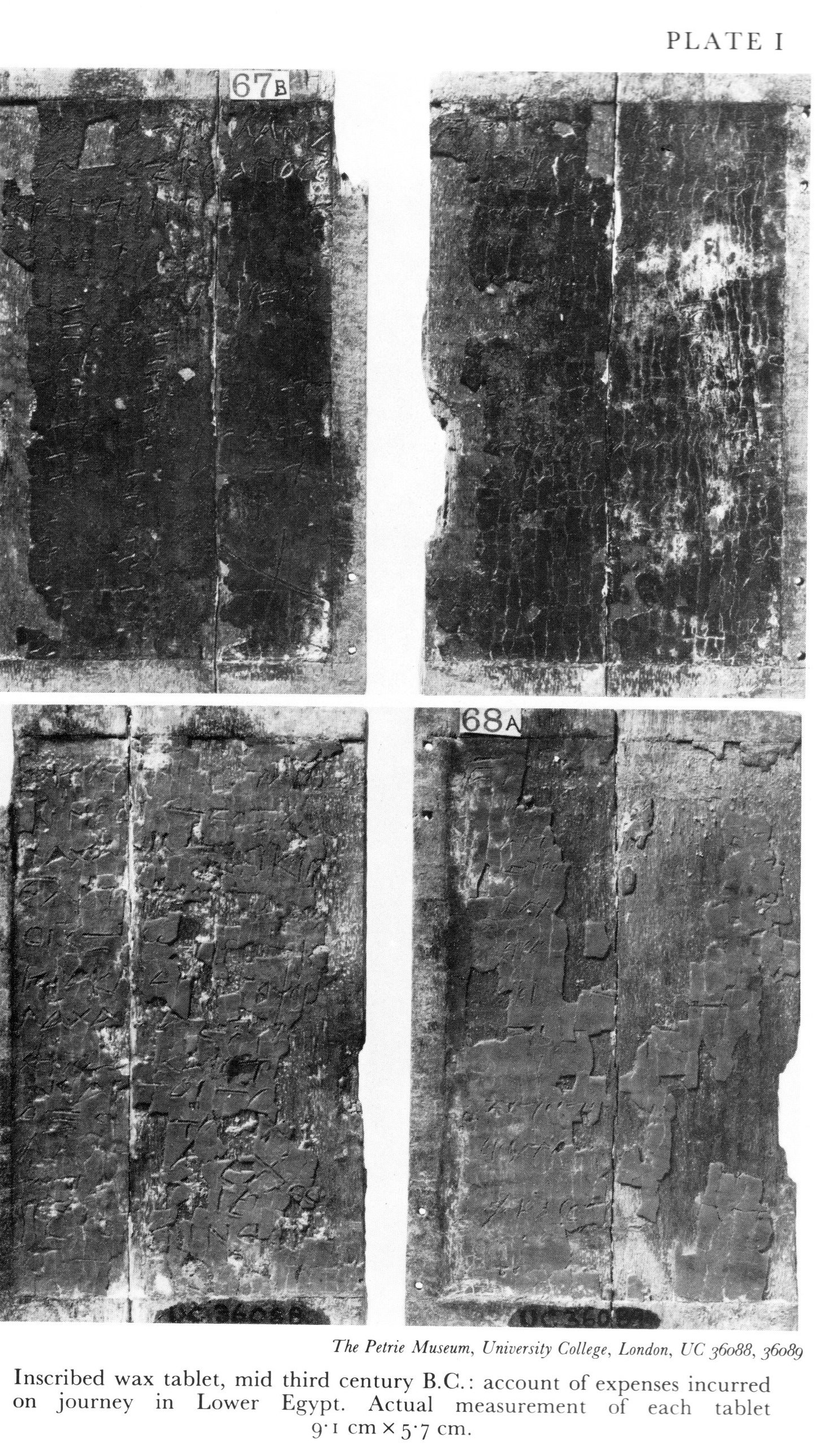
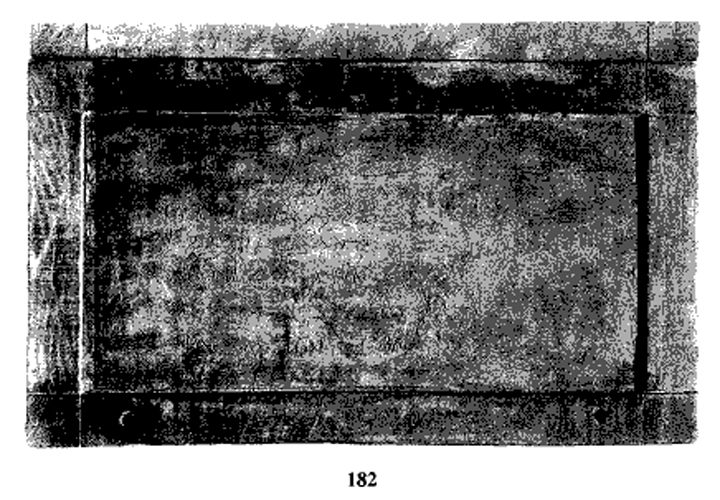
from the middle of the third century bce. Both sides of each leaf
were
covered with wax,
sometimes black, sometimes red; they are hinged horizontally and
contain rough accounts of expenses
during
a journey on the Nile.\3/ In Rome tablet
codices were
equally familiar from an early
date and were employed not only for the casual purposes of everyday
life but
for legal documents and official certificates [[e.g. debts and birth
records]].\4/
\1/
The Mycenaean Greeks used clay tablets and also, possibly,
papyrus (cf.
clay sealings containing impressions of papyrus fibres, Marinates,
Minos,
i, p. 40; Maurice
Pope,
"The
Cretulae and the Linear A Accounting System," Annual
of the British School at Athens 55 [1960] 201). For other Near
Eastern evidence, see C. Wendel,
Die griechisch-römische
Buchbeschreibung
verglichen mit der des Vorderen Orients,
1949, p. 91;
L. Koep, Das
himmlische Buch in Antike und Christentum,1952,
pp. 15-16. Especially interesting is the set of ivory
tablets from Nimrod, dated to about
707-705 bce, which still retained some of their yellow wax coating, and
had
originally been hinged together on both sides so as to fold up
concertina-fashion,
whereas the tablets of walnut wood found with them had perforations so
that
they could have been hinged on one side only by, e.g.
leather thongs (
Iraq
16 (1954) 65, 97-9; 17 (1955) 3 20. For representations of wooden
writing-tablets in Neo-Hittite
reliefs
of the same period see B. van Regemorter,
'Le codex relié à
1'époque néo-Hittite,' Scriptorium
12 (1958) 177-181 and
J. A. Szirmai, "Wooden Writing Tablets and the Birth of the Codex,"
Gazette du livre me/die/val 17
(1990) 31-31 (see also Tov,
Textual
Criticism of the Hebrew Bible 209). An Aramaic letter on two
folded wood slats was also found among the Bar Kokhba letters from ca
135 ce Palestine, similar in format to some of the Vindolanda wooden
tablet letters from slightly earlier in Britain (see Y.Yadin's report
in IEJ 11 [1961] 40ff, and the online Vindolanda materials by A.Bowman
and D.Thomas).
\2/
Homer, Iliad 6.168 sq. (Proitos sent Bellerophon to
Lycia, / with a lethal message, coded symbols / inscribed
on a folded tablet. These told / many lies about Bellerophon. The king was angered, but shrank
from killing Bellerophon, so he sent him to Lycia bearing baneful signs
[
sêmata],
written inside a folded tablet and containing much ill against the
bearer.
); Sophocles, fr. (Pearson) 144 (muster roll);
Euripides, fr. 506 (Nauck) (Zeus records human failings). On the authority of tablets in ancient Greek
thought, see Dziatzko, op. cit., p. 138, quoting a
paper by
Fr. Marx (not accessible to us); the
gods are represented as using δέλτοι, διφθέραι,
ὄστρακα, σκυτάλαι
(tablets, parchments, ostraca, stick-codes),
anything in fact
except βίβλοι,
written papyrus rolls.
\3/ Published by H.
I. Bell and Flinders
Petrie, Ancient Egypt
3 (1927) 65-74. For photographs of three of
them see Petrie, Objects of Daily Use, pl.
lix. One is reproduced here as Plate
I.
\4/ For
the uses to which tablets were put see Schubart, Das Buch...2,
pp. 24 sqq., and notes, p. 175; the ninefold wax
tablet illustrated on p. 24 must originally have had ten leaves (see
Plaumann's
article referred to by Schubart, p. 175). P. Fouad 74 of the fourth
century C.E. refers to and describes a
δελτάριον δεκάπτυχον
(ten folded
little tablet). [[Jewish rabbinic
literature refers to
a 12 leafed version -- see Lieberman, etc.]] On
"fold" as applied to rigid objects such as tablets, cf.
Euripides,
I.T. 727,
δέλτου
μὲν αἵδε πολύθυροι διαπτυχαί (of a tablet, then, many
folding pages). Schubart's
comment
(op. cit., p.
175) that
πτυχή
(fold) is not
strictly applicable to a rigid
material such as wood, and that therefore in this passage it implies a
previous
use of folded leather, papyrus, etc., is misconceived, since
πτυχή
can be used of the folds of
doors. Cf. LSJ
and Pollux,
Onomast., ed. Bethe,
i, p.
207 [= TLG 418, 2nd century CE]: καὶ
Ἡρόδοτος (VII 239) μὲν λέγει `δελτίον δίπτυχον,’ οἱ δ’ Ἀττικοὶ
‘γραμματεῖον δίθυρον,’ καὶ
θύρας τὰς πτύχας ἄχρι δύο, εἶτα πτύχας, καὶ τρίπτυχον καὶ πολύπτυχον
(and Herodotus said "two-fold tablet," but the Attic commentators
"two-paged notebook," and pages/doors the folds until two, then folds,
even tri-fold and multiple-fold) [[check ET of Herodotous 7.239]].
We have evidence of such tablet codices already in Greek
art of the 5th
century bce, and on into
the Islamic period in Egypt up to
modern times. The recommended use of such tablet codices by Roman
authors of orations is set out in some
detail by Quintilian
in the late first century ce (Institutio
Oratoria 10.3.6-33), in his advice to prospective
rhetoriticians about preparing their written materials:
[6] In order to do
this with the utmost
care, we must frequently revise what we have just written. . . ..
[19] The condemnation which I have
passed on such carelessness in writing
will make it pretty clear what my views are on the luxury of dictation
which is now so fashionable. . . . [22] the advantages of privacy are
lost when we dictate. . . . [31] There
are also certain minor details which deserve our attention, for there
is nothing too minute for the student. It is
best to write on wax owing to the facility which it offers for
erasure, though weak sight may make it desirable to employ parchment by
preference. The latter, however, although of assistance to the eye,
delays the hand and interrupts the stream of thought owing to the
frequency with which the pen has to be supplied with ink [32] But
whichever is employed, blank pages (tabellae) must be left in which one
is free to
make additions at will. For lack
of space at times gives rise to a
reluctance to make corrections, or, at any rate, is liable to cause
confusion when new matter is inserted. The wax tablets should not be
overly wide; for I have known a young and over-zealous student
write
his compositions at undue length, because he measured them by the
number of lines, a fault which persisted, in spite of frequent
admonition, until his tablets (codicibus) were changed, when it
disappeared. [33] Space
must also be left for jotting down the thoughts which occur to the
writer out of due order, that is to say, which refer to subjects other
than those at hand. [4.1] . . . There
is good reason for the view that erasure is quite as important a
function of the pen as actual writing.
There is no reason to doubt that such tablet codices also were in use
in other ancient cultural contexts such as Judaism,
although no actual
specimen have yet been publicized. The Bar Kokhba letter (above, n. 1)
does not seem to have been hinged, but consisted rather of two wooden
slats, each of which contained a column of Aramaic writing in ink, with
each slat then scored and folded [were the two originally joined?],
resulting in four sections (two still connected) as found. According to
Yadin, the resulting letter when opened was about 17.5 by 7.5 cm, which
suggests that the horizontal folding resembled more a scroll (accordian
style?) than a codex. Yadin comments that "the practice of writing on
wood was widespread throughout the Orient, and is often mentioned even
in rabbinical literature" (41 -- no references provided).
Quintilian's contemporary Martial, also writing in Rome near the end of
the first century ce, makes frequent mention of writing materials in
his long list of possible gifts for the Saturnalia celebration. Rigid
tablets are listed first (14.3-6): of citrus wood (pugillares
citrei), waxed five leaved (quinquiplices [cera]), of ivory
(pugillares eborei), and three leaved (triplices); most later
references by Martial are to parchment material, as we shall see below.
The rigid codices also make a strong showing in the older Roman legal
traditions gathered by Justinian's commission in the 6th century,
especially as objects containing records of debts the value of which
can be passed on to heirs along with the objects. Ulpian, for example,
in the early third century, is reported to debate whether the
designation "books" (libri) can include materials other than papyrus
and parchment, and concludes that all written objects qualify, with
explicit reference to
writing on wood-slabs (in philyra), on ivory (eboreis), and on wax tablets (in ceratis codicillis)..
Probably the most extensive and
longest lasting use of the rigid codex was in the "school"
context. The quest for literacy put everyone involved in contact
with tablets and tablet books. Raffaela Cribiore
has studied this material closely in her Columbia
dissertation (1993) and subsequent publications. In her
section on "notebooks" (##379-412), she describes 22 rigid codices
dating from the first to the 7th centuries, most of them waxed wood,
and the largest with 10 leaves.
Scroll to Codex in
Various Greco-Roman Contexts
The transition from scroll to codex in the Greco-Roman world at
large followed different patterns with different types of material. On
the "high literature side," the statistics provided by M-P\3 (January
2008) show the following for texts of Homer:
The total throughout the period covered (500 bce through 800 ce), is
1663 items (1413 Iliad; 250 Odyssey, including some scholia and other
paratextual materials and 10 ostraca), of which 161 are codices (112
papyrus and 49 parchment) and 8 are wood tablets (about 10%). For the
period up to about 200 ce, of the 1149 total only 11 (01%) codices are
listed (9 papyrus, 2 parchment), and from 201-300, of the 559 total, 48
(08.6%) codices (41 papyrus and 7 parchment); after 301 we find 230
total Homer texts, of which 125 (54%) are codices (80 papyrus and 45
parchment). The numbers don't add up correctly, presumably because
ambiguous dating shows up twice. But that is only part of the story,
since as we have seen, in the school setting in which the producers of
these texts learned to write, it was quite normal to see Homeric
materials written on tablets and tablet codices. Indeed, under
"Homerica" of various sorts, M-P\3 lists 187 items,
of which 29 are "codices" of papyrus (27) or parchment (2) and 7 are on
wood (2) or
waxed wood (5) -- a significantly higher percentage in codex format
(almost 20%). It is, then, somewhat surprising that Homer was so
relatively slow in being displayed in the emerging new format. Martial
at least could imagine Homer "in hand held parchments ... in many folds
of skin" (14.184-186) in the late first century, even if early examples
have not survived for us.
Perhaps the situations was significantly different for other types of
literature, such as Martial's Epigrams for which we not only have the
author's statement that they were available in codex form, but also the
name of the Roman bookseller from whom the work could be obtained in
that format in the late first century ce. M-P\3 combines "Elegy and
Epigrams" as a category, with 36 examples of which only one is a codex.
With regard to similar categories that can be explored rapidly:
"Oratorical" -- 95 total, with 9 codices (papyrus; only one earlier
than 300 ce)
"Epic poetry, pastoral, didactic, and hymns" -- 151, with 29 codices (7
before 300 ce)
"Unidentified poetry" -- 117, with 14 codices (7 before 300 ce)
More narrative types:
"History and Geography" -- 152 total, with 14 codices (10 on papyrus; 2
papyrus earlier than 300 ce; earliest on parchment ca 100 ce)
"Romances" -- 48 total, of which only one is in codex form (plus two
copies of the Jewish/Christian story of Jannes and Jambres, which we
will handle separately; all three on papyrus).
One subject area in which the codex format was adopted relatively early
was for calendric matters,
with nearly 30 such codex fragments (all on papyrus, plus two wooden
tablets) listed in M-P\3 (January 2008) as earler than ca 300 ce, and
13 more (all papyrus) in the 4th century. In the same periods, 191
papyri rolls and one parchment are listed up to 300 ce, and only 14
papyrus and no parchment in the 4th century. [detail: up to -101, 5
rolls; -100 to 001, 3 (includes1 wooden tablet; the search function
finds 54 total but this includes some 1st ce and a great many
undated!); between 001 and 100, 22 (no codices!!); 101-200, 94 (6
codices); 201-300, 96 (21 codices, one wooden tablet); 301-400, 28 (13
codices); after 401 only 8 (3 codices)]
M-P2021.71
Almanach,
pour 136-144 (?) = P.Oxy. 61.4189
Jones. Oxyrhynchus
after 144 ?
M-P2021.83
Almanach mensuel, Jupiter,
pour
14-6a = P.Oxy. 61.4199
Jones. Oxyrhynchus
II
M-P2040.02
Traité astrologique :
distinction des planètes en bénéfiques et
maléfiques = P.Med. inv.
160. Prov? II avec indication de la pagination
M-P2014
Tables astronomiques ("Tables
faciles") = P.Lond. 3.1278
(Brit.Libr. inv. 1278). Prov?. c. 200 (éd.; III Baccani)
M-P2021.38
Tables pour le soleil = P.Oxy. 61.4162 Jones. Oxyrhynchus II/III
M-P2043.16
Sur les qualités des
signes du zodiaque = P.Oxy.
65.4476. Oxyrhynchus
IIex./IIIin.
M-P2113
Traité de palmomancie = PSI 6.728. IIex./III (P. Degni, dans Mostra2 ;
IV éd.)
M-P2021.75 POxy 61.4193
almanac 195-203 (after 203)
M-P2021.69 POxy 61.4188a
almanac 201-208 (after 208)
M-P2021.87 POxy 61.4203
almanac Saturn for 215/216 (after 216)
M-P2021.78 POxy 61.4196
almanac 218-220 (after 220)
M-P2021.72 POxy 61.4190
almanac 241-243 (after 243)
M-P2021.73 POxy 61.4191
almanac 236-245 (after 245)
M-P2021.91 POxy 61.4205
five day almanac 257/258 (after 258)
M-P2021.92 POxy 61.4205a
five day almanac [see 2021.91 "same hand?"]
M-P2021.39 POxy 61.4163
tables (after 259)
M-P2021.93 POxy 61.4206
five day almanac 272-274 (after 274)
M-P2021.74 POxy 61.4192
almanac 276-280 (after 280)
M-P2021.76 POxy 61.4194
almanac 272-286 (after 286)
M-P2021.94 POxy 61.4207
five day almanac 289-291 (after 291)
M-P2021.81 POxy 61.4197
perpetual almanac (3rd c)
M-P2044
POxy 3.470 horoscope (3rd c)
M-P2053 PSI 3.158
on planets (3rd c)
M-P2066.4 PSI
15.1495 (unedited) fragment (3rd c)
M-P2033.1
POxy 46.3299 planetary tables (3rd c?)
M-P2024 POxy
31.2551 kings of Egypt/astrological text (3/4th c)
M-P2039 PErl
14 astrological treatise (3/4th c)
M-P2021.77 POxy 61.4195
almanac 300-304 (after 304)
M-P2021.98 POxy 61.4211
five day almanac 306/307 (after 307)
M-P2021.12
POxy 61.4143 Ptolemaic tables (after 329)
M-P2010
PHeid 34 (after 349)
M-P2037
(4/5th) PVindob 19370+ for year 348 or 424
M-P2017.1
POtago frg (later 4th c)
M-P2021.14 POxy 61.4145
calculations (4th c)
M-P2021.47 POxy 61.4173
tables (4th c)
M-P2021.48 POxy 61.4173a
tables (4th c)
M-P2021.84 POxy 61.4200
almanac Jupiter (4th c)
M-P2067 PGM
4.835-849 astrological section (4th c)
M-P
2021.49 (undated) POxy 4174 Table des mouvements moyens de la lune
M-P
2021.79 (undated) POxy 4196a Almanach
M-P
2021.82 (undated) POxy 4198 Almanach perpetual
M-P
2021.92 (undated; but see 2021.91 "same hand?") POxy
4205a Almanach for 5 days
M-P
2111.02 (undated, provisional) P.Prag. inv. G IV 71 + 156 Traité de palmomancie (inédit)
M-P
2762 (undated) Sept signes isolés du
"commentaire" (tétrades 72-73, 78, 83-84, 88-89
P.Monts.Roca 1) = P.Ant. inv. 2. Antinoé ?
M-P
2021.61 (undated) POxy 4182 Ephéméride
M-P
2021.62 (undated) POxy 4183 Ephéméride
M-P2020
(5th c)
M-P2021.58 (5th c)
Another subject area in which codicess made a
relatively strong showing overall is "law." Indeed,
Elizabeth Meyer has argued that "legal tabulae ... seem the most likely
model that a Christian codex could be imitating" (316-317), basing her
case especially on similar dimensions. In her third appendix (334-338)
she lists 37 "Roman Legal Documents on Wooden and Wooden-and-Wax
Tabulae" of which 16 or 17 are birth certificates, most of which have
their own special formatting for security purposes. Many of the other
tablets are similarly formatted; all are dated before the end of the
3rd century ce. None of these tablets are found in the "law" section of
the online M-P. Most of them are in Latin (23), or Latin and Greek
(13); only one is in Greek alone.
On the other hand, M-P does list 17 papyri codices under the category
"law." None
are
dated earlier than 3/4th CE, and most in 5th or 6th CE. Of 10 listed
codices on parchment,
several are dated 4th or 4/5th, only one possibly 3/4th CE. Here are
the earliest listed examples of parchment (CM) and papyri (CP) codices
under the heading "law":
M-P2985
= P.Berol. inv. 6757 Fragment juridique 1e moitié IV (Seider; III/IV
éd.; IV/V Turner, Typ.) CM
M-P2993.2 = CLA 10.1527 (P.Vindob. inv. L 59 + 92) Fragment légal Fayoum ? IV (Seider; IV/V éd.)
CM
M-P2989 = P.Berol. inv. 11323 Fragment juridique (inédit) Hermopolis ? IV/V CM
M-P2990 = P.Berol. inv. 11324 Fragment juridique (inédit) Hermopolis ? IV/V CM
M-P2979.31 = BKT 9.201 (P.Berol. inv. 21595) Texte juridique ? Hermopolis ? IV/V CM
M-P2972 = P.Grenf. 2.107 (Bodl.Libr. inv.
Lat.cl.g.1(P)) Fragment juridique
: Societas IV/V (éd.; IV
Seider) CM
M-P2979 = P.Ant. 1.22 Fragment
juridique Antinoé
IV ®
(¯ texte non
identifié) CM
M-P2978 = P.Amh. 2.28 (P.Pierpont Morgan inv. Pap. G 28) Fragment juridique IV (Seider; IV/V éd.)
CP
M-P2282 = P.Ryl. 3.476 Registre de constitutions impériales, en
grec et en latin IV/V
CP
M-P2991 = P.Coll. Arangio-Ruiz s.n. + P.Haun. 3.45 (inv.
L 1 + G 169 c-e + 172 b-c) Manuel
juridique IV/V (P.Haun.; IV
P.Coll.Arangio-Ruiz CP
M-P2281 = P.Berol. inv. 16976 + 16977 Fragment sur Longi Temporis Praescriptio (?) ou
sur "prescriptiones temporis" (Schönbauer) (en grec, avec quelques
mots latins) IV/V (Lowe; V ?
éd.; c. 400 Seider) CP
M-P2984 = P.Vindob. inv. L 110 Rubriques d'un ouvrage sur le droit criminel Fayoum ? c. 400
(Seider; VI Wessely) CP
M-P2988 = PSI 13.1346 (P.Cairo inv. SR 3796) Fragment juridique (?) Antinoé V (Lowe et Turner, Typ.; IV ?
éd.) CP
Otherwise, the earliest of
the 15 papyrus "Law" rolls are:
M-P2986 = P.Mich. 7.431
(inv. 513) from 1st CE;
M-P2987 = P.Mich. 7.456
(inv. 5604 br) + P.CtYBR inv. 1158r from perhaps 1/2nd; and
M-P2993.6 =
ChLA
XII 544
(P.Monac. inv. L 2r) from perhaps around 100 CE
M-P2286.1
= P.Brux.
inv. 7172 is 1/2nd CE; 2983 = P.Aberd. 130
(inv. 2 c) from about 100 CE or later;
M-P2279.1 = P.Oxy. 46.3285 is dated 2nd half of 2nd CE;
Several of
these
15 pieces are opisthographs or are written on reused materials. The 6
"Law" parchments rolls are dated 4th to 6th CE.
It is difficult to know what to do with this evidence. If Meyer's
argument based on tablet dimensions relative to early codex dimensions
is cogent (ca 1:1.33 width to height), we might expect the earliest
papyri and parchment law codex fragments to fit that pattern.
Unfortunately the evidence is spotty and, as has been noted, late,
making any evaluation of that sort difficult. Where measurements are
given in Turner's list, the law codices tend to be in the ratio 1:1.5;
but more importantly, many other types of material have similar size
ratios in all attested periods from the 3rd century onward. Dimensions
and content do not seem to be closely enough related to be
determinative.
Scroll and Codex in Jewish and
Christian Contexts
Many of the earliest preserved codices contain works that later came to
be
canonized as Jewish and Christian scriptures as well as some related
texts. This
is remarkable, given the small percentage of identifiable
Jewish
and Christian papyri in relation to other such remains from Egypt in
the
first
three centuries of the common era. This has caused some scholars to
look to Christianity as a major factor in the acceptance of the codex
format in the Greco-Roman world and in any event, it calls for
explanation. Almost noone has explored the
possibility that the codex also gained significant popularity in some
Jewish circles apart from Christianity, despite the clear evidence that
most Christian ideas and practices developed in continuity with the
Jewish origins of the Jesus movements. In what follows, an attempt will
be made to examine the remnants of Jewish and Christian writings
without identifying as "Christian" materials that do not contain
any identifiable Christian indicators.
The survival of horizontal scroll formats among Christians also
deserves note. Around the year 400, Jerome comments on the use of
scrolls for collections of his letters [R&S 24 n.68], and the "Deeds
of Zenophilus" [c 395] regarding Diocletian's attempt to collect
and destroy Christian books in the early 4th century includes
references such as "when
they came to the house of Proiectus [in Cirta, Numedia] he brought out
five big and two little books. Victor the schoolmaster brought out two
books, and four books of five volumes each." It is likely that at least
the mention of multi volumed "books" referred to scrolls. [William
Stearns Davis, ed., Readings in Ancient History: Illustrative
Extracts from the Sources, 2 Vols. (Boston: Allyn and Bacon,
1912-13), Vol. II: Rome and the West, 289-290; online
Paul Halsall's site]. Fragments of Jewish and Christian scrolls from
the end of the first century and later (as well as earlier Jewish
ones -- of pre-Christian date) also have been preserved: \n/
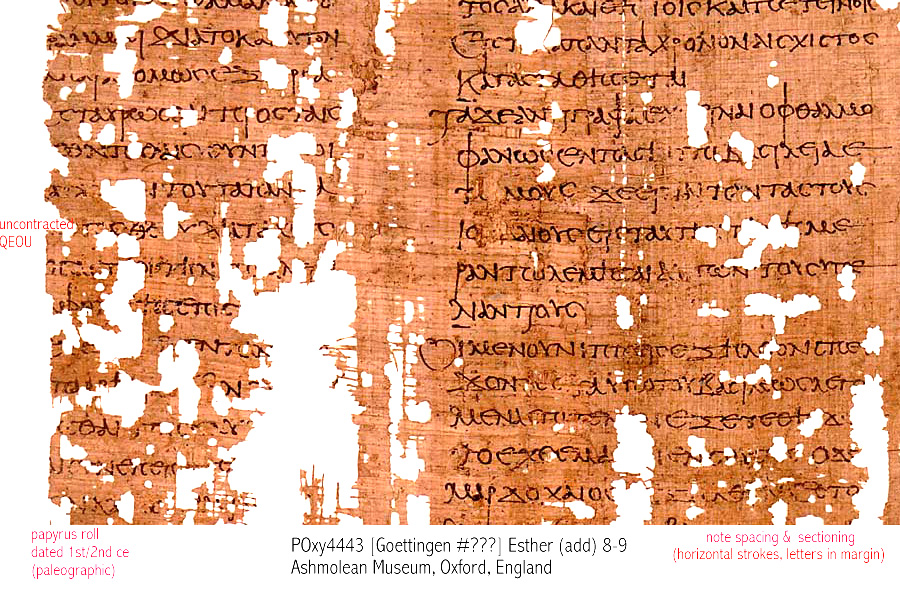
POxy4443
of Esther E + 8-9 (1st/2nd ce, papyrus roll; paragraphing,
ekthesis, spacing),
PFouad 203 prayer/amulet? (1st/2nd ce, papyrus roll) [no image yet]
[vh911]
P.
Oxy.
3.405. Irenaeus, Adversus Haereses. Van
Haelst 671; papyrus roll (7 fragments), ca 200 ce. [LDAB 2459]
P. Oxy.
10.1228v. John 15-16. Van Haelst 459. papyrus roll (|, -- blank) 3rd c.
[LDAB
2779]
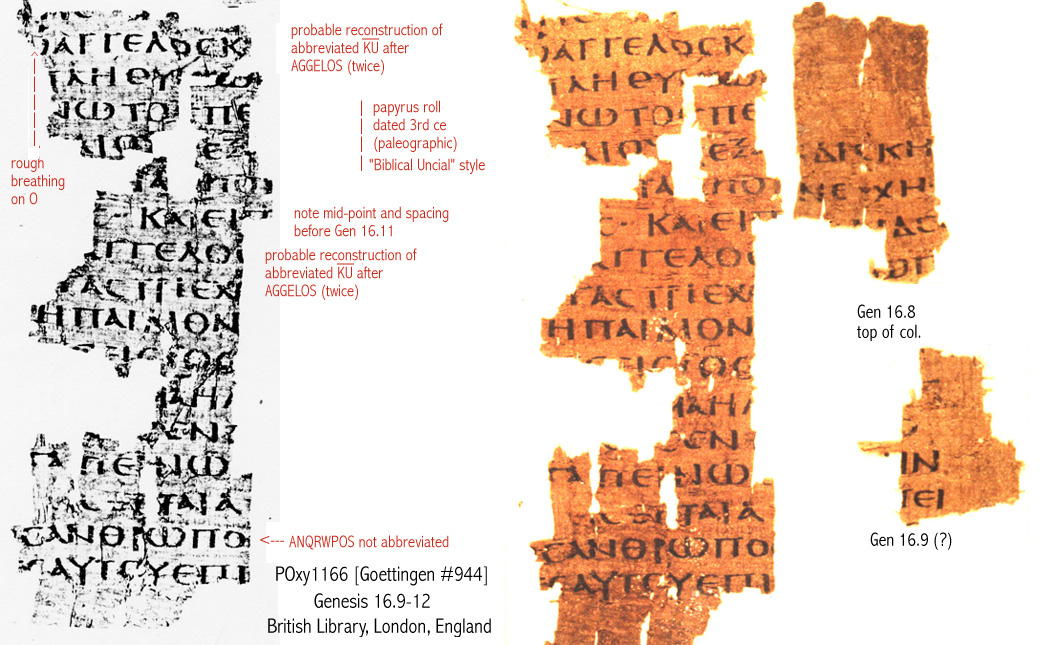
P. Oxy.
9.1166.
Genesis 16. Van Haelst 14. papyrus roll (--, | blank) 3rd c. [LDAB 3114]
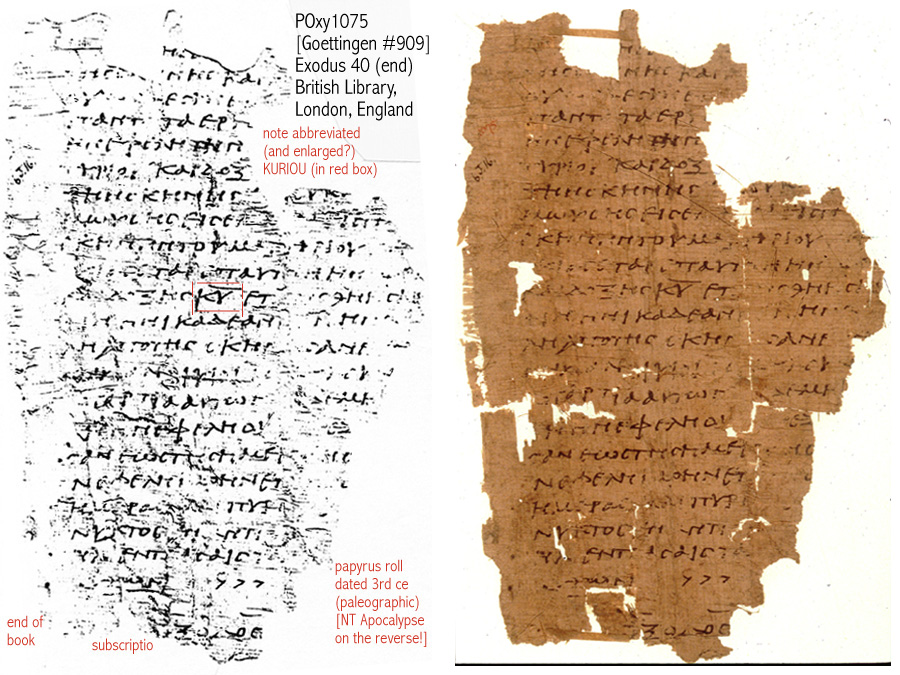
P.
Oxy. 8.1075 & 1079. Exodus 40.26-32 (--; nom sac KS), 3rd
ce; other side (|) has
Apocalypse 1.4-7 in a different hand .Van Haelst 44,
559; 3/4th ce. [LDAB
3477 & 2786]
Stud. Pal.
11.114. Psalms 68/69, 80/81 (Symmachus ?). Van Haelst 167. parchment
roll (--, | blank) 3/4 c. [LDAB 3492;
nom sac tetragrammaton]
++
Leiden, Private collection Scherling 126 + Cairo, IFAO Copte 379. Coptic Ascension of
Isaiah. 3/4th c. [LDAB
107888]
P. Lit. Lond.
207. Psalms 11-14, papyrus roll (--, 3/4 ce); other side (|) has
Isocrates [M-P 1245]. Van Haelst 109. 3/4th
c. [LDAB
3473]
P.
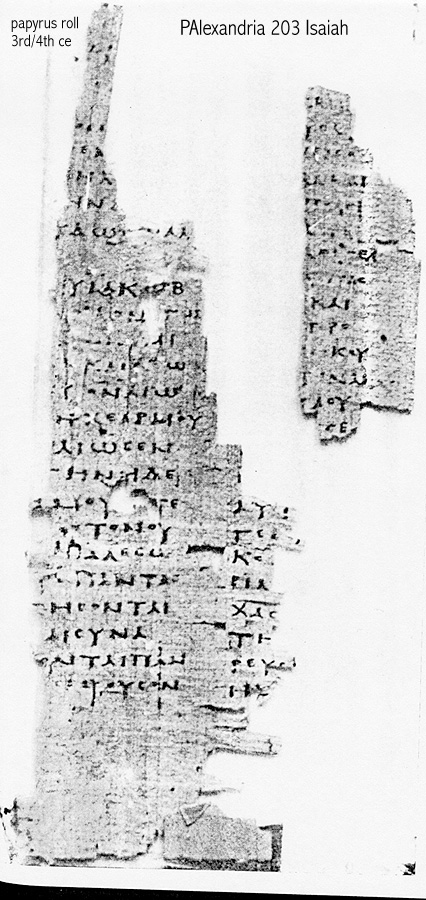
Alex. Inv. 203. Isaiah 48. Van Haelst 300. papyrus roll (--, |
blank) 3/4th c. [LDAB 3127;
nom sac KS]
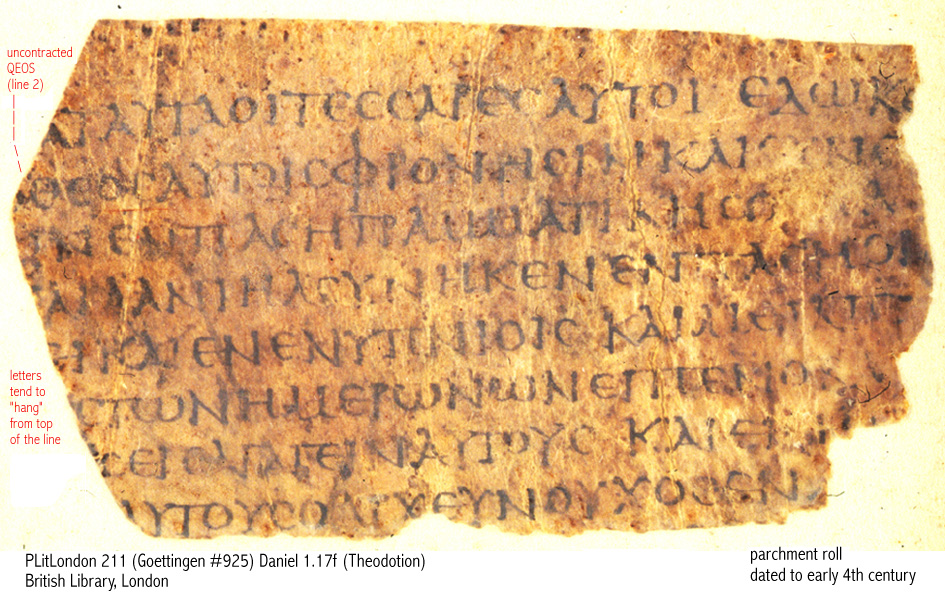
P.
Lit. Lond. 211. Daniel 1 (Theodotion) [reused in cover of a Sahidic
codex]. Van Haelst
319. early 4th c. parchment roll (other side blank) [LDAB
3493]
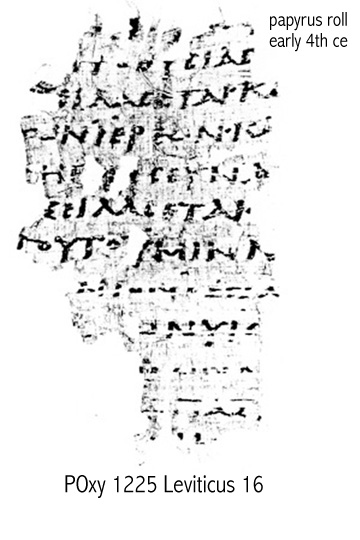
P.
Oxy. 10.1225. Leviticus 16. Van Haelst 48. papyrus roll (--, |
blank) 4th c. [LDAB 3185]
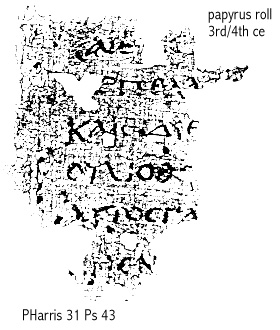
P.
Harr. 31. Psalms 43. Van Haelst 148.papyrus roll (--, | blank)
4/5th c.
[LDAB
3198]
Stud. Pal. 15.234.
Psalms 9. [roll or sheet?] Van Haelst 104. papyrus (--, | blank) 5/6th
c. or later [LDAB
3295]
Van Haelst catalog evidence ala R&S 42ff: "Apocrypha" -- both
manuscripts of the Gospel of Thomas are
rolls;
so too is the so-called
Fayum Gospel and an Oxyrhynchus
fragment dated to about C.E.
200 and now
plausibly assigned to the [[subsequently??]] banned Gospel of
Peter, while a roll is
also the
format of the only surviving manuscript of the Greek Diatessaron.
Shepherd of Hermas roll and oposthograph; of early patristic texts 6, including 3 manuscripts of
Irenaeus,
are rolls
In
view
of the persistent use of the roll in the liturgy of the Eastern Church
(see
below, p. 51, n. 6[[??]]) it is not surprising that 6 of the 11 texts
in the
Liturgical
section are on rolls.
In
the miscellaneous section we have 16 rolls
and 21 codices; the rolls (if we ignore 2 the nature of which is quite
uncertain) are all treatises or homilies (only one is opisthograph),
and their
significant proportion testifies to the maintenance of the literary
tradition.
[Philo (4) and Josephus (1) are codices, no scrolls]
\n/ The
following are reused scrolls on which the Jewish or Christian material
is secondary:
P. Mich.
130.
Hermas, Shepherd.
Van Haelst 657. (written on verso of a 2nd c. land register). [LDAB 1096]
P.S.I. 8.921v.
Psalms 77 [on other side of register of Arsinoite diagrafai from 143-144 = PSI
8.921r]. Van Haelst 174. 2nd/3rd c. [LDAB 3088]
++ Cairo, IFAO P. 237 b. Revelation 1.13-20.
Back of a used roll. 2/3rd
c. [LDAB
2776]
P. Oxy. 4.657
+ P.S.I. 12.1292. [P\13] Hebrews 2-5, 10-12; on back of P.Oxy. 668 Livy
epitome
(--, 3rd c) = LDAB 2574.
Van Haelst 537. papyrus roll (|, 3/4th c.) [LDAB
3018]
P. Lond. Inv. 2584
[10825]. Hosea-Amos Greek-Coptic glossary (|) on other side of a
papyrus scroll with a land
register (--, c 200 ce]. Van Haelst 286. 3/4th c. [LDAB
3141]
P. Lips. Inv.
39. Psalms 30-55 (almost complete in 35 cols., | of roll; on other side
(--) of
accounts from up to 338 ce = "P.
Lips. 1.97"].
Van Haelst 133. paprus roll, 4th c. [LDAB 3168]
Statistics and related details for the unusually extensive use of the
codex for Jewish and Christian texts prior to the 4th century are
provided by most of the works that deal with the codex developments.
Roberts took this approach already in his classic 1954 essay, and the
articles that led up to it. But apart from Treu, little attempt has
been made to isolate those early codex fragments that on the basis of
content might be claimed as Jewish. That list
is not insignificant or unimpressive, and includes the following
extra-biblical materials:
deuterocanonicals
(Tobit)
Philo
Josephus
Jannes-Jambres
Onomastica
Why did the codex catch on so relatively quickly with Christians? A
number of hypotheses have been offered:
1. The Gospel of
Mark was the catalyst (Roberts 1954, 187-191):
"The papyrus codex must have been an imitation of the parchment
notebook and this, as we have seen, was of Roman origin and was used in
Italy at a time when it was unknown in Egypt and (as far as we know)
elsewhere in the East. The first two generations of Christians may be
described in general as literate but not literary, and the form in
which their writings circulated would have been quite uninfluenced by
the practice of the Greco-Roman book trade. If we may make the common
assumption that the second Gospel was the first to be written and that,
as tradition records, St. Mark reduced to writing his own or St.
Peter's reminiscences before or not long after St. Peter died in Rome,
we can take the argument a stage farther. The circle in which he moved
in Rome -- Jewish and Gentile traders, small business men, freedmen or
slaves -- would use waxed tablets or parchment notebooks for their
accounts, their correspondence, their legal and official business, and
it would [[188]] be natural that St. Mark should use the same format
for a work intended to be copied but not to be published as the ancient
world understood publication. The Christian papyrus codex which we know
from the early second century must have had a parchment predecessor and
this is more likely to be traced to Rome than elsewhere. In Christian
circles there the Jews would be accustomed to leather rolls of the Law,
and at this early date St.Mark's reminiscences would scarcely be
thought of as a complement, let alone a rival, to the Law. Moreover, we
know from Jewish sources\1/ that while the Oral Law, the Mishnah, could
not be formally published in writing, isolated decisions or rabbinic
sayings might be and were put down on tablets (PINAKES) or on what the
Mishnah calls 'small private rolls'.\2/ The Jews would be accustomed to
the former since Jewish children started their education as did Gentile
children on tablets and continued to use them for private
memoranda. So the disciples of Jesus would write down His sayings as
part of the Oral Law either on writing tablets or on small rolls: a
decision quoted in the Mishnah,\3/ said to be not later than the middle
of the second century, mentions three kinds of tablet, that filled with
wax, that with a polished surface, and that made of papyrus, of which
only the second fulfils the ceremoinal requirements. This usage, while
it does not explain the exclusive use of the codex by Christians in the
second century, since the small roll might equally well have been
employed, makes it easier to understand why they adopted the parchment
notebook when they met it in Rome."
Problems:
1. Origin of parchment notebook is necessarily Rome? See earlier
discussion.
[Skeat 54] If
--
which is by no means certain -- the
papyrus codex was a development from the parchment notebook, we have
first to
consider where the parchment notebook itself originated.
We have already seen strong reasons for
thinking that it was of Roman origin, and these are supported by the
fact that
the earliest known examples of the parchment codex, the codices
mentioned by
Martial and discussed above, were Roman, while the very word codex is
Latin and
has no Greek equivalent.\139/ Conversely, there is no trace of the
parchment
notebook being used for literary purposes in the only Eastern country
for which
we have adequate evidence, namely Egypt.
All this suggests that we should look to Rome for the ultimate
origin of the papyrus codex and its adoption by Christians.
2. Such a
notebook not known in the east in late first century? Check
current evidence.
3. What do we know of the literacy of the first two Christian
generations? What languages, etc.?
4. What do we know of the "book trade" throughout that world, and how
is that relevant?
5. Relation of priority of Mark to earlier written sources. See below
on "sayings" as well.
6. What do we know of Mark, or Peter, in Rome -- circles in which they
moved, etc.?
[Skeat 54-55] If
we accept the common hypothesis that the
Gospel of Mark was the first to be written down, an explanation may be
forthcoming. Early tradition records
that Mark reduced to writing his own or Peter's reminiscences during
the
latter's lifetime or, according to some [[55]]
authorities, shortly after his
death,\140/ to meet the demands of those who had heard Peter preach.
Peter's auditors, whether Jews or Gentiles,
would be accustomed to use wax tablets or parchment notebooks and
notebooks for
their accounts, for legal and official business, and perhaps for
correspondence. It would therefore have
been natural for Mark to use the parchment notebook for a work intended
to be
copied in the same format for a limited and specialist readership, but
not to be
published as the ancient world understood.
7. How do we
know what Mark intended in relation to "publication"?
8. Why assume a parchment predecessor to Christian papyrus codex (Rome
setting)?
9. What do we know of the Jews of Rome in the first century? Languages,
texts, etc.
10. What relevance does rabbinic tradition have for Jews in this
period, especially in Rome?
11. What do we know about the education of Jewish children in Rome or
elsewhere at that time?
12. Why mention "sayings" of Jesus in this context? More to the point
for "Q" materials in Matthew and Luke!
13. What is implied in the last sentence? Choice of parchment as
distinct from approved Jewish materials?
"A late tradition associates St. Mark with the foundation of the Church
of Alexandria; whatever may lie behind this legend, there are
ceretainly grounds for thinking that the origins possibly, the
associations certainly, of the Alexandrian Church were western rather
than eastern.\4/ Supposing St. Mark's notebook to [[189]] have reached
Egypt, it woiuld have been copied on papyrus rather than on parchment
since the former was so much easier to come by. Why the notebook format
was retained and on material not at that time commonly used for such a
purpose it is harder to see. But we may guess that when his Gospel
circulated it already enjoyed a measure of authority, and so the form
itself, not least because, as the years went by, it stood in sharp
contrast both to the Jewish Roll of the Law and to the pagan book,
acquired a sentimental and symbolic value as well as a practical one.
This may seem far-fetched, but we have to explain why not merely the
Gospels but all distinctively Christian literature, Old Testament as
well as New, was copied and circulated in the codex form. Something
must have occasioned this breach with tradition and we may surmise that
it was the position enjoyed by the second Gospel as the earliest of
authoritative Christian writings to reach Egypt. Whatever the cause,
the process of adapting the codex form to receive all texts both of the
Old and the New Testament used in Christian communities in Egypt was
complete, as far as our present evidence goes, before the end of the
second century if not earlier. For the second Gospel (or any other
Christian writing) to establish itself and, once established, to
exercise so marked an influence on other Christian literature (even on
the third Gospel and Acts whose original format would certainly have
been the roll) must have taken time; so universial is the use of the
codex by Christians in the second century that the beginnings of this
process must be taken back well into the first century. For religious
history it is significant that Christian book production should have
severed itself from Jewish by the middle of the second century; for
even if the occasional use of the writing tablet by the Jews for
recording the Oral Law influenced the first generation of Christians in
their choice of the codex, yet the transcription of the Pentateuch on
to the codex shows how complete the severance was. It is worth noting
that the practice of writing in double columns, which is often said to
be characteristic of early codices\1/ and an indication that the book
in question had been directly copied from a roll, is found more
frequently in Christian manuscripts of the fourth century than in those
of the second or third, and is commoner in manuscripts of the Old
Testament (as would be expected if our [[190]] argument is correct)
than in those of the New; six of the eight biblical papyri of the
second century are written in single columns.\1/"
Problems:
1. What evidence is there for strong western associations of
earliest Alexandrian Christianity?
[Skeat 55] A
late tradition, preserved by Eusebius
and Jerome\142/ associates Mark with the foundation of the Church of
Alexandria,
and the connections of this
Church, when it emerges into the light of history, are with the West
rather
than the East.\143/ If the Gospel of Mark, in the form of the parchment
notebook
postulated above, had reached Egypt, it is likely that it would have
been
copied on papyrus, so much more readily available than parchment, and
the papyrus
codex might thus have been created.
[Roberts (1979) 44] The long historical contacts between Palestine and
Egypt and the close religious associations between Alexandria and
Jerusalem need no emphasis; but in themselves thay are not sufficient
to make it plausible that the system of nomina sacra originated in
Jerusalem and thence spread to Egypt and everywhere where Greek was
written.\fn on Antioch/ There are more compelling reasons which point
in t his direction. [Discusses "name" theology emphasis.]
2. Is it so
clear that papyri notebooks were not developed by ca 100 ce?
3. Mark is not alone as a proto-canonical early Christian writing; how
did all such
writings come together to be influenced?
4. No evidence that Christian choice of codex was intended to
differentiate from Jews and pagans.
5. How is it possible that Mark could influence all Christian practice
already in the late first century!?
[See further below, on Skeat's
evaluation of the Mark hypothesis]
6. If
Luke-Acts was originally two scrolls, what about Matthew, John,
Hebrews, Revelation, etc.?
7. What if Greek Jews already were using the Pentateuch in codex form?
8. Is the two column format argument of any value at all?
"Such a hypothesis of the origin and influence of the second Gospel, or
of the first two Gospels, if we accept the possibility that the first
was written on tablet form under Jewish influence,\2/ would go
some way to solve the problem set by the early Christian codices from
Egypt; it may even receive some support from the New Testament
itself. Firstly, we may note that, if we believe St. Mark's Gospel to
be incomplete, the loss is more intelligible if the original was
written in a codex, since in a codex the last leaf is the most exposed
to damage while the last column of a roll is the best protected.\3/
Secondly, we have noted that membranae
in Latin commonly denotes the parchment notebook and that there is no
exact equivalent in Greek since DIFQERAI would denote parchment rolls.
When therefore St. Paul\4/ asks Timothy to send him TA BIBLIA, MALISTA
TAS MEMBRANAS there is every reason to think that he is using the Latin
word in the Latin sense. The BIBLIA would be books in the then accepted
sense, perhaps rolls of the Septuagint, and the importance he attaches
to the MEMBRANAI makes it unlikely that they contained jottings of a
practical nature, lists of addresses, and the like. They may have
contained drafts for his own work, but it is at least possible that the
book in question was one of the earliest Christian writings. Among
[[191]] such would have been a Book of Testimonies, i.e. and anthology
of passages of the Old Testament, which could be used to support
Christian claims, but the possibility that it was the second Gospel or
a predecessor of it cannot be excluded.\1/"
Problems:
1. Note the injection of Matthew into the discussion, without reference
to "Q" possibilities (even in the footnote)!
2. The possibly lost ending of Mark probably tells us nothing about the
original form of that work.
[Skeat 55] That Mark’s original
manuscript was in
codex form is independently suggested by the text of the Gospel itself.
If the
Gospel as we have it is incomplete, as it was clearly thought to be in
the ancient
world, the loss of the ending is much more intelligible if the
manuscript was a
codex, since the outermost leaves of a codex are the most exposed to
damage, in
complete contrast to the last column of a roll, which being in the
interior of
the manuscript when rolled up is the best protected. \141/
3. Is the last
column of a roll necessarily the best protected?
4. How much mileage is possible from MALISTA, which Skeat reads
(unconvincingly) as an equals sign?
5. The contents of these MEMBRANAI is entirely conjectural, although
the Testimonies anthology merits closer exploration.
6. Pauline origins of the passage in 1 Tim (even if Paul did not write
1 Tim -- see his note) is unnecessary for the passage to be relevant,
and TA BIBLIA need not refer to scrolls.
Overall evaluation -- Skeat 55-57:
The
foregoing is the hypothesis put
forward in the predecessor of the present work,\144/ but it must be
admitted
that
the arguments [[56]]
against
it are formidable. In the first place it
is hard to see why the notebook format should have been retained in
conjunction
with a writing material, namely papyrus, not at that time commonly used
for
such a purpose. The assumption would
have to be made that Mark's original manuscript, or copies of it in the
same
notebook format, already enjoyed a measure of authority when they first
reached
Egypt, and that the codex format itself thus acquired a symbolic value,
not
least because it stood out in sharp contrast both to the Jewish Roll of
the Law
and to the pagan book; and that for these reasons when it came,
inevitably in
Egypt, to be copied on papyrus, the codex format was preserved.
A second
objection is that the obscurity of the early history of the Church of Alexandria
makes it difficult to believe that it could have imposed this novel
form on
other churches.\145/ Either Rome or Antioch would have been more likely
to have
been able to exert such influence. Nor
does the fact that the fortunes of discovery have brought to light
early
Christian codices from Egypt
and virtually none from anywhere else prove that the papyrus codex was
of
Egyptian origin. Moreover, the
suggestion that it was the Gospel of Mark which provided the
inspiration for the
codex is itself difficult to accept.
Despite the fact that there is more detailed tradition relating
to the
date and circumstances of composition of the Gospel of Mark than there
is for
any of the others (though in this early tradition there is no allusion
to
Alexandria), this is the very Gospel which has been described as the
'least
read and esteemed in the early Church.'\146/ Not only is this so in the
early
Church generally, but in Egypt in particular, in spite of the alleged
association of Mark with the See of Alexandria, no manuscript of the
second
Gospel earlier than the fourth century has so far been discovered
there, with
the single exception of the Chester Beatty codex of the four Gospels
and
Acts. This position contrasts sharply
with eleven copies of John, nine of Matthew, and four of Luke from the
same
first three centuries.\147/ The Coptic evidence makes it plain that
this
cannot
be explained as an accident of survival: in Coptic manuscripts of the
fourth
century [[57]] there
are 60 quotations from Matthew, 15 from Luke, 15 from John, and none
from Mark.\148/
A Gospel which was so largely ignored, and of which the original
manuscript [[or at least an early MS]] was
in all probability so neglected that it lost its final leaf, is
unlikely to
have set the standard for the Christian book.
2. The logia of
Jesus were recorded in notebook codices, and became a model
(Roberts 188-189 [see above]; Lieberman
205; Skeat
58-60)
The
claims
of Antioch\155/ for at least some part in the origin of both nomina
sacra and the codex are strong. It
was one of the principal places where Jewish
Christians, dispersed from Jerusalem after Stephen's death, sought
refuge,\156/
and
where
some of them, Jews from Cyprus
and Cyrene
(and
thus likely to possess
[[59]]
a knowledge of Greek) preached the
Gospel to the Greek-speaking section of the local population.\157/ More
important, it was in this center of Greek culture that the breakthrough
of the
mission to the Gentiles took place. The
missionaries to the Gentiles would have needed Greek manuscripts,
initially
perhaps only of the Septuagint. Obviously
these manuscripts, intended for Gentile consumption, cannot have
made
use of
the Hebrew tetragram for the Name of God, and the necessity to find an
alternative may have led to the invention of the nomina
sacra.\158/ But we
still have to explain the apparently simultaneous emergence of the
codex. We know from Jewish sources\159/
that
while the
Oral Law, the Mishnah, could not be formally committed to writing,
isolated
decisions or rabbinic sayings might be, and were, written down either
on
tablets (PI/NAKES) or on what the Mishnah calls 'small private rolls.'
Since Jewish children, like Gentile children,
started their education on tablets and continued to use them for
memoranda,
these would have been familiar everyday objects. A
decision quoted in the Mishnah\160/ said to
be not later than the middle of the second century, mentions three
kinds of
tablets, those filled with wax, those with a polished surface (like the
ivory
tablets of the Romans) and those of papyrus, of which, however, only
the second
fulfilled the ceremonial requirements. There
was a large Jewish community in Antioch from Hellenistic times
onwards, and
tablets of the kinds just mentioned, including tablets of papyrus,
would have
been in common use amongst the Jews there.
It is possible, therefore, that papyrus tablets were used to
record the
Oral Law as pronounced by Jesus, and that these tablets might have
developed
into a primitive form of codex. To the
records of these logia might have
been added an account of the Passion, and the way would be clear for
the
production of a Proto-Gospel.\161/ [[60]]
Once the
Jewish War
began, the dominating position of Antioch as the metropolis of
Christianity
in the
Greek-speaking world would have been unchallenged, and any development
of the tablet
into the codex is most likely to have taken place here, thus laying the
foundation of the city as a centre of biblical scholarship. If the
first work to be written on a papyrus
codex was a gospel, it is easy to
understand that the codex rapidly became the sole format for the
Christian
scriptures, given the authority that a gospel would carry.
Problems:
1. Picture of
Antioch is based on Acts accounts, otherwise mostly on silence;
Jerusalem is mentioned as another possibility, but is not explored in
depth. Caesarea is not mentioned, while Rome and Alexandria are
dismissed.
[Roberts (1979) 49] In the preceding
chapter we have found reason to think that Christianity reached Egypt
from Palestine in a form strongly influenced by Judaism.
[Roberts (1979) 71] The original Christian mission to Egypt, addressed
to the Jews and particularly to the Jews of Alexandria, came from the
Church in Jerusalem. This mission miscarried, its task becoming
increasingly difficult as relations between Jews and Greeks and Jews
and Romans became exascerbated; it was closely identified with Judaism,
all the more so because the gospel that reached Egypt was Jewish in
emphasis rather than Pauline. It persisted, however, and spread slowly
and a tradition of scholarship, once established in the favourable soil
of Alexandria, took root early and may well have had an unbroken
existence up to the time of its flowering at the end of the second
century. Then, when the link with Judaism was snapped in the twenties
of the second century, the suppressed energies of the church found
expression in a variety of directions. We may surmise that for much of
the second century it was a church with no strong central authority and
little organization . . . [to explain the "gnostic" direction taken by
some)].
2. Earlier
discussion of nomina sacra
neglects possibility of Jewish uses. Is nomina sacra development a mark of
centralized influences in early Christianity, along with codex?
[Roberts (1979) 46] Everything would
fall into place were we to assume that the guidelines for the
treatment of the sacred names had been laid down by the Church at
Jerusalem, probably before A.D. 70; that would carry the authority of
the leaders of the Church as the first Gospels must have done. The
system was too complex for the ordinary scribe to operate without
either rules or an authoritative exemplar; otherwise the difficulty of
determining which was a secular, which a sacred usage would have been
considerable even in a small community.
3. Largely
undocumented use of later rabbinic Jewish materials is problematic.
4. Any evidence for "tablets of papyrus" being used in Jewish Antioch?
5. Antioch theory fails to account for other Jewish and Christian
writings taking on codex form.
3. The Letters of
Paul circulated in codex format and became the model:
Gamble,
Trobisch
A case for Paul's letters, or a collection thereof, as the model
that led to Christian favoring of the codex format depends on showing
that long letters may have taken the form of codices in the century
between 50 and 150 ce. [The format of Marcion's collection of Pauline epistles is unknown.]The earliest surviving copy of the Pauline
corpus is in codex form, and normally dated paleographically to about
the end of the 2nd century. It seems clear that rigid surface codices
were used for letter writing (including drafts) and delivery from a
very early period, although surviving examples are few. The Jewish
letters of Bar Kokhba found in the Dead Sea area dating to around 135
ce are mostly single sheets of papyrus, and one of a wooden slat with
two columns of writing folded into four sections (see above). They bear
little resemblance to either rigid or flexible codices. Augustine is
thought by Roberts and Skeat (24 n.67) to have written letters in codex
form (Ep. 171 to Maximus), although the passage they cite is at best
ambiguous, mentioning only that Augustine writes quickly and on papyrus
to close associates.
Evidence for papyri letters (not school exercises) prior to 4th century
is plentiful, but mostly they are short, written on only one side of
the papyrus. APIS lists hundreds, but the search criteria are limited.
The following are on LDAB.
- PMich 18.763
[LDAB
5071] on back of an
accounts roll; 2 cols, papyrus, letter or homily, Paul 1 Cor 2.9;
Matt 8.20 = Luke 9.58, found at Karanis (2/3rd c)
- POxy 43.3106 [LDAB 7099] letter of Severus Alexander, later
included in Digesta 049 1 25, in Greek, roll (3rd c)
- P. Hibeh 2 232 [LDAB 5213] official letter or document, papyrus
sheet (other side reused; 3rd c)
4. Anthologies of
Jewish scriptural passages in codex form were
developed early on (see
Roberts 191)
This might follow the "scholia" model
in the Greco Roman world; see also Philo "Questions"
5. Greek Jewish
scriptural codices were available by ca 100 ce.
Perhaps for study purposes, also in
connection with textual notes such as "scholia"
More adequate
explanations are needed for:
1. Presence of codex format for almost all types of Jewish and
Christian works by 3rd century --
- Jewish scriptural writings clearly were in
scroll format in first
century ce
- Some early Christian writings apparently started out in scroll
format (Luke-Acts, Matthew, Hebrews?)
- The earliest evidence for Jewish and Christian codices comes from
Egypt
2.
Means of
book production among early Christians (private copies? booksellers?)
3. Relation of genres of materials (memoirs, letters, historical
narrative, record of revelation, law) to formats
Elizabeth Meyer (2007) argues for the
codex developing in Egypt in imitation of legal documents, basing her
arguments mainly on the physical dimensions of the legal (wood, wood
and wax) tablet codices, combined with "an aggressively anti-Jewish
stance" (326-328). "The argument here is that second-century Egyptian
Christians, when they looked to commit their traditions to writing,
were actively looking for a prestigious and authoritative form that
could preserve and convey authoritative versions of sayings and stories
of the authoritative master, Jesus. they found it in the Roman wooden
legal diptych, which was neither the papyrus scroll (nor parchment
codex) of [[318]] Greek and Roman literature, nor the leather roll of
Jewish law, and made it their own first by using papyrus, then by
slowly changing it according to their own needs and desires" (317-318).
Her arguments are to me unvonvincing not only because of weaknesses in
her description of early Egyptian Christianity, but mainly because the
Roman legal tabulae have little similarity to early Christian codices
beyond the ratio of external dimensions (many of the tabulae have
writing in horizontal relationship on the inside, and in transversa
[along the short side] on the outside; she bases her argument on the
outside [visible] format and dimensions).
Literature on grammarians may be useful:
See
Catherine M. Chin, Grammar and Christianity in the Late Roman World. Philadelphia: University of Pennsylvania Press, 2008. Pp. 272. ISBN 10: 0-8122-4035-9. ISBN 13: 978-0-8122-4035-1. $59.95.
Reviewed by M. Shane Bjornlie, Claremont McKenna College (sbjornlie@cmc.edu)
[note 2] Some of the more luminous works which have brought into sharp focus the rich texture of the history of late-antique education are
R. A. Kaster, Guardians of Language: The Grammarian and Society in Late Antiquity. Berkeley: University of California Press, 1988;
Raffaella Cribiore, Gymnastics of the Mind: Greek Education in Hellenistic and Roman Egypt. Princeton: Princeton UP, 2001;
Edward J. Watts, City and School in Late Antique Athens and Alexandria. Berkeley: University of California Press, 2006; Anthony Grafton and Megan Williams, Christianity and the Transformation of the Book: Origen, Eusebius and the Library of Caesarea. Cambridge: Belknap Press, 2006; and
Raffaella Cribiore, The School of Libanius in Late Antique Antioch. Princeton: Princeton UP, 2007.
4.
Jewish practices, especially in the Greek world, but also in semitic
contexts.
5. The location and organization needed for an initial impetus to
become virtually universal.
Appendix on tablets and tablet codices [in process]:
Using M-P3, the Paraliterary
Papyri data bank,
and Cribiore's
catalog, here is a list of known tablet codices,
arranged roughly chronologically: It is not always possible to
determine whether a wood slat was used independently, or whether it was
hinged to one or more other slats -- the summary descriptions (e.g. in
Cribiore) do not always indicate whether hinge holes are present.
M-P distinguishes between "tabula lignea" (92, 14 before 100 ce) and
"tabula
cerata" (46, 5 before 100 ce), further complicating the task of
determining when a rigid codex is represented. [Check Meyer's lists.]
[Not in M-P or Cribiore?]
University College London 36088-89 The earliest surviving Greek
tablets, seven
in
number, date
from the middle of the third century bce. All surfaces [[both
sides]] were
covered with wax,
sometimes black, sometimes red; they contain rough accounts of expenses
during
a journey on the Nile -- see H.
I. Bell and Flinders
Petrie, Ancient Egypt
3 (1927) 65-74. For photographs of three of
these tablets see Petrie, Objects of Daily Use (1927), pl.
lix. One is reproduced in Roberts & Skeat as Plate
I [horizontally hinged (holes)].
M-P 0430 [Crib
182=XIX] BKT 5.2.98 (inv.
17651) Euripides (1st c) [vertically hinged
(holes)]
M-P 1436 [Crib 381] T.Berol. inv.
14283 Posidippus & Elegy (1/2nd c
diptych)
M-P 1166.1 PBingen 8 (T.Mil.Vogl. inv.
8) Homeric scholia minora (first
part 2nd c)
M-P 1191 [Crib 329] Homeric Lexicon (2nd c) [hinge holes]
M-P 1196 [Crib 328] TBerol 10510 Homeric Lexicon (2nd c)
M-P 1198 [Crib 326-pl] TBerol 10508 Homeric Lexicon (2nd c) [hinge holes]
M-P
1199 [Crib 327-pl] TBerol 10509 Homeric Lexicon (2nd c) [hinge holes]
M-P 2713 [PP 0281 LDAB 2642 Crib 383] school text (waxed wooden diptych 2nd c)
M-P 2738 [PP 0362 LDAB 5007 Crib 384] Berlin
(now lost) school
exercise, declension (4 wooden waxed tablets [only 2 inscribed; sides
4-5] 2/3rd c)
M-P 1765 [Crib 202] TBM 29527
Epigrams (2/3rd c)
M-P 2739.01 TBerol 10506 fractions table
(2/3rd c)
M-P 0174 + 0491 [Crib 386] Babrius Fables
(7 tablets, both
sides 3rd c)
M-P 1882 [Crib 139] PRossGeorg 1.13 Maxim in
verse (3rd c)
M-P 2732 [PP 0255 LDAB 2418 Crib 388] Ps 46,
school text, grammar, Homerica (7 wooden tablets vertical, late 3rd c;
various hands)
M-P 2712 [PP 0278 LDAB 5315 Crib 385] Lond BM 37533
school word
lists (8[9] wooden tablets 3rd c; two student hands, both sides; ##6-8
blank; "pages" numbered both sides)
M-P
2731.1 [Crib 389] TBorely 1564-1567 (4 waxed tablets 3/4th c)
M-P 2758 BM 33270 commentary (3/4th c)
M-P 2643.12 [PP 0313 LDAB 5587] Paris
school word list
(5 wooden waxed tablet 3/4/5th c; two hands)
M-P 1886 [PP 0124 LDAB 5613 Crib 392]
PBrookl 31 Achilles
story (3 wooden tablets 4th c [3rd Goodsp]; final page only, unpracticed
schoolhand)
M-P 2736.01 [PP 0277 LDAB 2530 Crib 395]
Leiden
list of names (5 vertical wooden waxed tablets 4th c.;
waxed both sides)
M-P 1885 [0294 LDAB
5614 Crib 391] PBrookl 29 school word list (5 vertical wooden waxed tablets
4th c.[3rd Goodsp]; waxed both sides; teacher & student hands)
M-P 2736.23 [Crib 305] PLugdBat 25.16
acrostic poem (4th c)
M-P
2730 [Crib 399] alphabets & accounts (8 waxed tablets; 4th c?)
M-P 2643.11 [Crib 394] PFlor 18 misc (5
waxed tablets 4th c)
M-P 1619? [Crib 396 vanH 239] Louvre Menander, Ps
146, etc. (5 waxed
tablets [incomplete] 4th c; nom sacra)
Crib 397 [vanH 205] Ps 92 (2 waxed tablets;
4th c)
Crib 398 Leiden (2 vertical waxed tablets; mid 4th c)
M-P 2643.12 [Crib 400] PFlor 18 misc (5 waxed
tablets;
3-5th c)
M-P 2704.81 TBerol 17759 alphabets (4/5th c)
M-P 2643.16 [Crib 402] TWuertzburg 1013 arith, etc. (5 waxed tablets; 4/5th c)
M-P
2714 [Crib 401] BM 33368 gramm cases, portrait (8 waxed
tablets; 4/5th c?)
M-P
2737 [Crib 404-pl] T.Berlin 14000 (9 waxed tablets; 4/5th c or later;
Christian crosses, terms)
M-P 2704.81 TBerol 17759 alphabets (4/5thc)
M-P 2753.1 TVindob syllabaries (4/5th c)
M-P 2109 Numerology (not waxed; 5/6th c)
M-P 2274.2 TLouvre lists {byantine
epoch, 5/6th c?)
M-P 2310.01 TVatgr fractions (4 waxed
tablets, 6th c)
M-P 2753.11 TVindob tachygraph (8
waxed tablets 6th c)
M-P 2773 PHal 59++ tachygraphic syllabary
(6th c)
M-P 2773 PHal 59++ tachygraphic
syllabary (6th c)
M-P 2343.13 [Crib 407] TLouvre 913 arithmetic (4 waxed
tablets;
end 6th c)
M-P 2343.14 [Crib 408] TLouvre 914 arithmetic (10 waxed
tablets;
end 6th c; nom sac etc.)
M-P 2307.3 [Crib 320] TMoen 601
multiplication table (6/7th c)
M-P 2309.3 Crib 411 math stuff (3 waxed tablets; 7th c)
undated
M-P 1883.1 TBerol [no#] Gnomic (nd)
M-P 2710 [Crib 200] TBodl 159 writing
exercise? ("Roman period")
M-P 2742.01 TLeid 158 Alphabet (nd)
M-P 2161.2 TLouvre grammatical text
(byzantine epoch)
M-P 2161.3 TLouvre
exercises/conjugations (byzantine epoch)
M-P 2274.1 TLouvre lists {byantine
epoch)
M-P 2643.15 TPierMorg [no#] math
problems (5 wax tablets including one cover byzantine)
Bibliography:
Bibliography
and Abbreviations [indexed; new additions are preceded by a
"+"]
+Aland, Barbara. "The Significance of the Chester Beatty Papyri in
Early Church History," Pp. 108-121 in C. Horton (ed.), The Earliest Gospels: The Origins and
Transmission of the Earliest Christian Gospels -- the Contribution of
the Chester Beatty Gospel Codex P\45 (?? 2004)
Aland,
Kurt. Kurzgefasste Liste der griechischen
Handschriften des Neuen
Testaments (de Gruyter 1963) [02 & passim]
__, Repertorium der griechischen Christlichen Papyri: 1, Biblische
Papyri, 1976 [03, 38]
__. Studien
zur Uberlieferung des Neuen Testaments und seines Textes, p. 114
[n.103, n.117?]
+Alexander, L. "Ancient Book Production and t he Circulation of the
Gospels," pp. 71-111 in R. Bauckham (ed.), The Gospels for all Christians: Rethinking
the Gospel Audiences (?? 1998)
Archi, Gian Gualberto. Ivra: Rivista Internazionale di diritto
Romano e
Antico 12
(1961) 428-450 [nn.90, 92, 95]
Arns, E. La Technique du Livre d'après S. Jerome (Paris: De Boccard 1953) [nn.7,
68]
+Arvin, Leila. Scribes, Script and
Books: The Book Arts from Antiquity to the Renaissance (Chicago & London 1991)
+Ashton, J. The Persistence, Diffusion
and Interchangeability of
Scribal
Habits in the Ancient Near East before the Codex. PhD
Dissertation,
University of Sydney 1999.
Atsalos, B. La Terminologie
du livre-manuscrit à l'époque byzantine, 1e partie,
1971, pp. 148-176 [nn.133, 136]
+Bagnall, Roger S. Reading Papyri,
Writing Social History (London 1995)
+Bagnall, Roger S. "Jesus Reads a Book," JTS 51 (2000) 577-588.
+__. Early Christian Books in Egypt ( four lectures at the
E/cole Pratique des Hautes E/tudes, 2006; forthcoming).
+Bagnall and Cribiore, Raffaela. Women's
Letters from Ancient Egypt 300
BC-AD 800 (Ann Arbor 2006)
Bailey, D. R. Shackleton. Cicero's Letter to Atticus, vol.
v, no. 332, and commentary pp. 379, 380 [16 n.43]
+Barker, D. C. "A Comparative Anlaysis of Secular and Christian Codices
from Second Century Oxyrhynchus" [paper read at the 25th International
Congress of Papyrology, Ann Arbor, 31 July 2007]
+Beare, F.W. "Books and Publication in the Ancient World," University
of
Toronto Quarterly 14 (1945), 150-167
Bell, H. I. and W. Flinders Petrie, Ancient Egypt 3 (1927)
65-74 [n.28]
+Bell, H. Isdris. "Evidences of Christianity in Egypt during the Roman
Period," HTR 37 (1944) 185-208.
Bilabel, art. "Membrana" in Pauly-Wissowa, RE, [14]
Birt, Theodor. Das
antike Buchwesen in seinem Verhältnis zur
Literatur, mit Beiträgen zur Textgeschichte des Theokrit, Catull,
Properz und anderer Autoren (Berlin, 1882) [1 et passim]
__. Kritik und Hermeneutik nebst Abriss des antiken Buchwesens (Iwan v. Müller, Handbuch der Altertumswissenschaft 1.3
(München:
C.H. Beck’sche
Verlagsbuchh. 1913) [1 et passim]
__. Die Buchrolle in
der Kunst [25 n.75]
+Bischoff, Bernhard. Latin
Palaeography: Antiquity and the Middle Ages (Cambridge 1990)
+Blanchard, Alain. 1989. ed. Les débuts du codex: Actes de
la
journée organisée à Paris les 3 et 4 juillet 1985
par líInstitut de Papyologie de la Sorbonne et líInstitut
de Recherches
et díHistoire des Textes, Bibliologia 9 (Turnhout 1989).
+Bloom, Jonathan. Paper Before Print
(New Haven 2001)
+Bowman, Alan K. "The Vindolanda Writing-Tablets and the Development of
the Roman Book Form," ZPE 18 (1975) 237-252/
+Bowman, Alan K. Life and Letters on the Roman Frontier: Vindolanda and
its People (London 1984)
+Bowman,
A.K. and J. D. Thomas, Vindolanda:
The Latin Writing-Tablets (London, 1983), part 1.2 "Writing on Wood."
+__, with contributions by J.
N. Adams. The
Vindolanda Writing Tablets
(Tabulae Vindolandenses 11;
London 1994)
+Bowman, A. K. and J. D.Thomas, "New Writing-Tablets from Vindolanda," Brittania 27 (1996) 299-328.
+Brashear, William and F.A.J.Hoogendijk,. "Corpus Tabularum Litnearum Ceratumque Aegyptiarum," Enchoria 17 (1990)
21-54.
Browne, G. M.
'A new papyrus codex of the Sortes Astrampsychi', Arktouros:
Hellenic
Studies presented to Bernard M. W. Knox... 1979, pp. 434-439
[70]
+Brown, Michelle P. A Guide to
Western Historical Scripts from
Antiquity to 1600 (Toronto 1990)
Campenhausen, Hans von. The
Formation of the Christian Bible, 1972 [n.143, 63, 64, 66,
n.165]
+Capasso, Mario 1995. Volumen. Aspetti della tipologia del
rotolo
librario antico (Naples) [rev. Quaderni di Storia 44 (1996)
225-33, Rosa Otranto]
Cavallo, Guglielmo. 'La genesi dei rotoli liturgici Beneventani
alia
luce del fenomeno storico-librario in occidente ed oriente,' Miscellanea
in memoria di G. Cencetti, 1973, pp. 213-229 [n.136]
__. Libri, Editori e pubblico nel Mondo antico: Guida storica e critica
(Rome 1975) [2-3 & passim] [[1991
van pelt?!]]
+___ 1985. "La nascita del codice," SIFC ser. 3.111:
118-121.
+___ 1983. Libri Scritture Scribi a Ercolano. Cronache
Ercolanesi
supplement 1. Naples, 1983.
+___ 1992. "Le Tavolette come suppporto della scrittura: qualche
testimonianza indiretta," Pp. 97-101 in E/. Lalou (ed.) Les Tablettes
a\ e/crire de l'antiquite/ a\ l'e/poque moderne (?? 1992).
+___ (ed.) 1998. Scrivere libri e
documenti nel mondo antico (?? 1998)
+___ 1996. "Veicoli materiali della letteratura di consumo. Maniere di
scrivere e maniere di leggere," in O. Pecere and A Stramaglia, eds., Lat
letteratura di consumo nel mondo greco-latino (Cassino).
+Cavallo, G. and R. Chartier 1997. eds., Storia della lettura nel
mondo occidentale. / Histoire de la lecture dans le monde occidental
(Paris : Seuil).
Cavenaile, R. Corpus Papyrorum Latinarum 1958 [n.86]
Cencetti, G. 'Gli archivi dell' antica Roma nell' eta repubblicana,' Archivi
d'Italia, Ser. 2, 7 (1940) [n.33]
+Cerny, J. Paper and Books in Ancient Egypt (1952).
+Choat, Malcolm. Belief and Cult in
Fourth-Century Papyri (Studia Antiqua Australiensia 1; Macquarie
University - Turnhout 2006); reviewed by Roger Bagnall in BASP 43
(2006) 205-209.
+Citroni, M. 1988. "Pubblicazione e dediche dei libri in
Marziale," Maia
40: 3-39.
+___ 1989. "Marziale e la letterature per i Saturnali (poetica
dellíintrattenimento
e cronologia della pubblicazione dei libri)," ICS 14: 201-206
+Clark, John R. "Early Latin Handwriting and Plautus' Pseudolus," Classical Journal 97 (2001-02)
183-189
+Cribiore, Raffaela. Writing,
Teachers, and Students in
Graeco-Roman
Egypt (American
Studies in Papyrology 36; Atlanta 1996) [rev. CP
93.3 (1998) 276-79, W A. Johnson].
+__. Gymnastics of the Mind: Greek
Education in Hellenistic and
Roman
Egypt (Princeton 2001)
+__.
The School of Libanius in Late Antique Antioch. Princeton: Princeton UP, 2007
+Crisci, Edoardo. "Papiro e pergamenta nella produzione libraria in
Oriente fra IV e VIII secolo d. C. Materiali e reflessioni." Segno e
testo 1 (2003) 79-127
+Cugusi, Paolo. 1992. ed., Corpus Epistularum Latinarum
Papyris Tabulis
Ostracis Servatarum (Papyrologica Florentina 23) (Florence).
+Cuvigny, He/le\ne. "The finds of Papyri: the Archaeology of
Papyrology." Ch. 2 of The Oxford
Handbook of Papyrology, ed. R. S.
Bagnall (Oxford 2008 ?)
+Devijver, H., et al. "Eine lateinisch Holztafel in Leiden," OMRL 65
(1984/5) 19-22.
+Dimarogonas, A. D. 1995. "Pliny the Elder on the Making of
Papyrus Paper,"
CQ
45: 588-
+Diringer, David. The Book Before
Printing (NY 1982)
D'Israeli, Isaac. Curiosities of Literature (4 vols; London
[New York : A. C.
Armstrong, 1881]) [n.39]
+Dougherty, R. P. "Writing upon Parchment and Papyrus Among the
Babylonians and the Assyrians," Journal of the American Oriental
Society 47 (1928), 109-35.
Downey, Granville.
A History of Antioch in Syria,
1961, Chapter 2. "The Christian Community at Antioch from Apostolic
times to A.D.
284," [n.155]
Dziatzko, K. Untersuchungen über ausgewählte Kapitel des
antiken
Buchwesens: mit text, übersetzung und erklärung von Plinius, Nat.
hist. XIII 68-89 (Leipzig: Teubner 1900) [2 & passim]
__. 'Buch' and 'Buchhandel' in
Pauly-Wissowa, Real Encyclopädie [2]
+Elliott, J. Keith, "Manuscripts, the Codex, and the Canon," JSNT 63
(1966) 105-123.
+Elliott, J. Keith. The Collected
Biblical Writings of T. C. Skeat (NTS 113; Brill
2004)
+Emmel, Stephen. "The Christian Book in Egypt: Innovation and the
Coptic
Tradition." Pp. 35-43 in The Biblie as Book: The Manuscript Tradition,
ed. J. L. Sharpe and Kimberly van Kampen (London 1998)
+Epp, Eldon J. "The Codex and Literacy in Early Christianity and at
Oxyrhynchus." Pp 15-37 in Critical
Review of Books in Religion 1997,
ed. C. Prebisch (Atlanta 1997)
+Fo"rster, Hans. "Heilige Namen in Heiligen Texten." Antike Welt 33
(2002) 321-324.
+Fowler, Donald 1995. "Martial and the Book," Ramus 24:
31-58.
[see White 1996]
Galiano ii [n.113, with Wilcken]
+Gamble, Harry Y. The New Testament Canon: Its Making and Meaning.
New Haven/London: Yale University Press, 1985.
+__. Books and Readers in the Early
Church: A History of
Early Christian Texts (New Haven: Yale UP 1995)
+Gascou, Jean. "Lex codices documentaires E/gyptiens." Pp. 71-101 in Les
de/buts do codex, ed A. Blanchard (Turnhout 1989)
+Gelb, I. J. A Study of Writing
(1952)
+Grafton, Anthony, and Megan Williams. Christianity and the
Transformation of the Book: Origen, Eusebius, and the Library of
Caesarea (Cambridge MA 2006)
Giacchero, Marta. Edictum Diocletiani et Collegarum de
pretiis venalium (Genoa: Istituto di Storia Antica e Scienze
Ausiliarie 1974) [n.15]
Goodspeed, E..J. suggested
that the collection was the work of the slave Onesimus, placed the
event soon
after 85 C.E., [n.168]
+
Anthony Grafton and Megan Williams, Christianity and the Transformation of the Book: Origen, Eusebius and the Library of Caesarea. Cambridge: Belknap Press, 2006
+Hall, David D. 1997. Cultures of Print. Essays in the History
of
the Book (Amherst).
+Haran, Menachem. "Book-Scrolls in Israel in Pre-Exilic Times", Journal
of Jewish Studies 33:1-2, (1982), pp. 161-173.
+__. "Book-Scrolls at the Beginning of the Second Temple Period -- The
Transition from Papyrus to Skins", Hebrew
Union College Annual 54
(1983), pp. 111-122.
+__. "More Concerning Book Scrolls in Pre-Exilic Times", Journal of
Jewish Studies 35 (1984), pp. 84-85.
+__. "Bible Scrolls in Eastern and Western Jewish Communities from
Qumran
to the High Middle Ages", Hebrew
Union College Annual 56 (1985), pp.
21-62.
+__. "The Codex, the Pinax and the Wooden Slats", Tarbiz 57 (1988), pp.
151-164 [Hebrew with English abstract]
+Haines-Eitzen, Kim. Guardians
of Letters: Literacy, Power, and
the Transmitters of Early Christian Literature. New York: Oxford
University Press, 2000
+Harris, W.V., 1989. Ancient Literacy (Cambridge, Mass.).
+Hunger, H., O. Stegmüller, et al. Geschichte
der Textüberlieferung der antiken und mittelalterlichen Literatur (Zürich, 1961), especially pp. 47-51 (Hunger), 346-50 (K.
Büchner)
[[get titles]] [02]
+Hurtado, Larry W. The Earliest
Christian Artifacts: Manuscripts and
Christian Origins (Grand Rapids 2006)
Ibscher, H. 'Der Codex' in Jahrbuch der Einbandkunst 4 (1937)
3-15 [nn.10-11, 129]
+Immerwahr, Henry. 1964. Book Rolls on Attic Vases. In Classical,
Mediaeval and Rennaissance Studies in Honor of Berthold Louis Ullman.
Roma.
+Immerwahr, H. "More Book Rolls on
Attic Vases," ANTIKE KUNST 16 (1973)
143-147.
IVRA = Rivista Internazionale di
Diritto Romano e Antico (Italy)
+Jakab,
Attila. Ecclesia alexandrina:
Evolution sociale et institutionelle du christianisme alexandrin (IIe
et IIIe sie\cles) (Christianismes antiques 1; Bern 2001)
Johnson,
Richard R. The Role of Parchment in Greco-Roman
Antiquity (UCal dissertation 1968; University Microfilms, microfilm
and xerox).[5-6]
__. 'Ancient and Medieval accounts of the "Invention” of Parchment,' California
Studies in Classical Antiquity 3 (1970) pp. 115-122 [n.9]
+Johnson, William A. "Toward a Sociology of Reading in Classical
Antiquity." American Journal of
Philology 121 (2000) 593-627
+__. Bookrolls and Scribes in Oxyrhynchus (U
Toronto 2004) [coins term "voluminology"; review
by Silvia Barbantani in Classical Review 56 (2006) 485-488; review
by Efrosyni Stigka in Classical World 100 (2006) 67-69; review by
S. A. Stephens,
Bryn Mawr Classical Review 2005.01.04]
+Jones, A. The
Astronomical Papyri from Oxyrhynchus (Memoirs of the American
Philosophical Society 233; Philadelphia 1999). Nos. P.Oxy.
4133—4300a.
Jouanique, P.
'Le codex accepti et expensi chez Cicéron,' Revue
historique de Droit francais et étranger 46 (1968) 5-31.[n.32]
Judge, E. A. The Social Pattern of
the Christian Groups in the First Century, 1960 [n.170]
+
A. Kaster, Guardians of Language: The Grammarian and Society in Late Antiquity. Berkeley: University of California Press, 1988
+Katz, Peter. "The Early Christians' Use of Codices Instead of Rolls,"
JTS 46 (1945) 63
+Kenney, E.J. 1982. "Books and readers in the Roman world," in
E.J. Kenney
and W.V. Clausen, eds., The Cambridge History of Classical
Literature
Volume II: Latin Literature. Cambridge: 3-32.
Kenyon, F. G. Books and Readers in Ancient Greece
and Rome, 2nd ed., 1951 [nn.57,
76, pp.27, 40, n.113]
+Kilgour, Frederick G. 1998. The Evolution of the Book (Oxford).
Kleberg, Tönnes. Buchhandel und
Verlagswesen in der Antike (Darmstadt, 1969 [1967?]), especially "Exkurs
über die Buchherstellung und die Formen des Buches in der Antike" (69-86) [02-03]
Knox, John. who suggested that the collection was the work of the slave
Onesimus, placed the
event soon after 85 C.E. [n.165]
+Koenen, Ludwig. "Ein Mo"nch als Berufsschreiber: Zur Buchproduktion im
5/6 Jahrhundert." Pp. 347-354 in Festschrift zum 150 ja"hrigen
Bestehen des Berliner A"gyptischen Museums (Berlin 1974)
Koep, L. Das himmlische Buch in Antike und Christentum, 1952
[n.24]
+Kotsifou, Chrysi. "Books and Book Production in the Monastic
Communities of Byzantine Egypt." Pp. 48-66 in.Klingshirn and Safran
+Klingshirn,
W. E. and L. Safran (eds.). The Early
Christian Book (Washington
DC: Catholic University of America 2007)
+Kramer,
Johannes. "Antike Kanonbildung." Pp. 3-36 in W. Dahmen et al.
(eds.), Kanonbildung in der
Romanistik und in der Nachbardiziplinen (Romanistik Kolloquium
14; Tuebingen: Gunter Narr Verlag 2000)
+Krieg, W.
1974. ed., Kleine Schriften zum antike Buch- und
Bibliothekwesen
(Cologne)
Lassus, Jean. ‘Antioche à l’époque romaine:
Christianisme’ in Aufstieg
und Niedergang der römischen Welt 2.8 [[date]] [n.152]
Lefort, Th. "??" Muséon 66 (1953) 16 sq., quoted in Roberts, op. cit., p.
61, n.4. [148]
+[LDAB] Leuven Data
Base of Ancient Books (online at http://www.trismegistos.org/ldab/)
Lewis, Naphtali. Papyrus in Classical Antiquity (Oxford, 1974)
[05]
__. L'Industrie du Papyrus dans l’Egypte gréco-romaine (Paris,
1934) [05]
__. ??, Bulletin of the American Society of Papyrologists 11
(1974) 49-51 [n.34]
Lieberman, S. Hellenism in Jewish Palestine,
1950, Appendix III, 'Jewish and Christian Codices' [nn.159-160]
Lowe, E. A. C.L.A., 10 [nn.84-85]
__. 'Codices Rescripti: a list of the oldest Latin
palimpsests with stray observations on their origin,' Palaeographical
Papers 2, pp. 480-519 [17,
n.49]
Lührmann, D, in ZNTW 72 (1981), pp. 216-26 [n.116]
Marinates,
Minos, i, p. 40; [Marinates, Sp.
'Some
General Notes on the Minoan Written Documents.' In Minos, \
(1951), 39 ff.] [n.22]
Marquardt, Privatleben
der Romer 2 [n.10]
Marrou, Henri-Irénée. 'La technique de
l'édition à
l'époque patristique,' Vigiliae
Christianae 3 (1949) 208 sq. [n.68]
+
H. I. Marrou, A History of Education in Antiquity. Madison: University of Wisconsin Press, 1956.
+Marshall, A. J. 1976. "Library
Resources and Creative Writing at
Rome,"
Phoenix
30: 260-
McCown, C. C. 'Codex and Roll in the New Testament', Harvard
Theological Review 34 (1941) 219-250 [nn.1, 141]
__. ‘The earliest Christian books' in The Biblical
Archaeologist 6 (1943) 21-31 [n.1]
+McKitterick, Rosamond. The Carolingens and the Written Word
(Cambridge University Press 1989 )
+K. McNamee [identifying and grouping ancient libraries] Pp. 693-707 in Jaakko Froese/n, Tiina Purola, Erja Salmenkivi, Proceedings of the 24th International Congress of Papyrology Helsinki, 1-7 August, 2004. 2 vols. Commentationes Humanarum Litterarum, 122. Helsinki: Societas Scientiarum Fennica, 2007. Pp. 1075; pls. 34. ISBN 978-951-653-345-5.
Mertens, P. Proceedings
of the 12th International Congress of Papyrology, pp. 303-4
[nn.2-3]
Metzger, B, M. The Early Versions of the New Testament [nn.142,
163]
+Meyer, Elizabeth A. Legitimacy and Law in the Roman World: Tabulae in
Roman Belief and Practice (Cambridge 2004)
+Meyer, Elizabeth A. "Roman Tabulae, Egyptian Christians, and the
Adoption of the Codex," Chiron 37 (2007) 295-347
Montevecchi, O. La Papirologia, 1973,
pp. 360-363 [69]
Moule, C. The Birth of the New
Testament, 3rd ed., 1981 [n.141,
p. 63]
+Mratschek, Sigrid. "Codices vestri nos sumus: Bu"cherkult und
Bu"cherpreise in der christlichen Spa"tantike." Pp. 369-380 in Hortus
litterarum antiquarum, Festschrift fu"r Hans Armin Ga"rther zum 70
Geburtstag, ed. A. Haltenhoff and F.-H. Mutschler (Heidelberg 2000)
+Naldini, Mario. Il christianesimo in Egitto: Lettere private nei
papiri
dei secoli II-IV. (Fiesole1968, 1998\2)
+Norden, Edouard 1915. Die Antike Kunstprosa I3,
"Nachträge"
(Leipzig & Berlin)
+O'Donnell, James J. Avitars of the Word: From Papyrus to
Cyberspace
(Cambridge MA 1998)
+Oates, John F., Roger
S. Bagnall, Sarah J. Clackson, Alexandra A. O'Brien, Joshua D. Sosin,
Terry G. Wilfong, and Klaas A. Worp. Checklist
of Editions of Greek, Latin, Demotic and Coptic Papyri, Ostraca and
Tables (BASP Supplement 9, 2001; online at http://scriptorium.lib.duke.edu/papyrus/texts/clist.html)
Ohly, K. Stichometrische Untersuchungen, 1928, pp. 109-18
[n.128]
Pack, Roger A. The Greek and Latin Literary
Texts from Greco-Roman Egypt
(University of Michigan Press, 1st edition 1952, 2nd
edition 1965, here referred to as Pack-1 and Pack-2) [03 & passim
-- add Pack-Mertens]
Petrie, (W.M.) Flinders. Objects of Daily Life [sic, Use
(1927)] [n.28]
__. see also Bell
Pope, M. Annual of the British School at Athens 55 [1960] 201
[n.22]
Posner, E. Archives in the Ancient World [n.34]
Reed, R. Ancient Skins, Parchments and Leathers
(Seminar Press, 1972) [5,8]
__. The Nature and Making of Parchment, 1975
[[publ??]] [n.8,21]
Regemorter, B. Scriptorium 12 (1958) 177 ff. ('Le codex
relié à
1'époque néo-Hittite'
[n.23]
+Reynolds, L.D. 1983. ed. Texts and Transmission. (Oxford).
+Reynolds,
L. D.
and N. G. Wilson, Scribes and
Scholars: A Guide to the Transmission
of Greek and Latin Literature (Oxford 1978\2, 1991\3)
+Resnick,
Irven M. "The Codex in Early Jewish and Christian
Communities." Journal of Religious History 17 (1992) 1-17 [well
researched, with argument for "theological" considerations]
+
Pierre Riche/, Education and Culture in the Barbarian West: From the Sixth through the Eighth Century. Columbia: University of South Carolina Press, 1976.
Roberts, Colin H. The Codex. Proceedings of
the British Academy 40 (1954) 169-204 [passim]
+__. "Early Christianity in Egypt." Journal of Egyptian Archaeology 40
(1954) 92-96
__. Manuscript, Society and Belief in Early Christian Egypt
[n. 103]
Robinson, J. A. T. Redating the New Testament,
1976 [nn.140, 146, 150]
+Rossum-Steenbeek, Monique van 1998. Greek Readersí Digests?
Studies
on a Selection of Greek Sub-literary Papyri (Leiden) [rev. BMCR
98.6.29, Teresa Morgan].
Rudberg, G. Neutestamentlicher Text und Nomina Sacra,
Uppsala,
1915 [n.164]
Sabbe, E. 'Papyrus et parchemin au haut moyen age,' Miscellanea
historica in honorem Leonis van der Essen 1 (1947)
95-103.[n.18]
+Saenger, Paul 1997. Space between Words: The Origins of
Silent Reading
(Stanford: expands and supersedes his article, "Silent Reading: its
Impact
on late Medieval Script and Literacy" in Viator 13 [1982] 367-414.)
Sage, Evan T. "The Publication of Martial's Poems," Trans. Am.
Phil.Ass. ... (1919) [n.40]
Sanders, H. A. "The Beginnings of the Modern Book: the Codex," University
of Michigan Quarterly Review 44.15 (Winter 1938) 95-111 [02, n. 34
& passim]
__. 'Codices Librariorum,' Classical Philology 29 (1934)
251-252, [n.34]
Santifaller, L. Beiträge zur Geschichte
der Beschreibstoffe im Mittelalter mit besonderer Berucksictigung der
papstlichen Kanzlei, 1953, [nn.133,
135, 139]
Schönbauer, E. Ivra: Rivista Internazionale di diritto
Romano e Antico 12 (1961) 117-161 [nn.88, 95, 97]
Schubart, W. Das Buch bei
den Griechen und Römern (2nd ed., Berlin, 1921; 3rd ed., by E.
Paul, Heidelberg and Leipzig, 1961, adds some
illustrations, but omits the notes of the 2nd edition) [01 & passim]
+Seider, Richard. Pala"ographie der lateinischen Papyri (Stuttgart 1972)
+Sider, David. The Library of the Villa dei Papiri at Herculaneum
(Malibu CA 2005)
+Sirat, C., M. Dukan & M. Beit Arie, Les papyrus ecrits en lettres
hebraiques trouves en Egypt [CNRS].
Skeat, T.C. 'Two notes on Papyrus: 1.
Was re-rolling a papyrus roll an irksome and time-consuming task?' Scritti
in onore di Orsolina Montevecchi,
1981,
pp. 373-376. [[republished in Elliott ..]] [n.127]
__.
'The Length of the Standard Papyrus Roll and the Cost-advantage of the
Codex', Zeitschrift für Papyrologie und Epigraphik
45 (1982) 169-75 [reprinted in Elliott...]]. [nn.14, 121]
__. The Cambridge History of the Bible, vol. 2 [57, n.151]
__. "The Origin of the Christian Codex." Zeitschrift fu"r Papyrologie
und Epigraphik 102 (1994) 263-268
+Small, Jocelyn Penny. Wax Tablets of the Mind: Cognitive Studies of
Memory and Literacy in Classical Antiquity (Routledge 1997) [partial
copy online]
Hermann von Soden [n.164]
+Starr, R.J. 1987. "The Circulation of Literary Texts in the Roman
World,"
CQ
37: 213-23.
+_____ 1990-91. "Lectores and Book Reading," CJ 86: 337-343.
+__. `The
Used-Book Trade in the Roman World,' Phoenix 44(1990)
Ste Croix,
G.E.M. de. 'Greek and Roman Accounting' in Studies
in
the
History of Accounting, ed. A. C. Littleton and B. S. Yamey (1956)
41-3 [n.32]
+Stephens, S.A. 1988. "Book Production," in M. Grant and R.
Kitzinger,
eds., Civilization of the Ancient Mediterranean. Greece and Rome,
vol. 1 (New York) 421-36.
+Tov, Emanuel. "Copying
a Biblical Scroll," Journal of Religious History 26 (2002) 189-209
[col ##, dots, etc.]
+__. Scribal Practices and Approaches Reflected in the Texts Found in
the Judean Desert (Studies on the Texts of
the Desert of Judah 54; Brill 2004)
Treu, Kurt. "Christliche Papyri VI" and "...VII," in Archiv
für
Papyrusforschung 26
(1978) 149-159, and 27 (1980) 251-258 [[update needed]] [38]
+__. "Die Bedeutung des Griechischen fuer die Juden im roemischen
Reich"
["What
Greek meant for Jews in the Roman Empire"] in KAIROS 15 (1973)
123-144 (ET by W.
Adler and RAK)
+Trobisch, David. Paul’s Letter Collection:
Tracing the Origins (Minneapolis: Fortress. Press, 1994)
Turner, Eric G. The
Typology of the early Codex (University of Pennsylvania Press,
1977) [01 & passim]
__. Greek Papyri: an Introduction (Oxford 1968); paperback
with supplementary notes 1980 [02
& passim]
__. "The
Terms Recto and Verso: the Anatomy of
the Papyrus Roll" (Actes du XV\e Congrès
International de Papyrologie, ed. J. Bingen and G.
Nachtergael; Papyrologica Bruxellensia 16), 1978,
pp. 27-32
[n.55]
+__. Greek Manuscripts of the Ancient World (revised and enlarged by
Peter Parsons; Bulletin Supplement 46, Institute of Classical Studies:
London 1987)
+__.
Turner, E.G. 1954. Athenian
Books in the Fifth and Fourth Centuries
B.C. London.
Uebel, F. Literarische
Texte unter Ausschluss der Christlichen
in
Archiv für
Papyrusforschung, 21 (1971) 170-182 [36]
van Haelst, Joseph. Catalogue des Papyrus Littéraires Juifs
et
Chrétiens (Paris, 1976) [03
38 & passim]
+__. "Les Origines du Codex" in Blanchard, 11-35
+Van der Valk, H. L. M. "On the Edition of Books in Antiquity"
[especially Martial], Vigiliae Christianae ?? (1957) 1-10
+Van Sickle, J. 1980. "The Book-Roll and Some Conventions of the
Poetic
Book," Arethusa 13: 5-42.
Wattenbach, W. Das Schriftwesen ins Mittlealter, 3rd
ed., 1896 [n.134]
+
Edward J. Watts, City and School in Late Antique Athens and Alexandria. Berkeley: University of California Press, 2006
Wendel, C. Die griechisch-römische Buchbeschreibung
verglichen mit der des Vorderen Orients, 1949 [n.23]
+White, Peter. 1996. "Martial and Pre-Publication Texts," EMC
40 n.s. 15:
397-412 [see Fowler 1995]
Wieacker, F. Textstufen klassischer Juristen
(Abhandlungen der Akademie der Wissenschaften in Göttingen,
Phil.-hist.
K1., 3. Folge, Nr. 45 (1960),
especially § 4, 'Rolle und Codex, Papyrus und Pergament' [02 et
passim,
n.125]
Wilcken, U. [40, n.113]
+Williams, G.D. 1992. "Representations of the Book-Roll in Latin
Poetry:
Ovid, Tr. 1.1.3-14 and Related Texts," Mnemosyne 45:
178-89.
Willis, William H. "A Census of the Literary Papyri from Egypt," Greek,
Roman and
Byzantine Studies 9 (1968) 205-241 [36]
+Wipsycka, Ewa. "Remarques sur les lettres prive/es chre/tiennes des
III-IVe sie\cles: a propos d'un livre de M. Naldini" [see above].
Journal of Juristic Papyrology
18 (1974) 203-221.
+__. E/tudes sur le christianisme
dans l'E/gypte de l'antiquite/ tardive (Studia Ephemeridis
Augustinianum 52; Rome 1996).
+__. Les papyrus documentaires concernant l'E/glise d'avant le tournant
constantinien: Un bilan des vingt dernie\res anne/es (Atti del XXII
Congresso Internazionale di Papirologia [Florence 2001] 2; 2001)
1307-1330 [a survey of the pre-Constantinian papyrological
documentation of Christianity published in the previous 20 years, with
bibliography]
+Y. Yadin, J. C. Greenfield,
A. Yardeni, and B. Levine, The Documents from the Bar
Kokhba Period in the Cave of Letters. Hebrew, Aramaic and Nabatean
Aramaic Papyri, Jerusalem 2002, vol. II (Judean Desert Studies,
3).
Zahn, Theodor. Geschichte der
neutestamentlicher Kanons 1
(Berlin, 1888 or 1881??) [02,
n.165]
Zucker, F. Review of K. Ohly's
Stichometrische Untersuchungen (...) Gnomon 8
(1932) 384 [04]
Zuntz, G. the archetype of the Pauline corpus was produced, possibly in
Alexandria,
about 100 C.E.; Preferences in Monte, loc. cit. [n.168]
[[various authors??]] Testi
recentemente pubblicati:
Testi letterari greci in Aegyptus 51 (1971) 227-30; 52
(1972) 163-8;
53 (1973) 160-4; 54 (1974) 206-9; 55 (1975) 275-9; 57 (1977)
202-47; 58 (1978) 225-87; and 60 (1980) 233-65 [36]
[[author?]] Iraq 16 (1954) 65, 97-99; 17 (1955) 3 20 [n.23]
[[M. E.
L. Mallowan, "The Excavations at Nimrud (Kalhu)," Iraq
16 (1954) 98-107; Margaret Howard, "Technical Description
of the Ivory Writing-boards from Nimrud," Iraq 17 (1955) 14–20]
Marx, Fr. (not accessible to us) [n.24]
[Rheinische Museum für Philologie. Hrsg. v. Fr. Marx.
Neue Folge, Band 74, 3. Frankfurt a.M. 1925. 110 p].