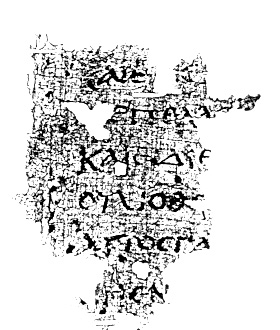
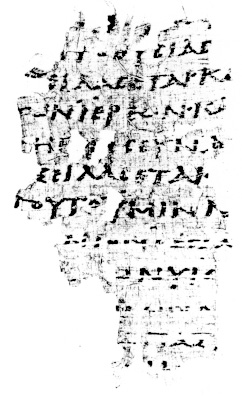
An anthology of preparations and presentations given by Robert Kraft on this subject, plus the related information on specific manuscripts and a link to the manuscript listing [updated and revised 18no2002; material added +2004/02 +2004/04+2007/12+2008/11]
Some Quicklinks within this file:
Table of Contents, in reverse chronological order:
11. "In Search of Jewish Greek Scriptures: Exposing the Obvious?" [31oc07 draft] for Toronto conference on "Editorial Problems" (1-4 November 2007); also presented at the Center for Advanced Judaic Studies in Philadelphia, 10de2007.
10. "From
Jewish Scribes to Christian Scriptoria?: Issues of Continuity and Discontinuity
in their Greek Literary Worlds" [for SBL San Antonio, Nov 2004]
09. "Early Christian Manuscripts and Jewish Scribal Practices: Exploring Trajectories" [for Brown University colloquium, May 2004]
08. "Early Jewish and Christian Scriptural Artifacts: Continuities, Discontinuities, and Social Significance" [for SBL Toronto, Nov 2002]
07. "Continuities and Discontinuities in the Transitions from Jewish to Christian Scribal Practices" [at Bangor Theological Seminary, Sept 2002] = jewchrpap.html
06. "Greek Scribal Culture in Early Jewish and Early Christian Settings: Continuities and Discontinuities" [for the conference on The Early Christian Book at the Catholic University of America, 7 June 2002] = "Introduction: Shorter Version"
05. "Selected Issues and Features of Early Greek Scriptural MSS" [for the "History of Material Texts" Presentation at UPenn on 18 February 2002]
04. "Format Features in the Earliest Jewish Greek Literary Papyri and Related Materials" [For the 2001 Papyrological Congress in Vienna] = jewishpap0.html [fullest form included also in #5 above]
03. "The 'Textual
Mechanics' of Early Jewish LXX/OG Papyri and Fragments" (May 1998, Hampton
Court Conference) -- [check web version 11no01?] = earlypap.html -- &
earlypap.986 [updated now in #5 above] [integrated below 12no2008]
02. "Some Observations on Early Papyri and MSS for LXX/OG Study" = earlypaplist.html [see #3 above] Early draft, for the conference on "The Bible as Book: The Transmission of the Greek Text" (Hampton Court, Herefordshire ENG; 27-30 May 1998)
01. "Exploring pre-Constantinian Developments of LXX/OG in Light of Early Papyri and Related Texts" [5/98, updated 6/99] = earlypap.raw & earlypap.mss & earlypap.985 [alternate title for early draft of #2 above]
---
My interest in this subject is nearly as old as my own wissenschaftlich career. When it came to choosing a subject for my Harvard dissertation some 40 years ago, I was torn between analyzing the pre-Hexaplaric fragments of Greek Jewish scriptures, and the topic I finally selected, the use of Jewish sources in the Epistle of Barnabas. My Doktor-Vater, Krister Stendahl, encouraged me towards the latter since he felt that it could receive better direction at that time than the LXX/OG topic. He also recommended me for my first full-time teaching job, at the University of Manchester, since he thought I might find there the archives from the Brooke-McLean- Thackeray-Manson "larger Cambridge Septuagint" project to nourish that side of my developing interests. I found no such archives.
Meanwhile, however, I had compiled a loose-leaf notebook with as much information as I could gather on the earliest LXX/OG fragments, arranged book by book in order of the current canonical sequence, and when Bas Van Elderen offered me this assignment, it seemed like a good opportunity to reacquaint myself with some old fragmentary friends.
Gathering the Raw Data. -- My first impulse was to create a computer file of the materials of which I had been aware 40 years ago, which I hastened to do, and then to rearrange those materials in roughly chronological order -- based on the well known vagrancies of available paleographical estimations.
I then turned to the main tools of which I was aware that had appeared since about 1959, that could help me supplement the list --
Kurt Treu's 1973 Kairos article on
"
Joseph van Haelst's 1976 Catalog of Jewish and Christian Papyri,
Eric Turner's 1977
Colin Roberts' 1977 Schweich Lectures on
and the new editions of individual Greek texts, especially by John Wevers in the Goettingen series.
Initially, I spread a wide net, attempting to catch everything prior to the success of Christianity under Constantine, and thus listing all papyri and related materials in Greek dated to the 4th century ce and earlier. As I said, it was a wide net, and it caught about 120 separate items (not all of them papyri), including a dozen that are dated to the first century ce or earlier and are almost certainly certifiably Jewish in origin. Of the 2nd - 4th century ce fragments, another half dozen have been claimed as Jewish by one or another of the respected authorities. Unanimity, of course, is difficult to obtain in this sort of Wissenschaft.
The textual work of Origen (c 185-253) in producing the multi-columned tool for studying and improving the extant text of Jewish scriptures in his day is usually viewed as a watershed in the study of the development of the Greek Christian "OT" manuscripts. Not only does Origen's "Hexapla" (in its various forms and formats) offer information about the Greek and Hebrew- Aramaic texts available to him in the first part of the third century, but to the extent that his endeavor to improve existing LXX/OG texts was successful, his work became a major factor in complicating the subsequent textual situation. In the two or three generations immediately following Origen, we also hear of extensive "recensional" work attributed to the now-mysterious persons of Hesychius and Lucian.
With this in mind, the quest for texts not affected by these well-intentioned efforts becomes important to the student of the development of Greek Jewish scriptures -- the LXX/OG and related materials. One way of approaching the problem is to try to identify texts and readings that do not show influence from Origen's "Hexapla," or other roughly contemporary recensional developments, and use that as a criterion for identifying presumably earlier materials. The textual apparatuses of the best available LXX/OG editions are filled with relevant information about such textual affinities.
Another approach, to which this report attempts to contribute, is to use chronological considerations for isolating materials that could not have been influenced by the work of these early critics because the materials predate the period when the 3rd and early 4th century products would have begun to cast their shadows. Manuscripts and fragments that predate the early third century are obviously the most significant in this regard, but any items that can reasonably be considered pre-Constantinian (early 4th century) have an excellent chance of being "uncontaminated" for these purposes.
The Manuscript Fragments
There are various convenient lists and collections from which to gather these early witnesses to the development of LXX/OG. A new one was released on CD-ROM in August 1998 by Willy Clarisse at the papyrological congress in Florence. Otherwise, to my knowledge, the most complete is the catalog by Joseph van Haelst, which appeared in 1976. Van Haelst includes appendices in which he lists Jewish and Christian materials by date, from earliest to latest, and also provides statistics for what he has listed, roughly generation by generation (early 2nd century, 2nd c in general, late 2nd c, 2nd/3rd c, etc.). Around the same time, the respected papyrologist Eric G. Turner produced his study of the development of the Early Codex, which also provides similar chronological lists of all codices known to him. Finally, still from the late 1970s, the Schweich Lectures by Colin Roberts also in their own way survey much of the relevant material, partly in response to Kurt Treu's list of possibly Jewish fragments from his 1973 article (see the appendix). I've put those lists together in what follows, and have tried to adjust the controversial datings towards Turner's judgment, on the belief that an experienced paleographer looking at the entire range of materials in a comparative way is more likely to be accurate than are individual editors who have seen only parts of the picture. Of course, paleographical judgments remain subject to modification, and are at best approximations based on certain assumptions about consistency, development, etc.
In the following list, which is arranged in roughly chronological order (according to paleographical estimations), the Jewish and possibly Jewish fragments (including some unidentified early pieces) and marked with *. Items are presented with the Goettingen number in brackets, when known, followed by the van Haelst number (vh###). Generous assistance in locating some of the fragments has been received from Matthew Hamilton, Moore Theological College Library, 1 King St Newtown NSW 2042 Australia [matthew.hamilton@moore.edu.au], and is gratefully acknowledged. See also Emanuel Tov's article in the Pietersma Festschrift (2001) mentioned in my draft linked below.
[The subsequent material is available in the following lists
and in the chronological
list file]
Early Christian groups and practices did not develop in a vacuum. Judaism,
in its various forms, provided the immediate background for much that we call
"early Christianity." We often hear and say such things, but do not always
pursue the implications. With reference to the adoption and development of
"book culture" in early Christian circles, questions about Jewish influences
are seldom explored in any depth with regard to the extant
physical remains. This presentation is part of an ongoing effort to look
more closely at what has been preserved from pre-Christian Jewish Greek writings
in an attempt to ascertain the extent to which continuities as well as discontinuities
with early Christian materials are likely.
The evidence under discussion is contained in my evolving electronic collection
of ancient fragments and modern claims (several versions appear here), which is already too extensive to receive complete
and detailed attention in a relatively brief presentation. Thus I have chosen
to focus on the following aspects:
1. For the most part, the Greek Jewish materials available to us are of very "professional" quality, reflecting highly developed scribal traditions in an established book-conscious segment of the Greco-Roman populace. We do not seem to be dealing with something relatively new or amateurish in Jewish Greek circles (the evidence is from Palestine and Egypt). In the early Roman period (when early Christianity was developing into its distinctive forms), literary scripts in general tended to be less ornamented and more simple, which is probably important to note when attempting to compare the early Jewish hands with somewhat later and less formal Christian and/or Jewish examples.
2. Within these Greek Jewish scribal materials, certain unusual features (relative to other attested Greco-Roman literary practices) are present -- such as the use of spacing and other physical indicators between some phrases or even words -- that appear also in some early Christian Greek texts but more rarely in non-Jewish and non-Christian literary texts. Might this indicate some sort of continuity of scribal practice from Judaism into early Christianity? Note that there is also variety in such practice within the Jewish materials -- I am not positing a homogeneous Jewish scribal culture by any means, whatever its level of sophistication.
3. Another feature that occurs frequently in the early Jewish materials (including Semitic fragments!) concerns the special treatment of words or names denoting deity (especially the "tetragrammaton," YHWH) -- and this did not go unnoticed among the practitioners of what we often classify as "magic." Whether and to what extent such attitudes may be seen as the background of the development in Christian scribal circles of the "nomina sacra" is worth exploring as another possible aspect of continuities. Again, this evidence fortifies the impression that Jewish scribal practice was quite varied, but also indicates a widespread, shared concern for the special nature of certain types of expression.
4. This brings us to the transition from scroll to codex, something known to be taking place in parts of the Greco-Roman world already in the first century of the common era, and also well publicized as a practice that quickly became somewhat "normal" in many early Christian circles. While hard evidence has not yet surfaced to connect this as well to Greek Judaism, the possible patterns of continuity between Greek Jewish scribal practices and early Christian texts suggests that the possibility should not be ignored that codex technology was also part of the heritage early Christian copyists adapted from their Jewish predecessors.
As we attempt to learn more about early Judaism in its varieties, and the relationship between those Jewish varieties and early Christian developments, we should not ignore this type of evidence, which can also make significant contributions to the continually emerging "overall picture." My impression, at this point, is that early Christian scribal practice owed a huge debt to earlier Jewish developments, probably including the use of such aids to reading as spacing (and similar markers) and the impetus for special treatment of special names and words, and possibly even the interest in the new codex technology. Such things didn't happen in a vacuum. And Judaism, in its various forms, provides the most obvious and most available seedbed for early Christian development.
This presentation will look at Jewish and early Christian examples of scriptures and related materials in Greek up to the fifth century, including the move from scrolls to codices, and the scribal cultures that produced them. Color images from the internet will be a part of the presentation. Attention will be paid to continuities and discontinuities in the transmission of biblical texts between Judaism and Christianity.
Although it is worth listing some of the more obvious continuities, there
is little to be learned in such an exercise since it would be very surprising
if Christians writing in Greek did not use the same materials that had become
widely available in the Greco-Roman world ( papyri and
parchment/leather,
readily available inks) and recognizable styles of letter formation ranging
from "highly professional" uncial (majuscule) writing to less formal hands.
A more distinctive continuity with Greek speaking Judaism was the adopting
of Greek forms of Jewish scriptures (plural!), somewhat loosely defined, along
with some works that we might call "parabiblical" (e.g. Enoch literature)
and other writings by authors such as Philo, Josephus, etc.
The Situation (oversimplified): early Christians quickly adopted the codex format -- proposed explanations include convenience (easier to carry, to use), costs (cheaper to produce), distinctiveness (different from Jewish and Greco-Roman practices), lowclass (relatively unsophisticated) -- and developed writing features more akin to "documentary style" (see Rylands G.John, Bodmer G.Luke-G.John and Chester Beatty G.John MSS from ca 200 ce) than to developed Greek literary usage (proposed reasons include lower social & cultural levels). As time went on, and clearly by the mid 4th century, Christian scribal practice developed its own sopisticated characteristic features (e.g. "Biblical Unical" style, multi volumed mega-codices such as Vaticanus (also here), Sinaiticus, Alexandrinus (also here), and Washingtonensis).
Scroll to Codex (format) --
What is the earliest example of a Jewish codex of a scriptural
work?
Are there examples of early Christian scrolls of scriptural
materials? (yes)
Levels of stylistic sophistication
in letter formation (paleography) --
Do Jewish Greek scriptural texts ever display "coarser" styles?
When do early Christian scriptural texts display similarly
highly developed style?
How do presumably non-Jewish and non-Christian texts from
the same periods compare? [1st ce]
[c100
ce and another]
[Thucyd
c100 ce and another][Moschus
c100 ce] [Herodotus
c100 ce]
Is the tendency to cursive forms and ligatures unusually present
in early Christian texts?
Tetragrammaton -- in
various
forms in Greek MSS (paleo-Hebrew, square script, transliteration, etc.)
Did Jewish scriptural texts use Greek "Lord"
(KURIOS)?
Did early Christian scriptural texts use Tetragrammaton
(YHWH -- see Greek
PIPI [PIPI] texts)?
Whence did "magic"
practioners derive their versions?
Nomina sacra
(special terms) --
Are these practices related to the development of "nomina
sacra" shorthand?
Do Jewish Greek scriptural texts exhibit any use
of "nomina sacra"?
Abbreviated numbers
and common words (condensation) --
Did Jewish scriptural texts ever use abbreviated numbers
(letters as numbers)?
Did early Christian scriptural texts ever use spelled-out
numbers?
Scriptio continua, marginal breaks, diacritics, etc.--
Was the use of spacing
between phrases, words, etc., standard
Jewish practice?
To what extent do early Christian scriptural copies use
unspaced Greek?
How do Christian texts use line formatting,
maginal marks, enlarged letters, etc.?
How extensive was use of marginal markings in non-Christian
(Jewish &
other) texts?
What is the evidence for the early use of diacritics
(breathings, accents, dieresis)?
A large part of the problem is inability to identify clearly the evidence (what is "Jewish," what is "Christian"?). It is reasonable to suppose that early Christian copyists learned from Jewish Greek predecessors from whom they also received scriptural and other texts and/or that some professional Jewish copyists may have joined the early Christian groups (as also some non Jewish professional copyists). Another part of the problem is our desire to simplify, despite our recognition that life then, as now, was not simple. Some people, scholars included, sometimes also feel the need to priviledge some streams of history over others -- in this case, it is important to some theorists that Christianity make its unique contribution to the developments. My own take on it is that most of the developments cited as evidence are either general tendencies in the Greco-Roman world of that time, or are most easily understood as developments from the practice of some Jewish scribal groups that somehow influenced early Christian practice. The evidence is still indecisive, but there is enough of it to call into question the older simplifications.
//end of this summary presentation//
2. There is occasional use on the left margin of "paragraph" markers ("paragraphoi") and enlarged letters ("ekthesis"), and even of more elaborate marginal markings (like the "coronis"), again similar to what is witnessed in other Greek manuscripts from the same period.
3. Some of the Jewish manuscripts even exhibit such special scribal features as the use of iota adscript, employment of the trema/dieresis, marks to identify proper names and to separate adjacent hard consonants in them, and the like -- again, generally in step with the literary world around them.
4. At obvious variance with the general trends in that surrounding literary world as it is represented to us in scholarly presentations, however, is the virtually universal practice in the Jewish manuscripts of the use of spacing (blank spaces within the writing block) to separate sections, word groups, and in one case, separation of even the individual words themselves. That is, the non-use (or at best, inconsistent use) of "scriptio continua" (uninterrupted flow of letters). My friend and colleage, Emanuel Tov, has looked carefully at this phenomenon in the Jewish and Christian biblical materials through the 4th century and suggests a close correlation with features of the Hebrew text from which the Greek was translated. Interestingly, even Jewish texts not (yet) identified as biblical (or as translated from Semitic) also seem to attest this spacing practice. While it is true that some (many?) documents (non-literary examples) in this period make use of sense divisions, and even word divisions, it is no longer satisfactory simply to attribute the phenomenon in the Jewish materials to "documentary" influence. Whatever its origins, it seems to come to us as part of a widespread and refined literary tradition represented strongly by these Jewish texts.
5. Does the preponderance of evidence, then, encourage us to posit a relatively homogeneous "Jewish" approach to such features of literary production -- relatively fixed "Jewish features" throughout the represented world? Another related factor causes serious hesitation: where these Jewish materials preserve relevant passages, they invariably give special treatment to the deity's special Hebrew designation, the so-called tetragrammaton (Hebrew YHWH) -- but the treatments differ! At least on this point, no universal rule among the Jewish scribes and copyists can be detected, not even in the texts found together in the Judean Desert, where the situation is similarly varied in the Hebrew and Aramaic manuscripts. We do not know enough about what people actually spoke when they encountered a form of the tetragrammaton, although it became traditional in Hebrew to say ADONAI ("Lord"), and in Greek KURIOS ("Lord"). Was this also the practice of Greek readers who encountered the Greek letters IAW? We cannot tell. It is likely that less traditionally aware or informed users of such traditions, such as in "magical" formulae and perhaps in onomastic compilations, would have tried to pronounce the Greek letters, but this does not guarantee that those who were more familiar with the system and its significance would have done so.
6. But I digress. With the exception of the rendering of the tetragrammaton, these earliest Jewish materials show no tendency to contraction, abbreviation, or the like, or of representing numbers by letter symbols. More of this later.
7. Finally, all of the uncontested Jewish texts are written on scrolls (or possibly, sometimes, on smaller sheets written on one side only, as with amulets) made of papyrus or parchment. This occasions no surprise, since the emergence of the codex as a viable option only begins at the end of the period from which these Jewish materials come, at the time when Christianity also is emerging and complicating the picture in certain ways.
In sum, the uncontested Jewish Greek materials in some ways reflect the general features of Greco-Roman literary production in the pre-Christian period, but also have some unusual features of their own, and enough variety in those characteristically "Jewish" features that we cannot assume a firmly fixed "Jewish scribal tradition" as such in the period represented.
The general approach, however, has been that if something is in codex form and contains contractions for the divine name(s), it must be Christian, even if it is a fragment of Jewish scriptures. Furthermore, to the extent that "Christian" materials employ spacing to divide text into units, and gradually even employ punctuation and associated signs in addition, not to mention letter-numbers and "cursive" features in the formation and sequence (ligatures) of letters, the explanation of "documentary influence" also comes strongly into play. Without denying that such influences must have existed at various levels, I would like to call for reexamination of all these criteria in the context of the Jewish evidence.
1. In the Greco-Roman world at large, which for our purposes means mainly what we can tell of it from Egypt, the 2nd and 3rd centuries ce seem to attest a general "degeneration" in the use of the sorts of ornamented formal scripts that we found represented also in the earlier Jewish materials. There is a "revival" of sorts with the emergence of a very attractive "round formal" style in the 3rd century and beyond, which is well illustrated by the "biblical uncial/majuscule" of the great biblical codices of the 4th century. But it is not limited to clearly Christian texts, and at least one possibly Jewish text represents this style. Whether Jewish or Christian professionals in that period might also have been involved in the copying of classical/pagan texts, and vice-versa, is impossible to answer at this point. But it is probably fair to say that there is no compelling evidence that would permit us to trace continuities from the earlier Jewish "style" into the Christian period (for Jews or for Christians) -- that is, the evidence from the 2nd-3rd centuries does not exhibit either Jewish or Christian materials of the ornamental type -- or to deny that there may have been some coincidental simultaneous development or even interaction during that period -- as with the less ornamental hands. That is to say, the "style" criteria are inconclusive in themselves.
2. Nor is the codex criterion helpful. It is clear that Christians came to prefer this new format very early, almost from as early as we can see anyone using it. But could they have arrived at this situation by imitating Jewish techniques? That is certainly not impossible, given the highly ambiguous state of the evidence and the Jewish origins of early Christianity.
3. The use of spacing in both early Jewish and early Christian materials is more promising as possible evidence of continuity. In the period of modern scholarship before substantial evidence from Judaism was available, this was often explained as a "documentary" influence in early Christian writing conventions. This explanation no longer seems compelling.
4. We have already noted that Jewish practices regarding the tetragrammaton were known to Christians (and presumably others, such as "magic" practitioners), and may have been imitated at some levels (as in onomastica traditions). Is it possible that the roots of the "nomina sacra" developments in Christianity may also be found here (as, indeed, L. Traube argued a century ago when he published his collection of such materials)? More recent scholars have tended to resist this conclusion, but without always carefully considering all of the evidence. Some Jewish treatments of the tetragrammaton are certainly moving in the direction further traveled in the nomina sacra phenomenon, and there is even some reason to think that the Greek substitution term, KURIOS ("Lord"), may have also received parallel treatment (abbreviation by suspension and/or contraction) at Jewish hands. To put it more directly, I would suggest that pre-Christian Greek Jews used the KURIOS substitution in writing as well as in speaking, that the impetus to "abbreviate" in writing was applied to that term as well -- and probably to the closely related word QEOS ("God") -- and it is this trajectory that took hold and was expanded further in Christian circles.\n/
\n/ It seems unlikely that the practice of representing the tetragrammaton in special letters (paleo-Hebrew, square Hebrew) goes back to the original translations, since that would make it difficult to explain the variety of approaches to this situation in the extant manuscripts. Rather, I suspect that the older Greek usage, probably KURIOS (possibly IAW) came under fire from archaizing tendencies in Jewish circles from at least the 2nd century BCE onward -- as seems also true of the transmission of Hebrew MSS in that period.
5. With regard to the literary use of numbers-letters, punctuation, diacritics, etc., the evidence is at best inconclusive. It has been argued that the occurrence of the letter-number "318" in PYale 1 (a codex fragment of Genesis dated variously to late 1st or more likely mid 2nd ce) is a Christian feature, but the reasoning is rather circular (Christians make codices, this is a codex, thus ...). We do not have sufficient evidence to judge. Indeed, does the development of the codex format itself, with the encouragement to put numbers on the leaves or even the pages, open the door to further uses of number-letters? Regarding the other matters of textual supplementation (diacritics, etc.), these features are not unique to "Christian" texts in the period, and are unlikely to represent anything uniquely developed in Christian or Jewish scribal circles.
The larger context. -- [as above]
The setting in scholarly discussion. -- [as above]
The Jewish evidence. -- [as above]
Summary of the findings. -- [as above]
The "Christian" Factor. -- [as above]
Greek speaking (and reading) Jews existed for centuries within the Greco-Roman world and through the Byzantine period. We have a great deal of secondary evidence for them, from references by outsiders [show Stern, title page] and insiders, to copies (often made by Christians) of actual literary productions (Aristeas, Philo, Josephus, Paul, etc.). Primary evidence in the form of inscriptions, archaelogical remains, and the like is also abundant, especially from ancient Palestine.
Probably the most easily recognized literary activity of Greek Jews in antiquity relates to their translations and transmission of "scriptures," although that category of writings is somewhat loosely defined in the earliest periods [LXX/OG title page?]. In addition to later references to and copies of these scriptures and related materials, we now have a significant body of actual fragments that almost certainly were produced, or at least commissioned and used, in Jewish circles. A more detailed treatment of these materials is available in my electronic report on "The 'Textual Mechanics' of Early Jewish LXX/OG Papyri and Fragments" from which most of what follows has been extracted and adapted.
As Christianity developed into its own trajectories separate from Judaism, it adopted and adapted Jewish sources to its own needs, especially Greek Jewish scriptures and related materials. How much of Christian scribal activity was derived from its Jewish predecessors (and contemporaries) is difficult to determine with confidence, and has sometimes been dealt with rather carelessly in modern discussions.
The goal of the present study is to identify and analyze the extant physical evidence from Jewish contexts, in hopes of being able thereby to understand more clearly its continuities and discontinuities with the development of selfconsciously Christian literature.
1. The least problematic approach is to proceed by date and location to
identify basically pre- and non-Christian materials -- most notably the Greek
fragments among the Dead Sea Scrolls from Qumran, but also some other early
Greek materials, documentary as well as literary. According to Emanuel Tov,
the Judean Desert discoveries (not only those from Qumran) have yielded more
than 155 Greek documentary texts, most of which are presumed to be Jewish
in origin (almost certainly not Christian), and some 34 fragmentary literary
texts (mostly from Qumran) [show his chart]. A few other literary texts from
Egypt that are dated paleographically to pre-Christian times round out this
corpus as a starting point for the investigation. Here
is the current list of scriptural and related materials predating the end
of the first century of the common era (omitting some of the rather small
unidentified scraps from Qumran).
01. Qumran cave 4 LXXDeut 11
(2nd bce, parchment roll) [#819]
02. PRyl 458 of Deut 23-28
(2nd bce, papyrus roll), [#957 = vh057]
03. Qumran cave 7LXXExod 28 (2nd/1st
bce, papyrus roll) [#805 = vh038]
04. Qumran cave 4LXXLev\a (2nd/1st
bce, parchment roll) [#801 = vh049]
05. Qumran cave 7LXXEpJer
(2nd/1st bce, papyrus roll) [#804 = vh312]
05+. Qumran
cave 7 frgs 4, 8, 12 [Epistle of Enoch? = "1 Enoch" 103] (1st bce[?],
papyrus roll) -- see also reconstruction
notes and frg 8
alone
05+.
Qumran cave 7 frg 5 (unidentified controversial "Mark" frg, turn of the
era[?], papyrus roll)
05+. Qumran cave 7 has produced several other Greek fragments that have
not yet been identified convincingly. In general, many of them seem to be
bilinear and showing serifs. No attempt is made to include them all in the
current listing, although in some ways they are also of relevance as attesting
Jewish literary activity.
06. PFouad 266a Gen 3-38
(1st bce, papyrus roll) [#942 = vh056]
07. Qumran cave 4LXXLev\b (1st
bce, papyrus roll; tetragrammaton = IAW; Lev 2-5) [#802 = vh046]
08. PFouad 266b Deut 17-33
(1st bce, papyrus roll; Hebrew/Aramaic tetragrammaton) [#848 = vh056]
09. PFouad 266c Deut 10-33
(late 1st bce, papyrus roll) [#847 = vh056]
10. Qumran
4Q127 Greek paraphrase of Exod(?) (late 1st bce, papyrus roll),
11. Qumran
4Q126 unidentified Greek (late 1st bce, parchment roll),
12. Qumran
cave 4LXXNum 3-4 (turn of the era, parchment roll) [#803 = vh051]
13. Nahal
Hever Minor Prophets (hand A), with example of paleo-Hebrew tetragrammaton
and hand
B (turn of the era, parchment roll) [#943a,b = vh285]
14.
POxy3522 of Job 42 (1st ce, papyrus roll; paleo-Hebrew tetragrammaton),
15.
POxy4443 of Esther E + 8-9 (1st/2nd ce, papyrus roll),
16. PFouad 203 prayer/amulet? (1st/2nd ce, papyrus roll) [no image yet]
[vh911]
2. More difficult is the attempt to identify Jewish productions that are contemporaneous with developing Christianity by isolating characteristic features. Is it possible to derive from careful analysis of the relatively firm body of ancient Jewish texts guidelines for further identification of later, possibly Jewish materials? On the other hand, does Christian scribal practice develop its own identifiable characteristics that differ significantly from Jewish conventions? As we shall see, a variety of claims have been made along those lines. Some appear to be inadequately founded. Of course, to the extent that Jews or Christians may not actually have produced their own texts and conventions, but used general resources available in their worlds (copy shops, etc.), such a quest will be all the more difficult if not impossible.
Here is a list of most of the debated materials
from the early period (and a few later pieces as well):
17. PYale
1 of Gen 14, recto, and verso
(2nd ce, papyrus codex; number 318 abbreviated) [#814 = vh012 = T007]
18. PBodl5 of Pss 48-49
(2nd ce, parchment codex) [#2082 = vh151 = T097A?] = Proc Br Acad 43 (1964),
229 (pl)
19.
POxy656 of Gen 14-27 (2nd/3rd ce, papyrus codex, problematic tetragrammaton)
[#905(U4)) = vh013 = T009]
+. PSchoyen 2649
of Lev 10-25 (late 2nd ce, papyrus codex, spacing, QS nom sac, diacritics)
+. PSchoyen
2648 of Joshua (late 2nd ce, papyrus codex, spacing, KS QS IHS nom sac,
diacritics)
20.
Chester Beatty Ezekiel-Daniel-Esther (about 200 ce, papyrus codex);
subscriptio
and end of Daniel/Susanna (PKoeln Theol 37v, p.196) [#967]
21.
22. PVindobGr 29828+29456 Jannes and Jambres (early 3rd ce, papyrus roll
[reused], nomina sacra uncontracted) [vh1068]
24.
POxy1007 of Gen 2-3 (3rd ce, parchment codex; unusual tetragrammaton
representation) [#907 = vh005 = t002]
25.
POxy1166 of Gen 16 (3rd ce, papyrus roll column)
[#944 = vh014]
26. PBerlin 17213 of Gen 19 (3rd ce, papyrus codex) [no image yet] [#995]
27.
POxy1075 of Ex 40 (3rd ce, papyrus roll; end of book) [#909 = vh044]
28. POxy1173+1356+2158++
Philo (3rd ce, papyrus codex) [vh696]
29. PAntin 8 Prov-Wisd-Eccl (3rd ce, papyrus codex) [#928 = vh254]
30. PAntin 9 Prov (3rd ce, papyrus codex) [#987 = vh252]
31. Freer Minor Prophets (late 3rd ce, papyrus codex) [vh284];
32. Berlin Genesis (late 3rd ce, papyrus codex) [#911 = vh004];
33. Cairo ostrakon 215 of Judith 15 (late 3rd ce) [no image yet] [#999
= vh080]
34. PLond Christ 5 (3-5th ce, liturgical codex) [vh921],
35.
PLitLond 202 of Gen 46-47 (3rd/4th ce, papyrus codex) = BM P 2557 [#953
= vh030 = T022]
36. PWien Rainer 18 of Pss 68, 80 (3rd/4th ce, parchment roll; Symmachus?)
[no image yet] = PVindob 39777 = StudPal 2.114 [#xx = vh167]
37. PAlex 203 of Isa 48
(3rd/4th ce, papyrus roll?) [# = vh300]
38. PHarris 31 of Ps 43
(3rd/4th ce, papyrus roll/amulet?) [#2108 = vh148]
39. POxy2745
Onomasticon of Hebrew Names (3/4th ce, papyrus roll; IAW represents
Hebrew YW/YA names) [vh1158]
39a. PHeid1359 Onomasticon
of Hebrew Names (3/4th ce, papyrus roll/sheet; IW and IAW represent Hebrew
YW/YA names) [vh1136]
40. POxy1225 of Lev 16
(early 4th ce, papyrus roll) [#947 = vh048]
41.
PLitLond 211 of Dan 1 Theodotion (early 4th ce, vellum roll) [#925 =
vh319]
42. POxy2068
(4th ce, papyrus liturgical roll) [vh966]
23. PMich 4925 Jannes
and Jambres (4th ce, reused verso of papyrus roll) [ed G.Schmelz, 2001]
43. PChBeat 16 Jannes and Jambres (4th ce, papyrus codex, odd nomina sacra)
[Pietersma]
+PHeid 1016 (4th ce, papyrus codex) [Schmelz, 2001]
44. PAntin 10 Ezek (4th ce, papyrus codex) [#988 = vh316]
+. POxy 4444 [no image 11/2004] Wisdom of Solomon (4th ce, parchment codex)
45. PSorbonne 2250 Jer 17f & 46 (late 4th ce, papyrus codex; aberrent
text) [#817 = vh308];
46. PRanier 4.5 Psalm 9 (5th ce, papyrus amulet?) [#2086 = vh105].
47. PBerlin 17035 Gen 36 Symmachus? (5/6th ce, parchment codex) [vh022];
48. PGiessen 13+19+22+26 [side
1] Deut 24-29 (5/6th ce; parchment codex; possibly non-Christian provenance;
contracted divine names) [side 2]
for additional images of scriptural and other (mostly Christian) fragments,
see Wieland Willkur's
links
1. In the history of scholarship on this subject, probably the primary criterion that has been used to distinguish Jewish from Christian is the use of scroll vs. codex. In the Greco-Roman world at large, clearly the codex technology was more quickly and broadly adopted by Christians than by the general book trade [show CHR chart?]. Christians also continued to produce scrolls, and some non-Christians experimented with codices from quite early on, but a definite preponderance of identifiably Christian works, and especially Christian scriptures, were preserved in codex format. Little attention has been given to the possible use of the codex in Jewish Greek circles in this same period of antiquity. A large part of the problem is the fact that codex technology became generally available about the same time that Christianity was becoming an identifiable movement (2nd and 3rd centuries). All earlier literature, Jewish or not, is in scroll format. How soon and under what conditions Jewish scribes came to use codex technology can only be conjectured, without new discoveries or the development of other criteria for judging. A 2nd or 3rd century scroll can have originated in Jewish, Christian, or other circles; similarly for a codex.
Here are some examples of post 100 ce scrolls containing
Jewish scriptures and related materials in Greek:
22. PVindobGr 29828+29456 Jannes and Jambres (early 3rd ce, papyrus roll
[reused], nomina sacra uncontracted) [vh1068]
23. PMich 4925 Jannes and Jambres (early 3rd ce, papyrus roll [reused])
[BASP 16 (1979) 114]
25.
POxy1166 of Gen 16 (3rd ce, papyrus roll),
27.
POxy1075 of Exod (3rd ce, papyrus roll; end of book),
36. PWien Rainer 18 of Pss (3rd/4th ce, parchment roll; Symmachus?) [no
image yet]
37. PAlex 203
of Isa 48 (3rd/4th ce, papyrus roll?),
38. PHarris
31 of Ps 43 (3rd/4th ce, papyrus roll/amulet?),
39. POxy2745
Hebrew onomasticon (3/4th ce, papyrus roll; Origen?) [vh1158]
40. POxy1225
of Lev 16 (early 4th ce, papyrus roll),
41.
PLitLond 211 of Dan 1 Theodotion (early 4th ce, vellum roll)
42. POxy2068
(4th ce, papyrus liturgical roll) [vh966]
43. PChBeat 16 Jannes and Jambres (4th ce, papyrus codex, odd nomina sacra)
[Pietersma]
46. PRanier 4.5 Psalm 9 (5th ce, papyrus amulet?) [#2086 = vh105].
2. Although it has become increasingly clear that most of the earliest preserved Jewish fragments attest an unusually striking sophistication of writing style (bilinearity, ornamentation, etc.), this has not to my knowledge been used in any consistent fashion to evaluate the later disputed pieces. Nor has much attention been paid yet to the allegedly less traditionally "classical" features of many (most?) of the same manuscripts such as the use of spacing to indicate major and sometimes minor sense or even word breaks, or the presence of other partition indicators (paragraph separators, enlarged letters at the margin, other markings in the margin).
Here are some examples of the ornamental formal style, as well as of other relatively formal styles.
3. With regard to particularly Jewish (and thus potentially Christian) writing conventions, the ways in which references to names for diety and associated terms are treated in the preserved materials has drawn much attention. The tradition of reverence for the special name of God (the tetragrammaton, or four-lettered designation YHWH in Hebrew) in Judaism was well known even before the Dead Sea Scrolls provided ample evidence for a variety of approaches to this problem. But since early Christian commentators, and presumably copyists as well, were also aware of such practices, it is not foolproof to argue that manuscripts that contain the tetragrammaton in non-Greek letters or perhaps in some other unusual form must be Jewish.
Here are some of the earliest known representations in Geeek materials of the Hebrew Tetragrammaton (Hebrew YHWH):
Early Christian authors such as Origen and Jerome were aware of manuscripts that attested this phenomenon -- the famous "PIPI" texts are probably the best known example. It is clear that such phenomena are reflections of earlier (and ongoing?) Jewish practice, even if the actual scribes or copyists who produced a given manuscript may have been Christian. Whether the discovery of codex (not scroll) fragments containing the tetragrammaton in unusual forms may be able to contribute to the question of the use of codices in Jewish circles is worth exploring. Here are some examples of possible scribal confusion where unusual forms of the tetragrammaton may have been encountered.
[new 6/02] Also of interest, and possible significance, is the influence that these special names had on "magic" materials, especially amulets and similar objects. The illustrations in Goodenough's Jewish Symbols provide many examples of various sorts: the simple Greek transliteration IAW, with apparent variations (e.g. AIA, WAWH), is frequent; probably the Greek representation of Hebrew letters as PIPI and of the abbreviated paleo-Hebrew ZZ also occur; and there are even objects that contain the word "TETRAGRAMMATON" itself. ADONAI and variations are also frequent, as is the related divine name SABAWQ (and variants) and the names of certain angels (especially Michael). These materials are notoriouisly difficult to date or to place into any historical context. Philo is already well aware of the mysterious specialness and symbolism of the "tetragrammaton," the name of "the existent one," engraved on the headpiece of the high priest and heard and spoken only by those most pure (Moses 2.114f, 132). A century and a half later, Origen is also quite conscious of the special power provided by knowing the right names of deity [get ref].
4. Closely related to the tetragrammaton phenomenon, and perhaps even derivitive from it, is the representation of divine names (especially KURIOS and QEOS) and associated terms in abbreviated forms [title pages of Traube and/or Paap?]. Because relatively consistent conventions for such abbreviation developed in Christian circles -- the so called "nomina sacra" -- and because shortened forms of the name IHSOUS (and of the title XRISTOS) were included among these special names, it has come to be assumed that the practice of such abbreviation originated in Christian circles and is a valid criterion for identifying Christian fragments! Many examples of such an operating principle from contemporary scholarship can be provided: if there are nomina sacra, the piece must be Christian [examples?]. I think this assumption needs careful reevaluation, despite the confidence with which it is usually stated. There is no reason whatsoever why a Jewish author or copyist accustomed to dealing with the tetragrammaton in special ways (e.g. represented in Hebrew by double yod, or in Greek by IAW, as well as by the substitute term KURIOS) might not also develop similar shorthand techniques for the Greek words for deity.
5. In the Greco-Roman world, names and other common terms are often found in abbreviated forms -- especially on inscriptions, coins, and "documentary" materials, as are numbers and certain symbols [show relevant list]. It is sometimes argued that Christian biblical fragments tend to display more of such "documentary" features as well, as a further criterion for separating Christian from more sophisticated literary activity, and sometimes from Jewish productions as well [show PYale 1].
Interestingly, as we have seen, other features that are sometimes characterized as "documentary," or at least sub-literary, such as the use of spaces or division markers, enlarged letters, tendency to ligature, and the like, sometimes occur in the earliest Jewish examples in combination with other very sophisticated features. To what extent such apparent developments may actually be indicative of general tendencies in the production of literature in the Greco-Roman world, rather than being specific to Judaism or Christianity, is worth further exploration. It is problematic to turn such allegedly "documentary" features into evidence of economic or culturally inferior situations (impoverished Christians, relatively unclutured and/or untrained) without closer analysis.
Indeed, a complicating factor is the frequent presence in the early Jewish texts of sense divisions and even word division, in a world in which the norm for literary productions seems to have been "scriptio continua" -- unbroken sequence of letters. There are a few exceptions (see Turner GMAW\2 7 and n 28), but they tend to be sub-literary, or even documentary, unlike our examples. One explanation might be the influence of Hebrew and Aramaic Jewish scribal habits, where word division is normal. In any event we have a situation in which at least this special characteristic deserves note -- an unusual use of spacing in materials otherwise of a very professional literary quality.
Interestingly, many presumably Christian copies seem to employ
If it could be established that the biblical codices from the 2nd and 3rd centuries ce that employ spacing were Jewish in origin or influenced strongly by Jewish scribal practices, the door would be opened for more careful discussion of the origins of "nomina sacra" practice, since most of these codices employ nom sac for KURIOS and QEOS (at least). Although the clearly Jewish exempla on which this presentation is based provide no examples in clearly scriptual texts of the use of Greek KURIOS for the tetragrammaton, they do show a variety of representations, occasionally bordering on abbreviation. We have also seen some ambiguous cases of abbreviation in the later materials. The suggestion that this practice had Jewish roots should not be rejected without careful further investigation.
Similarly, if these 2nd-3rd century biblical codices reflect a strong Jewish influence, questions of the process by which Christianity became so enamored of the codex may be illuminated somewhat. Jewish scribal practice had already moved in that direction, or was simultaneously moving. This issue is difficult to solve in isolation, since the codex technology was not restricted to any single group, as far as we know, and could have reached its early users by various routes, meeting the expected "conservative" resistance in favor of rolls as it progressed. But the evidence of such resistance in the biblical materials of the 2nd and 3rd centuries ce is not strong. If there had been significant resistance in Greek Jewish circles, shouldn't we expect to have more evidence of it in the surviving materials? Perhaps not. But it is worth further exploration. [add note on Roger Bagnall's discussion of textual variations in Luke 4.17 as possibly "an early reflection of the adoption of the codex as the standard form for Christian scriptures" -- or, I dare to add, perhaps even of an early perception that codices of scriptural writings (here Isaiah is in view) were used in some Jewish synagogues! "Jesus Reads a Book," Journal of Theological Studies 51 (2000), 577-588 (quote is from 588)]
And what can be said about the unambiguously "Christian" literature that we encounter in this period? It gradually becomes relatively standardized with reference to the use of scriptio continua and a nucleus of nomina sacra, with various extensions and adaptations. Letter-numbers also come to be standard in Christian literary texts (as they were in documentary conventions in general -- see Turner GMAW\2 15), but not in Greco-Roman literary productions. How much of this may have had Jewish roots remains to be argued with more care. I hope I have been able here at least to open some of the doors to that discussion.
//end of prepared Vienna presentation (July 2001)//
---[the earliest version(s)]
[Most of the above material is excerpted from my electronic study of "The 'Textual Mechanics' of Early Jewish LXX/OG
Papyri and Fragments," which is copied below and is itself a greatly expanded
and revised form of a paper first delivered in May 1998 (Hampton Court, Herefordshire
England) to the conference on "The Bible as Book: The Transmission of the
Greek Text" sponsored by the Van Kampen Foundation and The Scriptorium: Center
for Christian Antiquities. A shorter form of that revised essay is scheduled
to appear in the volume being prepared from that conference.]
The main sources cited below are abbreviated as follows:
Aland = Kurt Aland (ed), Repertorium der griechischen christlichen Papyri I: Biblische Papyri ... (Berlin/New York: de Gruyter, 1976).
DJD = Discoveries in the Judean Desert, the official publication
series for the Dead Sea Scroll materials (Oxford Press).
LDAB = Leuven Database of
Ancient Books
Rahlfs = Alfred Rahlfs, Verzeichnis der griechischen Handschriften
des Alten Testaments, fu%r das Septuaginta-Unternehmen (Aus den Nachrichten
der K. gesellschaft der Wissenschaften zu Go%ttingen, Philologisch-historische
Klasse 1914 Beiheft). This is the basis for the Go%ttingen numbering, which
has been continued in subsequent years by the Septuaginta-Unternehmen. Detlef
Fraenkel of the Unternehmen has been extremely helpful in providing Go%ttingen
numbers for more recently discovered materials.
Roberts (Book) = Colin H. Roberts, "The Christian Book and
the Greek Papyri" (JTS 50 [1949] 155-68)
Roberts (MSB) = Colin H. Roberts Manuscript, Society and Belief in Early Christian Egypt, The Schweich Lectures of the British Academy, 1977 (Oxford: Oxford University Press 1979)
Skeat = C.H.Roberts and T.C.Skeat, The Birth of the Codex
(Oxford University Press 1983, 1987)
TM = Trismegistos, An interdisciplinary portal of papyrological and epigraphical
resources
dealing with Egypt and the Nile valley between roughly 800 BC and AD 800.
Tov = his article in the aforementioned conference volume on The
Bible as Book: The Transmission of the Greek Text, edited by Scot McKendrick
and Orlaith A. O'Sullivan (British Library & Oak Knoll Press 2003) [proceedings
of a VanKampen Foundation conference, May 1998]); otherwise also "Scribal
Practices and Physical Aspects of the Dead Sea Scrolls" in The Bible as
Book: the Manuscript Tradition, ed by John Sharpe III and Kimberly Van
Kampen (British Library 1998) 9-33; The Text-Critical Use of the Septuagint
in Biblical Research (Jerusalem: Simor 1997\2); "The Nature of the Greek
Texts from the Judean Desert," Novum Testamentum 43 (2001) 1-11; "Scribal
Features of Early Witnesses of Greek Scripture," The Old Greek Psalter:
Studies in Honour of Albert Pietersma, ed. R.J.V.Hiebert et al. (JSOT
Supp 332; Sheffield Academic Press 2001); and numerous other pertinent publications
on textual issues and scribal practices -- some of these are now conveniently
available in The Greek and Hebrew Bible: Collected Essays on the Septuagint,
Supplements to Vetus Testamentum 72 (Brill 1999). See also Appendix 5 to his
Scribal Practices and Approaches Reflected in the Texts Found in the Judean
Desert (Brill 2004).
Treu = Kurt Treu, "The Significance
of Greek for Jews in the Roman Empire," with an excursus
on Jewish scriptural manuscripts/fragments, originally published as "Die
Bedeutung des Griechischen für die Juden im römischen Reich," Kairos
NF 15, Hft. 1/2 (1973), 123-144; translated by William Adler with Robert Kraft
(1991) -- for
Internet access.
Treu Archiv = Inventories by K. Treu, "Referat: Christliche
Papyri 1940-1967," Archiv für
Papyrusforschung 19 (1969) 169-214 (OT on 174-180).
Turner = E.G.Turner, Greek Manuscripts of the Ancient World, (Princeton University Press 1971); second edition revised and enlarged edited by P. J. Parsons (Bulletin Supplement 46, London: Institute of Classical Studies 1987).
Turner (Codex) = E.G.Turner, The Typology of the Early Codex (Philadelphia: University of Pennsylvania Press, 1977). Sometimes noted as "t###"
vh### = Joseph van Haelst, Catalogue des Papyrus Litte/raires Juifs et Chre/tiens (Paris: Sorbonne 1976).
The standard papyrological designations will be used, as listed also in vh, Aland, and elsewhere.
My work on this topic in many ways parallels and supplements the research of my colleague, Emanuel Tov, who focuses even more than I have attempted on the significance of various "physical" characteristics (spacing, punctuation, etc.) for the ancient preparers and users of the texts. I also view my efforts as continuations of the suggestive but relatively little known study by the late Kurt Treu, in his essay mentioned below (which is readily available in English through the aforementioned Internet link). That I am often critical of the conclusions of the late Colin Roberts on these subjects does not detract from my appreciation of and respect for his pioneering efforts as one of the papyrological giants of the 20th century, on whose shoulders we all must stand.
Among the 120 or so papyri and other early fragments of Greek Jewish scriptures ("LXX/OG") and related materials dated paleographically from the 4th century and earlier, we find more than a dozen that are clearly of Jewish origin, and another dozen or so for which this identification has also been strongly suggested.\1/ The vast majority of the remainder has been assumed to have been produced by Christian copyists, although the evidence is seldom unambiguously clear. This study attempts to reexamine the situation with a focus especially on details of format and presentation ("textual mechanics"), without any special attention to textcritical content.\2/
\1/I have not included several manuscripts listed by Treu as ambiguous but worth consideration when his reasons appear to be less "mechanical" than seem appropriate for this study. For example, he points out (142f) that since we have evidence for Jewish presence at such sites as Oxyrhynchos and Antinoopolis, it is not unreasonable to suppose that some of the Jewish Greek scriptural materials from those sites might be of Jewish origin, and he offers some textcritical observations in support (e.g. closer affinities to the surviving Hebrew text, "eccentric text"). From this textual basis, he expands his horizons further; see his notes on PAntin 8, 9, 10 [vh254, 252, 316]; PGiss 13... [vh58]; PSorbonne 2250 [vh308]; PBerlin 17035 [vh022]; Freer Minor Prophets [vh284]; Berlin Genesis [#911 = vh004]; Chester Beatty (etc.) Ezekiel-Daniel-Esther [#967 = vh315]; PRanier 4.5 [#2086 = vh105]. Probably POxy 2745, a Hebrew onomasticon roll [vh1158] mentioned by Treu (144) should be added to my list; see also n.11 below on liturgical materials (e.g. POxy 2068). A fresh look at the evidence from the early papyri (3rd ce) of Philo's works (e.g. POxy 1173+1356+2158) will also be in order at some point.
\2/The textcritical situation seems analogous to what the NT papyri have shown -- that the textual relationships prior to the imagined watershed of recensional activity in the 3rd and early 4th centuries ce are in many ways just as confused and confusing as afterwards. Of course, the materials from this early period, on rolls and early mini-codices, must be examined book by book (and sometimes even in smaller units within "books") rather than in generalized "text types," but even then clear patterns seldom emerge. Did we really expect clear patterns, given what we have learned from the Judean Desert discoveries as well as from other avenues of information about those textually tumultuous early times? For details, consult Emanuel Tov's
Text-Critical Use of the Septuagint .
The basis for scholarly discussion of these materials in the past quarter century was established primarily by the publications of Treu's article and Roberts' Schweich Lectures (MSB). Treu attempted to view the early fragments in the larger framework of how Judaism adapted to, or perhaps reacted to the Greco-Roman world in which it existed and often flourished. While Treu did not ignore textual matters (see n.1 above), he was much more focused on the sorts of "physical" and immediately visible criteria that could reasonably be employed in attempting to identify "Jewish" scriptural materials. The appendix to his 1973 article presents a challenge to previous analyses, and sets the stage for subsequent discussion.
Roberts, in his attempt to extract information from the early papyri for reconstructing the development of Christianity in Egypt, shows sympathy for some of Treu's observations while at the same time defending aspects of the "older" approach, with its tendency to focus on early Christianity.\3/ Perhaps unwittingly, in his quest to identify characteristic "Christian" traits in the early manuscripts and fragments, Roberts actually opens some new lines of investigation applicable to the Jewish materials as well: especially suggestive are his comments about the "documentary" tendencies exhibited in some aspects of the presentation of early Christian materials (use of spacing, punctuation, enlarged letters, etc.), and his attempt to distinguish the resultant paleographical "style(s)" of his "Christian" witnesses from a more "elegant" literary approach in (some of) the clearly Jewish fragments.
\3/This was not a new interest for Roberts, as his pioneering early article on "The Christian Book and the Greek Papyri" (JTS 50 [1949] 155-68) amply attests. It rewards rereading even now. [Any significant implications to be drawn from Robert's offhanded statement that "it was not until the first half of the third century that the Roman jurists finally decided that where a man bequeathed his library, codices as well as rolls were included in the bequest; so persistent was the convention that equated book and roll. ... The codex existed and was used in the pagan world long before it was accorded the status of a book." (158-159)? Might there be any motivation to use the new codex format in order to escape any legislation against suspect "books"?]
The older "criteria" to which Treu, especially, reacts, and the new issues introduced into the discussion by Roberts (with further elaboration recently by Lawrence W. Hurtado\4/), may be summarized as follows -- we will want to be especially alert to such matters when we survey the data:
\4/"The Origin of the
Nomina Sacra: A Proposal," JBL 117 (1998) 655-673. Hurtado's primary contribution to the ongoing discussion relates to the graphic marker (overline stroke) used to indicate the significance ofIH as both a suspension of thenomen sacrum IHSOUS (the name Jesus) and as the shorthand way of writing the number 18, which number in Hebrew gematria equivalences also is the word for "life" (XY . Perhaps not to be lost in this discussion is the fact that the Hebrew letter-number for 18 isYX , which in most early orthographies would resemble closely the anticipated (if the numbering system were consistent) Hebrew number 15YH , but in the development of Jewish tradition this numerical representation is not used, but we find instead+W (nine plus six = 15; also+Z or nine plus seven = 16), presumably as protection against careless representation that might be associated with the tetragrammaton and/or its abbreviated forms, but perhaps also to avoid ambiguity. It would be useful to know when, and under what conditions, such a supposed modification in the Hebrew numbering conventions arose.
1. Scroll or codex format -- as a rule of thumb, and especially when other evidence is lacking, the equation of scroll with Jewish and codex with Christian has tended to prevail. Admittedly, Christians continued to use the roll format well after codices became popular, and clearly codices came to be used among Jews at some point, but there is little clarity or agreement on the history of such developments. In the survey of 30 Jewish and possibly Jewish texts that follows, all but items 17, 18, 19, 20, 22, 24 (ostrakon) and 25 are scrolls.
2. Papyrus or parchment material -- it is clear now that early Jewish scriptural copies could be inscribed on either material (see the Dead Sea Scrolls, for example), but in 1973 Treu felt the need to argue against the idea that authentic Jewish copies could only be written on animal skins. Of the unambiguously (by date) Jewish manuscripts listed below, all but items 1, 4, 11, 12, and 13 (see also 20, 24 [ostrakon], 26, 30) are on papyri.
3. Use of "nomina sacra" -- Roberts especially (developed further now by Hurtado) has championed the view that a widely accepted "system" of abbreviation by contraction of certain key words with "sacral" connotations (especially "Jesus," "Christ," "Lord," and "God"; but also several others) developed early in Christian scribal circles, although the modern inventor of the term "nomina sacra" (Ludwig Traube -- at a time when virtually no early Jewish evidence was available) thought that the practice must have had Jewish roots.\5/ No unambiguously Jewish manuscripts with abbreviated nomina sacra in Greek (as opposed to tetragrammaton representations, on which see below) have yet been agreed upon by the debating scholars, but items 19, 21, 23, 27, (and 29?) below (see also n.11 on POxy 2068 and n.1 on PGiess 13) would seem to offer a strong challenge to Roberts' position.
\5/Traube,
Nomina Sacra: Versuch einer Geschichte der christlichen Ku%rzung (Munich: Beck 1907), 26. See also A.H.R.E.Paap,Nomina Sacra in the Greek Papyri of the First Five Centuries (Leiden: Brill 1959), 119ff, for a similar view of origins (but different details of development).
4. Treatment of the "tetragrammaton" -- the presence in many of
the clearly Jewish fragments of a special way of representing the four lettered
divine name
\6/Hurtado's article provides an excellent discussion of these related issues, as well as an extensive (if not exhaustive) bibliography.
5. Treatment of numbers -- Roberts also argued that Christian copyists
tended to use number symbols rather than spelling out the numbers in good
Greek literary style. He saw this as another "documentary" influence. (This
feature, if accurate, could strengthen Hurtado's theory that the abbreviated
use of
6. Use of "scriptio continua" (continuous writing, without word or sense division) or of spacing and other visual aids for the reader -- Roberts attempted to claim that influences from "documentary" scribal practices may have led early Christian scribes and copyists to abandon the strict literary convention of writing an unbroken string of letters and introduce various sorts of sense divisions and similar indicators (using blank spaces, punctuation, enlarged letters, marginal marks, etc.); similar features also seem to be present in many of the early Jewish texts (as Roberts also noted, rather in passing\7/). Of the unambiguously Jewish manuscripts listed below, only items 3 and 5 show completely unbroken strings of writing in their very limited fragmentary remains. Thus it makes no sense to employ this feature as a sign of "Christian" origin.
\7/Roberts MSB 18 and n.3: "Documentary practice may not have been the only influence on Christian scribes. In the manuscript of the Minor Prophets found in a cave near Engedi in Judaea [subsequently identified as Nahal Hever] and dated between 50 B.C. and A.D. 50, an enlarged letter, preceded by a small blank space, marks the beginning of a new phrase, while verses are marked off by larger spaces. This may well have been standard Hebrew usage in texts such as this, clearly intended for liturgical reading." The footnote refers to articles by E.J.Revell in BJRL 54 (1971) 214ff and StudPap 15 (1976) 131ff, comparing this situation with Hebrew Masoretic tradition. Roberts then concludes "this might indicate that the method of paragraphing by the initial letter was of Jewish origin." Study of such phenomena in early Jewish and Christian biblical texts is now underway by Emanuel Tov and will make it quite clear that this was no uniquely "Christian" development (in addition to the publications listed above, I have been privileged to see a draft form of his forthcoming "Scribal Features of Early Witnesses to Greek Scripture."
7. Assessment of literary style -- Roberts saw in most of the early Jewish materials an "elegance" of writing style distinct from most of the early Christian examples. He noted especially the use of "serifs" (decorative strokes) on certain letters. I have also tried to pay attention to "shading," that is, the relative thickness of horizontal, vertical, and oblique strokes (shading occurs when one type of stroke tends to be thinner than another). The general comments of Eric Turner on these matters in the Greco-Roman world at large deserve attention, since in what follows attempts will be made briefly to describe the various Jewish hands:
Several 'styles' of writing were simultaneously in use [in the Ptolemaic as in the Roman period]. Contemporary with each other, they cross-fertilize and hybridize easily. Study of these reciprocal influences is rewarding, provided only that the investigator is not trying to prove a derivation of one 'style' from another. ...
Then Turner lists some of the "objective considerations" on which his classifications are based, including degree of formality or informality in writing, speed and skill in execution, size, shape, and tilt of the letters, and consistency of spacing between letters and lines (ed 1, p.24 = ed 2, p.20f).
Turner's resulting general categories of classification for literary hands of the first four centuries are: (1) Informal round hands; (2) Formal round hands (with three subdivisions: Round/Square, Biblical Majuscule, Coptic Uncial); (3) Formal mixed hands (20-21). Most of the materials described below will fit into Turner's second category, of formal round/square decorated hands. Indeed, it may help to nuance his "round/square" style by noting the extent of formal decoration present -- "highly decorated" indicates that most non-rounded strokes terminate with full serifs (short perpendicular strokes to both sides) or half serifs (to only one side); "moderately decorated" would include the use of hooks or blobs as well as some serifs; "sporadically/minimally decorated" and "undecorated" complete the scale.\8/
[+2004/02 Collection of additional relevant data:\8/With such paleographical backgrounding in view, here is my summary checklist of the phenomena that ideally would deserve attention in a complete examination and description of the materials listed below (but for present purposes, a summary treatment must suffice). Note that Aland also tries to follow such a checklist in his descriptions (p.6), and the Corpus of Paraliteral Papyri (CPP) project has developed similar categories for its descriptive and searching strategies:
manuscript identification
contents (author, work, etc.) and relevant modern editions current location, identification number(s), ownership history, etc. place and circumstances of discovery place of origin, probable date overall form and format description
type of material used for writing surface (papyrus, leather, ostracon, etc.)
mega-format (roll, codex, amulet, etc.)
state of preservation
overall dimensions of (original) finished object
sizes of sheets (roll) or folia (codex)
type of any joins (sewn, glued) or binding (simply folded, sewn, multiple)
type and color of ink(s)
direction of writing on surface (e.g. with/against fibers, hair/flesh side)
language(s) of the lettering
overall dimensions of written areas dimensions of margins (upper, lower, sides
marginal markings (outside the writing blocks)
column/page numbers [Beatty Daniel]
coronis
forked paragraph marks (marginal, interlinear)
horizontal paragraph marks (marginal, interlinear) [Deut roll][Lev roll][Minor Prophets roll]
ekthesis/edentation (letter protrudes into left margin)
enlarged initial letter with ekthesis [Minor Prophets roll][Esther roll]
indicators of special (e.g. quoted) material
correction marks and marginal corrections
other (chrism, cross) overall style of writing (within the writing blocks)
relative bilinearity (consistent letter heights)
alignment relative to horizontal lineation (e.g. "hangs" from top line, rests on base line)
letter widths and proportions (square, rectangular, oval)
letter slant (e.g. upright, slanting right/left at top)
letter formation (strokes per letter, speed, ligatures, etc.)
letter shading (thick/thin strokes)
decoration
- serifs (i.e. horizontal strokes, esp. along the bilinear planes)
- finials, hooks and/or loops (other, less angular flourishes)
- shading (very subtle end strokes), blobs
use of internal spacing (absence of ink)
blank lines or unusual vertical spacing [Daniel codex]
indentations [Song of Songs]
end of line space [Minor Prophets roll][Esther roll]
normal/average spacing between letters
more than one letter width in line [Deut roll][Lev roll]
one letter width in line (or less)
between sections [Lev roll][Job roll]
between words [Minor Prophets roll]
other (e.g. writing in shapes, like a triangle) explicit in-line markings (presence of ink)
normal/average letters (size, forms)
enlarged letters
reduced size letters
unusual letters/characters/symbols (e.g. tetragrammaton) [Minor Prophets roll][Job roll]
ligatures
punctuation (high stop, middle stop, low stop; double stop, triple stop; comma, semicolon)
trema/dieresis [diaeresis] ("organic" and "inorganic")
special apostrophes/dots (e.g. to separate identical consonants, identify foreign names)
breathings (rough, smooth)
accents (acute, grave, circumflex)
contractions and/or suspensions (e.g. "nomina sacra") [Exod codex]
marking number symbols (e.g. between dots, overlined)
other special symbols (e.g. "year," monetary denominations, fractions)
correction marks and correction locations
line fillers (e.g. at end of sections) [Exod roll]
other (e.g. marked tetragrammaton space)
P.Bodmer V (IIIe s.) : emploi de l'apostrophe ou du point apr<E8>s
les noms h<E9>breux (Gabri<EA>l, Isaak, Elisabed).
<8B> P.Bodmer VII (IIIe s.): apostrophe apr<E8>s L<F4>t,
Balaam, etc.
- P.Bodmer II (d<E9>b. IIIe s.), l'apostrophe est utilis<E9>e
apr<E8>s les noms propres, mais aussi quelques noms communs comme "phrear",
"hyd<F4>r", "m<EA>t <EA>r", "an<EA>r", "nyx", "hex"
et "ex".
<8B> plus ancien encore, The John H. Scheide Biblical Papyri. Ezekiel,
Princeton 1938 (fin IIe /d<E9>but IIIe s.), "where the endings of proper
names, especially names transliterated from the Hebrew, were often marked
by signs ressembling the acute accent, or a hook somewhat similar to the smooth
breathing, or by a dot usually placed at the top of the line" (p. 10-15)
- enfin, une inscription IG X/2 1, 372, 1 (Mac<E9>doine) du IIe s.
donne l'exemple (<E0> ma connaissance le plus ancien) de ce ph<E9>nom<E8>ne,
sous la forme d'une apostrophe apr<E8>s le nom propre latin Felix: "Ph<EA>lix'
ho ktl." On voit que globalement l'apostrophe apr<E8>s un nom propre
se rencontre d'abord dans les textes litt<E9>raires chr<E9>tiens,
ce qui n'est pas indiff<E9> rent <E0> l'explication de ce ph<E9>nom<E8>ne
: la fr<E9>quence de noms h<E9>breux se terminant par une consonne
(et pouvant, dans la scriptio continua, provoquer des m<E9>coupures)
et l'usage des signes diacritiques (apostrophes, mais aussi accents et ponctuations)
qui se r<E9>pand de plus en plus dans la copie des textes litt<E9>raires
faisaient de ce type d'ouvrages le lieu par excellence o <F9> cette
apostrophe pouvait se d<E9>velopper et se syst<E9>matiser. Amiti<E9>s
et bonnes f<EA>tes, Jean-Luc Fournet
See also the introduction to Der Koelner Mani-Kodex. Abbildungen und Diplomatischer
Text, PTA 35 (1985) XXI where the editors take the use of the 'apostroph'
as marking the end of words and syllables (also between double consonants).
The editors explain the sign (also in Mesopotamian names, e.g. FARAT', GOUNAZAK'
OR GANZAK') as indicating word end and discuss it along with Greek FYLAX',
SYZYX', OUK', OUX' etc. (cf. Turner,Greek Manuscripts (2), p. 11). Indeed,
it seems to be a reading help telling the reader that he has reached the
word end despite the consonant uncommon in Greek at this position. It may
be significant that in 48.16 ADAM at line end is written without it (not
discussed in the preface). Cf. CMC 50.1 ADAM', 58.6 ENWcH, but 52.9 ENWS.
For the importance for reading Greek cf. D'O=De ho (CMC 23.6). Cf. also
Didymos, Kommentar zu Hiob IV (PTA 33.1), p. 22.
Best wishes for the feast to everyone. Ludwig Koenen
From: Robert Daniel <Robert.Daniel@UNI-KOELN.DE>
regarding apostrophe after non-Greek words, I remember BOLSAK' SAR[ in
Suppl.Mag. II 82 A 5 (AD III). I had a brief look at PGM, where single or
double dot after magical words is common, apostrophes are
exceptional, but maybe eurelibat' in the series in PGM VII 494 f. (AD III)
is of interest: athernekl<EA>six (with spiritus lenis) || athernebouni
(with spiritius lenis) : hixomw : xomwthi : Isi Swthi : souhri (high dot)
Boubastis (high dot) eurelibat' : etc. There is probably more in PGM VII or
elsewhere in PGM, but I can't check now, because I am off for a week.
[response to suggestion by "Prof. Guido Bastianini" <bastianini.pres@ISTITUTOVITELLI.IT>]
Je suis tout <E0> fait d'accord. Il s'agit bien de la diastole (cf.
le Peri pros<F4>d<F4>n, Gr. Gr. I/1, p. 105-106 <E9>d. Uhlig),
qui, comme on le sait, pouvait avoir divers r<F4>les : signaler l'<E9>lision
("all'" ou "ouk'" interpr<E9>t<E9> par les Anciens comme l'<E9>lision
de "ouki"!), marquer la s<E9>paration entre consonnes
g<E9>min<E9>es pouvant <EA>tre graphiquement ambigu<EB>s
("l'l", etc.), indiquer la fin d'un mot se terminant par une consonne qui
peut <EA>tre lue comme faisant partie du mot suivant (cf. XXth Int.
Congr. Pap., p. 418-419). Ces fonctions peuvent para<EE>tre assez diverses,
mais en fait elles se ram<E8>nent toute <E0>une seule: <E9>viter
la m<E9>lecture d'une s<E9>quence potentiellement amphibolique
(comme d'ailleurs le tr<E9>ma, qui, dans sa fonction "non organique",
joue le m<EA>me r<F4>le, mais r<E9>trograde en s<E9>parant
un iota ou un upsilon initial de la voyelle qui peut pr<E9>c<E9>der).
C'est en tout cas sa finalit<E9> au d<E9>but, mais tr<E8>s
vite, la diastole va se r<E9>pandre et devenir un tic d'<E9>criture
m<EA>me quand il n'y pas pas d'ambigu<EF>t<E9> (par exemple,
dans le P.Kell. I 52, 20: "Pha<F4>phi' k"; 24 : "Hathyr' k"; 28: "Tybi'
k"! Ou pire: CPR XXII 60: "d<EF>agr'aphou", o<F9> le syst<E8>me
de la diastole est compl<E8>tement d<E9>r<E9>gl<E9>;
mais nous sommes au VIIe/VIIIe s.). Ces petits signes diacritiques sont finalement
plus int<E9>ressants qu'il n'y para<EE>t en r<E9>v<E9>lant
une sorte de "philosophie" de l'<E9>criture, dont le IVe s. me semble
<EA>tre une p<E9>riode charni<E8>re.
Amiti<E9>s et bon No<EB>l, Jean-Luc
Lieber Jean-Luc, ich bin begeistert zu sehen, dass jemand nicht nur den CPR XXII <FC>berhaupt in die H<E4>nde nimmt, sondern dass er sogar Tafeln oder/und apparatus anschaut. Ich weiss aber nicht, ob in CPR XXII 60 "d<EF>agr'aphou" tats<E4>chlich "le syst<E8>me de la diastole est compl<E8>tement d<E9>r<E9>gl<E9>": Dieselbe diasto le ist in gr'ammateus, Z. 42, 43, 44, ebenfalls nach der Konsonantengruppe GR. Ich glaube, es gibt eine Logik. <DC>ber diese Verwendung des Apostroph in Texten aus derselben Zeit siehe auch P. Lond. IV S. xlii. Dr. Federico Morelli
===
Now let us turn to the detailed evidence (see also the general list):
Here are brief descriptions of the Jewish and possibly Jewish fragments (including a few unidentified, perhaps "parabiblical" early pieces) arranged in roughly chronological order (according to paleographical approximations).\9/
\9/Items are presented with the Goettingen Septuagint Institute (or "Rahlfs") number in brackets, where available, followed by the van Haelst number (vh###) and Aland's [AT##]. Other attempts to identify and discuss aspects of the early Jewish biblical papyri are noted by Hurtado (his n.6), and by Tov in his recent study (above, n.7).
Attention will be given especially to the aforementioned "presentational" issues, as described by the respective editors and reevaluated, when possible, by the present author from available photographs and images -- and with the problematic issues described above also in mind.
From Qumran, cave 4; ed. E.Ulrich, DJD 9 (1992) 195 (plate 43), with paleographical comments by P.Parsons, 11-12.
No judgments are possible on the mega-format (scroll size), margins, or writing columns.
Very few consecutive letters are preserved on these tiny, misshapen fragments, making precise judgments especially problematic. The manuscript seems to have contained 26-29 letters per line, but the length of each column cannot be determined.
The hand is literary, but not elegant, tending to a thick informal upright
bilinear round style (
There is some evidence of spacing between at least three of the possible 7 word breaks, but no preserved left margins and not enough words to determine the extent and nature of the use of spacing or associated devices.
No nomina sacra or other special markings are preserved.
[excerpts]
Ulrich, DJD 9 (1992) 195 (plate 43): "The manuscript is inscribed in a literary hand not particularly elegant, though not careless; its uncial letters seem to be somewhat influenced by cursive forms. ... Space for word division appears between some words but not between others, and an unexpected space appears within the word
ERUQRAS after theupsilon . Few, if any, clearly complete words survive, andERUQRAS fragiley bears the sole possibility for the identification of the manuscript." These scraps would have been unknown to Roberts and Treu.Parsons, DJD 9 (1992) 11-12: The letters ... are of irregular heights and widths. ... The letters are written with a thick pen, but without organised contrasts. ... There are small decorative hooks or blobs on the feet of some uprights, as well as on the tops of
K andU . ... The scroll is written in an informal hand with some ligatures. The overall impression is of a script rather earlier than the others of this find. It is comparable with [some texts] ... of the early second century BCE, or ... of the mid-second century BCE. ... But it should be emphasised that, with so small a sample, the dating must be more than usually uncertain."Parsons, DJD 8 (1990) 25: "The hand of this scrap shows no similarities with [#943a-b]; it is an informal script of Ptolemaic look with some cursive tendencies and no decoration except some terminal hooks and blobs."
Location of the find is unknown (purchased with other papyri in 1917 by
Rendel Harris; cartonnage, possibly from the Fayum); ed. C.H.Roberts,
The papyrus itself is light colored and of good quality. Originally it was about 28 cm tall with at least 30 lines per column, and columns about 10 cm wide with 27-29 letters per line (average). This can be classified as a "top quality" scroll.
These fragments are written in a relatively bilinear (
The use of spacing is noteworthy, with both smaller and larger spaces employed between various word groups, but no word division as such. Roberts comments: "our text ... shows no sign of documentary influence and we cannot ascribe to this cause the systematic use of [spacing] found here" (26), and wonders about possible influence from Hebrew or Aramaic. See now the investigations by Emanuel Tov mentioned above.
No nomina sacra occur, or other special markings.
[excerpts]
Roberts,
Two Biblical Papyri ... (Manchester Univ Press 1936) (with a facsimile): "The hand is a book hand, stylised and careful and of considerable elegance, if rather formal; its most striking feature is the use of decorative serifs, particularly noticeable on N, U and T. At first sight it has a somewhat archaic appearance, but this may well be deceptive and the formal character of the hand as a whole must be taken into consideration. [Then refers to similar hands, esp in PTeb]" 22f."What is paleographically of most interest about the text is the scribe's system of punctuation, or rather of interspacing. ...The writer regularly leaves a space not only at the end of a verse or sentence, but at the end of a
KWLON or group of words. At the end of a verse, as in [Dt 24.1], a wider space is left and a high point added; otherwise the writer's principle seems to be to leave a fairly large space at the end of a sentence or clause ... and a smaller one at the end of a group of words. The interspacing does not seem to follow the sense of the passage [in some instances]. But there is no attempt at word division. ... Our text ... shows no sign of documentary influence and we cannot ascribe to this cause the systematic use of [spacing] found here. ... Possibly it may be due to Aramaic influence, as word division is found in the Aramaic papyri of the fifth century B.C. The Nash papyrus, however -- a Hebrew text, probably liturgical, which contains the Decalogue and the Shema and was written not later than the second century A.D. -- has spacing between words but no verse division. ... This system [otherwise] is not to be found in Biblical manuscripts; its origin may perhaps be due to Aramaic influence or if, as is possible, this roll was the property of some Jewish synagogue, to the exigencies of public reading" (25- 28).
From Qumran cave 7; ed. M.Baillet (with J.T.Milik & R.de Vaux), DJD 3 (1962) 142-43 & plate 30. Brief paleographical comments by P.Parsons in DJD 8 (1990) 25.
Probably 19-20 letters per line average; column height cannot be determined
on the basis of the two small preserved fragments. The hand is a highly decorated
formal upright with strict bilinearity in the few preserved letters -- none
protrude above or below the projected lines (there are no occurrences of
No unusual formatting appears in the small extant fragments and there are no occurrences of nomina sacra or other special markings.
[excerpt]
Parsons DJD 8 (1990) 25: "This small serifed bilinear hand has some similarities with hands A and B [of #943 Minor Prophets] (note the pointed alpha, and wide tau hooked down at the left)."
From Qumran cave 4; ed. E. Ulrich DJD 9 (1992) 161 & plate 38; paleographical analysis by P.Parsons, 7.
Full scroll height about 20 cm, with at least 1.3 cm top margin and 1.5 bottom; about 28 lines per column, with an average of 47- 48 letters per line (about 10 cm wide, with at least .8 cm between columns). Perhaps "second level" quality as a scroll production, or even "third level" (private use?).
There are faint traces of horizontal guidelines, with the letters dropped
from the line. This produces greater linearity at the top of the roughly bilinear
(with
A textual break marked by an inline blank of about 3-4 letter widths and a horizontal paragraphos mark below that line on the left margin indicates the start of Lev 26.21. Otherwise there are a few possibly intentional short spaces between some words or clauses at other points in the fragment, but no observable pattern.
No nomina sacra are preserved in the fragment, or other special markings. Iota adscript is used. An interlinear correction occurs (apparently by the original copyist), and perhaps a couple of "strike-over" corrections as well.
[excerpts]
Ulrich, DJD 9 (1992) 161 (plate 38): "The scribe used the customary
scriptio continua but with occasional spaces for word-division, as after SPORON (line 6), UMWN (line 12), etc. Of the 12 lines whose beginnings are preserved, only two (lines 19, 23) show the division of a word between lines. A new section at 26.14 (line 21) is marked by an interval of about three letters' width within the line and by a horizontal paragraph-mark in the left margin." Parsons, DJD 9, 7: "The script ... is approximately bilinear .... The letter forms tend toward the oval/rectangular, but not consistently. ... There is no consistent use of shading as part of the style. ... There is no consistent use of ornament, but there are sporadic terminal hooks, notably on the foot of
R and the left extremity of T. ...The scribe displays a pinched, plain hand of no great pretensions .... The general impression is of a script ... unlikely to be later than the first century BCE, ... or much earlier. C.H.Roberts (apud Kahle, 616) thought of first century BCE, with the end of the second 'not out of the question'." Parsons, DJD 8 (1990) 25: "This is a pinched, undecorated hand ... with a pronounced Ptolemaic look; not similar to [#943a-b], and probably earlier"
From Qumran cave 7; ed. M.Baillet (with J.T.Milik & R.de Vaux), DJD 3 (1962) 143 & plate 30.
Parts of 5 lines (21 total letters) are preserved, with probably originally
23-24 letters per line; there is no way to know the size of the column(s).
The hand appears to be bilinear, formal upright round/square, relatively thick
but perhaps shaded on some horizontals and obliques, with subtle ornamentation
(small but full serifs, curved flourishes) on most non-rounded letters. There
are no preserved examples of the letters
No spacing appears in the preserved material, although it is tempting to reconstruct it for one of the lacunae. There are no abbreviations, nomina sacra, or other special marks.\10/
[excerpts]
Parsons, DJD 8 (1990) 25: "This tiny scrap shows a broad bilinear script without ornament (except for a half-serif on the foot of tau)."
\10/Qumran cave 7 has produced several other small Greek fragments, the identifications of which have been much debated. In general, many of them seem to be bilinear and decorated with serifs and/or hooks. Spacing may be present on 7Q5 [see now the meticulous physical description of this fragment by E.A.Muro, with enlargements] and 7Q15, and 7Q16 may have a paragraph mark (see also 7Q7?). Since they are probably of Jewish provenance, they are also of possible relevance as attesting Jewish literary activity and scribal practices. The identification of 7Q4.1 + 7Q8 + 7Q12 as from the Epistle of Enoch ("1 Enoch" 103) by G.W.Nebe (RevQum [1988]), E.A.Muro (RevQum 70 and on his home page), and E.Puech (RevBibl [1996], RevQum 70 [1997]) seems highly probable, despite certain apparent paleographical inconsistencies. Puech also suggests that 7Q12 is part of that same ensemble, and that 7Q11 may be from "1 Enoch" 100, 7Q13 from "1 Enoch" 103.15, and 7Q4.2 from "1 Enoch" 105.1. In his forthcoming article (above, n.7) Tov notes the following suggested identifications with LXX/OG locations, any of which if verifiable would qualify the respective fragment(s) for inclusion in the present list:
7Q4 Numbers 14.23-24 [but see above on the Epistle of Enoch identification]
7Q5 Exodus 36.10-11; Numbers 22.38
7Q6.1 Psalm 34.28; Proverbs 7.12-13
7Q6.2 Isaiah 18.2
7Q8 Zechariah 8.8; Isaiah 1.29-30; Psalm 18.14-15; Daniel 2.43; Qohelet 6.3 [but see above on the probable identification as Epistle of Enoch]
Unknown provenance (acquired by P.Jouget in 1943); ed. Zaki Aly and Ludwig
Koenen,
The height of the roll is unknown, while the preserved columns are about 15 cm wide (about 38 letters per line, average), and the width of vertical margins is unknown. It is good quality papyrus.
It is written by the same hand or in the same scribal tradition as #848
(item 8 below) in a highly decorated rigorous bilinear formal upright (only
Spacing of about half the width of a letter is occasionally found, especially before and after some proper names.
No examples of the tetragrammaton have survived on these eight small fragments,
nor any unusual markings, but
[excerpts]
Zaki Aly & Ludwig Koenen,
Three Rolls of the Early Septuagint: Genesis and Deuteronomy ... (Bonn: Habelt 1980) (includes plates). Descriptions are by Koenen. For #942 (Koenen 3): "The papyrus is of good quality. ... The use of the tetragrammaton is not attested for this roll, but may be inferred from the fact that 942 has probably been written by the same hand as 848 [see below] or, at least, by a scribe belonging to the same school and scribal tradition. Little blanks indicate new cola [footnote: "The practice was obviously the same as in 848 and 847" [see below]]. There is also a tendency to mark Hebrew names by little blanks before and after the names."Turner, Greek Manuscripts\2 #56 (describing #848, below, which is virtually identical to the 9 small fragments of #942): "Medium to large, formal, upright, rounded capitals, written slowly. ... Markedly bilinear, the lower line outlined by horizontal strokes on the feet of letters [full feet on
TU , half feet or hooks on most other verticals and on some obliques], the upper indicated by high horizontals; evenR andU fall inside the parallels, onlyF protrudes [below and above, andY slightly above, but not below]."
From Qumran cave 4; ed. E.Ulrich, DJD 9 (1992) 168 (plates 39- 41), with paleographical analysis by P.Parsons, 10.
A tall scroll, about 31 cm high (about 38 lines per column), with columns of about 10-11 cm in width (23-29 letters). Thus in overall size comparable to #1 above.
This fragment is written in a highly decorated bilinear script, with no significant shading (compare #848 and #943b, items 8 and 13 below).
Spacing is used before and after the divine name (represented by
[excerpts]
Ed. E.Ulrich, DJD 9 (1992) 168 (plates 39-41): "The scribe used the customary
scriptio continua, but with spaces before and after the divine name and occasionally with spaces between sense-divisions or sentences. Signs to mark a new paragraph occur at the left margin of frg. 27 between lines 6 and 7 (= Lev 6.1 [5.24]) and of frg. 32." It also uses iota adscript (usually); and contains some corrections. The tetragrammaton occurs as IAW twice, and KURIOS is not found in these fragments. Parsons, DJD 9 (1992) 10: "The scribe used a bilinear script ..., with square/circular letter forms. The upper line is broken by the risers of
F andY ; the lower line, emphasised by the serifs, is hardly broken at all. ... There is hardly any noticeable shading. ... Ornament ... is frequent. ... This is a full round hand, carefully executed, comparable with the Fouad Deuteronomy [#848 below] ... and the second script of the Greek Minor Prophets Scroll [below #943]. ... Such scripts may belong to the first century BCE, ... but they may extend well into the first century CE. ... This example has a slightly old-fashioned look ..., and could reasonably be assigned to the first century BCE."
Unknown provenance (acquired by P.Jouget in 1943); ed. Zaki Aly and Ludwig
Koenen,
The height of the roll, written on good quality papyrus, was about 24 cm, with 21-23 lines per column, while the preserved columns vary from about 15.5 to 16.5 cm wide (about 37 letters per line, average, but line endings are irregular and the final letters sometimes cramped), and the width of vertical margins varies from about 1.5 cm down to 0.2 cm(!), with a tendency for the lower lines gradually to "move" their beginnings more to the left ("Mass' Law"). Similarly, there is a tendency for the top lines in a column to have more space between them than those at the bottom.
The text was written by the same hand or in the same scribal tradition
as #942 (item 6 above) in a highly decorated rigorous bilinear formal round/square
upright (only
Paragraph markers are frequent at the left margin between the lines, and spacing of varying widths is found throughout to indicate various units (or sometimes with no apparent function). Spacing around proper names does not seem to be a feature of #848, unlike its sister MS #942 (item 6 above). At Deut 21.1, along with a paragraph sign, there is a large diagonal slash in the left margin. Its function (if any) is not clear. There are a few corrections, and a marginal gloss at the bottom of one column. Iota adscript is normal.
The tetragrammaton appears frequently, in small square Aramaic/Hebrew
letters (resembling
[excerpts]
Koenen, Three Rolls 4-5: "The quality of the papyrus is the same as in the case of 942, and both rolls have probably been written by the same scribe. The columns of 848 are smaller (... [about] 37 letters per line); the height of the writing area varies between 15.5-16.5 cm. (21-23 lines). The upper margin was originally at least 3.5 cm., the lower margin 4 cm. This indicates close to 24 cm. for the height of the entire roll.
Kolleseis [joins between sheets of papyri] are occasionally visible, but since too much of the roll is missing, the length of thekollemata [sheets] cannot be determined. The intercolumnation varies around an average of 1.5 cm., but occasionally it narrows down to 0.2 cm. Towards the bottoms the lines have the tendency to begin progressively more to the left, thus producing slightly longer lines (Mass's Law).Paragraphoi marking the beginning of verses are used throughout, though not regularly. An additional long oblique stroke marks the beginning of chapter 21 [footnote: "... This is the only instance; a reason for this special treatment is not apparent. ...]. Frequently small blanks indicate new verses, sentences, or cola [footnote: "... The size varies according to the function of the blank. In addition, there occur blanks for which I see no reason...."], while Hebrew names are not surrounded by blanks, as is the case in 942. The ends of lines are occasionally left blank in order to start the next verse on a new line. Corrections are rare. A gloss appears on the lower margin on pl. 6. col.4."The tetragrammaton is represented by small square Hebrew letters (slightly more than half the height of the Greek, written along the bottom part of the line) inserted into a space equivalent to about "5-6 Greek letters (i.e. about the size of
KU/RIOS written in full) and marked ... by a high dot at its beginning [preceded by a space]. A second scribe filled in the Hebrew letters. They cover only the middle of the blank, usually the space of 2 1/2 - 3 letters" (Koenen 5-6).Turner, Greek Manuscripts\2 #56: "The ends of lines are not even. Letters may be reduced in size at the line-end. Medium to large, formal, upright, rounded capitals, written slowly. Contrast between thick horizontals and downward obliques, and fine verticals [RAK Note: this is not obvious from the photos]. Markedly bilinear, the lower line outlined by horizontal strokes on the feet of letters [full feet on
TU , half feet or hooks on most other verticals and on some obliques], the upper indicated by high horizontals; evenR andU fall inside the parallels, onlyF protrudes [below and above, andY slightly above, but not below]." "...Few orthographical errors. Iota adscript is written."
Unknown provenance (acquired by P.Jouget in 1943); ed. Zaki Aly and Ludwig
Koenen,
The height of the roll, which is of good quality papyrus, may have been about 24 cm (as with #848, item 8 above), with about 21 lines per column, but the width of the columns was much smaller, around 17 cm (about 24 letters per line, average, but with a great deal of variation), and the width of vertical margins may have been around 1 cm.
Although in some ways the hand is similar to ##942 and 848 (items 6
and 8 above), it is less formal in execution, while still generally bilinear
(the top flourish on
One paragraph stroke is preserved, and small spacing is used similarly to #848 (item 8 above) but also in connection with the start of proper names (as in #942, item 6 above), but not after such names.
There are no instances of the tetragrammaton, but
[excerpts]
Koenen, Three Rolls 7: "The papyrus is of a quality similar to 942 and 848. Only 49 very small fragments of a few letters each are extant. ... The columns seem to have had [about] 21 lines. ... One might assume that the overall height of the roll 847 was the same (24 cm.) [as 848]. The width of the lines averages 24 letters ... but the number of letters per lines varies considerably.
Kollesis may occur [once]. ...Paragraphos is extant on pl. 51 col. V. Small blanks separate verses, sentences, or cola [footnote: "... small blanks also occur elsewhere. ..."] and mark Hebrew names [footnote: "... all in front of the name. No example survives for a blank after those names. ..."]. A large blank precedes Moses' blessing of Dan, presumedly at the end of line (4?) of col VIII (pl.53) [[conjectural reconstruction]] in order that the blessing may begin at a new line.... NoKURIOS or tetragrammaton is extant.QEOS is written in full; thus we may assume that the scribe did not use the Christian abbreviations of holy names, which came into use after 70 A.D. 'Inorganic'trema [or dieresis, a single or double dot above a vowel] indicating the beginning of a word) occurs once [51.IV.11; but not clear in photo]... [footnote: "'Inorganic' is the use of thetrema which marks the initial or emphasizes the final vowel of a word, while its use for separating vowels in a cluster is called 'organic.' The 'organic' use is attested as early as the 2nd cent. B.C., though it does not become common before the 2nd cent. A.D. For 'inorganic' use I am not aware of any example before the end of the 1st cent. B.C. ...."]. ...Corrections are frequent.""In many details, this hand is similar to 848 [above], but larger, thinner, more rounded and irregular, and less bilinear, though the extensions of letters above the 'upper line' and below the 'lower line' are only small (see particularly
A ). The letters are occasionally decorated by quite heavy strokes [Schubart's decorative style...]. Also the middle horizontal strokes are stressed" (6 n.28). In dating, Koenen has vacillated between 1st bce and 1st ce, preferring in his edition "the end of the 1st cent. B.C." (6 n.28 and see examples cited there). The use of serifs and hooks is similar to 848 and 942, but less obvious or obtrusive. It seems to be a more refined formal hand.
From Qumran cave 4; ed. E.Ulrich, DJD 9 (1992) 223f (plate 47), with paleographical analysis by P.Parsons, 12f.
Dimensions undetermined (no complete line or vertical fragment extending through an entire column's height has been preserved).
The writing is similar to #802 (see above, item 7); an informal round/square highly decorated (but no shading) literary script ("ineptly written," so Parsons). Some spacing (e.g. with proper names) and paragraph markings, plus a marginal "coronis" (as in #848, item 8 above) and a few corrections by the original hand. No occurrences of nomina sacra or tetragrammaton are preserved.
[excerpts]
Ulrich, DJD 9 (1992) 223f (very similar to 4QLXXLev\b = #802): "Where a margin is listed as questionable, there is insufficient evidence to determine whether the blank portion of the papyrus actually represents a margin, or rather a blank line above or below the extant text, or a space between words; it should be remembered, however, that in the Greek manuscripts from Cave 4 blank lines to signal a new paragraph are unusual." ... "Paragraphing is indicated in at least two places. Above
KAI in line 3 of frg. 17 is a short horizontal line of 0.3 cm. There is also a coronis, or elaborate marginal marking, preserved on frg. 8 (cf. also frg. 18?)." ... "The manuscript dates from about the first century BCE or the earlier first century CE.... It is written inscriptio continua , with full or narrow spaces occasionally left before sentences (cfKAI in frg. 1 line 5) and before or after proper names (cf. each of lines 6-11 in frg. 1)." There are some corrections by the original scribe. There is no evidence of tetragrammaton passages.Parsons, DJD 9, 12f: "The scroll is written in a bilinear hand ..., with the letter forms round and square [
F (and probablyY ) extend slightly below and also above the projected lines]. ... There is no noticeable shading. ... The tops of some uprights are hooked to the left; the feet of uprights and obliques are generally decorated with full or half serifs, sometimes in the form of angled hooks. ... The manuscript is rather ineptly written in a bilinear, decorated literary script. This ineptness is not necessarily personal, since many literary scripts of the early Roman period show the same characteristics .... It is likely that the manuscript was written in the first century BCE or the earlier first century CE. A date early in the period is certainly possible."
From Qumran cave 4; ed. E.Ulrich, DJD 9 (1992) 219 (plate 46), with paleographical analysis by P.Parsons, 12.
The dimensions represented in these 8 fragments are undetermined. The hand is similar to #802 (item 7 above) and #803 (item 12 below) -- a highly decorated bilinear, but with no shading.
Some use of spacing occurs for larger as well as smaller units. Fragment
2 seems to have
[excerpts]
Ulrich, DJD 9 (1992) 219 (plate 46): "The scribe used the customary
scriptio continua, though leaving some full- letter spaces probably between sentences ... and half- or quarter-spaces occasionally between words." Eight frgs (double plates of some). Parsons, DJD 9, 12: "The script ... is bilinear. ... There is no shading. ... There are some half-serifs or hooks on the feet of uprights, and full serifs on the base of
T andU . ... To judge from this very small sample, the scroll is written by a hand of the same kind as those of 4Q120[Lev\b = #802] and 4Q121[Num = #803] (but more shakily executed), and it can be assigned to the same date (i.e. the first century BCE or possibly the early first century CE)."Parsons, DJD 8 (1990) 25: "A decorated hand of the same type as [#803], but not so elegant."
From Qumran cave 4; ed. E.Ulrich, DJD 9 (1992) 188 (plates 42- 43), with paleographical analysis by P.Parsons, 11.
Medium-large format, more than 25 cm tall (34 lines per column), with columns about 10.5-11 cm wide (27-34 letters per line) and perhaps a 1.5 cm margin between.
Some use of spacing. Iota adscript. Highly decorated pronouncedly bilinear round/square hand (some oval letters, which tend to lean backwards) with no shading, similar to #802 (item 7 above). No occurrence of the tetragrammaton. A few corrections.
[excerpts]
Ulrich, DJD 9 (1992) 188 (plates 42-43): "The scribe does not usually leave a space for word-division. He does leave a single space for some sense-divisions, occasionally at the end of a 'verse,' but not always, and occasionally at other points within a 'verse.' Thus in counting letters per line, for this manuscript one should not count spaces between words, except possibly before some sense-divisions." Uses iota adscript; two or three corrections; no occurrences of tetragrammaton, but "in reconstruction, spacing would seem to allow either
KURIOS orYHWH , whereasIAW ... and the (Christian) abbreviationKS would be too short. Palaeo-Hebrew orPIPI forms in a Greek manuscript this early are improbable" [why?!].Parsons, DJD 9, 11: The scribe used a bilinear script ..., with the letter-forms square/circular [
FY and sometimesA extend above the projected top line (but not below?)]. ... Shading [is not] ... notable. ... Ornament ... is frequent: the tops of uprights and obliques are occasionally decorated with hooks, and the feet of uprights and obliques are regularly decorated with heavy full and half-serifs (these are sometimes oblique, sometimes formed as a hook in a single movement with the main stroke). The serifs are notably long, and may run into the serif preceding or following; this marks the lower line all the more emphatically. ... The script is similar to that of 4Q120[Lev\b = #802], but with heavier ornament. This too could be of late Ptolemaic date; but the early Roman period cannot be excluded."Parsons, DJD 8 (1990) 25: "This bilinear script (the descenders of rho and phi are curtailed), heavily ornamented with half- and full serifs, has some similarities with [#943a], but it is much more elegant and finely written; a distinctive feature is that the oval letters tend to lean backwards."
From the Cave of Horror, Nahal Hever (Wadi Habra), Israel; ed. E.Tov, DJD 8 (1990), with paleographical analysis by P.Parsons, 19-26.
Dimensions can vary somewhat from column to column (especially widths), but in general the scroll was very tall -- about 35 cm (42 lines per column for hand A, 33 for hand B) -- with column widths averaging around 9 cm (7.5-11.5 range), and about 1.7 average margins between. It is possible that the original scroll was around 10 meters long, if it was a single scroll containing all the Minor Prophets. It is also possible that two separate scrolls (hand A and hand B, thus #943a-b) are represented by the fragments. The leather inscribed by hand B is also coarser than that by hand A.
Scribe A uses spacing for sections and sub-sections (with some enlarged initial letters), but not for words as such; scribe B spaces between most words as well. Both hands are bilinear round/square in conception (but not necessarily in execution; hand A is especially inconsistent) and heavily ornamented (but not with full serifs). Hand A shows no consistent shading, while hand B does. Parsons concludes that hand B was "a much more fluent and consistent copyist than hand A" (22). Paragraph marks also occur in hand A, and some marginal marks.
Each of the respective sections (A and B) has a different rendering of the archaic Hebrew tetragrammaton, and probably hand A actually wrote the material in continuity with the Greek (not after the Greek was completed), from left to right. It is not clear whether hand B followed the same procedure (see Tov, DJD 8, p. 14).
It is possible that we have remnants of two scrolls here; in any event, two different hands worked on the materials that have survived, and the second hand presents virtual word division in those sections.
[excerpts]
Tov, DJD 8 (1990) 9ff: "The text of the scroll has been subdivided into paragraphs with both minor and major breaks .... What has not been observed by these scholars is that the scroll contains also a division into 'verses' and that in all three divisions the scroll agrees to a great extent with the Masoretic tradition, not only regarding the system of subdividing the text, but also regarding the location of the divisions themselves. ..." "In addition to the open and closed sections the scroll indicates with one or two spaces the beginning of what in MT is a new verse. This practice is known from a few Hebrew sources (1QpaleoLev [limited evidence] and 4QDan\a,d/ [reported by S. J. Pfann]; the situation with regard to 1QIs\a/ is not clear) as well as from two early Greek biblical sources: PFouad 266 [see #848] and PRyl Greek 458 [= #957]. [[para]] It is relatively easy to recognize these spaces in the scroll since in the section written by scribe A there are otherwise no spaces between words. ... The second scribe left spaces between most words, and for the beginnings of new verses he left more than one space. Likewise, the scribe of PRyl Greek 458 [= #957] often left spaces within the verse, and between verses he left more than one space. ..."
[It is possible that we have remnants of two scrolls here; in any event, two different hands worked on the materials that have survived, and the second hand presents virtual word division in those sections (RAK)]
Peter Parsons describes the hands (19ff): With scribe A (the bulk of the preserved material) "the script is in intention bilinear (only
F reaches well above the line; the descenders ofR F andY are normally curtailed), although uncertainty in execution, and the enlargement of initial letters, gives an irregular impression. ...[[para]]... The script is profusely ornamented. The feet of verticals and descending obliques carry blobs or hooks or half-serifs (horizontal or angular or arched) or -- rarely -- full serifs; hooks and half-serifs normally point to the right; they may be very large." For scribe B, "the script is bilinear (allowing for the enlargement of some line-initials), except forR andF (this scribe makes no attempt to curtail them). ... The general [horizontal] effect is round and square. ...[[paragraph]]... The feet of uprights, the tops of uprights inI, K, N, F , and the left- hand tips ofU andX , take decoration in the form of blobs, hooks and half-serifs (horizontal or oblique), rarely full serifs; hooks and half-serifs more often (but not consistently) point to the left." In general, A "aspires to be a book-hand ..., but the performance is inconsistent." Hand B "is a much more fluent and consistent copyist than hand A." Comparison with other, especially dated materials (23) concludes: "Most of this material is documentary; but the comparison is rather appropriate, since the use of enlarged initials at line-beginning (hands A and B) and phrase-beginning (hand A) and (set out in the margin) to mark a new section (hand A) gives this manuscript a documentary look. ... The fact is itself remarkable. Early Christian books show the same characteristic; copies of the Greek classics do not. It has therefore been tempting to argue that the texts of the Early Church stood closer to the world of business than to that of literature, and to draw condlusions about the social milieu in which the texts circulated or the esteem in which they were held. Now we see the same thing in a Jewish manuscript of pre-Christian date. This may suggest that the Christians inherited the practice, rather than inventing it; the problem remains, why Greek-speaking Jews should have adopted it in the first place" (23f).
From Oxyrhynchos; ed. P.Parsons, POxy 50 (1983) 1 (with plate).
Dimensions may be as small as 14 cm tall (15 lines per column), or as large as 29 cm (39 lines) or even 32 cm (46 lines), depending on the identification of the poorly represented (3 legible letters!) 2nd column, with 19-22 letters per line.
Informal (even careless) upright bilinear (some ovals, tending to lean
left) with moderate ornamentation (mostly by hooks on some vertical strokes);
no shading; some ligatures and cursive tendencies; dieresis/trema on the initial
letter of
Use of spacing followed by an exaggerated letter for sense divisions. Tetragrammaton in paleo-Hebrew, written consectutively by the original scribe from left to right.
[excerpts]
POxy 50 (1983) 1 (with plate): "The lines are of 19-22 letters; the columns perhaps of 15 lines [but see the discussion in the notes], which would give a roll-height of c. 14 cm.... There are no lectional signs; punctuation by blank space (i.4, 5, 7). The informal upright bilinear script, in which the verticals are often ornamented with back-hooks, has similarities with [[two dated MSS]]; a date in the early first century would suit. ... [[paragraph]] A copy in roll-form, and of this date, will have been Jewish, not Christian."
With regard to the "archaic Hebrew" tetragrammaton, "the scribe of 3522 himself wrote the Hebrew continuously and fluently ...; but apparently without understanding, since the medial and final he have different shapes." The writing appears to be relatively undisciplined (quickly executed, some ligatures and run-on strokes in letter formation), with no serifs of note beyond the "hooks" (mostly on
T, H ) mentioned above. The initial letter of the name JOB has a dieresis/trema (see above, on #847) over it, and the name may be followed by a short blank.Tov, DJD 8 (1990) 12: "The scribe of POxy 3522 (Job) very clearly wrote the tetragrammaton from left to right, creating a ligature between the yod and the next Greek letter."
From Oxyrhynchos; ed. K.Luchner, POxy 65 (1998) 4ff (with plate).
A tall scroll of about 30 cm, with writing block 20 cm (31 lines) by 7 cm (25 letters average) and about 2 cm between columns. Has paragraph markers with enlarged initial letters of next line projecting into the left margin, and initial letters of most other lines also enlarged. Otherwise relatively bilinear with minimal ornamentation (some hooks and flourishes), and various "documentary" tendencies (ligatures, cursive forms, etc.).
Some spacing for word/phrase separation and at line ends before paragraph markers; dieresis/trema occurs several times, and iota adscript (not always where expected!). Otherwise no punctuation or special markings.
No occurence of tetragrammaton; "nomina sacra" are uncontracted -- e.g.
[excerpts]
Ed K. Luchner, POxy 65 (1998): "...This was a luxurious copy. The columns have 31 lines (height 20 cm) with an average 25 letters (width 7 cm, plus 0.5 cm for projecting letters at paragraphs). The intercolumnium is approximately 2 cm. The back is blank." [[paragraph]] "This is the first known [Greek] copy of a passage from Esther in roll-form, a rare format for biblical texts, probably indicating Jewish provenance (C.H.Roberts and T.C.Skeat,
Birth of the Codex 38-40). It is also the first papyrus to preserve this passage [and it supplies many variants in the "E" "additions" section]. ..." [[paragraph]] "There are no diacritical signs or punctuation, apart from some paragraphi (with short lines preceding them, and projecting enlarged letters at the beginning of the following line), and diaeresis above I (ii.24, 31; iii.6, 24) andU (i.6, ii.16). Words are occasionally separated. There are occasional space fillers at the line ends, and the centre bar ofE is frequently extended for the same purpose. Iota adscript is generally used (ii.10 the only exception); four examples are irrational (ii.25, 27, 28, 29). Itacism occurs in i.2, 18, 19." [[paragraph]] "The script is fluent and broadly bilinear, but with its frequent ligatures, cursive forms, enlarged initial letters [also enlargedB elsewhere] and tall risers [e.g.H, F ] / deep descenders (R, F, sometimesI ) it perhaps owes more to official documentary styles than to bookhands. For the general appearance cf. the earlier Roberts GLH 9a (between 7-4 BC)." Also, "nomina sacra" are uncontracted -- e.g.QEOU, SWTHRIAN, ANQRWPOIS in E.16 (reconstructed) and 18, 23, 24.
Unidentified provenance; Ed P.Benoit, RevBiblique 59 (1951) 549-65.
From the top of the middle column (of three), 19 lines (about 17- 18 letters per line) are preserved, but it is not possible to determine how much has been lost below. I have not seen a photo of this material but the editor provides an extensive paleographical description and classes the hand as clearly "literary," carefully written without any cursive forms.
Roberts MSB 78: "There can be little doubt of the Jewish origin [of this manuscript], a prayer against evil spirits, written on a roll of papyrus and attributed to the late first or early second century."\11/
\11/Roberts continues, MSB 78: "Both PLond Christ 5 (=vh921), a leaf from a liturgical book of the third century [vh reports 4- 5th ce!], and POxy 17.2068 (=vh966), some fragments of a papyrus roll of the fourth century, have been thought to be Jewish [e.g. by G.D.Kilpatrick]; but in the latter the contraction of
QEOS , the eccentricnomen sacrum BS =BASILEUS , and the apparent echoes of Revelation 15.3 and 1 Timothy 1.17 in l. 7 render the suggestion doubtful. To these should be added the Vienna text ofThe Penitence of Iannes and Iambres : it was written on the recto of a roll andnomina sacra are left uncontracted [p.61f n.5 calls this PVindobGr 29456 (=vh1068); p.63 n.3 refers to the forthcoming ed of Jannes/Jambres material by A. Pietersma and also to the republication of the Vienna fragment by P.Maraval in ZPE 25 (1977) pp. 199ff.]."
[excerpt]
Roberts MSB 78 (no plate?): "There can be little doubt of the Jewish origin ..., a prayer against evil spirits, written on a roll of papyrus and attributed to the late first or early second century. Both PLond Christ 5 (=vh921), a leaf from a liturgical book of the third century, and POxy 17.2068 (=vh966), some fragments of a papyrus roll of the fourth century, have been thought to be Jewish; but in the latter the contraction of
QEOS , the eccentricnomen sacrum BS =BASILEUS , and the apparent echoes of Revelation 15.3 and 1 Timothy 1.17 in l. 7 render the suggestion doubtful. To these should be added the Vienna text ofThe Penitence of Iannes and Iambres : it was written on the recto of a roll andnomina sacra are left uncontracted [p.61f n.5 calls this PVindobGr 29456 (=vh1068); p.63 n.3 refers to the forthcoming ed of Jannes/Jambres material by A. Pietersma and also to the republication of the Vienna fragment by P.Maraval in ZPE 25 (1977) pp. 199ff.]."
Largely bilinear upright round/square lettering but with descenders on
The text includes mid-points after most proper or gentilic names, some
breaks between verse-units, possibly some smaller breaks as well, and mid-points
to offset number shorthand
The editor, Bradford Welles, dated PYale 1 to around the year 90 and especially because of the codex form considered it unquestionably Christian. Treu would date it at least a century later , and wonders if it might be of Jewish origin. Turner also dates it to late 2nd or early 3rd c [Codex "OT 7" pp. 90, 164].
Roberts also dates this text later than 100 [see van Haelst], but considers it definitely of Christian origin not only because of its codex form but because "the numeral 318 is written not in words but in symbols, contrary to the usual practice of Graeco- Jewish manuscripts; moreover, in this passage the symbols had for the author of the epistle of Barnabas [9.7-9; see further Hurtado] a mystical significance which the words could not have conveyed and it is reasonable to think that they had the same meaning for the writer of PYale 1" [MSB 78]. [It is perhaps worth wondering where the author of the Epistle of Barnabas got the image of the cipher number? If from an actual manuscript, why not a Jewish copy? (RAK)]
Ed J.W.B.Barns and G.D.Kilpatrick, Proc Br Acad 43 (1964), 229-32 (plate).
Originally 35-40 lines per page.
The photographs are difficult to read, but the hand appears to be a "delicate" round/square minimally decorated bilinear similar to #905 (item 19 below).
Stichometric format (with some long lines continued at the end of the
next line and marked with guidelines accordingly). Uncontracted forms of
Oxyrhynchos; ed. Grenfell & Hunt, POxy 4 (1904) 28f (plate).
Page dimensions at least 11 by 24 cm, 41-42 lines per page (Turner, Codex OT 9).
Carefully written in a round/square large upright hand with minimal decoration
(similar to #2082, item 18 above). Some use of spacing as well as explicit
high and middle stops. No abbreviations except the stroke representing
Treatment of tetragrammaton passages warrants further comment. At Gen
15.8 (where the absence of
The remaining two passages are especially interesting since they both
occur at the end of lines at Gen 24.31 (line 122) and 24.42 (line 166; see
the photo), and in neither case is the full form of the word
[excerpts]
Grenfell & Hunt, POxy 4 (1904) 28f: "The MS was carefully written in round upright uncials of good size and decidedly early appearance, having in some respects more affinity with types of the second century than of the third. To the latter, however, the hand is in all probability to be assigned, though we should be inclined to place it in the earlier rather than the later part of the century. ... Another mark of age is perhaps to be recognized in the absence of the usual contractions forQEOS, KURIOS , &c., but this may of course be no more than an individual peculiarity. The only abbreviation that occurs is the horizontal stroke instead ofN , employed to save space at the end of a long line. Both high and middle ... stops are found, but are sparingly used: more often a pause is marked by a slight blank space. A few alterations and additions have been made by a second hand, which seems also to be responsible for the numeration in the centre of the upper margin of each page."Roberts MSB 76f: [does not comment on literary style] "... The implication is that the Hebrew Tetragrammaton stood in the exemplar and the first scribe, like the scribe of PFouad 266 [#848], either did not know how to write it or was not entrusted with the writing. In the event the second scribe, perhaps not accustomed to writing biblical manuscripts but aware that
KURIOS was the Greek equivalent ofAdonai inserted it here. The text has a number of unique readings which may point to a revision of the LXX."
Oxyrhynchos; ed. A.S.Hunt, POxy 7 (1910) 1-3 (plate).
Relatively square page format, about 16 cm high, with two columns of about 33 lines each and 20-25 letters per line.
Basically upright "formal mixed" bilinear lettering (
The tetragrammaton is rep resented by paleo-Hebrew double yod (two yods
with a line through them both; a form found already on coins from the 2nd
century bce [[locate a photo?]]), and
"Either we have an instance of a Jewish scribe being influenced by Christian
practice or we must assume that a Christian copying a Jewish manuscript preserved
the Hebrew form of the Name, as a few later manuscripts, e.g. the Marchalianus
[MS Q], do" (MSB ...). Apparently Roberts does not consider the possibility
that the tradition of abbreviating
Oxyrhynchos; ed. A.S.Hunt, POxy 9 (1912) (plate).
At least 28 lines per column, about 14-15 letters per line.
The calligraphic style in this scroll fragment differs significantly from
all that we have seen above; this is in an attractive large undecorated bilinear
round/square "Biblical Uncial/Majuscule" with thick strokes except for the
horizontals (thus "shaded").
This is an especially important text for the discussion of Jewish or Christian scribal practice. Roberts sees the evidence as ambiguous, finally concluding that "It is perhaps more likely to be Christian than Jewish" (MSB 77; but see his earlier comments in JTS 50 [1949] 157). Treu is less sure.\12/ If this text is Jewish in origin, it suggests that the "biblical majuscule" style may have come into Christianity from Judaism, and that the use of nomina sacra was no less Jewish than Christian in this early period!
\12/The fragment contains a variant that might also be relevant to this discussion: in Gen 16.11 which parallels the familiar wording of Matt 1.21 "she shall bear a son," #944 has
paidion in agreement with some MSS of Philo, while all other known witnesses to the Genesis and the Matthew passages haveuion . Was this an old Jewish reading that survived in our fragment (and in Philo) despite the temptation that Christian scribes might have had to harmonize the text with Matthew? Or is it evidence for Christian revisionary activity to make the Genesis text (on the birth of Ishmael) more different from the Matthew wording (Ishmael is a "servant/son," while Jesus is simply "son")?
Provenance unknown; ed. K.Treu, Archiv fuer Papyrusforschung 20 (1970) 46f (plate).
Fragments of 8 and 9 lines from a page that originally contained 27-28 lines of about 26-27 letters each. The script is in a relatively bilinear round/square hand that tilts slightly to the left at the top, with little obvious decoration (some feathering) or shading, and regular ligaturing of some letters (e.g. alpha, epsilon, and tau with what follows them).
There is a mid-stop with a space at the end of 19.17, and a space of
about 3 letter widths at the end of 19.18, where most texts have a form of
Oxyrhynchos. Ed A.S.Hunt POxy 8 (1911) (plate).
The remains of 23 lines plus a simple subscription at the end of the book of "Exodus," with about 19-23 letters per line. On the reverse side and in a different and slightly later hand from the 3rd/4th ce are 17 lines from near the beginning of the Apocalypse (POxy 1079 = vh559 = NT18).
The Exodus scroll is clearly written in a "sloping uncial hand of medium
size," bilinear in concept but erratically executed without literary formalism;
there is sporadic ornamentation (no serifs as such) and appears to be some
consciousness of word or phrase division (a few very small spaces, and some
slightly enlarged letters) in addition to the one high-stop and space after
40.28. Dieresis/trema occurs on the first letter of "Israel." At the end
of the text are found three pointed space fillers (> > >) after
the last word (underlined, to separate it from the subscription?) and then
centered (or indented) on a separated line the title
The reuse of this roll within a generation or so to inscribe a Christian apocalypse inclines one to believe that the Exodus text was also Christian in origin, but as Treu is quick to point out, "Jewish manuscripts in the possession of Christians are attested" (as well as the opposite -- see the reused Cairo Geniza copies of the Hexapla and of some church fathers). Roberts does not discuss this fragment in MSB.
Fayum; ed. J. Schwartz, RevBiblique 53 (1946) 534-37 (plate).
This unusual fragmentary piece containing at least 19 lines (often with 50 letters or more) from Judith 15.1-7 is written in a sloping but neat semi-cursive hand with minimal ornamentation and no evidence of spacing or added marks of any sort. "Israel," "sons of Israel," and "Jerusalem" are spelled out in full.
The editor discusses some pros and cons of whether to classify the fragment as Jewish or Christian, and leaves the question open. Treu (143f and n.81) and Roberts (MSB 78) seem to agree.
Provenance unknown; ed. H.J.M.Milne, Catalogue... (1927) 165f (no plate).
The page was originally about 14 by 17 cm, with 16-17 lines per page,
written in a "medium-sized upright laterally compressed cursive hand of a
type familiar in documents of the period of Diocletian. Punctuation by a middle
point and a small space in the line. The
Fayum or Heracleopolites Nome; ed. C.Wessely in Melanges ... Chatelain (1910) 224-29 [identified as Aquila], with handwritten replica in Studien zur Palaeographie und Papyruskunde ... Theologischen Inhalts 2 (1911) [corrected identification to Symmachus].
Roberts MSB 77: "The Tetragrammaton is in the archaic Hebrew characters;
the writing is noticeably elegant." In the handwritten facsimile, it appears
to be moderately decorated with cursive tendencies and frequent ligatures
and no pattern of spacing.
Provenance unknown; ed. A.Carlini, Ann. Sc. Norm. Sup. Pisa, series 3, vol 2.2 (1972) 489-94 (plate).
The two best preserved columns (of three) differ significantly in width, with the first averaging about 11 letters, and the second about 15; the columns seem to have contained 24-25 lines (not 27 as the editor estimates).
The writing style fits Turner's "formal mixed" classification, with a combination of petit rounded letters (except omega) some medium sized forms (e.g. alpha, iota, rho) and otherwise bold strokes. The result is a relatively attractive upright hand with minimal decoration and a hint of shading (the photo is somewhat blurred, making subtle judgments difficult). One dieresis/trema is visible, on the first letter of the name Jacob. There is a wider space than normal between the last line of 48.11 and the first line of 48.12, and possibly a space was present in the line on which 48.16 begins. Otherwise, no spacing between letters is obvious.
The editor claims that
Unknown provenance; ed. J.E.Powell, Rendel Harris Papyri 1 (1936) (plate); identified by G.D.Kilpatrick, JTS 50 (1949) 176-177.
Beginning of six fragmentary lines, stichometric (longest line has 44
letters, shortest 23 -- thus perhaps a page rather than a roll?). "The writing
is of the elegant character referred to above [in connection with Jewish
biblical manuscripts]" (Roberts MSB 77) -- shaded and modestly ornamented
(mostly by feathering), with slightly enlarged initial letters.
Oxyrhynchos; ed. A.S.Hunt, POxy 10 (1914) (plate).
Parts of only 12 lines are preserved, with about 15-20 letters per reconstructed
line. The style is a heavy, slightly sloping "formal mixed" tending towards
"biblical majuscle" (but with relatively smaller
In this short amount of text, three instances of dieresis/trema occur,
and three middle stops, without any accompanying spacing (which suggests that
they may have been added by a later hand). No nomina sacra are visible, although
the editor has supplied -- perhaps unnecessarily -- the contracted form of
"Israel" in one reconstruction, preceded by the full form of
Upper Egypt, from the cover of a Sahidic codex; ed. H.I.Bell in Budge, Coptic Biblical Texts (1912) xiv (no plate).
Parts of 8 lines are preserved. Since I have not seen a reproduction of
this piece, here are Roberts' comments: "A fragment of a parchment roll of
Daniel in the version of Theodotion, written in the first half of the fourth
century;
Listing of other early fragments
There are various ways in which this complex body of literary "presentational evidence" can be analyzed, depending to a large extent on what sort of conclusions are being tested or what hypotheses developed. There are few "control" criteria, such as date, to assist the process. Intuitions are important, but also need careful testing. My own approach tends to assume that developments of this nature came into early Christian circles by means of the Greek Jewish world unless the evidence clearly indicates otherwise; my impression is that Roberts (and Hurtado) would assume the Christian origin of such practices unless there were contrary evidence. So how is the evidence to be evaluated?
It would be useful to have an appropriate and unambiguous term to denote the sorts of features under analysis, some of which have come back into the spotlight partly as a result of scholarly reconsideration of the "oral" side of ancient textual culture. Hurtado seems to prefer "material culture" (659 n.14), but that seems to me unnecessarily imprecise. Something like "textual presentation" or even "textual mechanics" gets closer to the point -- the conventions involved in laying out the text,
"Style": A central point in the overall discussion is the assessment of relevant Greek transcriptional styles. Colin Roberts has moved farther than most in this area, in which he was very experienced -- although sometimes his desire to illuminate early Christian "orthodox" development seems to me to problematize aspects of his presentation.
Roberts sees most of the clearly "Jewish" LXX/OG texts as more professionally written -- more "literary" and "elegant" in appearance than most of the earliest "Christian" texts -- although exactly what features indicate the degree of "literaryness" for him would be useful to know with more precision (e.g. "bilinearity" or consistent height of letters, use of "serifs" and other embelleshments on non-rounded basic strokes, thickness of strokes, shading, etc.). For him this observation goes hand in hand with his explanation of certain "documentary" (in contrast to "literary") tendencies in the early Christian materials (e.g. the use of spacing/punctuation, diacritics, abbreviated numbers and special contractions, less formal script, cursive tendencies, ligatures).\13/
\13/Roberts, MSB 76: "There seems to have been a distinctive style of writing used for Jewish copies of the scriptures in Greek from the second century B.C. onwards and still used, with modifications of course, down to the third century A.D. [\fn/ The style of these Jewish manuscripts needs closer examination and definition than they have as yet been given, especially in the use of serifs (for these see GMAW, p.25).]; a parallel would be the development of the so-called Biblical Uncial or Biblical Majuscule.... But not all Greek manuscripts known to be Jewish are written in this style, witness the roll of the Minor Prophets from Engedi [actually, Nahal Hever], and parallels to it can be found among the secular literary papyri." See also P.Parsons, DJD 8 (1990) 23f, on the Minor Prophets scroll (item 13 above): "...the use of enlarged initials at line-beginning (hands A and B) and phrase-beginning (hand A) and (set out in the margin) to mark a new section (hand A) gives this manuscript a documentary look. ... The fact is itself remarkable. Early Christian books show the same characteristic; copies of the Greek classics do not. It has therefore been tempting to argue that the texts of the Early Church stood closer to the world of business than to that of literature, and to draw conclusions about the social milieu in which the texts circulated or the esteem in which they were held. Now we see the same thing in a Jewish manuscript of pre-Christian date. This may suggest that the Christians inherited the practice, rather than inventing it; the problem remains, why Greek-speaking Jews should have adopted it in the first place" (23f). Parsons adds, in his comparisons of the various Dead Sea Scroll Greek scripts: "This makes it clear that serifed hands are common enough (but not universal) in Judaean material assignable to the period i B.C.-i A.D." (25).
The range of hands and styles even within the Judean Desert fragments, which were produced within a fairly limited period of time, is noteworthy, and is also reflected in the Egyptian materials contemporary with the Judean. A detailed comparative analysis of the relevant features remains to be made, but I doubt that it will result in identifying "schools" or traditions of scribal culture except in very broad terms. Of course, comparison with what was happening at the same time in the larger Greco- Roman world will also be very relevant.\14/ If, in general, the Roman period (moving into the "common era") witnessed a tendency for literature to be copied less elegantly than it had been before, the presence of such a "decline" in Jewish texts, and its reflection in Christian materials would seem less significant than otherwise.
\14/Note, for example, Turner's strictures on giving too much weight to the use and forms of "serifs" in classifying styles of Greek hands (ed1, 25 = ed2, 21)!
Nevertheless, progress has been made in this survey simply by recognizing the extent of the problem and sampling some of the possibilities. A next step in assessing these phenomena more carefully would require availability of excellent reproductions of the extant fragments in a framework that facilitates close comparison and contrast (e.g. by computerized paleographic analysis). Hopefully, the Internet can be used to provide such a resources in the near future, if permissions from the current "owners" of the materials can be obtained to display high quality digitized images.
Scroll/Codex: Of course, the main vehicle for Greek literary production at the start of the period we are examining was the roll, and a major point of discussion is the introduction of the codex format and its very rapid acceptance in emerging (Egyptian) Christianity -- where the roll also survives, but not in such relative abundance.\15/ How soon and under what conditions Jewish authors and copyists accepted the codex format is not clear. But as Treu pointed out forcefully, the mere fact that a fragment of LXX/OG is in codex format does not necessarily mean that it must be of Christian origin. Whether there will ever be sufficient evidence to support my suspicion that the codex form came into early Christianity from Judaism remains to be seen. Probably not in my lifetime. But it is almost certain that at least one Jewish codex can be identified in the raw data of this report (as even Roberts gradually came to admit) -- POxy 656, from the late 2nd or early 3rd century ce (item 19; see also 20 and 22).
\15/The previous state of this question has been defined by the study produced jointly by Roberts and T.C.Skeat, The Birth of the Codex (1983; also released with a 1987 date).
Spacing: Whether roll or codex, comprehending the texts required some mental gymnastics on the part of the reader, especially when little or no visual assistance was available to identify larger or smaller sense units or ideally, words. In general, traditional literary Greek texts are in scriptio continua -- an uninterrupted flow of letters -- with occasional breaks or indicators for larger units. As Roberts correctly points out, in many -- perhaps most -- of the early Christian texts with which he deals (not only LXX/OG texts), there are various helps for indicating sense units, whether spaces or lines in the left margin (paragraphoi) or punctuation marks, or exaggerated initial letters or letters that protrude into the left margin. Roberts explains this as part of what he calls the "documentary" influence on early Christian scribal practice.
What Roberts notes (e.g. in editing item 2) but fails to pursue with the same vigor or consistency is that despite their relatively more "literary" flavor the clearly Jewish fragments almost all show evidence of the same sort of "aids to the reader" phenomenon. Indeed, the second hand (or, if I am right, second scroll) of the Nahal Hever Greek Minor Prophets materials [#943b, item 13b above] uniquely engages in actual word division of an obvious sort. To me, this kind of evidence deserves much closer exploration than it has received thus far, and Emanuel Tov is making a major contribution to this discussion by his careful analysis of such phenomena in the Judean Desert materials and in other biblical texts (see n.7 above). Spacing occurs in the Jewish materials whether "elegant" or not, early or late. It also occurs quite early in materials of clearly Christian origin. To view this as coincidental seems highly unlikely, given the fact that early Christianity developed out of Judaism! This not so unambiguously "documentary" practice -- which has not yet received the attention it deserves in the study of Greco-Roman literature in general\16/ -- almost certainly has been inherited by Christian scribes, if not from their Jewish examples (which seems to me most likely), then from the scribal culture of the Greco-Roman world at large.
\16/A small (yet large!) step in this direction is taken by William A. Johnson in his Yale dissertation on
The Literary Papyrus Roll: Formats and Conventions -- An Analysis of the Evidence from Oxyrhynchus (1992); witness his long list of corrections to the editions of these literary papyri (22-70), where he regularly notes the omission in the editions of signs of paragraphing, punctuation, and occasionally spacing. See also his brief note on "The Function of the Paragraphus in Greek Literary Prose Texts" in ZPE 100 (1994) 65-68.
Special Words: Some of the spacing issues in these early Jewish and Christian texts are associated with the appearance of personal or ethnic names and certain special words that, for present purposes, fall into three categories: (1) the tetragrammaton, (2) "nomina sacra," and (3) number symbolism.
Jewish scribes were selfconscious about the representation of the
tetragrammaton -- the special revered 4 letter name of the Jewish God
-- and had available a variety of devices, from paleo-Hebrew, to square Hebrew
(thus Greek
Roberts certainly wants to see it otherwise, and traces the practice that
became so prevalent, if not pervasive, in Christian MSS of abbreviating a
select group of "nomina sacra" terms to the initial and original Christian
sacralizing of "the Name" Jesus, which then led to similar treatment for
"Lord," and for "God," and for the other "nomina sacra." Hurtado introduces
some considerations (see n.4 above) to strengthen this argument. Nevertheless,
I remain skeptical. Though it admittedly remains ambiguous, some of the evidence
presented above suggests that Jewish scribes sometimes may have used contractions
of
One other "special words" detail that comes up in the discussion is treatment of numbers. Roberts argues that good literary Greek texts invariably (or perhaps, normally) spell out numbers rather than using symbols, while Christian texts -- again following "documentary" influences -- usually employ the symbols. In our early texts, examples are few, and I have not systematically explored all of the early fragments of Greek Jewish scriptures for this feature. If PYale 1 (item 17), a codex fragment of Genesis that should probably be dated no earlier than the 2nd century ce, is of Jewish origin, Roberts' hypothesis would be in trouble since number symbols are found in that material. But the combination of codex and symbolized number in PYale 1 unites to make it difficult for Roberts even to consider the possibility that the text is of Jewish origin. Treu is not so troubled, and leaves open the possibility. Obviously I agree that this should be an open question.
This just scrapes the surface of the variety of information and of issues that can emerge from close study of these early LXX/OG materials. Roberts recreates a developmental historical hypothesis about early Christianity in Egypt from the details as he interprets them, and in general, the hypothesis makes a great deal of sense. But he does not consistently engage the question of what we can learn about Greek speaking/writing/reading Judaism in Palestine and Egypt from the same materials, and in that regard, often fails to be convincing about details.
The evidence is clear that prior to the emergence of Christianity, Greek speaking/writing Jews had access to a range of scriptural (and other) works copied in a highly "professional" manner. That these manuscripts were produced by specifically Jewish copyists cannot be assumed, although in some instances, the treatment of the tetragrammaton and the apparently selfconscious attention to indicating significant sense units by means of spacing suggests that the task must have been entrusted to persons who were familiar with those sorts of special literary traditions. The differences in overall "style" between some of the early Jewish manuscripts suggests that our preserved witnesses represent varieties of technique that had developed in Jewish literary circles. Whether on the basis of this evidence one can mount economic arguments (these Jews were rich enough to afford such quality), or liturgical ones (the spacing techniques were developed to assist in oral reading in the synagogues), or even issues of cultural-educational status (these Jews knew what was appropriate to their social station) I will leave to others. The data suggests variety, and that is what we should have expected. And as new situations developed in the transition to Roman rule and influence, we should expect changes to evidence themselves, not only in our Jewish to Christian trajectories, but in the surrounding world as well.
Early Christianity was formed in large measure in close relationship (positive and negative) to the types of Judaism present in the Greco-Roman world in the first century of the common era. The "scriptural" preoccupations of many early Christian representatives surely were influenced by the established Jewish frameworks of the time. Thus in the end -- if one can responsibly speak of such an end -- I would expect to find that the debt of early Christianity to its Jewish heritage is even greater in these areas of "textual mechanics" and transmitted scribal craft than our scholarly traditions and approaches have permitted us to recognize.
//08 July 1999 draft #6//
Appended Excerpts added to main listings 18no2002; directory updated 12de2007; further adjustments 12no2008
//end//
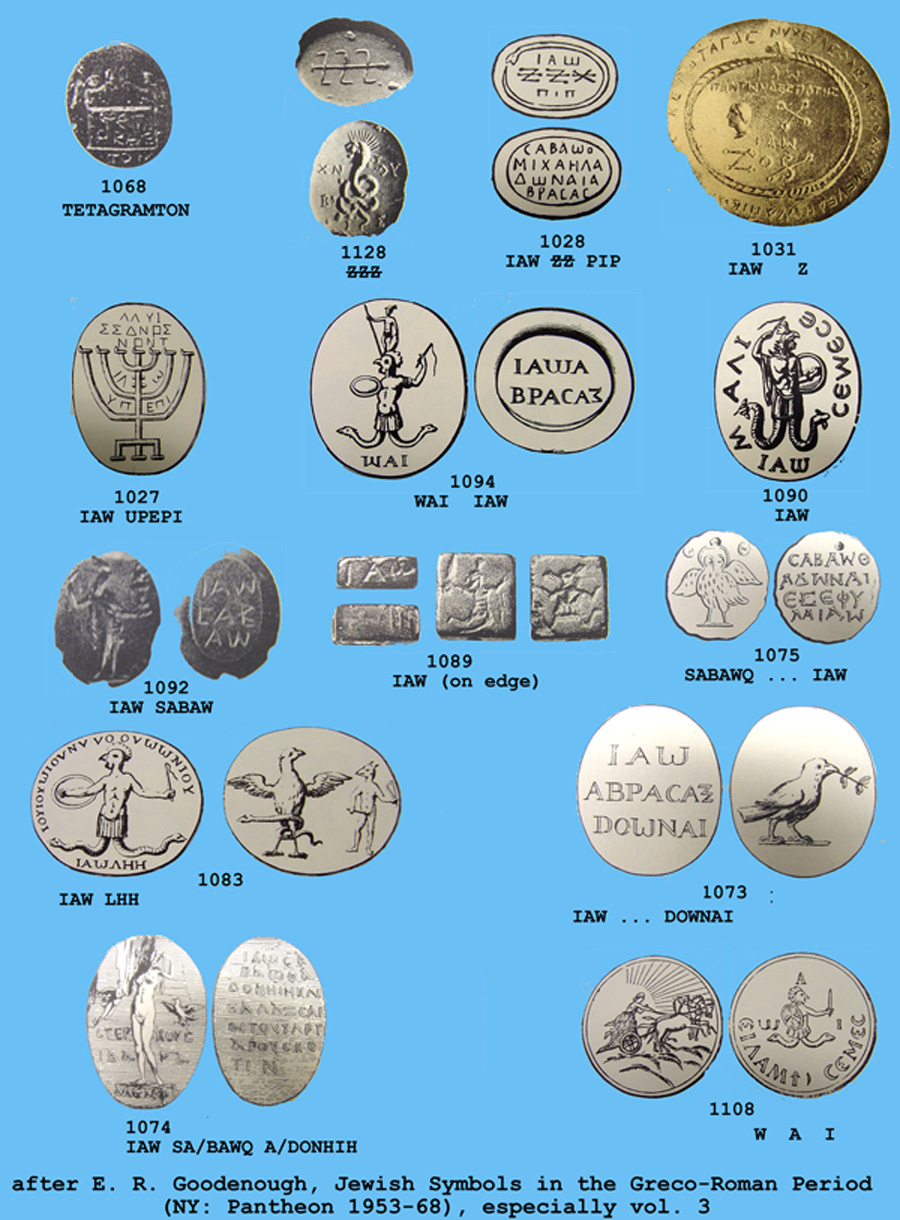

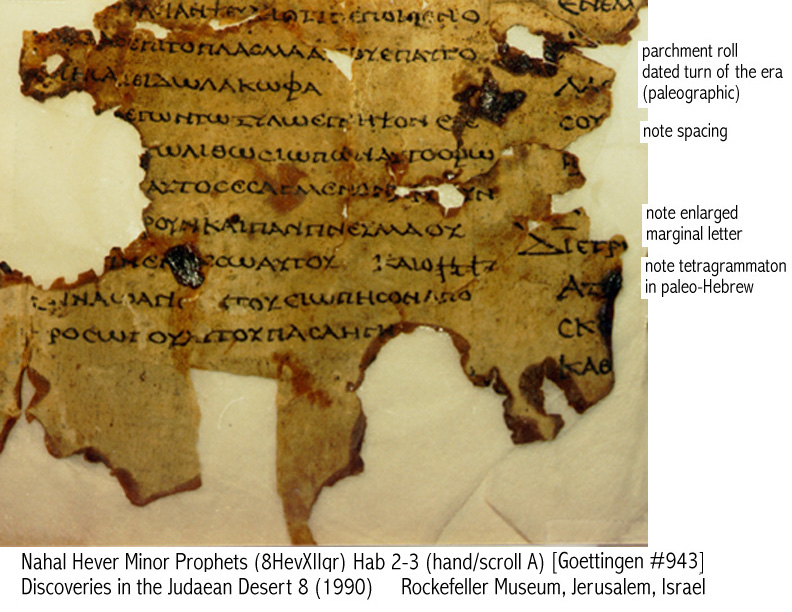


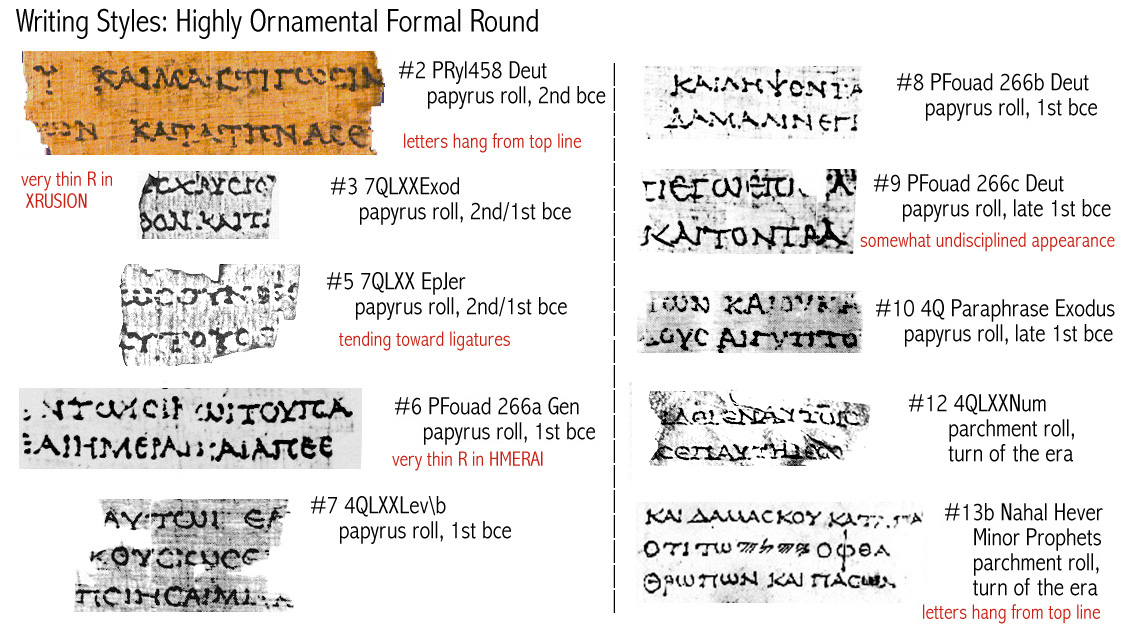
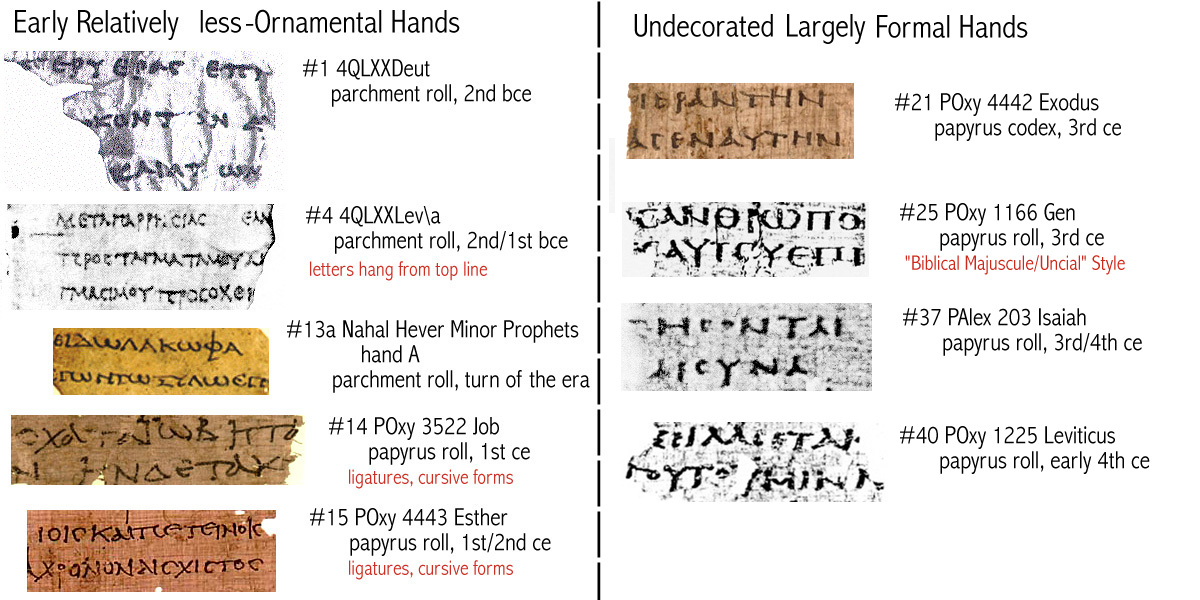


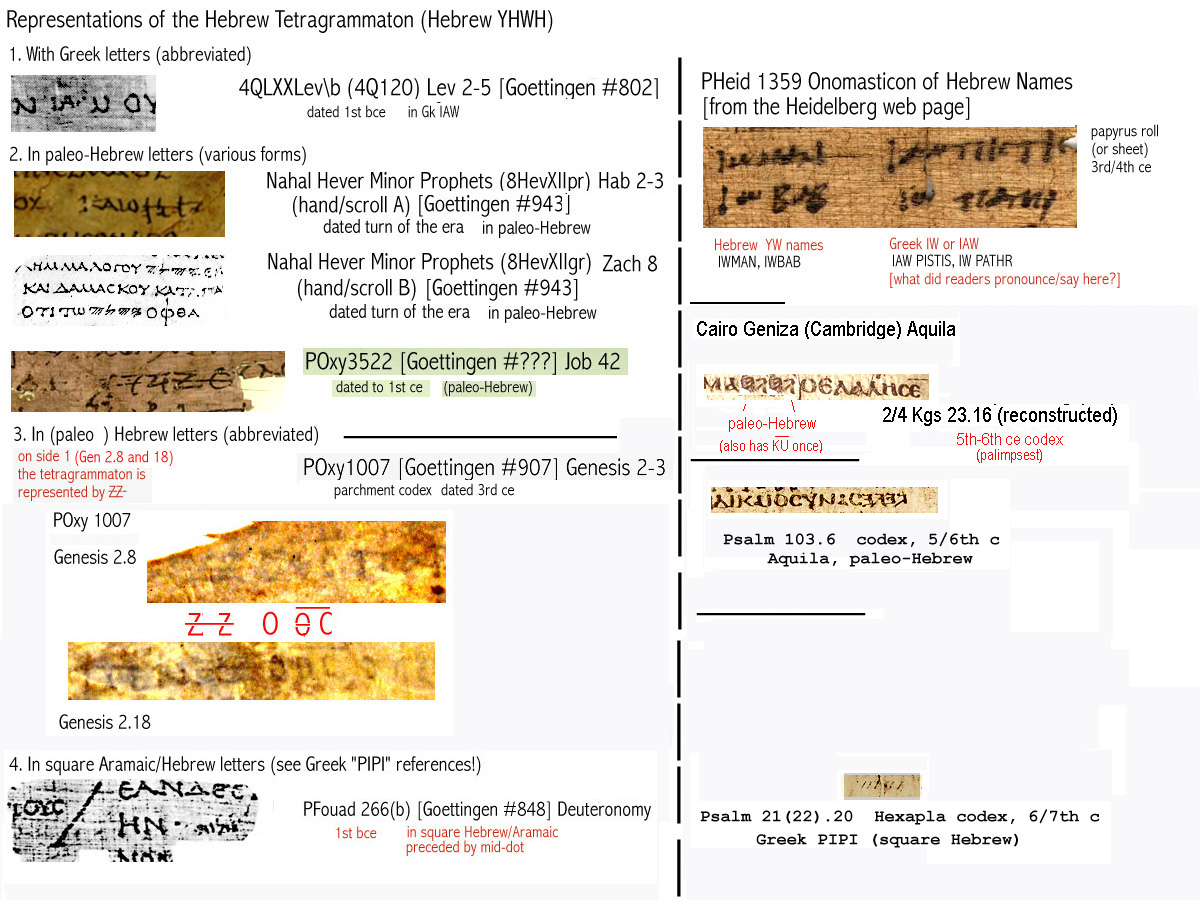
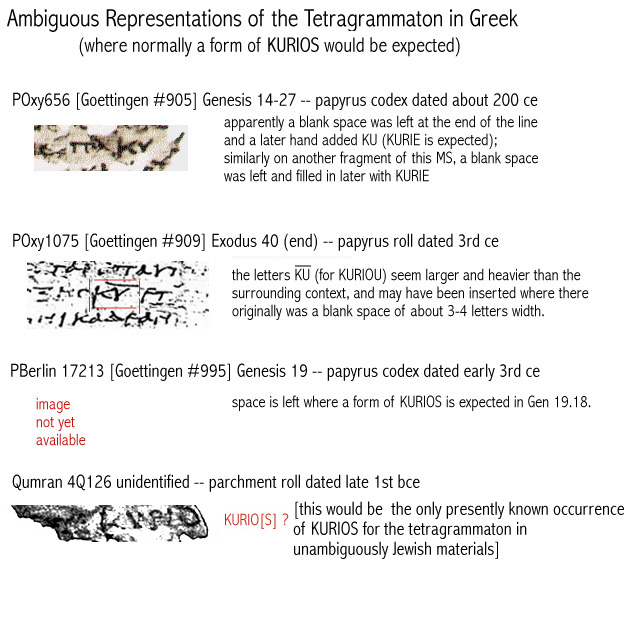

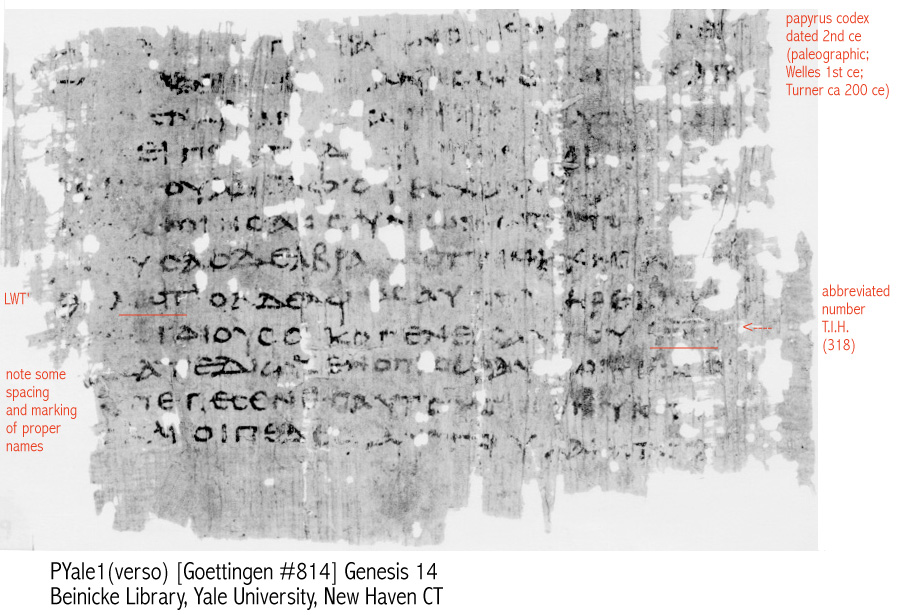
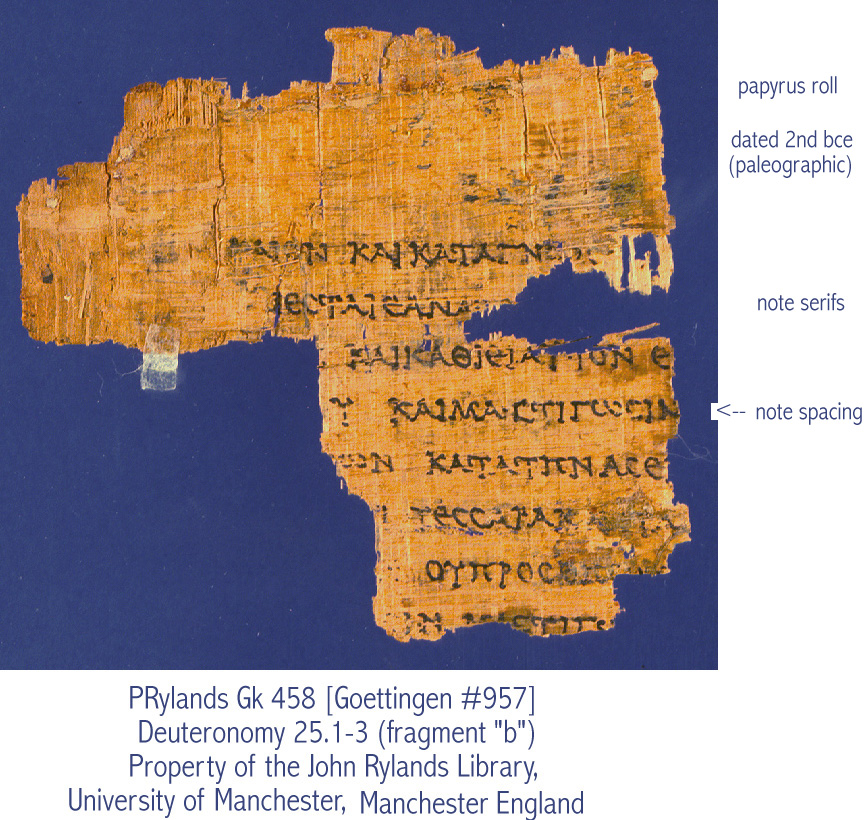
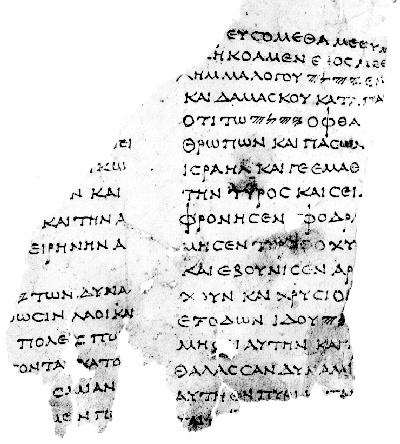
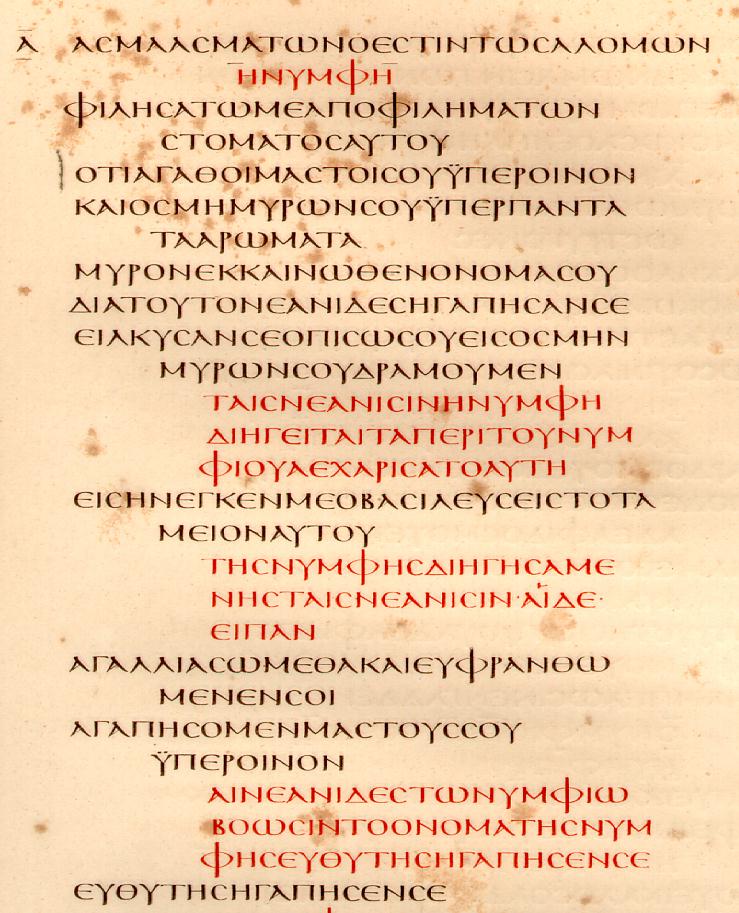

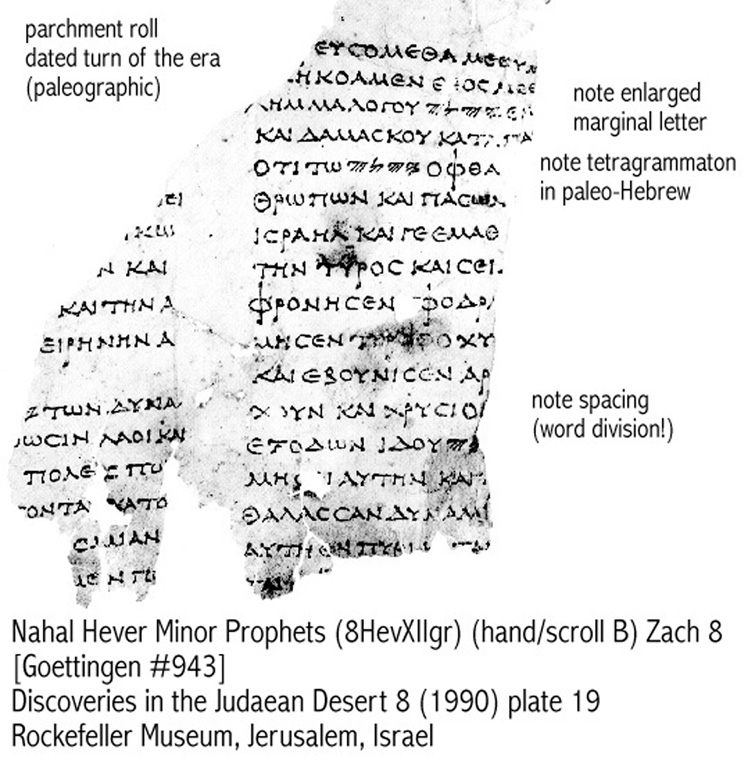





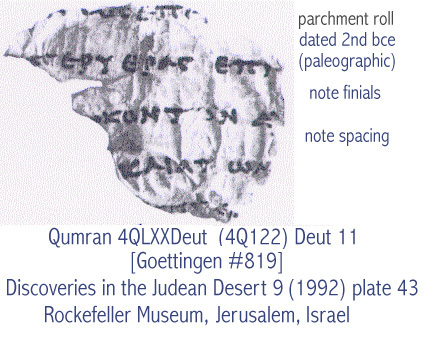


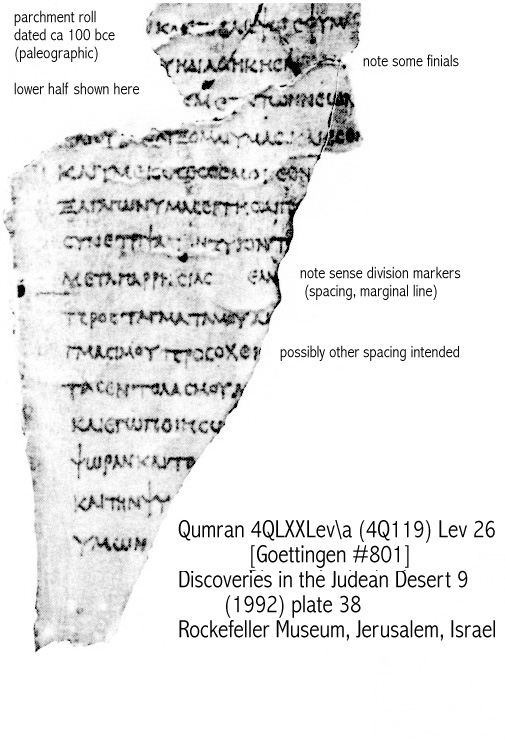

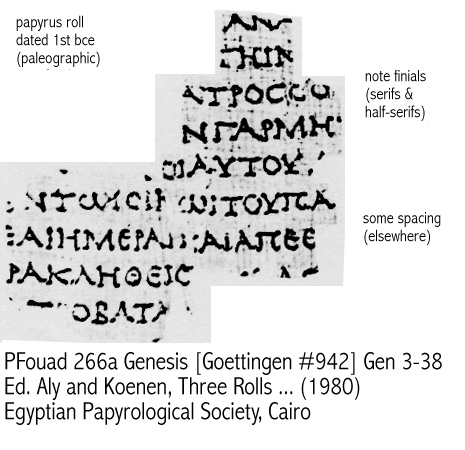
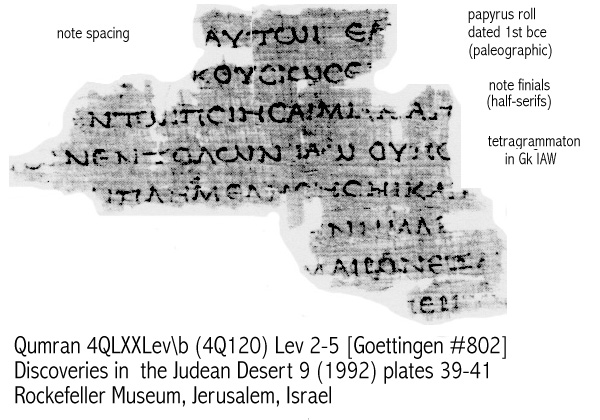

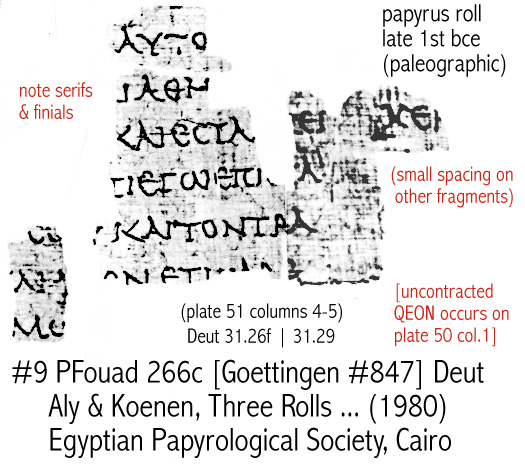
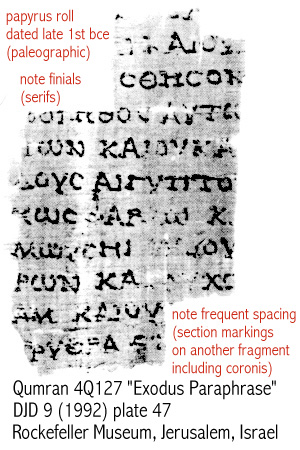
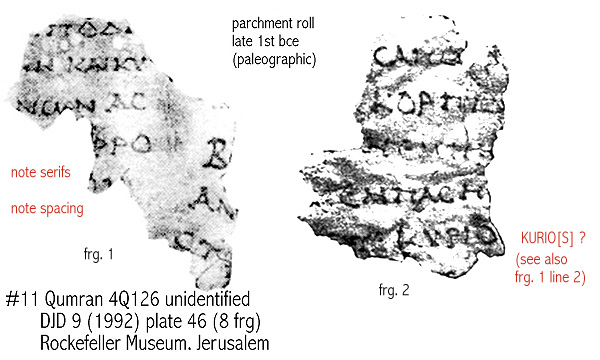
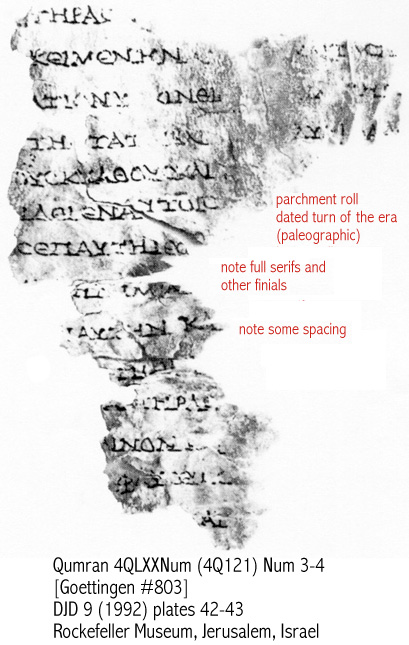


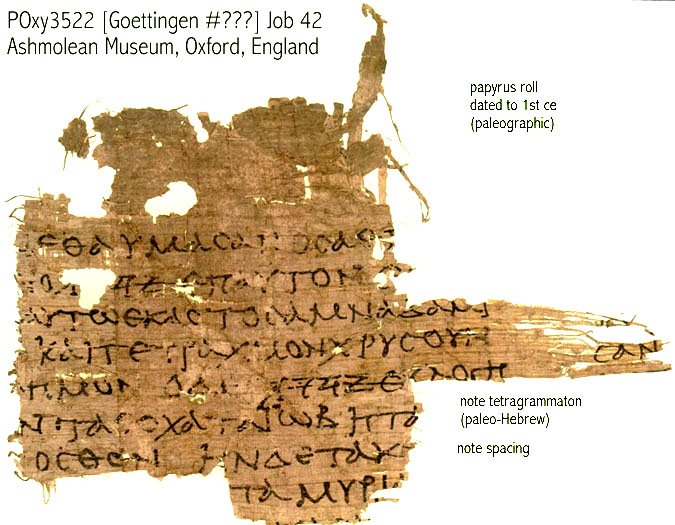
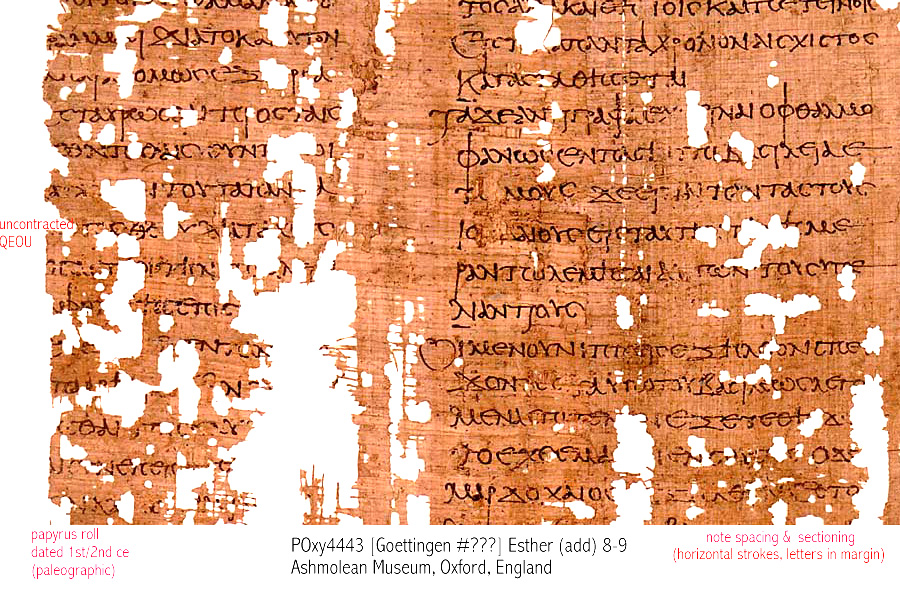
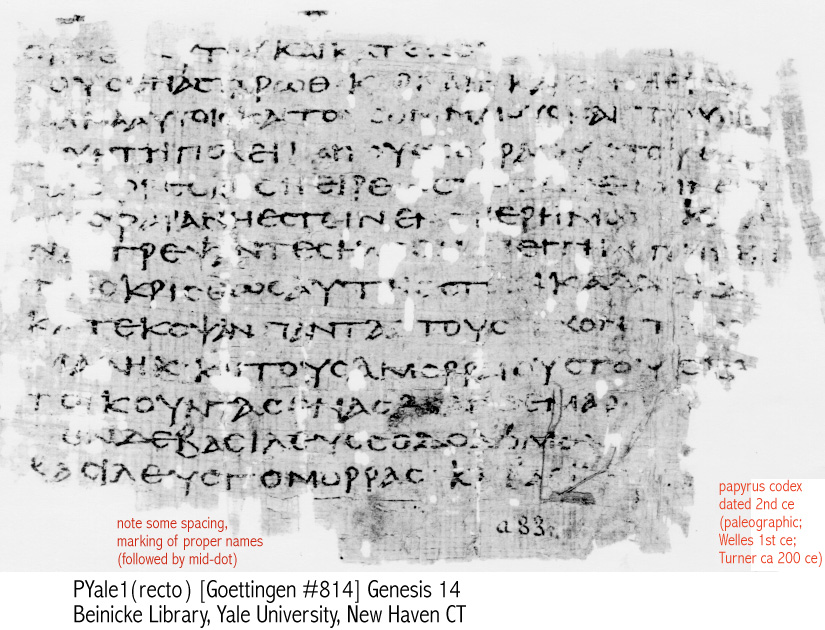
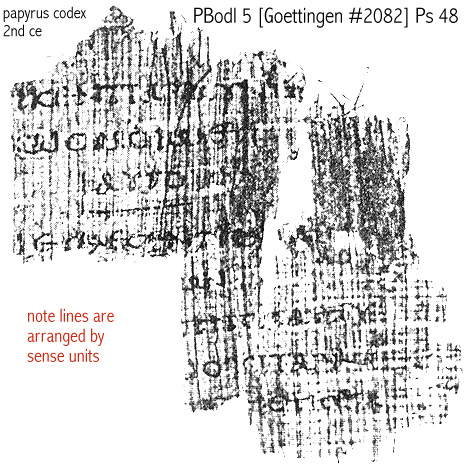
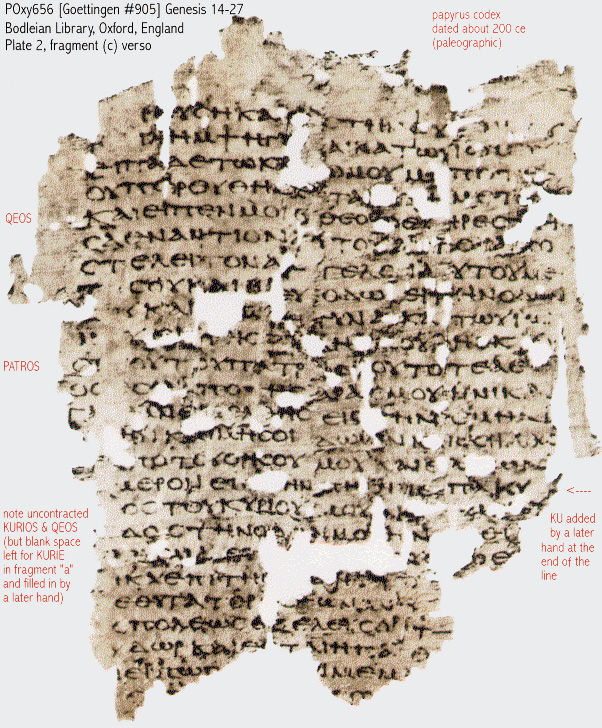

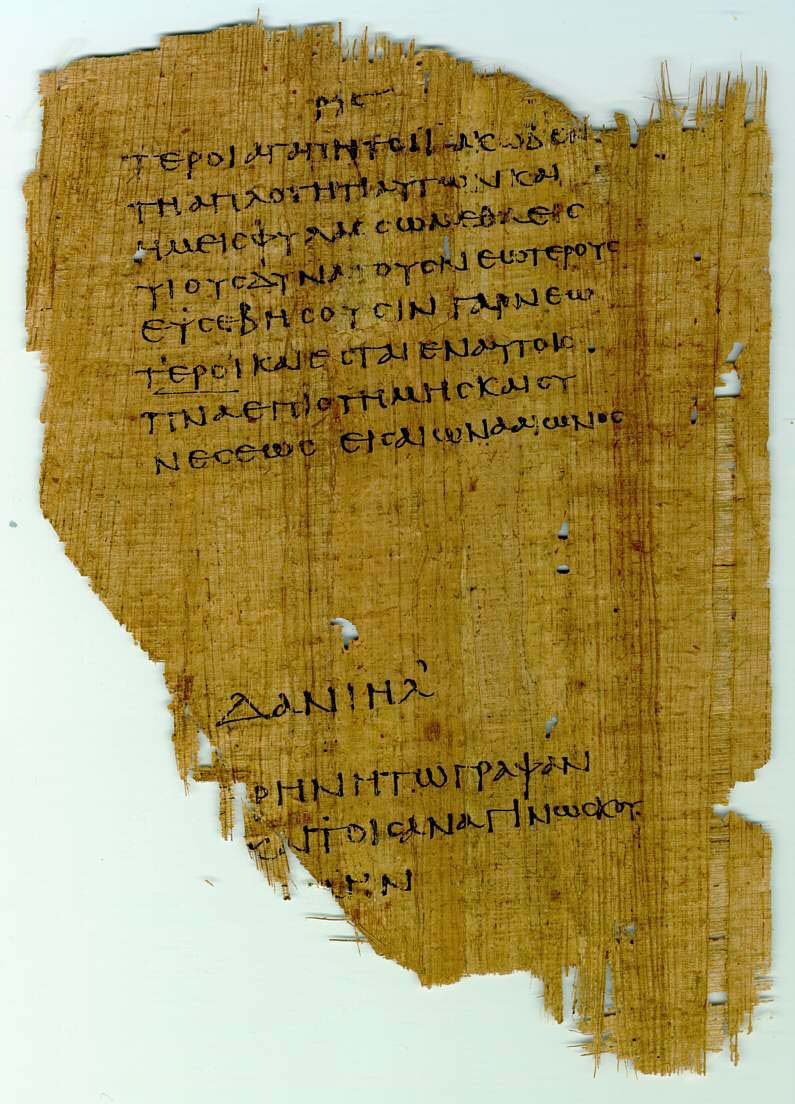
![POxy4442 Exodus [first side]](http:/rs/rak/lxxjewpap/POxy4442r.jpg)
![[other side]](http:/rs/rak/lxxjewpap/POxy4442.jpg)

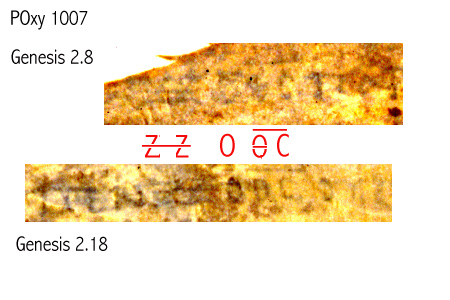
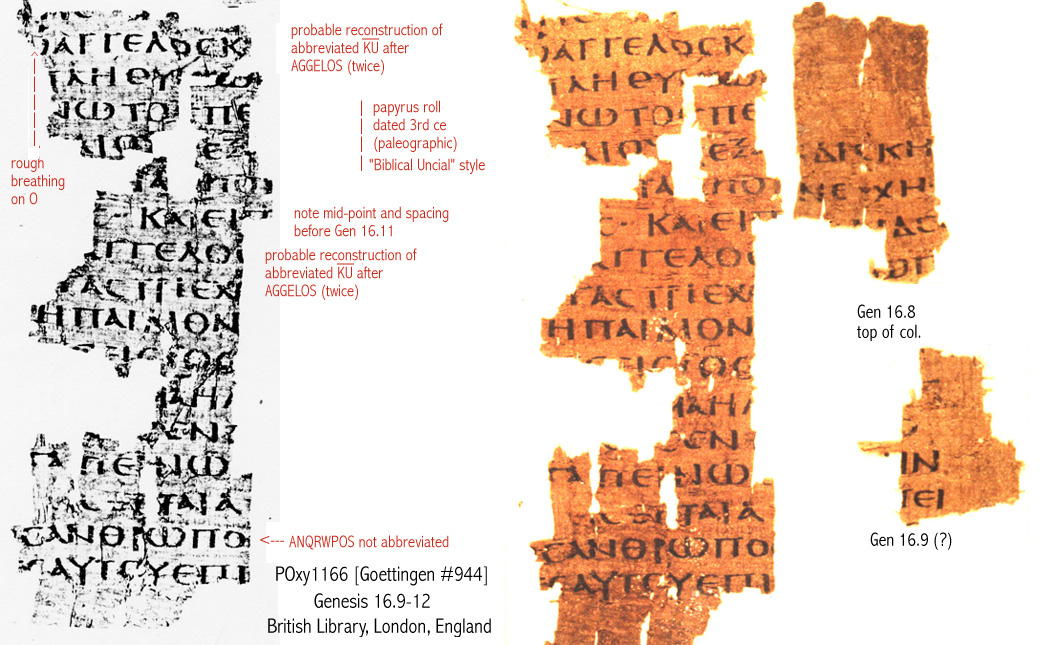
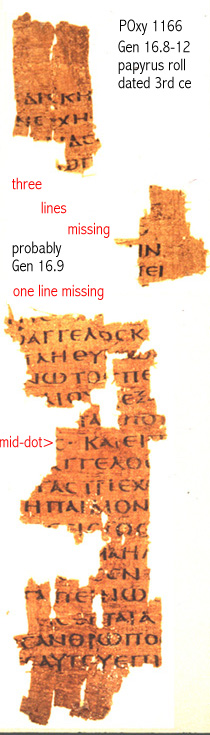
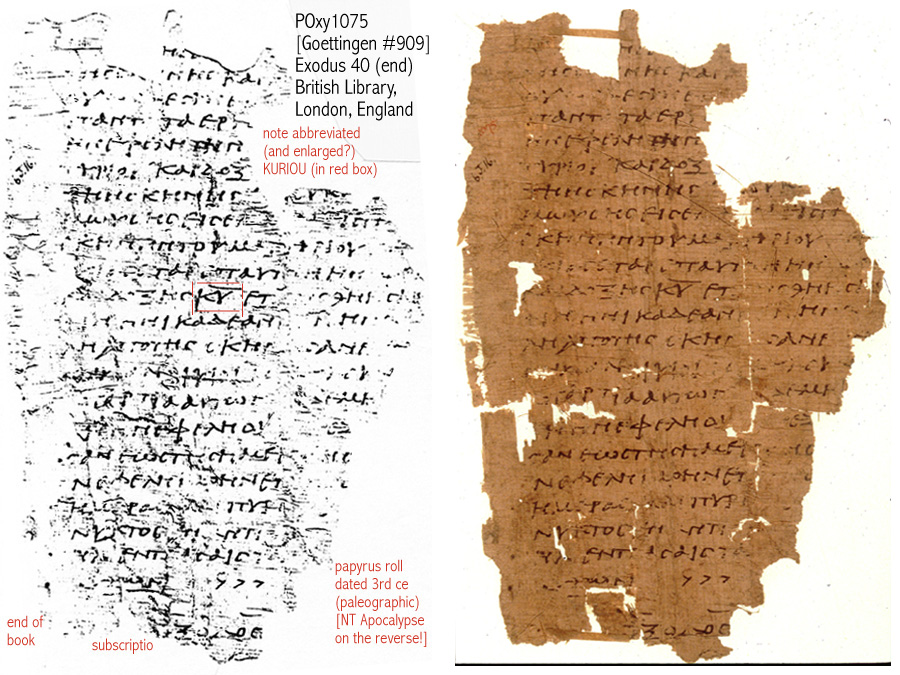
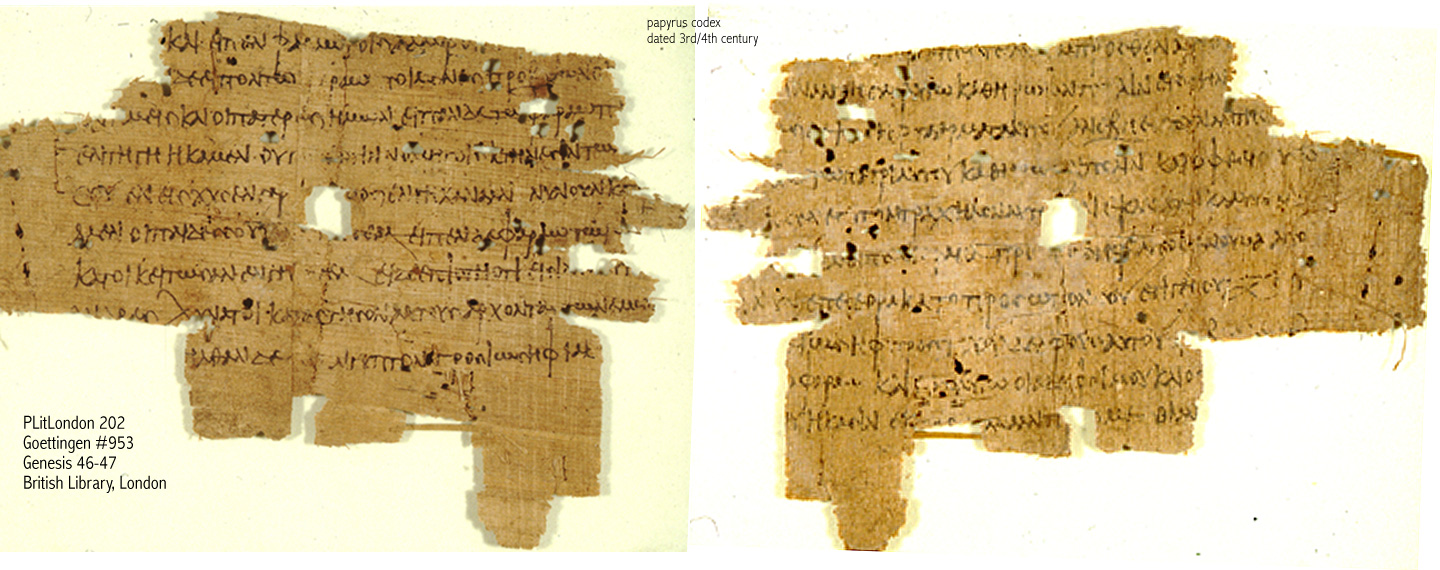
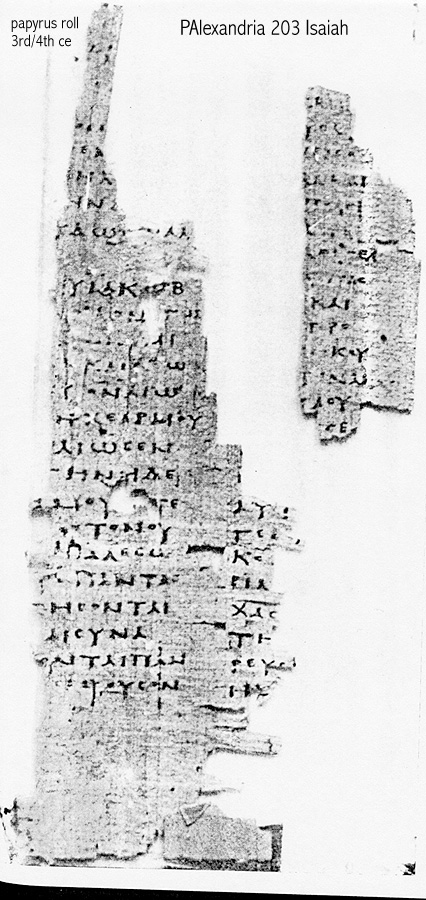
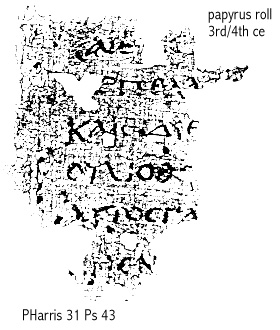
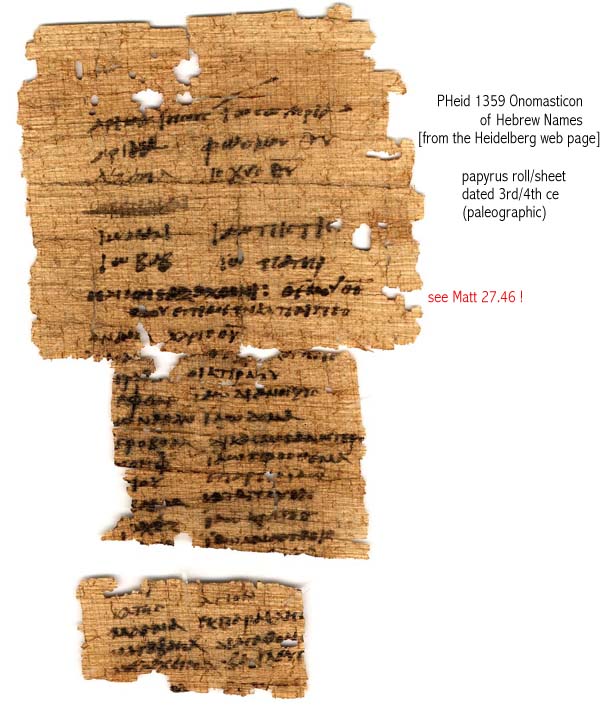
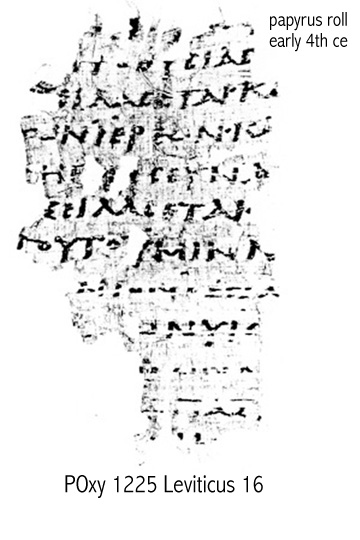
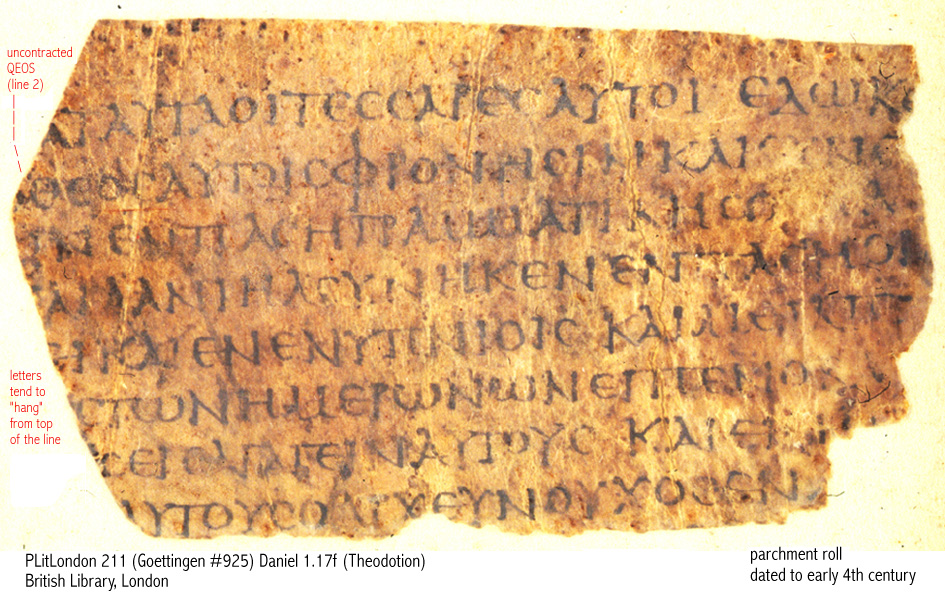
![PGiessen 13+19+22+26 [side 1]](/rs/rak/lxxjewpap/PGiessA.jpg)
![[side 2]](/rs/rak/lxxjewpap/PGiessB.jpg)